
OLED vs. Mini-LED: The 2026 TV Buying Guide
The gap between OLED and Mini-LED televisions has narrowed in 2026, but fundamental differences in physics mean each technology still dominates specific viewing environments.
By Factlen Editorial Team
- Home Theater Enthusiasts
- Prioritize absolute black levels, infinite contrast, and cinematic fidelity in controlled, dark environments.
- Bright-Room & Everyday Viewers
- Value sustained brightness, glare reduction, and large screen sizes for daytime sports and casual viewing.
- Gamers & Power Users
- Weigh the benefits of OLED's motion clarity against the peace of mind Mini-LED offers regarding static UI burn-in.
What's not represented
- · Budget-conscious buyers looking for sub-$500 standard LED TVs
- · Professional colorists who require reference-monitor accuracy
Why this matters
Choosing between OLED and Mini-LED is the single biggest factor in a premium TV purchase. Making the wrong choice for your room's lighting or your viewing habits can result in either washed-out daytime sports or distracting light-bleed during cinematic movie nights.
Key points
- OLED panels offer perfect black levels and infinite contrast by turning off individual pixels.
- Mini-LED displays can sustain significantly higher brightness levels, making them ideal for sunlit rooms.
- OLEDs carry a slight risk of burn-in from static images, whereas Mini-LEDs are immune to permanent image retention.
- Mini-LEDs may exhibit blooming around bright objects on dark backgrounds due to zone-based backlighting.
- OLEDs provide superior viewing angles, while Mini-LEDs often lose contrast when viewed off-center.
- Mini-LED is generally much more cost-effective at massive screen sizes of 85 inches and above.
The 2026 television market has consolidated around two premium display technologies, forcing buyers into a high-stakes decision between OLED and Mini-LED. While marketing departments often blur the lines with proprietary acronyms, the fundamental physics of these two panel types dictate entirely different viewing experiences. The gap between them has narrowed significantly this year—OLEDs have engineered ways to get brighter, while Mini-LEDs have dramatically increased their dimming precision—but they still represent a choice between perfect contrast and overwhelming luminance. For consumers navigating the premium TV space, understanding the specific trade-offs, rather than searching for an objective overall winner, is the only way to make a confident purchase.[1][2]
The core divergence lies in how each technology creates light. OLED, or Organic Light-Emitting Diode, is a self-emissive technology where each individual pixel generates its own light and color. Mini-LED, conversely, is an evolution of traditional LCD technology that relies on a backlight shining through a liquid crystal layer. Instead of a few dozen large LEDs, a Mini-LED TV packs thousands of microscopic diodes grouped into dimmable zones. This architectural difference means that OLED controls light at the pixel level, while Mini-LED manages light in clusters, setting the stage for their respective strengths and weaknesses.[2][3]
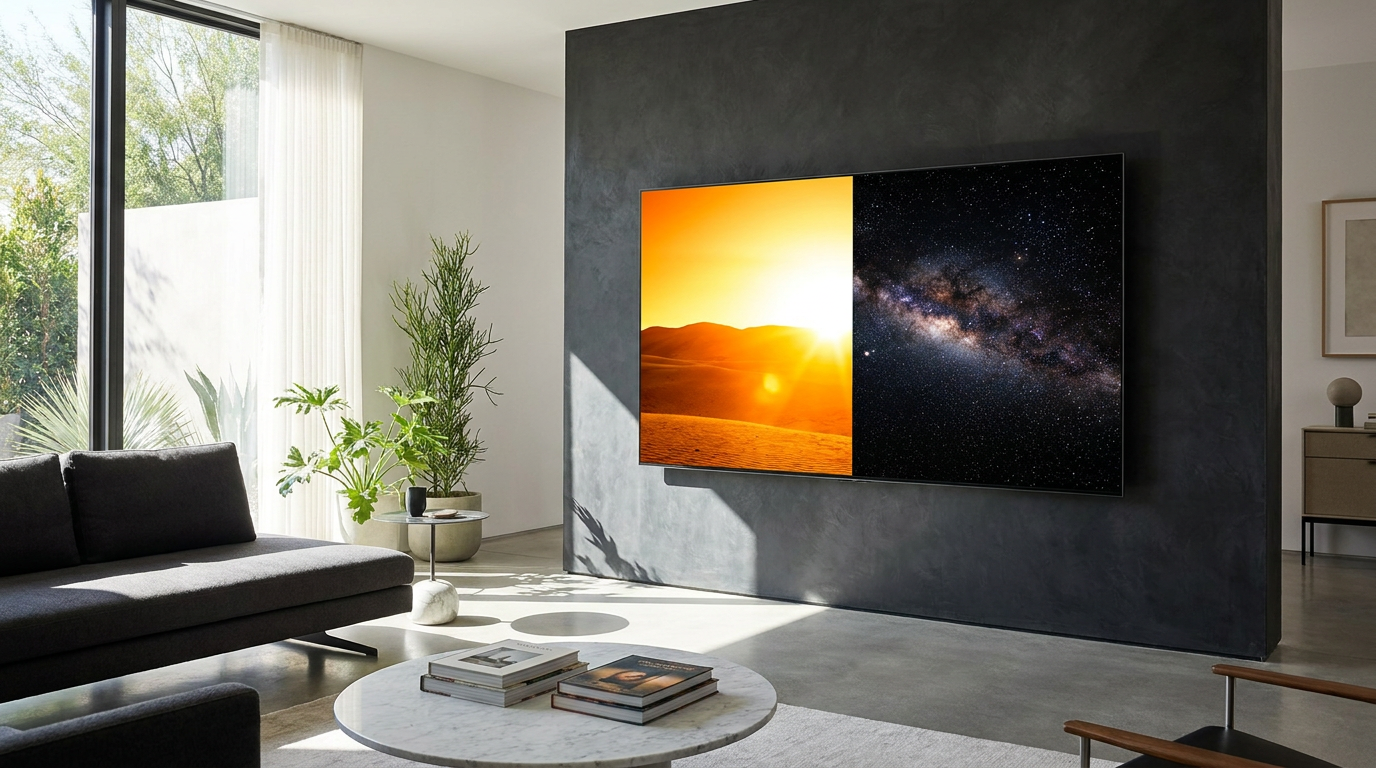
The primary argument for OLED centers on absolute contrast and cinematic fidelity. Because an OLED panel can turn off each of its 8.2 million pixels independently, it achieves a true 0.000-nit black level. This infinite contrast ratio means that a starfield in a science fiction movie appears as piercing pinpricks of light against an inky, perfect void, with zero light bleeding into the surrounding darkness. Additionally, the self-emissive nature of the pixels grants OLED near-instantaneous response times and exceptionally wide viewing angles, ensuring the picture remains vibrant even for viewers sitting at the far edges of a wide sectional sofa.[1][4]

The argument against OLED focuses on sustained brightness limitations and long-term panel longevity. To manage heat dissipation and prevent the organic compounds from degrading prematurely, OLED televisions utilize an Automatic Brightness Limiter (ABL). When a scene requires a massive amount of bright white light—such as a snow-covered landscape or a brightly lit hockey rink—the television aggressively dims the entire screen to protect itself. Furthermore, while modern pixel-shifting and cooling technologies have drastically reduced the risk, OLED panels remain susceptible to permanent burn-in if exposed to static elements like news tickers or video game interfaces for thousands of hours.[5][6]
The evidence from 2026 testing confirms these boundaries. Reviewers note that while new Tandem OLED architectures can push small, momentary highlights to an impressive 2,000 nits, their full-screen sustained brightness still drops to around 200 to 300 nits. This makes them perfectly suited for dynamic HDR movie highlights but less impactful during bright daytime broadcasts. The data consistently shows that while OLED is the undisputed champion of the dark room, it struggles to overpower direct sunlight or heavy ambient glare.[1][2]
This makes them perfectly suited for dynamic HDR movie highlights but less impactful during bright daytime broadcasts.
The argument for Mini-LED is built entirely on sheer luminance and durability. By leveraging thousands of tightly packed LEDs, these displays can sustain massive brightness levels across the entire screen without triggering any protective dimming algorithms. A premium Mini-LED can comfortably hold 1,200 to over 4,000 nits of brightness, making colors pop and HDR highlights sear even in a sun-drenched living room. Crucially, because the technology does not rely on organic compounds, Mini-LED is entirely immune to permanent burn-in, offering total peace of mind for users who leave their screens on all day.[3][4][6]

The argument against Mini-LED revolves around blooming and off-axis degradation. Because the backlight relies on zones rather than individual pixels, a bright object on a dark background—like white subtitles on a black letterbox bar—will inevitably illuminate the pixels immediately surrounding it, creating a visible halo effect. Additionally, most Mini-LED televisions utilize VA (Vertical Alignment) LCD panels, which are notorious for color shifting and contrast loss when viewed from an angle. If you are not sitting dead-center, the deep blacks quickly wash out into a milky gray.[2][4]
The evidence for Mini-LED's progress is found in the sheer volume of its dimming zones. Industry analysts highlight that 2026 flagship models now feature thousands of independent zones driven by highly advanced local dimming algorithms. While testing proves that blooming is still measurable in torture tests, it has been reduced to a level that most casual viewers will never notice during standard content. Furthermore, the economic evidence heavily favors Mini-LED in the large-format category; buyers seeking massive 85-inch or 98-inch screens will find Mini-LEDs priced at a fraction of their OLED equivalents.[3][5]
For gamers and productivity users, the trade-offs require careful calculation. The argument for OLED in gaming is its motion clarity; with pixel response times under 0.1 milliseconds, fast-paced action remains perfectly crisp without the ghosting or smearing inherent to LCD panels. However, the argument for Mini-LED is workflow friction. Users who connect their television to a PC or play games with persistent heads-up displays often prefer Mini-LED, as it entirely eliminates the anxiety of burning a static taskbar or health meter into a premium display.[5][6]

Ultimately, the decision comes down to matching the technology to the environment. OLED fits well when the viewing space is controlled and cinematic fidelity is the highest priority. If you primarily watch movies and prestige television in a dim room, sit at varying angles, and demand absolute black levels without compromise, OLED remains the definitive choice. It is the technology built for the dedicated home theater, rewarding viewers who want to see exactly what the director intended in the shadows.[1][4][6]
Conversely, Mini-LED fits well when the room fights back. If your living space features large windows, skylights, or overhead lighting that cannot be fully eliminated, Mini-LED provides the necessary brute-force brightness to cut through the glare and maintain a vibrant image. It is also the superior choice for households that leave the TV running on news channels, use it as a primary computer monitor, or simply want the largest possible screen size without paying an exorbitant premium.[3][5][6]
How we got here
2013
The first commercial OLED TVs hit the market, establishing a new benchmark for contrast but struggling with low brightness and high burn-in risk.
2019
Mini-LED technology is introduced to the consumer market, offering a massive leap in LCD local dimming precision.
2022
QD-OLED panels debut, combining quantum dots with OLED to dramatically improve color brightness and saturation.
2026
Tandem OLED architectures and multi-thousand-zone Mini-LEDs push both technologies to their highest performance peaks yet, narrowing the gap between them.
Viewpoints in depth
Home Theater Enthusiasts
Purists who prioritize absolute black levels, infinite contrast, and cinematic fidelity in controlled, dark environments.
For home theater enthusiasts, the conversation begins and ends with OLED. This camp argues that the foundation of a great image is its black level, as true blacks allow colors to pop and shadow details to emerge exactly as the director intended. They point to the fact that Mini-LED's zone-based dimming, no matter how advanced, will always introduce some level of blooming or crushed shadow detail when displaying complex scenes like a starry night or a dimly lit interior. For these viewers, the lower full-screen brightness of OLED is a non-issue, as their viewing environments are typically light-controlled or completely dark.
Bright-Room & Everyday Viewers
Consumers who value sustained brightness, glare reduction, and large screen sizes for daytime sports and casual viewing.
This perspective prioritizes practical, everyday usability over absolute cinematic perfection. Bright-room viewers argue that a TV's primary job is to be visible, and in a living room with open blinds or overhead lights, OLED's perfect blacks are entirely washed out by ambient glare. They champion Mini-LED for its sheer horsepower, noting that a screen pushing 3,000 nits can make daytime sports and news broadcasts look incredibly vibrant. Furthermore, this camp often values screen size and budget, pointing out that Mini-LED allows families to purchase massive 85-inch or 98-inch displays for the price of a much smaller OLED.
Gamers & Power Users
Users who weigh the benefits of OLED's motion clarity against the peace of mind Mini-LED offers regarding static UI burn-in.
Gamers and PC users find themselves split between the two technologies based on their specific habits. Competitive gamers and those playing fast-paced action titles heavily favor OLED for its near-instantaneous pixel response time, which eliminates motion blur and ghosting. However, power users who utilize their TV as a massive PC monitor, or gamers who spend thousands of hours playing titles with static heads-up displays (HUDs), often lean toward Mini-LED. For this group, the workflow friction and anxiety associated with OLED burn-in outweigh the benefits of perfect contrast, making Mini-LED the safer, lower-stress investment.
What we don't know
- Whether future Micro-LED technology will eventually scale down in price enough to replace both OLED and Mini-LED.
- Exactly how long the new 2026 Tandem OLED panels will last before showing signs of degradation under heavy use.
Key terms
- OLED
- Organic Light-Emitting Diode, a display technology where each pixel generates its own light, allowing for perfect black levels.
- Mini-LED
- An LCD display technology that uses thousands of microscopic LED backlights grouped into zones to improve contrast and brightness.
- Local Dimming
- A feature that dims specific zones of a TV's backlight to improve black levels in dark scenes.
- Automatic Brightness Limiter (ABL)
- A protective mechanism in OLED TVs that dims the screen when large areas of bright white are displayed to prevent overheating.
- Blooming
- A visual artifact on LED TVs where light bleeds from a bright object into surrounding dark areas, creating a halo effect.
- Nits
- A unit of measurement used to quantify the brightness of a display.
Frequently asked
Does OLED still suffer from burn-in in 2026?
While significantly reduced by modern pixel-shifting and cooling technologies, burn-in remains a risk if static elements like news tickers or game HUDs are displayed for thousands of hours.
What is blooming on a Mini-LED TV?
Blooming, or haloing, occurs when the backlight zones behind a bright object illuminate the surrounding dark pixels, creating a visible glow around things like subtitles or stars.
Is QD-OLED different from standard OLED?
Yes. QD-OLED combines an OLED panel with a Quantum Dot layer, allowing it to produce brighter, more saturated colors in high-luminance scenes compared to traditional White-OLED panels.
Which TV is better for a bright living room?
Mini-LED is generally the better choice for bright rooms, as its high sustained brightness can cut through window glare and overhead lighting without aggressively dimming.
Sources
Source coverage
6 outlets
3 viewpoints surfaced






[1]CNETHome Theater Enthusiasts
Mini-LED vs. OLED: Which TV Tech Should You Get?
Read on CNET →[2]RTINGSHome Theater Enthusiasts
OLED vs Mini LED
Read on RTINGS →[3]Data Wire SolutionsBright-Room & Everyday Viewers
Best TVs for 2026: 10 OLED and Mini-LED Picks
Read on Data Wire Solutions →[4]EcoPicksGoBright-Room & Everyday Viewers
OLED vs Mini LED TVs: 2026 Buyer's Guide
Read on EcoPicksGo →[5]KTC PlayGamers & Power Users
Workflow Friction Comparison: OLED vs Mini-LED
Read on KTC Play →[6]Alibaba TechGamers & Power Users
OLED vs Mini LED: 2026 Tech Breakdown
Read on Alibaba Tech →


Every angle. Every day.
Get guides stories with full source coverage and perspective breakdowns delivered to your inbox.