
How mRNA Cancer Vaccines Work: The Science Behind the 2026 Breakthroughs
Personalized mRNA vaccines are moving from experimental theory to clinical reality, demonstrating a profound ability to train the immune system to hunt down cancer cells.
By Factlen Editorial Team
- Oncology Researchers
- Medical scientists focused on the long-term durability of the immune response.
- Biotech Industry
- Pharmaceutical companies scaling the manufacturing and commercialization of bespoke therapies.
- Public Health Systems
- National health administrators managing trial access and future cost burdens.
What's not represented
- · Health Insurance Providers
- · Patients Awaiting Trials
Why this matters
After decades of research, therapeutic cancer vaccines are finally demonstrating long-term survival benefits in human trials. This technology represents a fundamental shift in oncology, moving away from toxic, one-size-fits-all chemotherapy toward bespoke treatments engineered for a patient's specific genetic mutations.
Key points
- Personalized mRNA cancer vaccines are therapeutic, designed to treat existing tumors rather than prevent them.
- Five-year clinical data shows a 49% reduction in recurrence or death for high-risk melanoma patients.
- The vaccines are custom-built for each patient by sequencing their specific tumor to identify unique neoantigens.
- They are typically paired with checkpoint inhibitors to maximize the immune system's ability to attack the cancer.
- Manufacturing currently takes about a month, and future costs are estimated at around $200,000 per patient.
For decades, the holy grail of oncology has been teaching the human body to destroy its own cancer. In 2026, that ambition is crossing from experimental theory into clinical reality, driven by the same messenger RNA (mRNA) technology that altered the course of the COVID-19 pandemic.[4]
Unlike traditional preventative vaccines that ward off future infections, mRNA cancer vaccines are therapeutic. They are administered after a patient has already been diagnosed, acting as a highly targeted software update for the immune system to help it recognize and eliminate the existing disease.[4][5]
The most compelling evidence to date arrived at the 2026 American Society of Clinical Oncology (ASCO) Annual Meeting in Chicago. Moderna and Merck presented five-year follow-up data for their personalized mRNA vaccine, intismeran autogene, in patients with high-risk melanoma.[2][3]
The long-term results were striking: when combined with Merck’s blockbuster immunotherapy drug Keytruda, the personalized vaccine reduced the risk of cancer recurrence or death by 49% compared to Keytruda alone. Furthermore, the combination slashed the risk of the cancer metastasizing to distant organs by 59%.[1][2][3]

"If you and I were diagnosed the same day by the same doctor with skin cancer, Moderna would make a different medicine for your cancer and a different medicine for mine," Moderna CEO Stéphane Bancel explained, highlighting the bespoke nature of the treatment.[3]
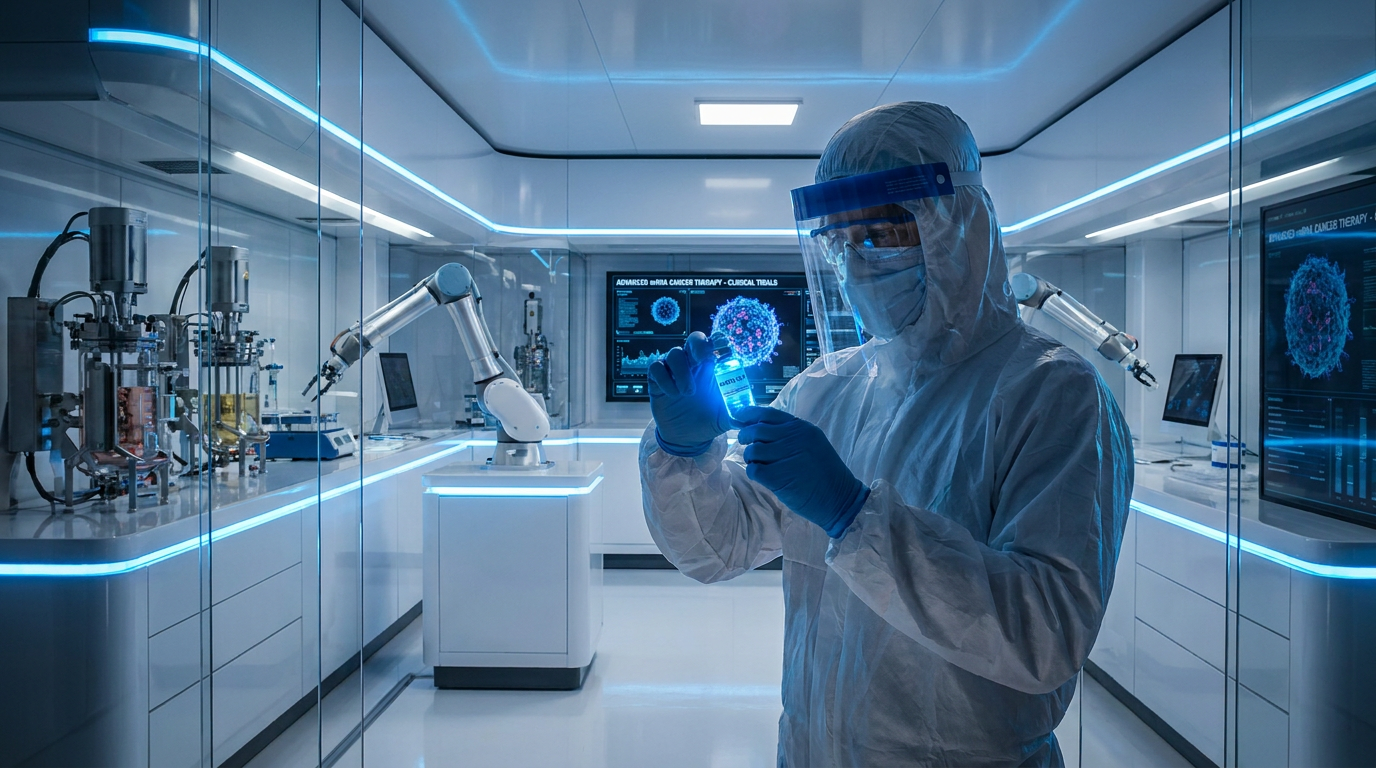
The mechanism behind these personalized therapeutics begins in the operating room. After a surgeon removes a patient's tumor, the tissue is sent to a specialized laboratory for deep genomic sequencing.[4]
Scientists compare the genetic code of the tumor cells against the patient's healthy cells to identify "neoantigens"—unique mutated proteins that are present only on the surface of the cancer cells, making them an ideal target for the immune system.[4][7]
Computer algorithms then select up to 34 of the most immunogenic neoantigens—the ones most likely to trigger a strong immune response. The genetic instructions for these specific proteins are synthesized into a custom mRNA strand.[4]
Computer algorithms then select up to 34 of the most immunogenic neoantigens—the ones most likely to trigger a strong immune response.
Because naked mRNA degrades rapidly in the bloodstream, the instructions are encased in lipid nanoparticles (LNPs)—microscopic fat bubbles that protect the fragile payload and deliver it safely into the body's cells.[4][7]

Once injected, the mRNA is taken up by dendritic cells, the master sentinels of the immune system. Recent research from Washington University School of Medicine revealed that mRNA vaccines engage multiple subsets of these dendritic cells in an unconventional pathway, which helps explain their potent efficacy.[6]
The dendritic cells read the mRNA instructions, manufacture the tumor neoantigens, and display them on their surface. They then present these targets to T cells, effectively training the immune system's "killer cells" to hunt down any tissue in the body bearing that specific protein signature.[4][6]
Crucially, these vaccines are rarely used in isolation. They are typically paired with checkpoint inhibitors like Keytruda. While the mRNA vaccine acts as the accelerator—generating an army of tumor-specific T cells—the checkpoint inhibitor removes the "brakes" that cancer cells often use to hide from the immune system.[3][7]
The success in melanoma has triggered a massive expansion into other oncology targets. Moderna and Merck are currently running nine large-scale clinical trials for lung, kidney, bladder, and pancreatic cancers.[1][7]

Concurrently, German biotech BioNTech is advancing its own pipeline, including BNT116, an mRNA vaccine targeting non-small cell lung cancer. To accelerate this research, the UK's National Health Service (NHS) has launched the Cancer Vaccine Launch Pad, aiming to enroll 10,000 patients in personalized immunotherapy trials by 2030.[5][7]
Despite the optimism, significant logistical hurdles remain. Manufacturing a bespoke vaccine currently takes roughly 30 to 45 days—a window during which aggressive cancers can spread. Additionally, the estimated cost of these personalized therapies hovers around $200,000 per patient, raising questions about equitable access once they achieve full regulatory approval.[1][3][4]
How we got here
2020
mRNA technology achieves global validation through the rapid development of COVID-19 vaccines.
2023
Moderna and Merck release 3-year data showing early success of their personalized melanoma vaccine.
June 2024
The UK's NHS launches the Cancer Vaccine Launch Pad to accelerate clinical trial enrollment.
June 2026
Five-year data presented at ASCO confirms long-term durability, halving the risk of melanoma recurrence.
Viewpoints in depth
Oncology Researchers
Medical scientists focused on the long-term durability of the immune response.
For researchers, the 2026 ASCO data is a watershed moment because it proves the durability of the mRNA approach. The immune system's 'memory' appears to hold strong at the five-year mark, suggesting that the T-cells trained by the vaccine continue to patrol the body for microscopic metastases long after the initial tumor is removed. Scientists are now heavily focused on understanding the exact dendritic cell pathways involved, hoping to optimize the lipid nanoparticle delivery systems to make the vaccines even more potent.
Biotech Industry
Pharmaceutical companies scaling the manufacturing and commercialization of bespoke therapies.
The biotech sector views personalized mRNA vaccines as the next multi-billion-dollar frontier, capable of replacing lost revenue from declining COVID-19 vaccine sales. Their primary challenge is logistical: reducing the 30-to-45-day manufacturing window. Companies are investing heavily in automated, decentralized manufacturing hubs that can sequence a tumor, synthesize the custom mRNA, and deliver the final product to the hospital faster, as speed is critical for patients with aggressive cancers.
Public Health Systems
National health administrators managing trial access and future cost burdens.
Organizations like the UK's NHS are aggressively building infrastructure, such as the Cancer Vaccine Launch Pad, to match patients with clinical trials. However, public health officials are quietly bracing for the financial impact. With personalized vaccines projected to cost upwards of $200,000 per patient, health systems must figure out how to fund these bespoke therapies at scale without bankrupting oncology budgets, setting the stage for complex future reimbursement negotiations.
What we don't know
- Whether the profound success seen in melanoma can be replicated in solid tumors with lower mutation rates, like prostate or breast cancer.
- How health insurance and national health systems will handle the estimated $200,000 per-patient cost once the therapies receive full regulatory approval.
- If the manufacturing timeline can be reliably compressed from 30 days down to two weeks to help patients with rapidly advancing disease.
Key terms
- Messenger RNA (mRNA)
- A molecule that carries genetic instructions to cells, directing them to build specific proteins.
- Neoantigen
- A unique, mutated protein found only on the surface of cancer cells, making it an ideal target for the immune system.
- Dendritic Cell
- An immune system sentinel cell that processes foreign material and presents it to T-cells to trigger an attack.
- Checkpoint Inhibitor
- A type of immunotherapy drug that blocks proteins cancer cells use to hide from the immune system.
- Lipid Nanoparticle
- A microscopic fat bubble used to protect and deliver fragile mRNA molecules into the body's cells.
Frequently asked
Are mRNA cancer vaccines used to prevent cancer?
No, they are therapeutic vaccines. They are given after a patient is diagnosed to help the immune system fight the existing disease and prevent it from returning.
How long does it take to make a personalized vaccine?
It currently takes about 30 to 45 days to sequence a patient's tumor and manufacture their custom mRNA vaccine in a laboratory.
Why are they combined with other drugs?
They are usually paired with checkpoint inhibitors. The vaccine trains the immune system to attack, while the inhibitor strips away the cancer's ability to hide from immune cells.
Sources
Source coverage
7 outlets
3 viewpoints surfaced







[1]ReutersBiotech Industry
Moderna, Merck experimental melanoma vaccine cuts risk of recurrence by 49% at 5 years
Read on Reuters →[2]BioSpaceBiotech Industry
Moderna, Merck's Personalized Cancer Vaccine Halves Risk of Death in 5-Year Melanoma Trial
Read on BioSpace →[3]Fox BusinessBiotech Industry
Moderna, Merck report cancer vaccine breakthrough in melanoma trial
Read on Fox Business →[4]National Cancer InstituteOncology Researchers
Can mRNA Vaccines Help Treat Cancer?
Read on National Cancer Institute →[5]NHS EnglandPublic Health Systems
NHS Cancer Vaccine Launch Pad
Read on NHS England →[6]Washington University School of MedicineOncology Researchers
mRNA vaccines follow unconventional immune path to destroy tumors
Read on Washington University School of Medicine →[7]Factlen Editorial TeamOncology Researchers
Synthesis by Factlen editorial team
Read on Factlen Editorial Team →

Every angle. Every day.
Get guides stories with full source coverage and perspective breakdowns delivered to your inbox.