
New Fed Chair Kevin Warsh Leads First Interest Rate Meeting Amid Inflation Surge
Kevin Warsh presides over his first Federal Open Market Committee meeting as Fed Chair, facing pressure to balance rising inflation against political demands for rate cuts.
By Factlen Editorial Team
- Monetary Hawks
- Advocates for keeping interest rates high to combat the 4.2% inflation rate.
- Pro-Growth Advocates
- Voices pushing for rate cuts to stimulate the economy and ease consumer borrowing costs.
- Institutionalists
- Observers focused primarily on preserving the Federal Reserve's political independence.
What's not represented
- · Everyday consumers struggling with the dual burden of 4.2% inflation and 3.5%+ interest rates.
- · Real estate and mortgage industry groups facing prolonged stagnation due to high borrowing costs.
Why this matters
The Federal Reserve's interest rate decisions directly dictate the cost of mortgages, auto loans, and credit card debt for American consumers. With inflation accelerating again, Warsh's inaugural meeting will signal whether the central bank plans to keep borrowing costs high to stabilize prices, or cut them to spur economic growth.
Key points
- Kevin Warsh is leading his first Federal Open Market Committee meeting as Fed Chair on June 16-17, 2026.
- Markets expect the Fed to hold its benchmark interest rate steady at 3.5% to 3.75%.
- Inflation surged to 4.2% in May, driven largely by global energy shocks.
- Warsh faces intense political pressure from the Trump administration to cut rates and stimulate economic growth.
- Investors are closely watching the Fed's updated Summary of Economic Projections for clues on future rate hikes or cuts.
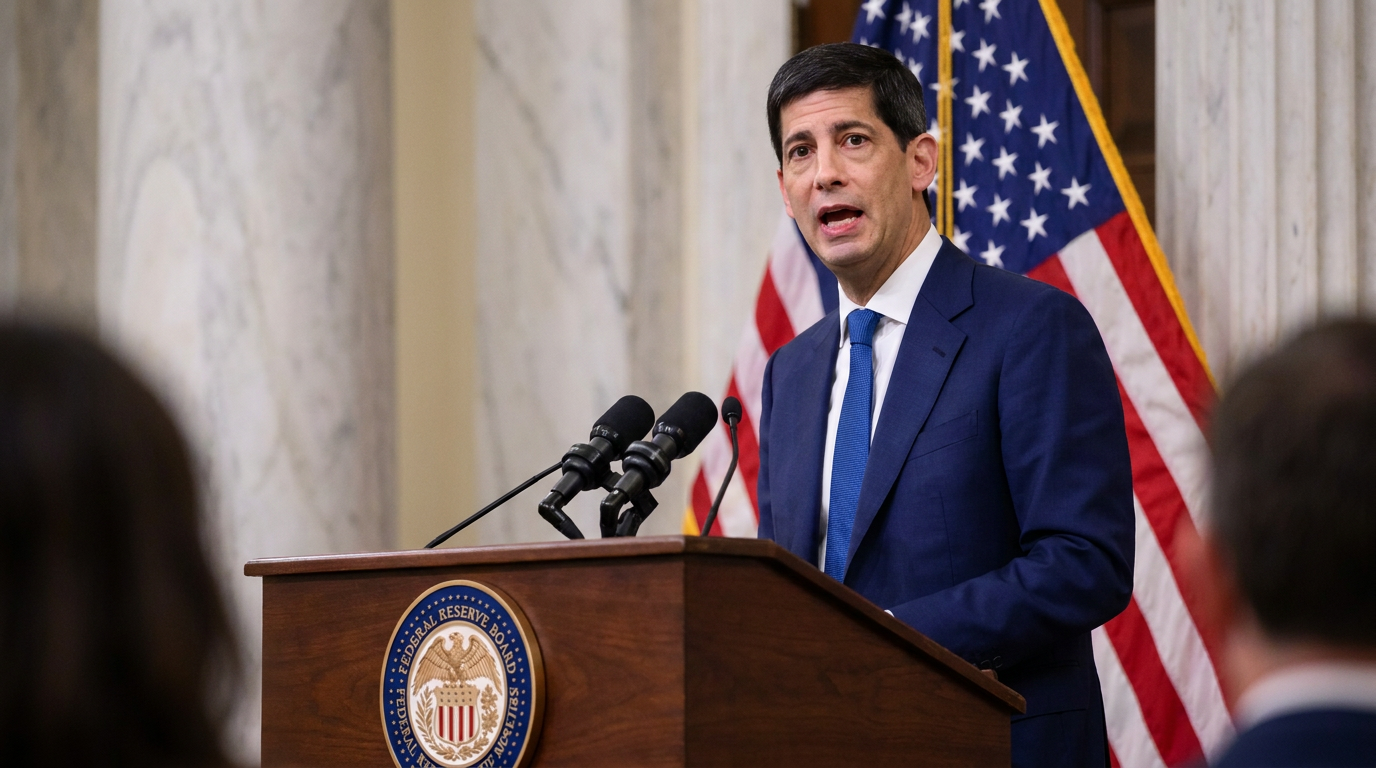
Kevin Warsh is officially at the helm of the world's most powerful central bank. On Tuesday, the newly minted Federal Reserve Chairman opened his first Federal Open Market Committee meeting, inheriting an economy caught between resurging inflation and intense political pressure. The transition of power comes at a highly volatile moment for the United States economy, with both Wall Street and Main Street looking for clear signals on the future of borrowing costs. Warsh, who previously served as a Fed board governor, steps into the role following a contentious confirmation process and a public mandate from the White House to prioritize economic growth.[1][2]
The two-day policy gathering, which concludes on Wednesday, marks Warsh's first official opportunity to signal how he will steer U.S. monetary policy after succeeding Jerome Powell. Markets overwhelmingly expect the central bank to hold its benchmark interest rate steady at a range of 3.5% to 3.75%. The Federal Reserve has maintained this rate throughout the first half of 2026, with its last cut occurring in December 2025. While the immediate rate decision is widely anticipated, the broader financial community is hyper-focused on the tone Warsh will set regarding the trajectory of future rate hikes or cuts.[2][4]
The stakes for Warsh's debut are exceptionally high because the economic landscape has shifted dramatically since the Fed last updated its long-term projections. Late last year, policymakers had penciled in expectations for steady rate cuts throughout 2026. However, those optimistic forecasts have collided with a harsh new reality. The economic tailwinds that defined the end of 2025 have been replaced by complex global headwinds, forcing the central bank to fundamentally reevaluate its strategy for achieving a soft landing without triggering a recession.[2]
Inflation, which had been steadily cooling, flared up aggressively this spring. The Consumer Price Index reached an annual rate of 4.2% in May, marking the highest level of inflation since April 2023. This sudden spike has been largely driven by surging global oil and gas prices, which have skyrocketed in response to the ongoing conflict involving Iran. The resulting energy shock has rippled through the domestic economy, raising the cost of production, transportation, and everyday consumer goods at a pace that has alarmed economic forecasters.[2][5]

The unexpected jump in both consumer and producer prices makes it exceedingly difficult for the Federal Open Market Committee to justify a rate cut in the near term. Instead of discussing when to lower borrowing costs, some economists suggest the Fed might even need to consider raising interest rates again to tame the renewed inflationary pressures. The balance of risks has decidedly shifted toward inflation being the primary concern, meaning the committee must tread carefully to avoid letting price instability become deeply entrenched in the broader economy.[2][3]
The unexpected jump in both consumer and producer prices makes it exceedingly difficult for the Federal Open Market Committee to justify a rate cut in the near term.
Warsh's appointment by President Donald Trump was finalized in May following a narrow 55-45 Senate confirmation vote. The confirmation process was marked by intense partisan debate over the future direction of the central bank. Trump has been a vocal and persistent critic of the Fed's previous leadership under Jerome Powell, frequently demanding faster and deeper interest rate cuts to stimulate economic growth and boost domestic manufacturing. The administration's explicit desire for looser monetary policy forms the political backdrop against which Warsh must now operate.[4][7]
During his swearing-in ceremony at the White House, President Trump declared that Warsh would go down as "one of the truly great chairmen" in the institution's history, while reiterating his administration's desire for a robust, pro-growth economic agenda. This public embrace places immediate and intense scrutiny on the central bank's independence. Financial markets and international observers are watching closely to see if the new chairman will align the Fed's policies with the administration's political objectives, or if he will maintain a strict distance from the Oval Office.[5]
For his part, Warsh has publicly vowed that the institution will remain "strictly independent" in its oversight of monetary policy. He has emphasized a strong desire to return the Federal Reserve to its core statutory mandate of maintaining price stability and maximizing employment, explicitly steering clear of broader political debates. Warsh brings a wealth of experience to the role, having served as a Wall Street banker and a Fed governor during previous economic crises, which supporters argue gives him the steady hand required to navigate the current turbulence.[2][6]

Investors and borrowers will be closely analyzing Wednesday's release of the Fed's Summary of Economic Projections, colloquially known as the "dot plot." This highly anticipated report will distill the committee's updated forecasts for unemployment, gross domestic product growth, and inflation. More importantly, it will offer a concrete roadmap for where individual policymakers believe interest rates should head for the remainder of 2026 and into 2027, providing the clearest indication yet of how the committee is reacting to the recent inflation data.[2][3]
One key area of focus is how Warsh will handle the Fed's forward guidance. Analysts anticipate he may shift the central bank away from making explicit, long-term commitments about future rate moves. Instead, Warsh is expected to favor a more flexible, data-dependent approach that allows the committee to react dynamically to incoming economic indicators. This shift in communication strategy would represent a departure from recent years, where the Fed often telegraphed its policy intentions months in advance to manage market expectations.[3]
Warsh has also introduced novel economic perspectives to the committee's deliberations. During his confirmation hearings, he suggested that rapid productivity gains driven by the widespread adoption of artificial intelligence could naturally help ease inflation. In his view, if AI technologies make American workers and businesses significantly more efficient, the resulting surge in economic output could cool prices organically. This technological dividend could potentially create the conditions for lower borrowing costs down the line, allowing the economy to grow without requiring aggressive, demand-crushing intervention from the central bank.[2][6]
As Warsh steps to the podium for his first post-meeting press conference on Wednesday afternoon, his immediate challenge will be rhetorical as much as economic. He must convince both Wall Street investors and Main Street consumers that the Federal Reserve has the absolute resolve to keep consumer prices in check, regardless of the political headwinds blowing from Washington. How he threads the needle between acknowledging the pain of high borrowing costs and committing to the fight against inflation will set the definitive tone for his tenure as Chairman.[1][2]
How we got here
December 2025
The Federal Reserve makes its last interest rate cut, penciling in further cuts for 2026.
January 2026
President Trump announces his intention to nominate Kevin Warsh as Fed Chair, succeeding Jerome Powell.
May 13, 2026
The U.S. Senate confirms Warsh in a 55-45 vote.
May 22, 2026
Warsh is officially sworn in as the 17th Chair of the Federal Reserve.
June 16, 2026
Warsh convenes his first Federal Open Market Committee meeting amid a renewed surge in inflation.
Viewpoints in depth
Inflation Hawks
Economists and analysts who prioritize price stability over immediate economic growth.
This camp argues that the recent surge in the Consumer Price Index to 4.2% requires the Federal Reserve to maintain or even increase interest rates. They point to rising energy costs stemming from geopolitical conflicts as a persistent threat that could embed inflation into the broader economy if the Fed cuts rates prematurely. For these analysts, Warsh's primary test is proving he will not bow to political pressure for loose monetary policy.
Pro-Growth Advocates
Voices aligned with the administration pushing for lower borrowing costs to stimulate the economy.
Supporters of immediate rate cuts argue that high borrowing costs are stifling business investment and hurting consumers, particularly in the housing and auto markets. They emphasize that current inflation is driven by external supply shocks—like global oil prices—rather than domestic demand, meaning high interest rates are the wrong tool for the job. This perspective heavily favors Warsh's theory that AI-driven productivity will naturally cool prices, allowing the Fed to safely lower rates.
What we don't know
- Whether the Federal Reserve will ultimately raise interest rates later in 2026 to combat the renewed surge in inflation.
- How aggressively the Trump administration might react if Warsh explicitly rules out rate cuts for the remainder of the year.
- The extent to which AI-driven productivity gains will actually materialize to help offset inflationary pressures.
Key terms
- Federal Open Market Committee (FOMC)
- The branch of the Federal Reserve responsible for directing monetary policy, primarily by setting target interest rates.
- Federal Funds Rate
- The target interest rate set by the Fed at which commercial banks borrow and lend their excess reserves to each other overnight.
- Consumer Price Index (CPI)
- A measure that examines the weighted average of prices of a basket of consumer goods and services, used to assess price changes associated with the cost of living.
- Forward Guidance
- The communication from a central bank about the likely future course of monetary policy, used to influence market expectations.
Frequently asked
Will the Fed cut interest rates at this meeting?
It is highly unlikely. Economists overwhelmingly expect the Fed to hold rates steady at 3.5% to 3.75% due to recent increases in inflation.
Why is inflation going up again?
Inflation rose to 4.2% in May 2026 largely due to higher global oil and gas prices stemming from geopolitical conflicts, including the US-Israel war on Iran.
Who is Kevin Warsh?
Kevin Warsh is a former Wall Street banker and Federal Reserve board governor who was nominated by President Trump to succeed Jerome Powell as Fed Chair.
Sources
Source coverage
7 outlets
3 viewpoints surfaced







[1]The New York TimesPro-Growth Advocates
Good Luck, Kevin Warsh. You’ll Need It.
Read on The New York Times →[2]CBS NewsMonetary Hawks
Kevin Warsh set to lead his first Federal Reserve interest rate meeting. Here's what to expect.
Read on CBS News →[3]ForbesMonetary Hawks
Warsh's Debut Fed Meeting Sets The Tone For Policy And Possible Hikes
Read on Forbes →[4]Al JazeeraInstitutionalists
Kevin Warsh sworn in as new US Fed chair
Read on Al Jazeera →[5]The GuardianPro-Growth Advocates
Kevin Warsh sworn in as Fed chair as Trump faces backlash over economy
Read on The Guardian →[6]Council on Foreign RelationsInstitutionalists
What to Expect From Kevin Warsh's Fed in the First 100 Days
Read on Council on Foreign Relations →[7]Consumer Finance Monitor
Warsh to be sworn in as Fed Chair on May 22
Read on Consumer Finance Monitor →
Every angle. Every day.
Get news politics stories with full source coverage and perspective breakdowns delivered to your inbox.