
SpaceX Shatters Options Trading Records Days After Historic $85 Billion IPO and $60 Billion Cursor Acquisition
Following the largest initial public offering in history, SpaceX debuted on the options market to unprecedented demand while simultaneously acquiring AI coding startup Cursor for $60 billion.
By Factlen Editorial Team
- Institutional Investors
- Focused on the structural depth of the market to handle the massive listing and the validation of the fixed-price IPO model.
- Retail Traders
- Driven by the hype, piling into the options market and leveraged ETFs to gain exposure to the Musk ecosystem.
- Tech & AI Ecosystem
- Focused on the $60 billion Cursor acquisition and the escalating arms race against AI incumbents like OpenAI.
What's not represented
- · OpenAI and Anthropic Executives
- · Independent Software Developers
Why this matters
SpaceX's record-shattering public debut and immediate $60 billion acquisition of Cursor signal a massive consolidation of capital and talent in frontier technologies. For investors and the tech industry, it proves that public markets can still digest unprecedented mega-cap listings, while establishing SpaceX as a formidable, well-funded challenger to AI incumbents like OpenAI and Anthropic.
Key points
- SpaceX executed the largest IPO in global history, raising $85.7 billion and reaching a $2.2 trillion valuation.
- The company's options market debut shattered volume records as retail and institutional investors piled into derivatives.
- Simultaneously, SpaceX acquired AI coding startup Cursor for $60 billion in an all-stock transaction.
- The acquisition aims to bolster SpaceX's xAI division and challenge incumbents like OpenAI and Anthropic.
- The listing minted an estimated 4,400 employee millionaires and delivered historic returns for early venture capital backers.
SpaceX didn't just execute the largest initial public offering in capital markets history; it immediately followed the milestone with a record-breaking options market debut and a massive artificial intelligence acquisition.[1][3][5]
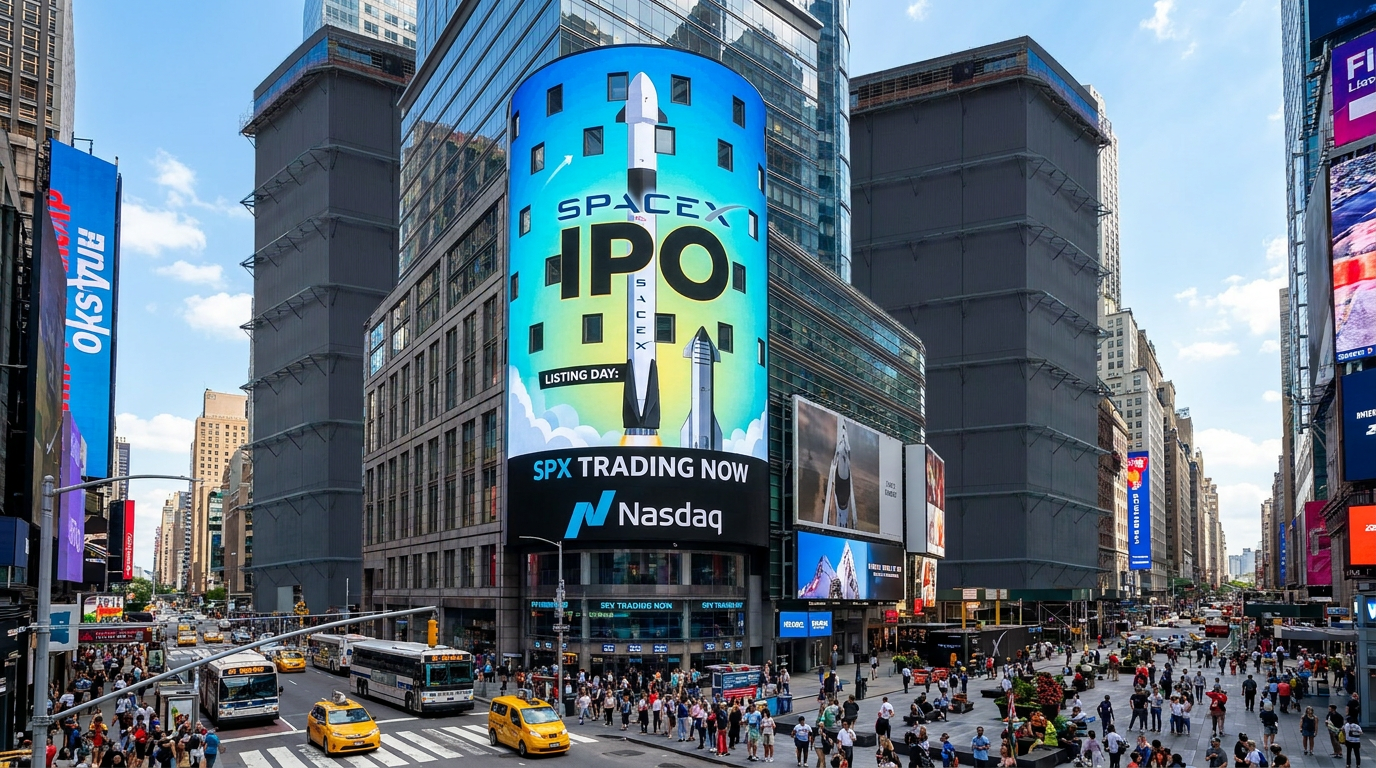
The sheer scale of the June 12 listing rewired Wall Street's expectations. Trading under the ticker SPCX, the aerospace and technology conglomerate raised a staggering $85.7 billion after underwriters exercised their greenshoe options, dwarfing the previous global record held by Saudi Aramco.[3][4]
The stock opened at $150—above its $135 fixed pricing—and closed its first day up 19.2% at $160.95. The surge instantly propelled SpaceX to a market capitalization of roughly $2.2 trillion, cementing its status as one of the most valuable corporate entities on Earth.[3][7]
The wealth generation event was unprecedented. Beyond elevating CEO Elon Musk to the status of the world's first trillionaire, the listing minted an estimated 4,400 current and former employees as millionaires, according to pre-IPO trading platforms.[4][7]

Early institutional backers also booked some of the largest paper gains in venture-capital history. Founders Fund, which invested $20 million in 2008 after three failed rocket launches, now sits on a position worth more than $75 billion.[7]
But the momentum did not pause after the closing bell on Friday. On Tuesday, June 16, options trading for SpaceX officially commenced on the Nasdaq, triggering a massive influx of capital that shattered first-day volume records.[1][8]
Retail and institutional investors alike piled into the derivatives market, seeking leveraged exposure to the space and artificial intelligence conglomerate. Newly launched exchange-traded funds tied to SpaceX also saw heavy inflows, underscoring the intense market appetite for frontier technologies.[1]
Retail and institutional investors alike piled into the derivatives market, seeking leveraged exposure to the space and artificial intelligence conglomerate.
Volatility indexes and options pricing models had to adjust rapidly to the sheer volume of SPCX contracts. Market makers navigated wide bid-ask spreads during the initial price discovery phase, yet the exchange infrastructure processed the unprecedented share volume without operational interruptions.[3][8]

Amid the trading frenzy, SpaceX executed a massive strategic maneuver, announcing the acquisition of San Francisco-based artificial intelligence startup Cursor for $60 billion in an all-stock deal.[2][5][6]
Cursor, developed by parent company Anysphere, has enjoyed a meteoric rise over the past four years as a leader in AI coding assistants. Founded by a team of Massachusetts Institute of Technology dropouts, the platform boasts roughly 4 million active developer users and annualized revenues approaching $4 billion.[5][6]
The software kick-started the phenomenon of "vibe coding," allowing engineers and non-technical users alike to instruct the AI in plain English to autonomously generate complex computer software and applications.[5][6]
The acquisition is a direct shot across the bow of AI rivals like Microsoft-backed OpenAI and Amazon-backed Anthropic. By bringing Cursor in-house, SpaceX aims to supercharge its xAI division and its proprietary Grok models.[5][6]

The two companies had already been collaborating closely. Earlier in the year, SpaceX secured an option to acquire Cursor, and the startup had begun utilizing computing power at xAI's massive "Colossus" data center in Memphis, Tennessee.[2][5]
The integration of Cursor's developer ecosystem into SpaceX's broader infrastructure signals a shift in how frontier AI companies are consolidating the application layer. Industry analysts note that enterprise pricing and data privacy policies for Cursor's millions of users may evolve under the new ownership.[2][6]
For Wall Street, the dual narrative of space exploration and artificial intelligence proved irresistible. The fixed-price IPO model, which bypassed traditional book-building mechanics, was validated by the seamless execution and persistent retail support.[3]
How we got here
2002
Elon Musk founds Space Exploration Technologies Corp.
2008
SpaceX secures early crucial funding from Founders Fund after three failed rocket launches.
2022
AI coding startup Cursor is founded by a team of MIT dropouts.
April 2026
SpaceX and Cursor announce a strategic partnership, giving SpaceX the option to acquire the startup.
June 12, 2026
SpaceX executes the largest IPO in history, raising $85.7 billion on the Nasdaq.
June 16, 2026
SpaceX options begin trading to record volume, and the company officially acquires Cursor for $60 billion.
Viewpoints in depth
Institutional Investors
Focused on the structural depth of the market and the validation of the fixed-price IPO model.
For large-scale institutional backers and market operators, the SpaceX IPO was a stress test of the global financial infrastructure. The ability of the Nasdaq to process an $85.7 billion listing and over 500 million shares in trading volume without triggering volatility pauses validated the exchange's structural depth. Furthermore, the success of SpaceX's fixed-price model—bypassing the traditional weeks-long book-building process—may set a new precedent for how highly anticipated mega-cap companies approach the public markets.
Retail Traders
Driven by the hype, the options market frenzy, and the desire to own a piece of the Musk ecosystem.
Retail investors viewed the SpaceX listing as a generational wealth-building opportunity, driving unprecedented demand in both the underlying stock and the newly launched derivatives market. The immediate surge in options trading and leveraged ETFs reflects a massive appetite for frontier technologies. For this camp, the narrative is less about traditional valuation metrics and more about securing a stake in a company that promises to colonize Mars and dominate the artificial intelligence landscape.
Tech & AI Ecosystem
Focused on the Cursor acquisition, the consolidation of developer tools, and the arms race against OpenAI.
Within Silicon Valley, the $60 billion acquisition of Cursor overshadowed the IPO itself. Tech analysts and developers see the move as a massive escalation in the AI arms race, positioning SpaceX's xAI division as a direct threat to OpenAI and Anthropic. However, the acquisition also raises concerns among independent developers regarding data privacy, potential pricing hikes, and the broader trend of massive tech conglomerates swallowing up the most successful independent tools at the application layer.
What we don't know
- How Cursor's pricing and data privacy policies for its 4 million developers will change under SpaceX ownership.
- The exact timeline for the full integration of Cursor's technology into SpaceX's Grok AI models.
- Whether the unprecedented retail options volume will lead to extreme volatility in SPCX's share price in the coming weeks.
Key terms
- Initial Public Offering (IPO)
- The process of offering shares of a private corporation to the public in a new stock issuance.
- Greenshoe Option
- A provision that allows underwriters to sell more shares than originally planned if demand is higher than expected.
- Options Trading
- Financial derivatives that give buyers the right, but not the obligation, to buy or sell an underlying asset at an agreed-upon price and date.
- Vibe Coding
- A trend where users instruct artificial intelligence in plain English to autonomously write and generate computer software.
- Market Capitalization
- The total value of a publicly traded company's outstanding shares of stock.
Frequently asked
How much did SpaceX raise in its IPO?
SpaceX raised a record-breaking $85.7 billion after underwriters exercised their greenshoe options to meet massive investor demand.
What is Cursor and why did SpaceX buy it?
Cursor is a highly popular AI coding assistant. SpaceX acquired it for $60 billion to integrate into its xAI division and compete directly with rivals like OpenAI and Anthropic.
How did the stock perform on its first day?
Trading under the ticker SPCX, the stock opened at $150 and closed at $160.95, a 19.2% surge that pushed the company's valuation to roughly $2.2 trillion.
Did Elon Musk become a trillionaire?
Yes. The massive valuation of SpaceX following its public debut officially made CEO Elon Musk the world's first trillionaire.
Sources
Source coverage
8 outlets
3 viewpoints surfaced







[1]MarketWatchRetail Traders
Investors pile into moonshot SpaceX bets as first-day options trading shatters records
Read on MarketWatch →What to know about Cursor, the AI coding startup SpaceX is buying for $60 billion
Read on MarketWatch →[3]NasdaqInstitutional Investors
SpaceX Makes History, Raising $85.7 Billion through Nasdaq Listing
Read on Nasdaq →[4]ForbesInstitutional Investors
SpaceX Says Historic IPO Raised More Than $85 Billion
Read on Forbes →[5]CBS NewsTech & AI Ecosystem
SpaceX buys AI coding startup Cursor for $60 billion
Read on CBS News →[6]Los Angeles TimesTech & AI Ecosystem
SpaceX buys AI startup Cursor for $60B in race over Anthropic, OpenAI
Read on Los Angeles Times →[7]Business InsiderRetail Traders
SpaceX stock popped in its first day of trading
Read on Business Insider →[8]Saxo BankInstitutional Investors
Options Brief - SpaceX options launch
Read on Saxo Bank →
More in finance
See all 5 stories →Wealth Management
The One-Page Pledge That Forces Financial Advisers to Put You First
0 sources

Credit Scores
Rent Now Counts: How New Mortgage Credit Scores Are Unlocking Homeownership for Millions
0 sources

Life Insurance
What Is Indexed Universal Life Insurance? The Booming Financial Product, Explained
0 sources

Every angle. Every day.
Get finance stories with full source coverage and perspective breakdowns delivered to your inbox.