
OLED vs. Mini-LED in 2026: The Great Convergence in TV Technology
With the arrival of Tandem OLED and RGB Mini-LED, the traditional trade-offs between perfect blacks and retina-searing brightness have nearly vanished.
By Factlen Editorial Team
- Home Theater Purists
- Advocate for OLED's perfect black levels and pixel-level contrast for cinematic viewing.
- Bright-Room & Power Users
- Favor Mini-LED for its sustained brightness, glare reduction, and immunity to burn-in.
- Competitive Gamers
- Value motion clarity and low input lag, weighing OLED's speed against Mini-LED's durability.
What's not represented
- · Budget-conscious consumers who are priced out of both flagship technologies.
- · Commercial display installers who prioritize 24/7 reliability over peak HDR performance.
Why this matters
For anyone upgrading a living room or gaming setup in 2026, the old rules no longer apply. Understanding the new panel chemistries prevents buyers from spending premium prices on the wrong technology for their specific lighting and viewing habits.
Key points
- Tandem OLED stacks organic layers to boost peak brightness to 1,500+ nits while reducing burn-in risk.
- RGB Mini-LED removes color filters, utilizing pure diodes to hit 3,000–5,000 nits with 20,000+ dimming zones.
- OLED remains superior for pixel-perfect contrast, dark-room viewing, and wide seating arrangements.
- Mini-LED is the better choice for sunlit rooms, daytime sports, and users who leave static images on screen.
- OLED's 0.03ms response time offers perfect motion clarity for gaming, though Mini-LED eliminates all burn-in anxiety.
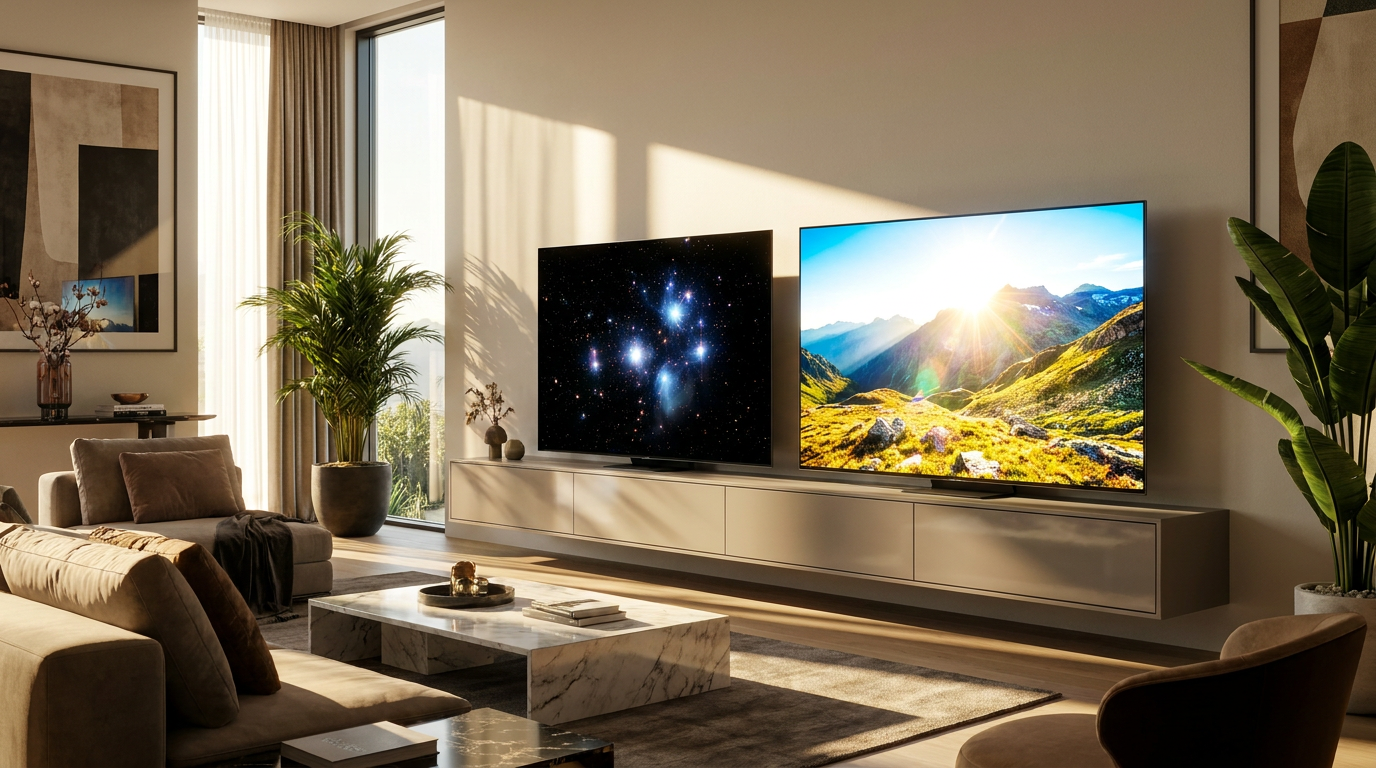
For the past decade, buying a premium television required a painful compromise between the perfect, infinite contrast of OLED and the retina-searing brightness of LED. In 2026, the display market has entered what industry analysts call the Great Convergence. Driven by massive leaps in panel engineering—specifically Tandem OLED and RGB Mini-LED—the traditional boundaries have blurred. Shoppers are no longer choosing between a flawed bright television and a flawed dark television; they are choosing between two highly refined engineering philosophies that have nearly solved their respective historical weaknesses. The era of settling for a subpar picture is over.[1][5]
The case for OLED in 2026 is built on unprecedented brightness gains without sacrificing absolute black levels. By utilizing Tandem OLED architecture, manufacturers are now stacking multiple organic light-emitting layers on top of each other. Combined with Micro Lens Array technology and deuterium-stabilized pixels, these panels now hit peak brightness levels of 1,500 to 2,000 nits in small highlights. The evidence for this approach is clear in cinematic viewing: OLED delivers pixel-level contrast that makes HDR specular highlights, like stars against a pitch-black sky, perfectly precise with zero light bleed.[1][2][6]
The arguments against OLED, however, still center on sustained full-screen brightness and long-term durability. While peak highlights are brilliant, the evidence shows that OLEDs still rely on an Automatic Brightness Limiter to protect the organic pixels from overheating. If a bright, static image like a hockey rink stays on screen, the panel will aggressively dim itself. Furthermore, while Tandem technology drastically reduces the risk of differential aging, organic panels still carry a cumulative risk of permanent burn-in if subjected to thousands of hours of static news tickers or gaming interfaces.[4][5]

Conversely, the case for Mini-LED is anchored by brute-force brightness and inorganic durability. The 2026 shift to RGB Mini-LED has removed the traditional color filter layer entirely, utilizing pure red, green, and blue microscopic diodes. The quantifiable evidence is staggering: flagship models now pack upwards of 20,000 local dimming zones and push peak brightness between 3,000 and 5,000 nits. Because the panel uses inorganic Gallium Nitride, it is entirely immune to burn-in and can hold a full-field white screen at maximum brightness indefinitely without dimming.[3][4][5]
Conversely, the case for Mini-LED is anchored by brute-force brightness and inorganic durability.
The trade-offs against Mini-LED primarily involve off-angle viewing and microscopic contrast limitations. Even with 20,000 dimming zones, one zone still controls thousands of pixels on a 4K display. The evidence reveals that when a bright white cursor moves across a pitch-black background, a faint gray halo—known as blooming—can still be visible, particularly when viewed from the side. Because Mini-LED relies on layers of liquid crystals, colors and contrast will slightly wash out for viewers sitting at the far edges of a wide seating arrangement.[3][5]

When quantifying the gaming experience, the trade-offs become highly specific. OLED offers a near-instantaneous pixel response time of 0.03 milliseconds, delivering zero ghosting and absolute precision for competitive esports. Mini-LED response times hover closer to 1 millisecond, which is excellent but technically slower. However, the evidence heavily favors Mini-LED for players who log thousands of hours in a single game, as the inorganic panel completely eliminates the anxiety of burning a static health bar or heads-up display into the screen.[4][6]
Ultimately, there is no single winner without conditions. Tandem OLED fits well when the television is placed in a light-controlled or darkened room, when the primary content is cinematic movies or prestige television, and when seating arrangements are wide and require perfect off-angle viewing. It delivers an unparalleled, pixel-perfect experience for those who want to see films exactly as the director mastered them. It does not fit well when the display acts as a permanent PC monitor with static taskbars, or when it is placed opposite a wall of massive, unshaded windows.[5][6]

RGB Mini-LED fits well when the television lives in a sun-drenched living room, when the household watches hours of daytime sports or news channels with static banners, and when the user wants maximum HDR impact without ever worrying about panel degradation. It is the ultimate worry-free powerhouse for mixed-use environments where the television is left on all day. It does not fit well when the buyer is a home theater purist who demands absolute, pixel-perfect black levels in a pitch-black room, or when extreme off-axis viewing is required for a large group.[3][5]
How we got here
Mid-2010s
OLED emerges as the premium standard for perfect blacks, but struggles with low brightness and burn-in.
2021
Mini-LED technology enters the mainstream, using thousands of tiny backlights to improve LCD contrast.
2024
Micro Lens Array (MLA) and QD-OLED technologies push OLED brightness past the 1,000-nit barrier.
Early 2026
The 'Great Convergence' arrives at CES, with Tandem OLEDs and RGB Mini-LEDs closing the historical performance gaps.
Viewpoints in depth
Home Theater Purists
Prioritize absolute black levels, pixel-level contrast, and dark-room viewing.
For cinephiles who watch movies in controlled, dark environments, OLED remains the undisputed champion. This camp argues that no amount of local dimming zones can match the precision of a self-emissive pixel turning completely off. They value the infinite contrast ratio and perfect shadow detail that OLED provides, viewing the 2026 Tandem OLED brightness boosts as the final piece of the puzzle that makes the technology flawless for cinematic mastering.
Bright-Room & Power Users
Prioritize sustained full-screen brightness, glare reduction, and zero burn-in anxiety.
Users with sun-drenched living rooms or those who use their displays for PC productivity and news channels heavily favor Mini-LED. This camp points out that OLED's "perfect blacks" are irrelevant if the screen is covered in window reflections. They value the brute-force 3,000+ nit output of RGB Mini-LEDs to punch through ambient glare, and they appreciate the inorganic nature of the panel, which allows them to leave static UI elements on screen all day without fear of permanent burn-in.
Competitive Gamers
Torn between OLED's motion clarity and Mini-LED's durability for static HUDs.
The gaming community is split. Esports professionals lean toward OLED for its near-instantaneous 0.03ms response time, which eliminates motion blur during fast-paced shooters. However, MMO and strategy gamers who play the same title for thousands of hours often prefer Mini-LED. They argue that the peace of mind of never having to worry about a static health bar or minimap burning into the screen outweighs the slight hit to motion clarity.
What we don't know
- How the long-term degradation curve of Tandem OLED panels will compare to traditional single-layer OLEDs after 20,000+ hours of use.
- Whether the extreme heat generated by 5,000-nit RGB Mini-LEDs will impact the lifespan of internal power supplies over a decade.
Key terms
- Tandem OLED
- A display architecture that stacks multiple organic light-emitting layers to increase brightness and panel lifespan.
- RGB Mini-LED
- A backlight system that uses separate red, green, and blue microscopic LEDs instead of a white backlight with a color filter.
- Local Dimming Zones
- Specific areas of a TV's backlight that can dim or turn off independently to improve contrast in dark scenes.
- Blooming
- A visual artifact where light bleeds from a bright object into the surrounding dark areas of the screen.
- Automatic Brightness Limiter (ABL)
- A software protection mechanism in OLED TVs that dims the screen when a bright, static image is displayed to prevent overheating and burn-in.
- Nits
- A unit of measurement for display brightness, roughly equivalent to the light of one candle per square meter.
Frequently asked
Which TV is better for a bright living room?
Mini-LED is the superior choice for bright rooms. Its ability to sustain 3,000+ nits of full-screen brightness effortlessly cuts through window glare and sunlight.
Do 2026 OLED TVs still get burn-in?
While the risk is significantly lower thanks to Tandem OLED architecture and deuterium-stabilized pixels, organic panels still carry a cumulative risk of image retention if static elements are displayed for thousands of hours.
Which technology is better for gaming?
Both are excellent, but they serve different needs. OLED offers a near-instant 0.03ms response time for blur-free motion, while Mini-LED offers peace of mind against burn-in for games with static HUDs.
What is blooming, and does Mini-LED still have it?
Blooming is a halo effect around bright objects on dark backgrounds. While 2026 Mini-LEDs with 20,000+ dimming zones have nearly eliminated it when viewed straight on, it can still be slightly visible from wide angles.
Sources
Source coverage
6 outlets
3 viewpoints surfaced






[1]RTINGSCompetitive Gamers
2026 TV Market Trends: RGB Mini LED and Tandem OLED
Read on RTINGS →[2]TechRadarCompetitive Gamers
The best TVs of CES 2026: brighter OLEDs and RGB mini-LED everywhere
Read on TechRadar →[3]What Hi-Fi?Home Theater Purists
Best TVs 2026: OLED vs RGB Mini LED
Read on What Hi-Fi? →[4]PCWorldBright-Room & Power Users
OLED is old news. Mini-LED is the future
Read on PCWorld →[5]DisplayMasterBright-Room & Power Users
The 2026 Display Dilemma: Which Tech Reigns Supreme?
Read on DisplayMaster →[6]Data Wire SolutionsHome Theater Purists
Tandem OLED vs QD-OLED vs Mini-LED
Read on Data Wire Solutions →
Every angle. Every day.
Get shopping stories with full source coverage and perspective breakdowns delivered to your inbox.