
How 'Libraries of Things' Are Reshaping Neighborhoods and the Sharing Economy
Community lending hubs are allowing residents to borrow everything from power tools to camping gear, saving households thousands of dollars while reducing environmental waste.
By Factlen Editorial Team
- Circular Economy Advocates
- Focus on reducing manufacturing demand, cutting carbon emissions, and minimizing landfill waste by maximizing the lifespan of goods.
- Community Resilience Builders
- View tool libraries as vital social infrastructure that fosters mutual aid, skill-sharing, and disaster recovery.
- Municipal Planners & Librarians
- Focused on the operational logistics, funding models, and integration of non-traditional lending into existing public services.
What's not represented
- · Traditional hardware retailers and tool manufacturers whose sales models rely on individual ownership.
- · Rural residents who face geographic barriers to centralized community sharing hubs.
Why this matters
By shifting from individual ownership to community access, neighborhoods are saving residents thousands of dollars, reducing environmental waste, and rebuilding local social connections.
Key points
- Libraries of Things allow residents to borrow rarely used tools and appliances instead of buying them.
- There are now an estimated 2,000 formal lending hubs operating globally.
- The model saves households money and democratizes access to expensive equipment.
- By maximizing the lifespan of goods, the movement significantly reduces carbon emissions and landfill waste.
- These hubs serve as vital community centers, hosting repair cafes and fostering local resilience.
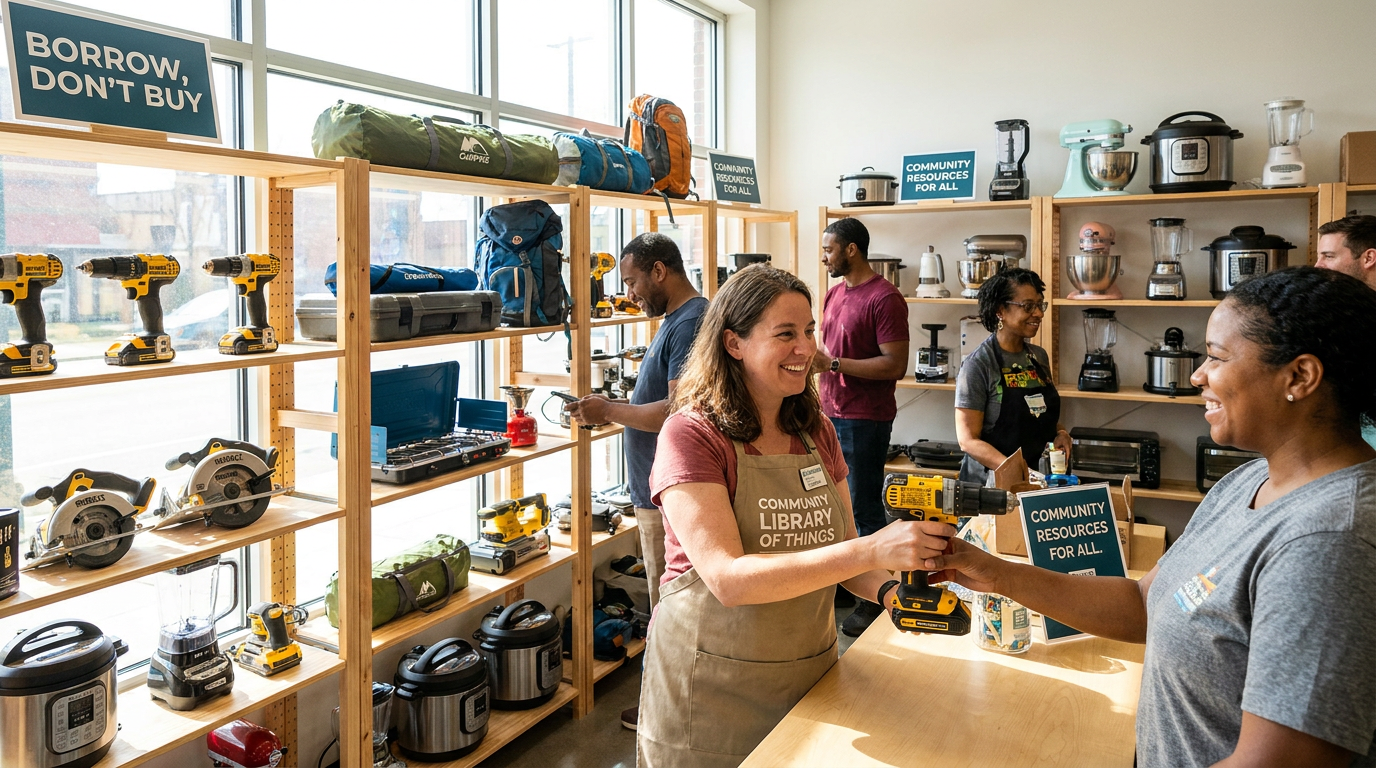
The modern garage is often a graveyard of good intentions. Tucked behind the bicycles and holiday decorations sit the pressure washers, tile saws, and camping tents that see the light of day perhaps once a year. This accumulation of rarely used equipment represents a massive drain on household finances and environmental resources. But a growing movement is challenging the assumption that every home needs its own complete inventory of tools and appliances.[1]
Enter the "Library of Things"—a community-based lending model that applies the mechanics of a traditional book library to physical goods. Instead of purchasing a carpet cleaner or a cordless drill for a single weekend project, residents can borrow these items for a nominal fee or a low-cost annual membership. By shifting the focus from individual ownership to shared access, these hubs are quietly reshaping how neighborhoods consume, connect, and build resilience.[1][2]
The concept is scaling rapidly. There are now an estimated 2,000 formal Libraries of Things operating worldwide, alongside countless informal neighborhood sharing networks. They range from grassroots volunteer-run basements to sophisticated social enterprises operating out of high street kiosks. As the cost of living rises and urban living spaces shrink, the appeal of accessing high-quality equipment without the burden of storage or maintenance has broadened significantly.[2][4]
The mechanics of a typical library are straightforward but highly effective. Members browse a digital catalog, reserve the item they need, and pick it up from a central community location. After the borrowing period—usually a few days to a week—the item is returned, cleaned, and checked for safety before being loaned out again. Many libraries operate on a sliding scale for membership fees, ensuring that low-income residents are not priced out of the service.[2][7]

The economic impact for members is substantial. In Canada, the Toronto Tool Library has facilitated more than 80,000 loans since its launch in 2013. By providing access to an inventory of over 15,000 donated items, the project has generated an estimated $750,000 in direct savings for its community. For a family looking to renovate a room or repair a leaky pipe, the ability to borrow specialized tools democratizes the capacity for self-sufficiency.[1][5]
Beyond individual savings, the movement is a cornerstone of the emerging circular economy. The traditional "take-make-waste" model of consumption drives immense carbon emissions and resource extraction. By maximizing the lifespan and utility of a single manufactured item, a Library of Things directly reduces the demand for new products. A high-quality drill shared among fifty households prevents forty-nine drills from eventually ending up in a landfill.[2][4]
In the United Kingdom, the broader sharing economy—which includes peer-to-peer lending and community resource pooling—is projected to be worth £140 billion by 2025. Organizations like London's Library of Things Ltd. have capitalized on this trend, expanding to over a dozen locations and serving tens of thousands of borrowers. They have even partnered with major manufacturers like Bosch and Kärcher, who provide high-quality equipment in exchange for anonymized data on how their tools hold up under heavy community use.[4][7]

In the United Kingdom, the broader sharing economy—which includes peer-to-peer lending and community resource pooling—is projected to be worth £140 billion by 2025.
But the benefits of these libraries extend far beyond economics and environmentalism; they are potent engines for social cohesion. In an era marked by an epidemic of loneliness, a Library of Things serves as a vital "third place"—a community hub outside of home and work where neighbors interact. The transaction of borrowing a tool often sparks conversations, advice-sharing, and a renewed sense of local trust.[1]
Many tool libraries amplify this social impact by hosting regular skill-building workshops and "repair cafes." During these events, experienced woodworkers, electricians, and artisans volunteer their time to teach community members how to fix broken appliances, mend clothing, or safely operate power tools. This transfer of generational knowledge empowers residents and fosters a culture of repair over replacement.[1][5]
The resilience fostered by these networks becomes especially critical during times of crisis. Following the devastating 2022 floods in the Northern Rivers region of New South Wales, Australia, the Mullumbimby Library of STUFF played a crucial role in the community's recovery. The library provided immediate access to water blasters, dehumidifiers, and rebuilding tools, proving that shared resource infrastructure is a vital component of disaster preparedness.[3]

Researchers studying the Mullumbimby project found that the library positively impacted individual wellbeing in multiple ways: decreasing climate-related financial stress, providing opportunities for skill-building, and aiding in long-term psychological resilience. When neighbors know they can rely on a shared pool of resources, the anxiety of facing a crisis alone is significantly diminished.[3]
Advocates are quick to distinguish this movement from the highly commercialized iterations of the "sharing economy," such as ride-sharing or short-term rentals. While those platforms often extract value from communities to benefit distant shareholders, a Library of Things represents the "real sharing economy"—rooted in mutual aid, non-profit structures, and localized control. The primary goal is community enrichment, not venture-capital returns.[1][2]
Recognizing this value, traditional public library systems are increasingly adopting the model. The Sacramento Public Library in California, for example, has expanded its mandate far beyond books, lending out sewing machines, musical instruments, and digital cameras. This evolution builds on a long history of libraries serving as adaptive community centers, a lineage that traces back to the pioneering Berkeley Tool Library established in 1979.[6]
Despite their success, operating a Library of Things is not without challenges. Grassroots organizations often struggle with the logistics of storing bulky items, maintaining broken equipment, and securing consistent funding. Volunteer burnout is a persistent risk, as the administrative burden of tracking inventory and managing memberships can become overwhelming for small teams.[1][2]

To achieve long-term sustainability, many libraries are exploring hybrid funding models. This includes a mix of membership dues, municipal grants, and strategic corporate sponsorships. Some are also integrating directly into new affordable housing developments, ensuring that shared resource infrastructure is built into the neighborhood from day one, rather than retrofitted later.[1][2]
Ultimately, the Library of Things movement asks communities to fundamentally rethink their relationship with material goods. It challenges the deeply ingrained cultural narrative that success and security are defined by individual ownership. By proving that access is often more valuable than possession, these libraries are helping to sketch the outlines of a fairer, more sustainable, and more deeply connected society.[1]
How we got here
1979
The Berkeley Tool Library is established in California, pioneering the modern tool-lending model.
2013
The Toronto Tool Library launches, eventually facilitating tens of thousands of loans and saving the community hundreds of thousands of dollars.
2016
London's Library of Things opens, later expanding to multiple kiosks and partnering with major tool manufacturers.
2022
The Mullumbimby Library of STUFF in Australia plays a critical role in community recovery following devastating regional floods.
Viewpoints in depth
Circular Economy Advocates
Focus on the environmental necessity of reducing consumption and maximizing the lifespan of manufactured goods.
This camp argues that the traditional 'take-make-waste' economic model is environmentally unsustainable. By creating shared infrastructure, communities can drastically reduce the carbon emissions and resource extraction associated with manufacturing rarely used items. They point to data showing that a single shared power tool can replace dozens of individual purchases, significantly reducing landfill waste and household clutter.
Community Resilience Builders
Emphasize the social benefits of shared resources, including skill-building, mutual aid, and disaster recovery.
For these advocates, the tools themselves are secondary to the social connections they facilitate. They view Libraries of Things as vital 'third places' that combat urban isolation and rebuild neighborhood trust. By hosting repair cafes and skill-sharing workshops, these hubs empower residents to become self-sufficient while ensuring that vulnerable populations have a safety net during economic downturns or natural disasters.
Municipal Planners & Librarians
Focus on the operational logistics and the evolution of public services to meet modern community needs.
This perspective looks at the practicalities of scaling the sharing economy. Librarians and city planners are exploring how to integrate non-traditional lending into existing public infrastructure, grappling with challenges like liability, storage space, and funding. They advocate for hybrid models that combine municipal grants with corporate partnerships, ensuring these libraries can survive long-term without burning out grassroots volunteers.
What we don't know
- How smaller, volunteer-run libraries will secure long-term, sustainable funding without relying entirely on unpredictable grants.
- Whether the model can scale effectively in rural areas where population density makes central pickup locations less convenient.
- How major tool and appliance manufacturers will adapt their business models if community sharing significantly reduces individual retail sales.
Key terms
- Library of Things (LoT)
- A community-based lending model that allows people to borrow physical goods like tools and appliances rather than purchasing them.
- Circular Economy
- An economic system aimed at eliminating waste and the continual use of resources by sharing, leasing, reusing, and repairing existing materials.
- Third Place
- A sociological term for a social surrounding separate from the two usual social environments of home and the workplace, crucial for community building.
- Mutual Aid
- A voluntary, reciprocal exchange of resources and services for mutual benefit, often forming the foundation of grassroots sharing networks.
Frequently asked
What exactly is a Library of Things?
It is a community lending hub where residents can borrow rarely used items—like power tools, camping gear, and kitchen appliances—instead of buying them.
How much does it cost to borrow items?
Most libraries operate on a low-cost annual membership or charge a nominal fee per item, with many offering sliding scales for low-income residents.
Who maintains the tools when they break?
Items are typically maintained by staff and skilled volunteers, often through community 'repair cafes' that also teach residents how to fix things.
Can traditional public libraries lend tools?
Yes, many traditional library systems are expanding their catalogs to include non-book items like sewing machines, seeds, and musical instruments.
Sources
Source coverage
7 outlets
3 viewpoints surfaced






[1]Factlen Editorial TeamCommunity Resilience Builders
Synthesis by Factlen editorial team
Read on Factlen Editorial Team →[2]ShareableCircular Economy Advocates
Library of Things Toolkit
Read on Shareable →[3]Mullumbimby Library of STUFFCommunity Resilience Builders
The Effects of a Library of Things upon Individual Wellbeing
Read on Mullumbimby Library of STUFF →[4]Good HousekeepingCircular Economy Advocates
Why you need to know about the Library of Things
Read on Good Housekeeping →[5]Circle EconomyCommunity Resilience Builders
Toronto Tool Library and Sharing Depot
Read on Circle Economy →[6]99% InvisibleMunicipal Planners & Librarians
Library of Things: Public Libraries Now Lending Tools, Toys, Tech & Seeds
Read on 99% Invisible →[7]Library of Things Ltd.Municipal Planners & Librarians
Borrow useful Things for your home, projects and adventures
Read on Library of Things Ltd. →
Every angle. Every day.
Get community stories with full source coverage and perspective breakdowns delivered to your inbox.