
At-Home Brain Implant Restores Speech and Independence for ALS Patient
A groundbreaking brain-computer interface has allowed a man with severe paralysis to communicate and control a computer independently from home for nearly two years. The system's ability to auto-calibrate marks a major leap toward practical, everyday assistive neurotechnology.
By Factlen Editorial Team
- Neurotechnology Researchers
- Focuses on the technical milestones of algorithmic auto-calibration and the long-term stability of intracortical electrodes.
- Patient Advocates & Caregivers
- Emphasizes the profound restoration of autonomy, quality of life, and the reduction of daily technical burdens on families.
- Clinical Ethicists
- Examines the accessibility, cost, and long-term generalizability of the technology for broader populations.
What's not represented
- · Health insurance providers determining coverage models for advanced neuroprosthetics
- · Patients with non-ALS forms of paralysis whose brain topographies present different decoding challenges
Why this matters
For decades, brain-computer interfaces were fragile experimental tools confined to research labs. This breakthrough proves that a paralyzed individual can use a brain implant independently at home to speak, work, and connect with the world—crossing the critical threshold from scientific curiosity to practical, life-changing medicine.
Key points
- A 48-year-old man with ALS has successfully used a brain-computer interface at home for nearly two years.
- The device translates his intended speech into text at 56 words per minute with 97.5% accuracy.
- Unlike previous implants, the system uses AI to auto-calibrate, removing the need for daily supervision by scientists.
- The patient used the device on 364 out of 397 monitored days, totaling over 3,800 hours of independent use.
- The peer-reviewed findings represent a major milestone in transitioning neurotechnology from the lab to practical assistive devices.
Casey Harrell, a 48-year-old man diagnosed with amyotrophic lateral sclerosis (ALS), gradually lost his ability to speak and move as the progressive neurological disease took its toll. Today, however, he is communicating with his family, browsing the internet, and managing his daily affairs. Harrell has become the world’s first 'power user' of a highly advanced, speech-decoding brain-computer interface (BCI) that he operates entirely from the comfort of his own home, marking a watershed moment in the history of assistive neurotechnology.[3][4]
The core claim of this breakthrough is detailed in a comprehensive, peer-reviewed study published this week in the journal Nature Medicine. The research outlines how Harrell utilized the intracortical BCI for nearly two years to communicate and interact with the digital world. Unlike previous experimental devices that were strictly confined to laboratory settings, this system was designed for genuine independence. It does not require a team of scientists to be present in the room to monitor the hardware or adjust the software, representing a massive leap forward in usability.[1][2][5]
The mechanism behind this achievement relies on state-of-the-art surgical and engineering techniques. In 2023, neurosurgeons implanted four tiny microelectrode arrays—comprising a total of 256 microscopic electrodes—directly into the precentral gyrus of Harrell's brain. This specific region of the motor cortex is uniquely responsible for coordinating the complex, rapid muscle movements of the jaw, lips, and tongue required for human speech. By placing the sensors exactly where the brain formulates these movement commands, the system can intercept the signals before they reach the damaged motor neurons.[1][5]
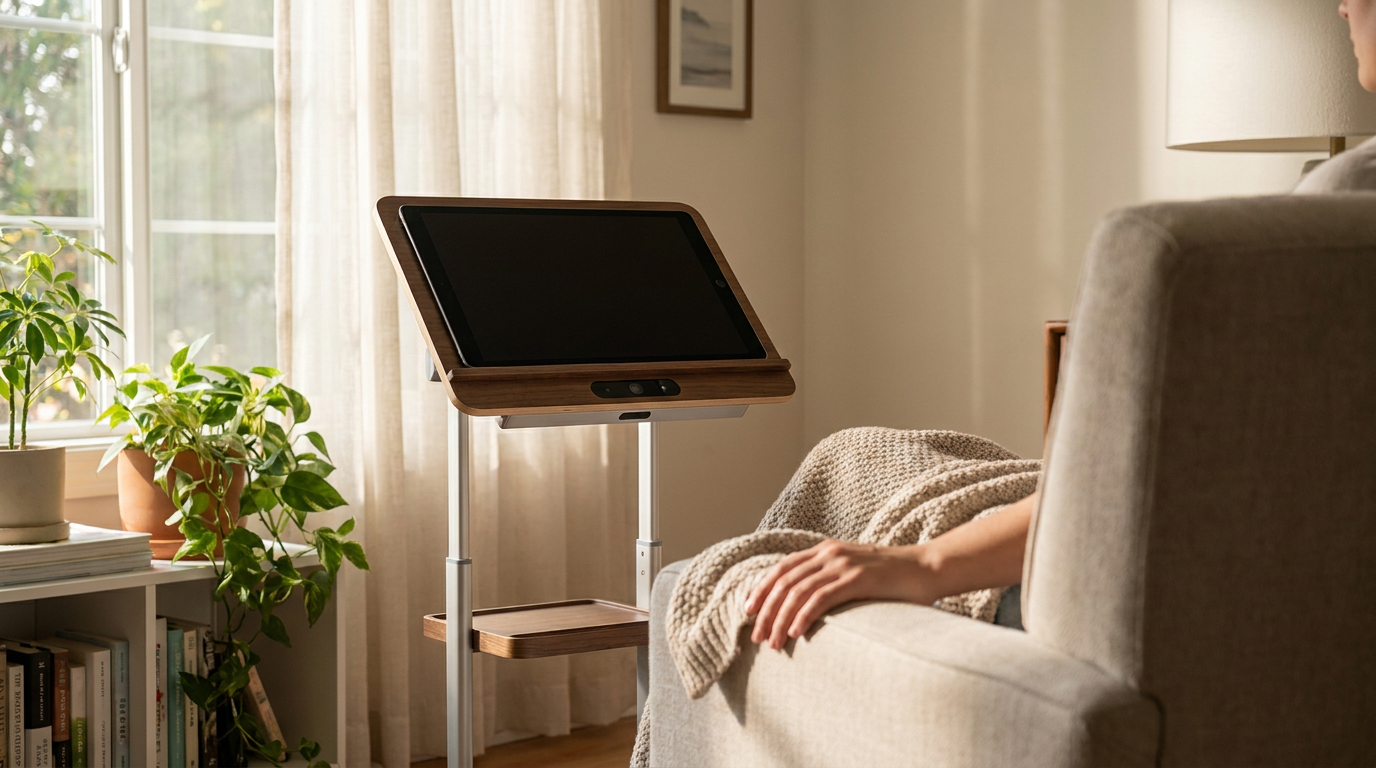
Decoding intended speech from these raw biological signals is a complex computational challenge. The implanted electrodes record the electrical firing of individual neurons in real-time whenever Harrell attempts to silently mouth words. This raw neural data is then transmitted through a physical wired connection embedded in his skull to a local computing system. The hardware, which consists of several networked computers mounted on a mobile cart in his living room, processes the data instantaneously to determine exactly what he is trying to say.[5][7]
The evidence for the system's efficacy is exceptionally strong, setting new benchmarks for the field. According to the longitudinal data published in Nature Medicine, the BCI translates Harrell's brain signals into text at an average speed of 56 words per minute. This approaches the speed of natural conversational speech. Furthermore, the system boasts an astonishing 125,000-word vocabulary and maintains a 97.5% accuracy rate, allowing him to express complex thoughts and nuanced ideas without being artificially constrained to a limited set of pre-programmed phrases.[1][3][7]

To understand the magnitude of this achievement, it is necessary to look at the historical context and the recalibration problem that has long plagued the field. For decades, BCIs have been fragile proof-of-concept devices confined to highly controlled clinical environments. The primary barrier to home use has been 'signal drift.' The neural signals recorded by the electrodes shift slightly from day to day due to microscopic movements of the brain or changes in tissue. Historically, this required engineers to manually recalibrate the decoding software before every single session.[2][5][7]
To solve this persistent technical hurdle, a collaborative team of researchers from UC Davis, Brown University, and Mass General Brigham developed a revolutionary self-calibrating algorithm. The software relies on advanced artificial intelligence models that automatically update themselves in the background. As Harrell uses the device, the machine learning system continuously adapts to the subtle shifts in his neural activity without any human intervention, effectively creating a user-friendly, plug-and-play process that maintains high accuracy over months of continuous use.[1][2][5]

The software relies on advanced artificial intelligence models that automatically update themselves in the background.
This algorithmic stability is what ultimately allowed Harrell to use the device on his own terms, integrating it seamlessly into his daily routine. Over a monitored period of 22.6 months, he utilized the BCI for more than 3,800 hours. He logged onto the system on 364 out of 397 days, demonstrating an unprecedented level of long-term reliability for an intracortical implant. This volume of usage far exceeds any previous clinical trial, proving that the technology can withstand the rigors of everyday life outside a laboratory.[1][3][7]

The true measure of the system's success is the independence it affords both the patient and his family. The automation of the software means that Harrell's caregiver can simply plug him into the device in the morning without needing any specialized technical training. Sergey Stavisky, a neuroengineer at UC Davis and co-senior author of the study, noted that Harrell can simply wake up, get connected by his caregiver, and immediately start communicating, drastically reducing the daily burden on his support network.[3]
Beyond basic interpersonal communication, the BCI functions as a comprehensive digital interface, acting as a standard computer mouse and keyboard. Harrell has used the system to send emails, browse the internet, read the news, and interact with the broader digital world. For a patient whose physical world has been severely restricted by ALS, this capability effectively restores a significant degree of personal and professional autonomy, allowing him to participate in society in ways that were previously thought lost.[2][4]
While the longitudinal data presented in the study is robust, the scientific community acknowledges transparent uncertainty regarding the long-term viability of the hardware. The evidence is currently limited to a single participant, and it remains unknown exactly how these specific microelectrode arrays will perform over a decade or more. The brain's natural immune response can sometimes encapsulate foreign implants in scar tissue over time, which could eventually degrade the quality of the recorded neural signals and reduce the system's effectiveness.[1][6]
Another crucial area of uncertainty is whether these self-calibrating algorithms will perform equally well across a diverse population of patients with varying medical histories. ALS primarily damages motor neurons in the spinal cord and brainstem while leaving the brain's upper cortical structures relatively intact. It is not yet clear if the same high level of decoding accuracy can be achieved for individuals whose paralysis stems from strokes, traumatic brain injuries, or severe cerebral palsy, where the physical topography of the motor cortex itself may be damaged or fundamentally altered by the underlying condition.[6][7]

Despite these open questions, the research team is already looking toward the next frontier of neuroprosthetics: restoring the full, rich nuance of human speech. They are actively developing 'brain-to-speech' systems designed to decode not just the intended words, but the underlying cadence, inflection, and emotion. The ultimate goal is to generate a synthesized voice that sounds entirely natural—one that can express happiness, anger, or sarcasm, returning a vital layer of human connection to those who have lost their natural voice.[3]
The broader implications of this research extend far beyond a single successful clinical case study. David Brandman, co-senior author of the paper and co-director of the UC Davis Neuroprosthetics Lab, stated that the scientific community has finally 'crossed a threshold' with this achievement. By successfully moving this highly complex, data-heavy technology out of the controlled laboratory environment and into a patient's everyday living room, the study provides a vital, undeniable proof-of-concept for the eventual commercialization, regulatory approval, and widespread deployment of advanced assistive neurotechnology.[2][5]
For patients facing the devastating, progressive reality of motor neuron diseases, the transition from an experimental lab curiosity to a reliable daily communication tool represents a profound paradigm shift in neurological care. While widespread commercial availability and insurance coverage may still be several years away, this breakthrough offers a tangible, evidence-backed blueprint for the future. It provides concrete hope that severe physical paralysis will no longer equate to permanent silence, fundamentally redefining what is medically and technologically possible for the next generation of patients.[4][6][8]
How we got here
2023
Surgeons implant four microelectrode arrays into Casey Harrell's motor cortex as part of a clinical trial.
Early 2024
Researchers transition the system to allow Harrell's caregiver to operate it without lab technicians present.
June 2026
Nature Medicine publishes the longitudinal data, confirming nearly two years of successful independent home use.
Viewpoints in depth
Neurotechnology Researchers
Focuses on the technical milestones of algorithmic auto-calibration and long-term stability.
For the engineering and neuroscience communities, the true breakthrough is not just the decoding of speech, but the system's self-sufficiency. Historically, the 'signal drift' of intracortical electrodes meant that the neural patterns recorded on Tuesday looked slightly different than those recorded on Monday. This required a Ph.D. researcher to manually retrain the algorithm before every use. By implementing machine learning models that continuously update in the background, the team proved that a BCI can function as a reliable, plug-and-play consumer device rather than a fragile laboratory experiment.
Patient Advocates & Caregivers
Emphasizes the profound restoration of autonomy and the reduction of daily technical burdens.
From the perspective of patients with severe paralysis and their families, the value of this technology is measured in independence. ALS strips individuals of their ability to interact with the world, often leaving them 'locked in.' The ability to wake up, have a caregiver plug in a cable, and immediately begin sending emails, browsing the internet, or talking to family members restores a fundamental human right to communicate. Advocates stress that the ultimate goal must be making these systems robust enough that they do not add a technical maintenance burden to already overwhelmed caregivers.
Clinical Ethicists
Examines the accessibility, cost, and long-term generalizability of the technology.
While celebrating the clinical success, ethicists and health economists raise questions about the future scalability of such advanced neuroprosthetics. The current setup involves highly invasive brain surgery, custom-built hardware, and millions of dollars in research funding for a single patient. There is transparent uncertainty regarding how healthcare systems will eventually cover the costs of these devices, and whether the self-calibrating algorithms will perform equally well for patients whose motor cortex damage stems from strokes or traumatic brain injuries rather than ALS.
What we don't know
- How the microscopic electrodes will perform over a decade or more, as the brain's immune response can sometimes encapsulate implants in scar tissue.
- Whether the self-calibrating algorithms will work equally well for patients with different neurological conditions, such as stroke or severe cerebral palsy.
- How quickly this highly customized, expensive technology can be scaled and made affordable for the broader population of paralyzed patients.
Key terms
- Brain-Computer Interface (BCI)
- A system that records electrical activity directly from the brain and translates it into digital commands for a computer or device.
- Amyotrophic Lateral Sclerosis (ALS)
- A progressive neurological disease that destroys motor neurons, leading to severe paralysis and loss of speech.
- Precentral Gyrus
- A specific fold in the brain's frontal lobe that contains the primary motor cortex, responsible for executing voluntary movements.
- Signal Drift
- The tendency for the neural signals recorded by implanted electrodes to shift slightly over time, traditionally requiring frequent manual recalibration.
- Intracortical
- Situated or occurring within the cortex, which is the highly folded outer layer of the brain.
Frequently asked
Does the patient need to speak out loud for the device to work?
No. The system decodes the electrical signals generated in the brain when the patient silently attempts to mouth words.
Why is this study different from previous brain implant research?
Previous devices required a team of scientists to manually recalibrate the software daily. This system uses AI to auto-calibrate, allowing the patient to use it independently at home.
Is this technology available to the general public?
Not yet. It is currently part of an ongoing clinical trial and remains an experimental proof-of-concept, though this study marks a major step toward commercialization.
Can the device decode emotions or tone of voice?
The current iteration translates signals into plain text and standard synthesized speech, but researchers are actively developing upgrades to decode intended cadence and emotion.
Sources
Source coverage
8 outlets
3 viewpoints surfaced







[1]NatureNeurotechnology Researchers
At-home brain implant gives man with motor neuron disease his daily life back
Read on Nature →[2]UC Davis HealthNeurotechnology Researchers
Brain-computer interface enables independent, accurate communication for man living with ALS
Read on UC Davis Health →[3]MIT Technology ReviewClinical Ethicists
This man with ALS is 'the first power user' of a brain implant that lets him speak
Read on MIT Technology Review →[4]The Washington PostPatient Advocates & Caregivers
Two years, 2 million words: How a brain implant transformed an ALS patient's life
Read on The Washington Post →[5]PsyPostClinical Ethicists
A recent study published in Nature Medicine provides evidence that a specialized brain implant can allow a person with severe paralysis to independently communicate
Read on PsyPost →[6]Factlen Editorial TeamNeurotechnology Researchers
Synthesis by Factlen editorial team
Read on Factlen Editorial Team →[7]Medical XpressPatient Advocates & Caregivers
Brain-computer interface enables independent, accurate communication for man living with ALS
Read on Medical Xpress →[8]NOSPatient Advocates & Caregivers
Paralyzed ALS Patient Can Communicate Again Thanks to Brain Implant
Read on NOS →

Every angle. Every day.
Get science stories with full source coverage and perspective breakdowns delivered to your inbox.