
How Neuroaesthetics is Rewiring Interior Design for Brain Health
Advancements in brain-scanning technology are proving that interior design is a biological imperative, not just a matter of taste. The emerging field of neuroaesthetics reveals how light, shape, and texture actively alter our nervous systems.
By Factlen Editorial Team
- Neuroscience Researchers
- Focuses on the empirical data and biometric tracking that legitimized the field of neuroaesthetics.
- Residential Designers
- Focuses on translating the science into accessible home improvements, emphasizing emotional resonance and daily well-being.
- Healthcare Architects
- Focuses on applying neuroaesthetic principles to hospitals to accelerate healing and reduce institutional fear.
- Sensory Inclusion Advocates
- Emphasizes that 'calming' is subjective and advocates for customizable, neurodivergent-friendly environments.
What's not represented
- · Low-income renters who lack the autonomy or budget to alter their built environments.
- · Urban planners focused on exterior cityscapes rather than interior spaces.
Why this matters
Humans spend roughly 90% of their lives indoors, meaning our homes and workplaces are constantly shaping our brain chemistry. Understanding neuroaesthetics allows you to optimize your environment to actively lower stress, improve focus, and boost your daily mental health.
Key points
- Neuroaesthetics is the scientific study of how the brain and nervous system respond to the built environment.
- fMRI scans reveal that aesthetically pleasing spaces activate the brain's orbitofrontal cortex, reducing stress hormones.
- Biophilic design, which incorporates natural fractal patterns, can lower cortisol levels by 15 to 20 percent.
- Curvilinear furniture and smooth architectural lines signal safety to the subconscious, while sharp angles can elevate tension.
- Hospitals and corporate offices are increasingly using these principles to accelerate patient healing and boost employee productivity.
Have you ever walked into a room and felt an immediate, involuntary sense of relief? Or, conversely, stepped into a space and felt a sudden spike in tension, as if the walls were closing in? For decades, interior design was dismissed as a superficial matter of "taste"—a subjective choice between velvet or linen, blue or gray. If a room made you feel anxious, you might have blamed your mood rather than the architecture. But advanced brain-scanning technology has fundamentally shifted this conversation from aesthetics to biology. Welcome to neuroaesthetics, the scientific study of how our brains and bodies respond to the built environments we inhabit. It turns out that beauty, harmony, and spatial design are not just "nice to have"; they are biological imperatives that actively shape our mental and physical health.[1][4]
The foundation of neuroaesthetics lies in the autonomic nervous system. Every second, the human brain processes roughly 11 million bits of sensory information, the vast majority of it entirely unconsciously. Researchers using functional MRI (fMRI) and biometric tracking have discovered that our nervous systems react to spatial cues within milliseconds. When we encounter a thoughtfully designed, aesthetically pleasing space, the brain's orbitofrontal cortex—the region linked to emotional regulation and decision-making—lights up. The physiological changes that follow are measurable and profound: heart rates slow, blood pressure drops, and the body shifts from a sympathetic "fight or flight" state to a parasympathetic "rest and digest" mode.[1][6]

One of the most powerful triggers for this neurological relaxation is biophilic design, specifically the incorporation of fractal patterns. Fractals are the complex, repeating geometric shapes found abundantly in nature—think of the branching of trees, the veins of a leaf, or the jagged edges of a coastline. Because the human nervous system evolved outdoors, our brains are hardwired to process these natural patterns with minimal cognitive effort. Studies show that exposure to fractal-rich environments, whether through real plants, architectural details, or even printed textiles, can lower cortisol levels by 15 to 20 percent. This exposure induces a mild meditative state, reducing stress while simultaneously improving sustained attention and creative thinking.[1][5]
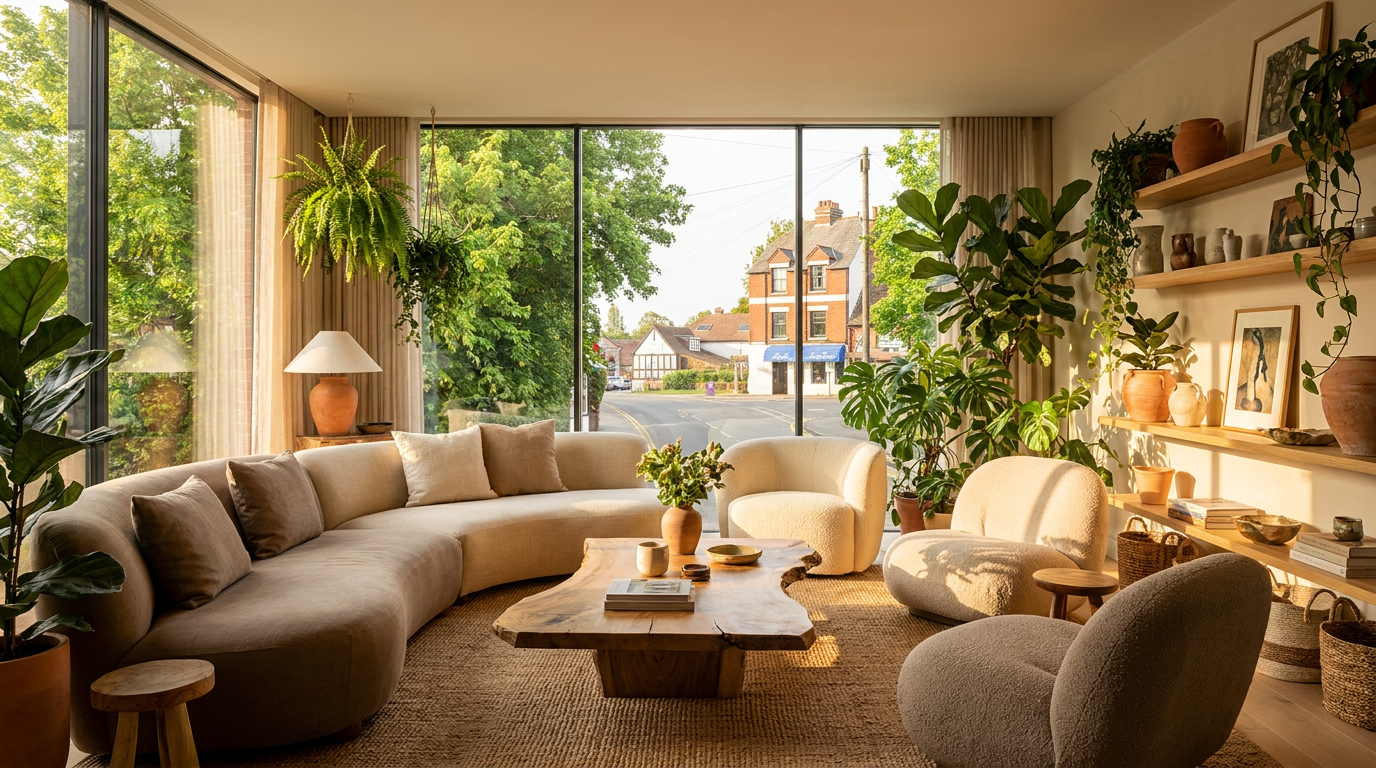
Beyond patterns, the physical shape of our architecture and furniture plays a crucial role in how safe we feel. fMRI studies reveal that curvilinear spaces and rounded furniture actively stimulate the brain's reward networks. Smooth, flowing lines mimic the organic forms of the natural world, signaling safety and comfort to the subconscious mind. By contrast, sharp, rectilinear angles and harsh geometric layouts can subconsciously signal threat, requiring more cognitive load to process and subtly elevating stress hormones. This is why a room filled with rigid, angular furniture can feel exhausting to sit in, even if it looks perfectly tidy.[3][6]

Texture and tactile input also communicate directly with the brain, shaping our emotional resonance with a space. Materials like natural wood, raw stone, and woven fabrics stimulate the somatosensory cortex. This neural activation produces feelings of warmth, grounding, and belongingness. In contrast, an overabundance of synthetic materials, glossy plastics, and cold metals can leave a space feeling clinical and alienating. The brain constantly scans its environment for tactile cues of comfort, and integrating natural textures provides a subliminal reassurance that resources are available and we are protected.[5][6]
Texture and tactile input also communicate directly with the brain, shaping our emotional resonance with a space.
Lighting is perhaps the most immediate and impactful neuroaesthetic lever available to designers. Natural sunlight acts as a biological trigger for serotonin, the neurotransmitter responsible for mood elevation, focus, and overall well-being. When natural light is abundant, it regulates our circadian rhythms, ensuring we feel alert during the day and sleepy at night. When natural light isn't available, the color temperature of artificial lighting dictates our biological response. Warm-toned LEDs mimic the setting sun, signaling the brain to produce melatonin and wind down. Conversely, harsh blue-white fluorescent tubes—often found in older offices and hospitals—can leave the nervous system feeling "wired but tired," exacerbating decision fatigue and sensory overload.[4][5]
This robust body of science is rapidly transforming commercial and healthcare architecture. For example, at the University of Kansas Health System's Strawberry Hill Campus, architects utilized neuroaesthetic principles to turn a dreary government building into a mental health sanctuary. By layering natural light, curved contours, and biophilic elements, clinical designers are proving that the built environment can actively accelerate patient recovery. Decades ago, mental health facilities were designed as places to be feared, characterized by dark corridors and dead ends. Today, evidence-based design is replacing institutional bleakness with environments that actively lower patient blood pressure and reduce clinical staff fatigue.[2][3]

The corporate world is also taking note, recognizing that neuroaesthetics is essentially a form of preventive mental healthcare. In the workplace, the integration of biophilic design and dynamic lighting has been linked to a 15 percent increase in productivity and a significant reduction in employee burnout. When employees are placed in environments that harmonize light, color, and proportion, their nervous systems are calmed, allowing them to restore depleted attention and focus on complex tasks. The design of a workspace is no longer just about fitting desks into a floor plan; it is about optimizing the cognitive bandwidth of the people using it.[6][7]
However, as neuroaesthetics moves into the mainstream, researchers caution that it is not a one-size-fits-all prescription. The way a brain processes sensory input is highly individual, and what feels calming to one person may feel chaotic to another. For instance, while neurotypical individuals might find a visually complex, fractal-heavy room stimulating and creatively inspiring, someone on the autism spectrum might experience it as overwhelming sensory overload. For neurodivergent populations, high visual coherence, clear spatial organization, and minimal visual noise are often far more important than complex biophilic patterns. True neuroaesthetic design must account for these diverse sensory needs.[3][7]

Ultimately, the rise of neuroaesthetics represents a profound paradigm shift in how we view the spaces we inhabit. A room is no longer just a container for our belongings or a backdrop for our lives; it is an active, biological participant in our mental health. By moving away from trends and decorating for the eye, and instead designing intentionally for the nervous system, we can transform our homes and workplaces into true sanctuaries. In an increasingly chaotic world, leveraging the science of beauty to lower our daily stress and help us flourish is not just a design choice—it is a vital investment in our well-being.[5][7]
How we got here
1990s
Advancements in fMRI technology allow scientists to observe the brain's real-time physiological responses to beauty and architecture.
2010s
Biophilic design enters mainstream commercial architecture, driven by data linking natural elements to workplace productivity.
2022
Major healthcare facilities begin adopting neuroaesthetic principles to accelerate patient healing and reduce staff fatigue.
2026
Neuroaesthetics becomes a foundational pillar of residential interior design, shifting focus from visual trends to nervous system regulation.
Viewpoints in depth
Neuroscience Researchers
Focuses on the empirical data and biometric tracking that legitimized the field of neuroaesthetics.
For decades, the impact of design was considered purely subjective. Neuroscience researchers changed this by bringing fMRI scanners and biometric tracking into the conversation. By measuring heart rates, cortisol levels, and brain wave coherence, this camp proved that our bodies react to spatial cues within milliseconds. They argue that beauty is not a luxury, but a biological imperative that dictates whether our nervous systems remain in a state of chronic stress or achieve restorative homeostasis.
Healthcare Architects
Focuses on applying neuroaesthetic principles to hospitals to accelerate healing and reduce institutional fear.
Clinical designers view neuroaesthetics as a critical tool for medical intervention. Historically, mental health facilities and hospitals were designed for extreme durability and sterility, often resulting in bleak, fear-inducing environments. This camp advocates for overhauling institutional design by integrating natural light, curved contours, and biophilic elements. Their evidence shows that these changes not only lower patient blood pressure and speed up recovery times, but also significantly reduce fatigue and burnout among medical staff.
Sensory Inclusion Advocates
Emphasizes that 'calming' is subjective and advocates for customizable, neurodivergent-friendly environments.
While much of neuroaesthetics focuses on universal biological responses to nature, sensory inclusion advocates warn against one-size-fits-all design prescriptions. They point out that what soothes a neurotypical brain—such as highly complex, fractal-heavy biophilic patterns—might trigger severe sensory overload for someone on the autism spectrum. This camp argues that true neuroaesthetic design must prioritize flexibility, allowing individuals to control their environment's lighting, visual coherence, and stimulation levels to match their specific neurological needs.
What we don't know
- How long-term exposure to highly optimized neuroaesthetic environments affects baseline brain chemistry over decades.
- The exact threshold at which biophilic complexity transitions from soothing to overstimulating for neurodivergent individuals.
Key terms
- Neuroaesthetics
- The scientific study of how the brain and nervous system respond to beauty, art, and the built environment.
- Biophilic Design
- An architectural approach that connects building occupants more closely to nature through natural lighting, ventilation, landscape features, and organic patterns.
- Orbitofrontal Cortex
- A region of the brain involved in cognitive processing of decision-making and emotional regulation, which activates in response to pleasing environments.
- Fractal Patterns
- Complex, repeating geometric shapes commonly found in nature (like ferns or snowflakes) that have been shown to reduce cognitive stress.
- Somatosensory Cortex
- The part of the brain that processes sensory input from the body, including touch and texture.
Frequently asked
Do I need to buy expensive furniture to use neuroaesthetics?
No. Neuroaesthetics can be applied through simple changes like maximizing natural light, decluttering to reduce visual noise, and incorporating natural textures or plants.
How does lighting affect mental health?
Natural light triggers serotonin production, which boosts mood and focus. Conversely, harsh artificial lighting can disrupt circadian rhythms and elevate stress hormones.
Are the benefits of neuroaesthetics the same for everyone?
While humans share baseline biological responses to nature, sensory processing varies. Neurodivergent individuals, for example, may require different levels of visual coherence and stimulation.
Sources
Source coverage
7 outlets
4 viewpoints surfaced






[1]Science in DesignNeuroscience Researchers
Neuroaesthetics: The Science of Beauty and Wellness
Read on Science in Design →[2]ArchDailyHealthcare Architects
Neuroaesthetics and Neuroarchitecture: Designing for the Mind
Read on ArchDaily →[3]proto.lifeHealthcare Architects
Neuroaesthetics: Mental Health Facilities of the Future
Read on proto.life →[4]Artful LivingResidential Designers
A Neuroaesthetics Approach to Home Design
Read on Artful Living →[5]Forest HomesResidential Designers
Designing with neuro-aesthetics for a stress-free home
Read on Forest Homes →[6]Pearl AcademyNeuroscience Researchers
The Brain, Beauty, and Built Environments
Read on Pearl Academy →[7]Factlen Editorial TeamSensory Inclusion Advocates
Synthesis by Factlen editorial team
Read on Factlen Editorial Team →


Every angle. Every day.
Get lifestyle stories with full source coverage and perspective breakdowns delivered to your inbox.