
Trail Running Shoes vs. Hiking Boots: The Definitive Trade-Off Analysis
As ultralight backpacking pushes trail runners into the mainstream, the debate over outdoor footwear has never been louder. We break down the biomechanical evidence, durability trade-offs, and exact conditions where each shoe excels.
By Factlen Editorial Team
- Ultralight Backpackers
- Prioritize weight reduction and speed, arguing that lighter footwear prevents fatigue and joint pain over long distances.
- Traditional Mountaineers
- Value structural support, weather protection, and durability, maintaining that rugged terrain requires heavy-duty footwear.
- Footwear Biomechanists
- Focus on the empirical data of energy expenditure, foot articulation, and the mechanics of ankle sprains.
Why this matters
Choosing the wrong footwear is the fastest way to ruin a backcountry trip, leading to severe blisters, joint fatigue, or rolled ankles. Understanding the biomechanical trade-offs between weight, support, and durability allows hikers to match their gear precisely to their terrain and load.
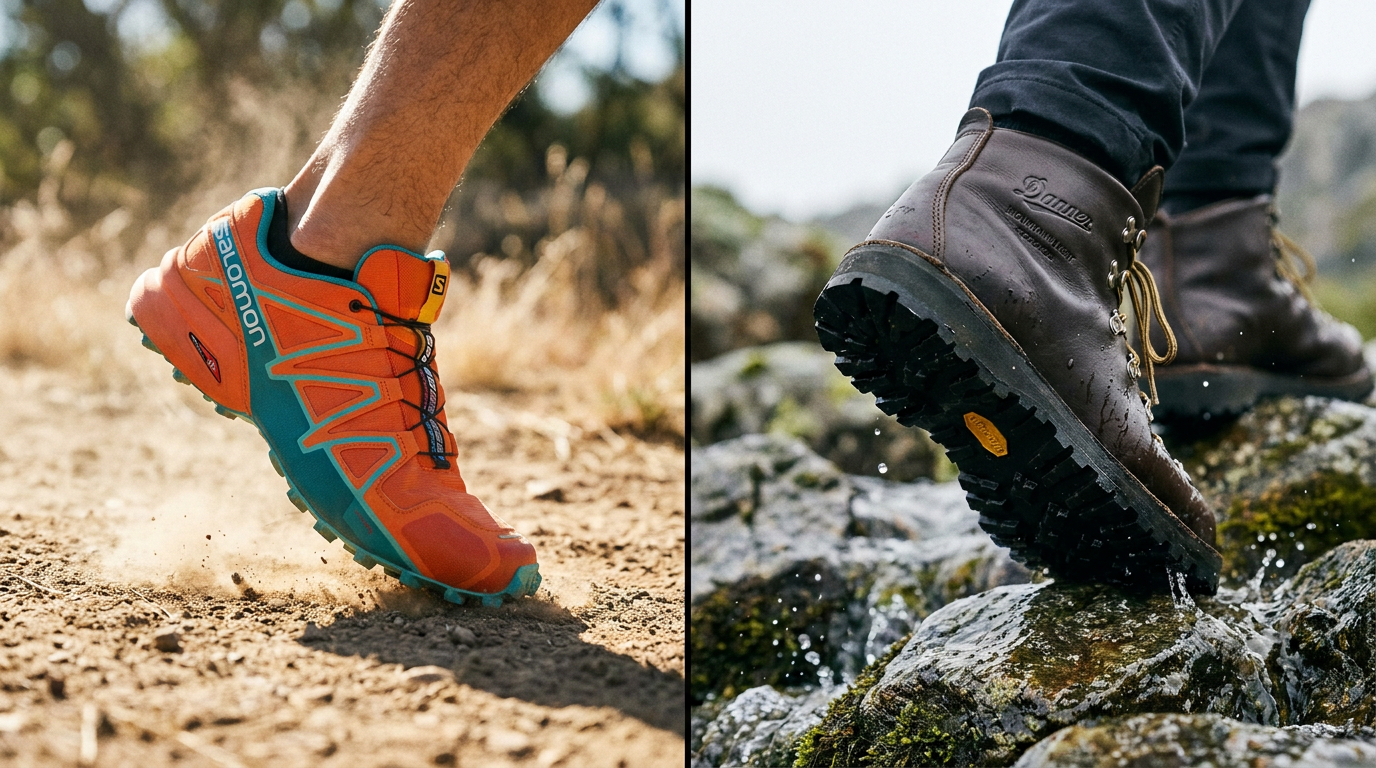
Spend enough time on a popular backcountry route, and you will inevitably witness the contrast: a hiker grinding uphill in heavy leather boots alongside someone in lightweight trail runners moving with apparent ease. The debate between traditional hiking boots and modern trail running shoes has become one of the most passionate discussions in outdoor culture. For decades, the conventional wisdom dictated that anyone carrying a backpack required the rigid ankle support and thick soles of a dedicated boot. Today, however, a significant shift has occurred, driven by the ultralight backpacking movement and advances in footwear materials.[1][7]
The case for trail running shoes begins with a simple, quantifiable metric: weight. Trail runners typically weigh up to forty percent less than traditional hiking boots, a difference that compounds dramatically over long distances. The evidence supporting this shift is rooted in footwear biomechanics. Research consistently demonstrates that weight carried on the foot requires approximately four to six times the energy to move compared to an equivalent amount of weight carried on the back. This multiplier effect is the primary reason long-distance thru-hikers have overwhelmingly abandoned boots.[2][5]
To quantify this advantage, consider the math of a typical gear swap. If a hiker trades a two-and-a-half-pound pair of hiking boots for a one-pound pair of trail runners, they save one and a half pounds of footwear weight. Applying the biomechanical multiplier, this energy savings feels equivalent to removing six to nine pounds from their backpack. Over a twenty-mile day, this reduction in fatigue translates to less strain on the knees and hips, allowing hikers to move faster and recover more quickly.[1][2]

However, the argument against trail runners is equally grounded in practical reality, primarily focusing on durability and financial cost over time. Trail running shoes are built with soft EVA foam midsoles and lightweight mesh uppers that degrade rapidly under the friction of rocks and the compression of a loaded backpack. The evidence shows that a typical pair of trail runners will only last between 300 and 500 miles before the cushioning flattens and the tread wears smooth. For a thru-hiker on a 2,000-mile trail, this means purchasing and breaking in four to six pairs of shoes.[1][3]
Conversely, the case for traditional hiking boots centers on structural protection and longevity. A well-constructed leather or synthetic boot with a polyurethane midsole can easily survive over 1,000 miles of rugged use, and some premium models can even be resoled. Boots provide a rigid platform that shields the bottom of the foot from sharp, repetitive rock strikes—a phenomenon known as 'stone bruising' that frequently plagues trail runner users on rocky terrain. Furthermore, the reinforced toe caps and thick uppers protect against abrasive scree, thorny underbrush, and snake bites.[1][4][6]

Conversely, the case for traditional hiking boots centers on structural protection and longevity.
The debate over ankle support remains highly contested. The traditional argument insists that the high collar of a hiking boot physically prevents the ankle from rolling when navigating uneven ground, especially under the burden of a heavy pack. However, the counter-evidence from sports medicine and trail running advocates suggests a different mechanism. Critics argue that the thick, stiff soles of boots create a higher fulcrum point; if the ankle does begin to turn, the leverage is more severe. Trail runners, by keeping the foot closer to the ground and allowing natural articulation, enable the hiker to quickly sense instability and correct their balance before a sprain occurs.[1][5][7]
Moisture management presents another stark trade-off. The argument for boots often highlights their waterproof membranes, such as Gore-Tex, which excel at keeping feet dry during quick stream crossings, morning dew, or light snow. The evidence against waterproof boots, however, emerges when conditions become truly saturated. If water overtops the collar of a waterproof boot—or if the hiker's feet sweat heavily in warm weather—the membrane traps the moisture inside. A soaked hiking boot can take days to dry in the backcountry, leading to severe maceration and blistering.[3][5]
Trail runners approach moisture with the opposite philosophy: embrace the wet. Because they are typically made of highly breathable, non-waterproof mesh, trail runners will flood instantly when submerged. However, the evidence shows that the mechanical action of walking pumps the water out through the mesh. In warm, dry conditions, a soaked pair of trail runners can dry completely while being worn in just a few hours. This quick-drying capability makes them the preferred choice for routes with frequent, unavoidable river crossings.[3][5]

The industry has responded to this binary debate by creating a middle ground: the lightweight hiking shoe and the mid-top trail runner. These hybrid options take the aggressive outsoles and lightweight foam of a running shoe and add a slightly stiffer shank and a mid-height collar to keep out debris. While they do not offer the bombproof durability of a full leather boot, they provide a compromise for hikers who want the agility of a runner but feel psychologically or physically more secure with ankle coverage.[2][4]
Ultimately, the decision requires a strict trade-off analysis based on conditions. Trail running shoes fit well when the hiker is carrying a total pack weight under thirty pounds, traveling primarily on established and maintained trails, and hiking in warm or moderate weather where quick drying is advantageous. They are the optimal choice for prioritizing speed, reducing joint fatigue, and maximizing daily mileage.[2][5][7]
Conversely, hiking boots do not fit well in those fast-and-light scenarios, but they become essential under a different set of parameters. Boots fit well when the hiker is carrying a heavy pack exceeding thirty to forty pounds, navigating off-trail through abrasive brush or loose scree, or traveling in near-freezing, snowy, or persistently muddy conditions where thermal retention and absolute waterproofing are matters of safety rather than mere comfort.[1][4][6]

There is no universal winner in the great footwear debate, only the correct tool for a specific environment. As gear continues to evolve, the most experienced backpackers are moving away from dogmatic brand loyalty and instead building a footwear quiver. By objectively weighing the evidence of biomechanics against the realities of the terrain, hikers can ensure their feet remain an asset rather than a liability on the trail.[1][7]
Viewpoints in depth
The Ultralight Argument
Advocates for trail runners believe that weight reduction is the single most important factor in backcountry comfort.
This perspective is driven by the mathematical reality of energy expenditure. Ultralight hikers argue that the traditional fear of ankle sprains is overblown and largely a symptom of carrying unnecessarily heavy backpacks. By reducing total pack weight to under twenty pounds, the need for rigid ankle support vanishes. Instead, they prioritize the agility, breathability, and blister-prevention that comes from a soft, flexible shoe that dries quickly after river crossings.
The Traditionalist Argument
Proponents of hiking boots argue that the backcountry is unpredictable and requires footwear built for worst-case scenarios.
Traditional backpackers and mountaineers point out that not every hike takes place on a perfectly groomed trail in sunny weather. When carrying a heavy load of winter gear, bushwhacking through thorny undergrowth, or kicking steps into frozen mud, the structural integrity of a boot is non-negotiable. They view the frequent replacement of trail runners as both financially wasteful and environmentally unsustainable, preferring a single pair of leather boots that can be trusted for years.
The Biomechanical Perspective
Researchers focus on how footwear alters the natural gait and the physics of injury prevention.
From a sports medicine viewpoint, the debate is less about the shoes and more about the foot inside them. Biomechanists note that heavy, stiff boots restrict the natural splay of the toes and the flex of the arch, effectively immobilizing the foot. While this protects against acute trauma like rock strikes, it can lead to repetitive stress injuries in the knees and hips. Conversely, while trail runners allow natural foot mechanics, they require the hiker to have strong, conditioned foot and ankle muscles to prevent injury.
What we don't know
- Whether future advancements in foam technology will eventually allow trail runners to match the 1,000-mile lifespan of traditional boots.
- Exactly how individual foot anatomy (like arch height and pronation) alters the biomechanical weight-multiplier effect for different hikers.
Sources
Source coverage
7 outlets
3 viewpoints surfaced







[1]UNPLUG MagazineFootwear Biomechanists
Trail Running Shoes vs. Hiking Boots: The Debate
Read on UNPLUG Magazine →[2]BootsGuruUltralight Backpackers
Trail Running Shoes vs Hiking Boots (2026): The Research-Backed Guide
Read on BootsGuru →[3]AdvntureFootwear Biomechanists
Hiking shoes vs trail running shoes: which is best for you?
Read on Advnture →[4]Expedition DetroitTraditional Mountaineers
Expedition Essentials: Trail Running Shoes vs. Hiking Boots
Read on Expedition Detroit →[5]Ultralight GearUltralight Backpackers
Trail Runners Vs Hiking Boots
Read on Ultralight Gear →[6]Academy SportsTraditional Mountaineers
Hiking Boots vs. Trail Runners
Read on Academy Sports →[7]Factlen Editorial TeamFootwear Biomechanists
Synthesis by Factlen editorial team
Read on Factlen Editorial Team →


Every angle. Every day.
Get shopping stories with full source coverage and perspective breakdowns delivered to your inbox.