
The Post-Engine Era: How AI Transformed Modern Chess Strategy
Artificial intelligence didn't solve chess—it revolutionized it. The introduction of neural network engines like AlphaZero and Stockfish NNUE has fundamentally changed how human grandmasters understand and play the game.
By Factlen Editorial Team
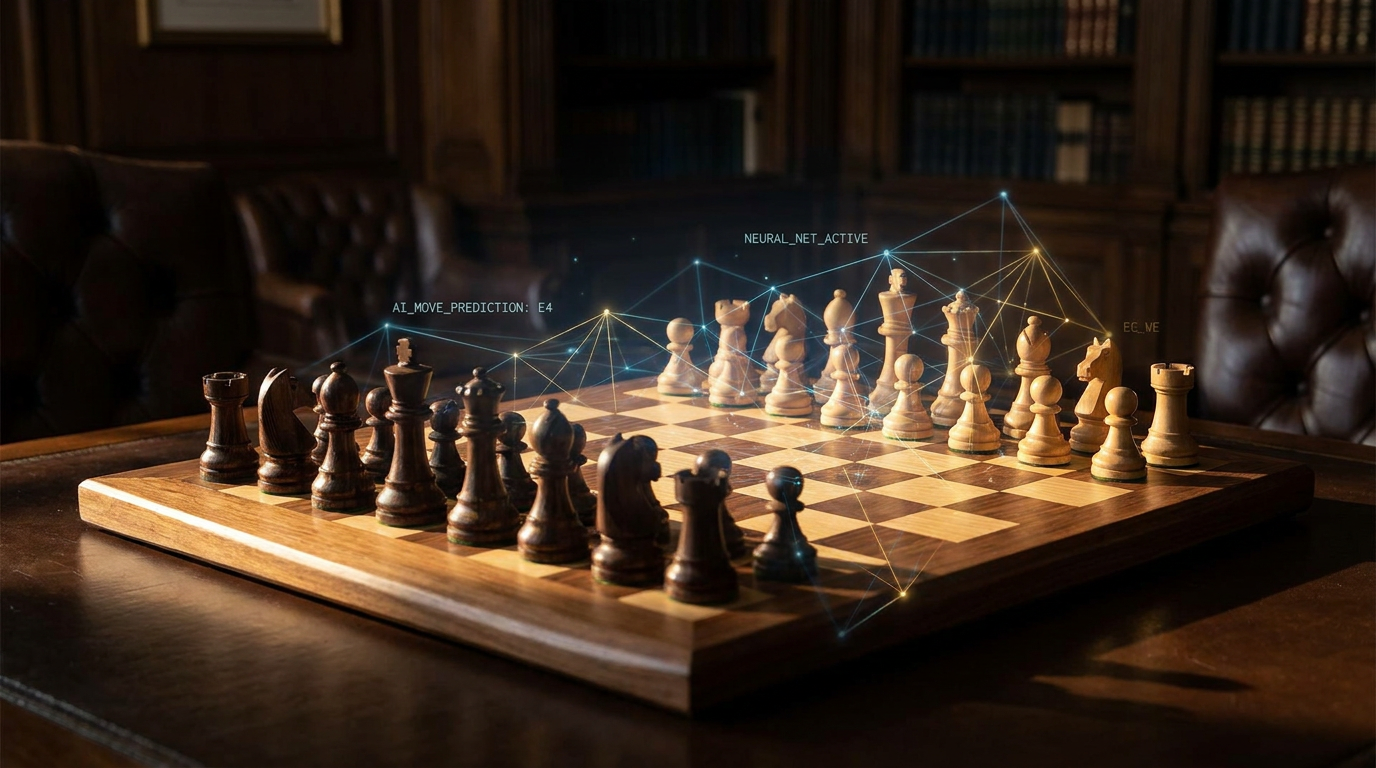
- Modern Grandmasters
- View engines as essential, collaborative sparring partners that unlock new creative possibilities and deepen human understanding of the game.
- AI Researchers
- Treat chess as the ultimate proving ground for machine learning architectures, contrasting deep reinforcement learning with efficient CPU-based hybrids.
- Chess Analysts
- Focus on how engine evaluations have changed the data and meta-game of chess, specifically tracking shifts in opening theory and pawn structures.
What's not represented
- · Amateur players who struggle to understand cryptic engine evaluations
- · Anti-cheating arbiters dealing with the consequences of accessible superhuman AI
Why this matters
The evolution of chess engines offers a blueprint for how humans can collaborate with artificial intelligence. Instead of making human effort obsolete, AI has unlocked new levels of creativity, proving that machines can be partners rather than replacements.
Key points
- Early chess engines relied on brute-force calculation and human-coded material values.
- In 2017, AlphaZero revolutionized strategy by using self-taught neural networks to prioritize positional dominance over material.
- AlphaZero popularized unconventional strategies, such as early flank pawn pushes, which human grandmasters quickly adopted.
- Stockfish integrated neural networks (NNUE) in 2020, creating an unstoppable hybrid of brute force and pattern recognition.
- Modern players practice 'Centaur Chess,' using engines as collaborative tools to discover new ideas rather than just calculating variations.
When IBM’s Deep Blue defeated World Champion Garry Kasparov in 1997, many observers declared the death of human chess. If a machine could calculate millions of positions per second and dismantle the greatest human mind in the game, the romantic era of chess seemed permanently over. Yet nearly three decades later, chess is experiencing an unprecedented global boom. Top grandmasters stream their games to hundreds of thousands of viewers, and the quality of human play has never been higher.[1][5]
This paradox—that human chess is thriving in an era where free smartphone apps can effortlessly defeat the world champion—is the result of a second, quieter technological revolution. The narrative shifted from humans competing against machines to humans learning from them. This collaborative approach, often referred to as "Centaur Chess," has fundamentally rewritten the strategic rulebook of the 1,500-year-old game.[5][6]
To understand this shift, one must look at how early chess engines operated. Programs like Deep Blue and the early iterations of Stockfish relied on brute-force calculation and human-coded heuristics. They evaluated positions by counting material—assigning a queen nine points, a rook five, and a pawn one. While tactically flawless, these engines often lacked long-term strategic vision, playing a cold, materialistic brand of chess that humans respected but rarely found beautiful.[1][3]
That paradigm shattered in December 2017 with the introduction of AlphaZero, a neural network developed by Google's DeepMind. Unlike its predecessors, AlphaZero was not fed opening books, endgame tables, or human heuristics. It was given only the basic rules of chess and instructed to play against itself. Within four hours of self-play, it developed a superhuman understanding of the game and subsequently crushed Stockfish in a historic 100-game match.[1][2][3]

What stunned the chess world was not that AlphaZero won, but how it won. The neural network played with an almost alien creativity. It routinely sacrificed pawns and even major pieces for long-term positional compensation—a concept traditional engines struggled to quantify. AlphaZero prioritized piece activity, king safety, and space over raw material, proving that centuries of human dogma had been overly rigid.[2][6]
One of the most visible strategic shifts inspired by AlphaZero was the "h-pawn revolution." In classical chess theory, pushing the flank pawns (the a- or h-pawns) early in the game was widely considered a beginner's mistake, as it neglected central control and weakened the king's defenses. AlphaZero, however, routinely launched its h-pawn up the board as early as move five or six to cramp the opponent's position and create attacking vectors.[2]
AlphaZero, however, routinely launched its h-pawn up the board as early as move five or six to cramp the opponent's position and create attacking vectors.
Human grandmasters immediately took notice. Data analysis from Nova Chess AI reveals that the frequency of early h-pawn advances by human players skyrocketed following the AlphaZero matches. Between the 2010s and the 2020s, the frequency of White pushing the h-pawn before move 15 increased by 45%. What was once considered a strategic taboo became a standard weapon in elite tournament play.[2]

Because AlphaZero was a closed research project, the open-source chess community quickly mobilized to replicate its success. This led to the creation of Leela Chess Zero (Lc0), a neural network engine trained via distributed computing by volunteers worldwide. Leela brought the creative, positional style of AlphaZero to the public, allowing grandmasters to analyze their games with an engine that understood deep strategic concepts rather than just tactical calculations.[1][3]
The traditional engine developers did not sit idle. In 2020, the team behind Stockfish introduced a revolutionary hybrid architecture known as NNUE (Efficiently Updatable Neural Networks). Originating in computer Shogi, NNUE embedded a lightweight neural network directly into Stockfish's classical search algorithm. This allowed the engine to evaluate positions with the nuanced pattern recognition of a neural network while maintaining the blindingly fast tactical search speeds of a traditional CPU engine.[3][4]
The integration of NNUE created an unstoppable hybrid. Stockfish NNUE quickly reclaimed its title as the world's strongest engine, pushing its Elo rating well past the 3700 mark—astronomically higher than Magnus Carlsen's record human rating of 2882. The combination of deep positional understanding and flawless tactical execution meant that engines were no longer just calculators; they were absolute oracles of the game.[1][4]
For modern grandmasters, preparation has entirely transformed. Elite players no longer study openings in isolation; they use engines like Stockfish NNUE and Leela as sparring partners. When analyzing a position, a player might consult Leela for a creative, long-term plan, and then use Stockfish to verify that the plan doesn't contain any hidden tactical flaws. This dual-engine approach has uncovered "novelties"—new moves in established openings—that humans would never have discovered alone.[1][5][6]

This dynamic has birthed the era of the "Centaur." In advanced chess, a human paired with an engine consistently outperforms an engine playing alone. The machine provides flawless calculation and objective evaluation, while the human provides metacognition—knowing which engine lines are practically difficult for a human opponent to defend under time pressure. The human guides the search, asking the engine the right questions.[5][6]
The psychological aspect of the game remains deeply human. An engine might evaluate a position as "0.00" (dead equal), but the human player knows that defending that equality requires finding ten consecutive "only-moves" while the attacker has a wide margin for error. Modern preparation involves finding these engine-approved lines that maximize practical discomfort for the opponent.[5]
Ultimately, the AI revolution in chess offers a hopeful narrative for the broader integration of artificial intelligence in society. The machines did not replace the players; they elevated them. By outsourcing raw calculation to engines, human players have been freed to focus on deeper strategic concepts, psychological resilience, and creative exploration. The game that machines supposedly "killed" has never been more alive.[5][6]
How we got here
1997
IBM's Deep Blue defeats World Champion Garry Kasparov, marking the triumph of brute-force calculation.
Dec 2017
DeepMind's AlphaZero crushes Stockfish, introducing neural-network-driven positional play to the chess world.
2018
The open-source community launches Leela Chess Zero (Lc0) to replicate AlphaZero's neural network approach.
Aug 2020
Stockfish integrates NNUE, combining classical search with neural evaluation to become the undisputed strongest engine.
Viewpoints in depth
Modern Grandmasters
Elite players view engines as essential collaborative tools that expand human creativity.
For today's top competitors, the engine is no longer an opponent to be feared, but a sparring partner to be utilized. Grandmasters use engines to stress-test their opening preparation, searching for 'novelties' that carry deep venom. They recognize that while the engine provides objective truth, the human must still navigate the psychological pressure of the board. By studying engine suggestions, players have learned to embrace long-term sacrifices and unconventional maneuvers that previous generations would have dismissed as fundamentally unsound.
AI Researchers
Computer scientists treat chess as the ultimate benchmark for testing machine learning architectures.
For developers, the evolution of chess engines represents a microcosm of the broader AI landscape. AlphaZero proved the viability of deep reinforcement learning, showing that a system could teach itself complex strategy without human bias. Conversely, the success of Stockfish NNUE demonstrated the power of hybrid architectures. By embedding a lightweight, CPU-efficient neural network into a traditional deterministic search algorithm, researchers proved that combining classical computing strengths with modern machine learning often yields the most robust real-world results.
Chess Analysts
Statisticians and theoreticians focus on how engine evaluations have permanently altered the meta-game.
Analysts track the tangible shifts in how the game is played at the highest levels. They point to data showing massive spikes in specific engine-approved strategies, such as the early advance of the h-pawn or the willingness to trade queens early for subtle structural advantages. For theoreticians, the engine era has effectively 'solved' many classical openings, forcing players to venture into obscure, less-explored variations simply to avoid playing against their opponent's memorized engine preparation.
What we don't know
- Whether future engines will discover entirely new strategic paradigms that contradict current neural network evaluations.
- How the continued rise of engine strength will impact the format of classical time-control tournaments in the long term.
Key terms
- Elo Rating
- A mathematical system used to calculate the relative skill levels of players in zero-sum games like chess.
- Heuristics
- In computer chess, hand-coded rules created by human programmers to help an engine evaluate a position, such as assigning specific point values to pieces.
- Novelty
- A move in a well-known chess opening that has never been played before in recorded competitive history, often discovered today using engine analysis.
- Positional Compensation
- A scenario where a player sacrifices material (like a pawn or a knight) in exchange for intangible long-term advantages, such as better piece activity or control of the center.
Frequently asked
What is the difference between Stockfish and AlphaZero?
Early Stockfish relied on brute-force calculation and human-coded rules to evaluate positions. AlphaZero used a neural network trained entirely through self-play, allowing it to recognize deep strategic patterns without human bias.
What does NNUE stand for?
NNUE stands for Efficiently Updatable Neural Network. It is a hybrid architecture that embeds a lightweight neural network into a traditional chess engine, combining pattern recognition with blazing-fast tactical search.
Can a human beat a modern chess engine?
No. Modern engines like Stockfish NNUE have Elo ratings exceeding 3700, while the highest human rating ever achieved is 2882. Even the best human players cannot defeat top engines under tournament conditions.
What is Centaur Chess?
Centaur Chess is a format or preparation style where a human player collaborates with a chess engine. The human guides the strategic direction and psychological pressure, while the engine ensures tactical perfection.
Sources
Source coverage
6 outlets
3 viewpoints surfaced





[1]Chess.comModern Grandmasters
From Deep Blue to AlphaZero: The Rise of AI in Contemporary Chess
Read on Chess.com →[2]Nova Chess AIChess Analysts
The H-Pawn Revolution: How AlphaZero Changed Chess Forever
Read on Nova Chess AI →[3]ChessBaseAI Researchers
AlphaZero and Stockfish NNUE: The Evolution of Chess Engines
Read on ChessBase →[4]RSIS InternationalAI Researchers
NNUE Architecture and CPU Efficiency in Modern Chess Engines
Read on RSIS International →[5]The New AtlantisModern Grandmasters
Centaur Chess and the Future of Human-AI Collaboration
Read on The New Atlantis →[6]Factlen Editorial Team
Synthesis by Factlen editorial team
Read on Factlen Editorial Team →

More in sports
See all 11 stories →Standings
World's Top Swimmers Converge in Indianapolis for Final 2026 Pro Swim Series Stop
0 sources
Women's Soccer
Record-Shattering Crowds and a D.C. Championship: Inside the NWSL's Historic 2026 Season
0 sources

Women's Sports
NWSL shatters attendance and contract records in historic 2026 season
0 sources

Injury
BWF World Tour Injury Report: Axelsen Retires as Top Stars Race to Recover for World Championships
0 sources
Every angle. Every day.
Get sports stories with full source coverage and perspective breakdowns delivered to your inbox.