
The return of the ecosystem engineer: How beaver rewilding is reshaping flood management
Across Europe and the UK, reintroduced beavers are transforming landscapes, mitigating floods, and boosting biodiversity—though the shift requires careful collaboration with local farmers.
By Layla Zaher

In short
- Eurasian beavers are returning to European waterways after being hunted to near-extinction 400 years ago.
- As ecosystem engineers, beavers build dams that slow river flows, significantly reducing downstream flood risks.
- Beaver-created wetlands act as natural sponges, buffering against droughts and creating fire-resistant landscape patches.
For centuries, the waterways of Britain and much of Western Europe were missing a crucial architect. Hunted to extinction in the UK roughly 400 years ago for their dense fur and castoreum—a glandular secretion used in perfumes—the Eurasian beaver was nearly erased from the continent. By the early 20th century, the global population had plummeted to a precarious 1,200 individuals. Today, however, a quiet revolution is taking place along riverbanks. Through targeted rewilding efforts, beaver populations have rebounded to an estimated 600,000 across Europe.[1]
The return of Castor fiber is not merely a conservation victory for a single species; it represents a fundamental shift in how scientists and policymakers approach landscape management. Beavers are widely classified as "ecosystem engineers" and a keystone species. Unlike most animals that adapt to their environment, beavers actively alter their surroundings to suit their needs, initiating a cascade of ecological changes that disproportionately benefit a vast array of other flora and fauna.[1]
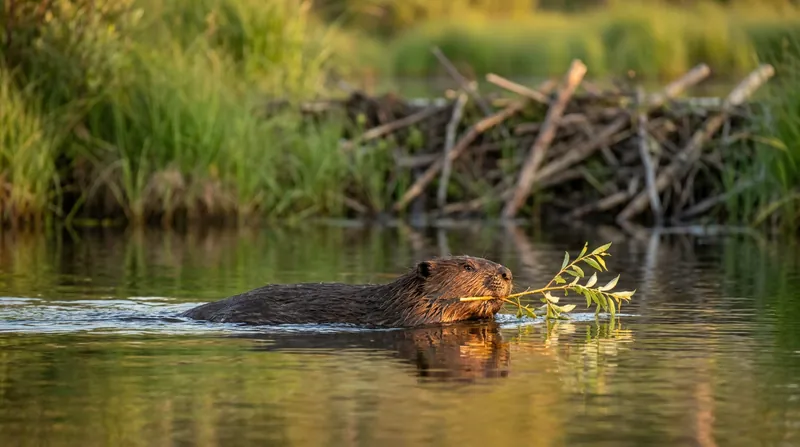
The core mechanism of this transformation is the beaver dam. While often misunderstood as a simple barrier, a beaver dam is a complex, permeable structure built from felled trees, mud, and stones. Beavers construct these dams to create deep, still pools of water—lentic habitats—which serve a vital defensive purpose. The deep water submerges the entrances to their lodges, protecting them from terrestrial predators, and provides a safe, buoyant medium for transporting heavy winter food caches.[2]
From a hydrological perspective, these dams act as massive, natural shock absorbers for river systems. During periods of intense rainfall, the network of dams and the resulting ponds physically slow the velocity of the water. Instead of rainwater rushing down a straightened river channel and overwhelming downstream towns, the flow is attenuated. The water spreads laterally across the floodplain, losing its destructive kinetic energy and significantly reducing peak flood heights in vulnerable communities.[2]
This water-retention capability proves equally vital during the opposite extreme: drought. By impounding large volumes of water and forcing it to slowly percolate into the surrounding soil, beaver wetlands act like giant sponges. They elevate the local water table, keeping riparian corridors lush and green even when surrounding landscapes are parched. Recent studies have even highlighted how these saturated, beaver-engineered zones act as natural firebreaks, resisting wildfires and providing refuge for wildlife during extreme heat.[2]
The biological response to this engineering is profound. The transition from a fast-flowing, simplified stream to a complex mosaic of ponds, canals, and braided channels creates an explosion of colonizable niches. Sunlight reaches the water where beavers have coppiced the canopy, encouraging aquatic plant growth. These wetlands become nurseries for amphibians, breeding grounds for insects, and havens for waterfowl. Researchers have documented fish populations increasing by as much as 37% in beaver-modified waters, as the ponds provide ideal rearing habitats for juvenile fish.[1]
Furthermore, beaver wetlands serve as immense biological filters. As water slows behind a dam, suspended sediments drop out of the water column and settle on the pond floor. This process traps agricultural runoff, including excess nitrogen and phosphorus, preventing these pollutants from degrading downstream water quality or causing algal blooms in estuaries. Over time, the accumulation of organic material in these submerged, oxygen-poor environments also turns beaver ponds into highly effective carbon sinks.[2]
The practical application of these benefits is moving from theory to large-scale practice. In early 2026, the Boothby Wildland project in Lincolnshire marked a major milestone by releasing a family of beavers into a 617-hectare nature restoration site. Operating within England's largest enclosure, the beavers are tasked with "re-wiggling" the historically straightened West Glen River, restoring natural processes to a landscape that had been heavily modified to drain water away from farmland as quickly as possible.
The strategy is not limited to remote countryside. In Enfield, North London, beavers were recently reintroduced to the capital for the first time in four centuries. Living in a specialized enclosure within the grounds of a 17th-century estate, this urban rewilding initiative is specifically designed to test natural flood defenses. By holding water back in the upper catchment, the Enfield beavers are providing a nature-based buffer for the sprawling, heavily paved suburbs downstream.
Despite the undeniable ecological and hydrological benefits, the beaver's return is not universally celebrated. The very traits that make beavers excellent wetland creators—felling trees and damming water—can put them in direct conflict with modern human land use. For the agricultural sector, the unmanaged spread of beavers presents significant, tangible risks to livelihoods and food production.
The primary concern for farmers is localized flooding. While a beaver dam may save a downstream village from inundation, the water held back behind the dam must go somewhere. In flat, low-lying river valleys, this can result in the flooding of highly productive arable land or vital grazing pastures. Additionally, beavers frequently burrow into riverbanks and flood embankments, which can destabilize the heavy machinery used in modern farming.
Furthermore, the intricate networks of man-made drainage ditches that keep much of Europe's agricultural land viable are prime targets for beavers. To a beaver, a drainage ditch is simply a leak in their territory that needs plugging. The National Farmers' Union has consistently highlighted these challenges, noting that while beavers offer societal benefits, the costs are often disproportionately borne by individual landowners whose fields are submerged or whose crops are damaged.
The broader agricultural consensus acknowledges that while beaver reintroduction is hugely positive in many ways, the benefits do not always accrue to those who bear the costs. Farming advocates have pushed for a highly managed approach, insisting that landowners must have the legal right and practical support to remove problematic dams or, in extreme cases, relocate beavers that threaten critical agricultural infrastructure.
Bridging this divide requires moving beyond a binary debate of nature versus agriculture. Successful coexistence models are emerging, heavily reliant on dedicated "beaver officers" or local management groups. These rapid-response teams work directly with landowners to implement mitigation strategies, such as installing "beaver deceivers"—flow-control pipes placed through dams that regulate the pond's maximum water level without triggering the beaver's instinct to rebuild.
Long-term success, however, may depend on fundamentally restructuring how land is valued. In regions like Bavaria, which experienced similar agricultural resistance 30 years ago, farmers now coexist with beavers thanks to robust compensation funds.
In the UK, emerging blended finance models and Environmental Land Management schemes aim to pay farmers not just for the crops they produce, but for the public goods their land provides. If a farmer is financially compensated for allowing a portion of their land to become a water-storing beaver wetland, the animal transitions from an agricultural pest to an economic asset.
The reintroduction of the Eurasian beaver is ultimately a test of modern society's ability to share space with a species that refuses to be passive. By embracing the beaver as a partner in landscape management, communities can harness a powerful, self-sustaining engine for climate resilience. The challenge lies not in the ecology of the beaver, but in the flexibility of human systems to accommodate the messy, dynamic, and profoundly vital wetlands they create.[1]
Definitions
- Ecosystem Engineer
- An organism that creates, significantly modifies, maintains, or destroys a habitat, having a large impact on the species richness of an area.
- Keystone Species
- A species on which other species in an ecosystem largely depend, such that if it were removed the ecosystem would change drastically.
- Lentic Habitat
- A still-water ecosystem, such as a pond or lake, as opposed to flowing water (lotic).
- Castoreum
- A glandular secretion historically harvested from beavers for use in perfumes and food flavorings, which drove them to near-extinction.
- Biodiversity Net Gain
- A strategy to develop land and contribute to the recovery of nature, ensuring the habitat for wildlife is left in a better state than it was before.
Questions & answers
Do beavers eat fish?
No, beavers are strict herbivores. They eat tree bark, aquatic plants, grasses, and leaves. The increase in fish near beaver dams is due to improved habitat, not a food source for the beavers.
Why do beavers build dams?
Beavers build dams to create deep, still water. This protects the underwater entrances to their lodges from predators and allows them to safely transport food and building materials.
Can beaver dams cause flooding?
Yes. While they reduce downstream flooding by holding water back, the area immediately behind the dam becomes a wetland, which can cause localized flooding on adjacent land.
Analysis by camp
Conservationists & Rewilders
Advocate for the widespread reintroduction of beavers as a vital tool for restoring degraded ecosystems.
This camp views the beaver not just as an animal, but as a keystone species capable of performing landscape-scale restoration that human engineering cannot replicate. They point to the dramatic increases in biodiversity, carbon sequestration, and water quality that follow beaver reintroductions. For rewilders, the temporary loss of some agricultural land to flooding is a necessary and acceptable trade-off for the broader ecological resilience and natural flood management that beaver wetlands provide.
Agricultural Landowners
Concerned about the economic impact of unmanaged beaver populations on productive farming.
Farmers and agricultural unions emphasize that the European landscape has changed drastically since beavers were last widespread. They argue that modern food production relies on highly managed drainage systems and predictable water levels. When beavers dam ditches and flood arable land, the financial burden falls entirely on the individual farmer. This camp advocates for strict management protocols, the right to remove problematic dams, and comprehensive financial compensation for land lost to beaver-created wetlands.
Hydrologists & Policymakers
Focused on quantifying the flood-mitigation benefits and integrating them into national infrastructure planning.
This perspective treats beavers as a form of 'nature-based infrastructure.' Hydrologists are actively measuring the exact volume of water beaver dams can hold back during storm events and how much they reduce peak flow velocities. Policymakers use this data to design blended finance schemes, aiming to pay landowners for the 'ecosystem services'—like flood protection for downstream towns—that beavers on their property provide, thereby aligning ecological benefits with economic incentives.
- Conservationists & Rewilders
- Advocate for widespread beaver reintroduction to restore biodiversity and climate resilience.
- Agricultural Landowners
- Highlight the economic risks of localized flooding and demand management and compensation.
- Hydrologists & Policymakers
- View beavers as nature-based infrastructure to be measured and integrated into flood planning.
Perspectives this story doesn't cover
- Indigenous voices on historical coexistence
- Downstream urban residents benefiting from flood protection
Sources
Source coverage
2 outlets
3 viewpoints surfaced


- [1]Factlen Editorial TeamConservationists & Rewilders
Synthesis by Factlen editorial team
Read on Factlen Editorial Team → - [2]Hydrological ProcessesHydrologists & Policymakers
Beaver dams attenuate flow: a multi-site study
Read on Hydrological Processes →

More in Environment
See all →Bioacoustics
How AI and Underwater Speakers Are 'Singing' Ecosystems Back to Life
2 sources
Beaver Reintroduction
How the Reintroduction of Beavers is Quietly Solving Modern Climate Crises
6 sources
Bioacoustics
How AI and Bioacoustics Are Decoding the Natural World
3 sources

Marine Biology
How Deep-Diving Whales Avoid Decompression Sickness
10 sources

Comments
Every angle. Every day.
Get Environment stories with full source coverage and perspective breakdowns, free every day.