
Databricks Unveils Unified Data Architecture to Eliminate Pipelines for AI Agents
Databricks has introduced a new architecture that merges operational and analytical databases, solving a decades-old data pipeline bottleneck that has hindered the deployment of real-time AI agents.
By Factlen Editorial Team
- Databricks Leadership
- Argues that unifying transactional and analytical data is the necessary evolution for the agentic era.
- Industry Analysts
- Views the traditional separation of databases as a growing liability that enterprises must address.
- Ecosystem Partners
- Focuses on the benefits of simplified governance and real-time application building.
What's not represented
- · Legacy ETL pipeline vendors
- · Database administrators managing traditional OLTP systems
Why this matters
As companies rush to deploy autonomous AI agents to handle everything from customer service to supply chain logistics, these systems are being crippled by stale data. By eliminating the latency of traditional data pipelines, this new architecture allows AI to make accurate, real-time decisions, fundamentally accelerating enterprise automation.
Key points
- Databricks announced Lakehouse//RT and LTAP to unify operational and analytical data.
- The new architecture eliminates the need for slow ETL pipelines.
- AI agents require real-time access to both live and historical data to function accurately.
- Partners like Sigma and Microsoft are already integrating with the unified architecture.
The generative AI revolution is rapidly moving from chatbots that answer questions to autonomous agents that execute tasks. But as enterprises rush to deploy these AI agents to manage inventory, process orders, and resolve customer service tickets, they are hitting a structural wall. The bottleneck is not a lack of compute power or model intelligence, but rather the decades-old plumbing of enterprise data infrastructure.[1][3]
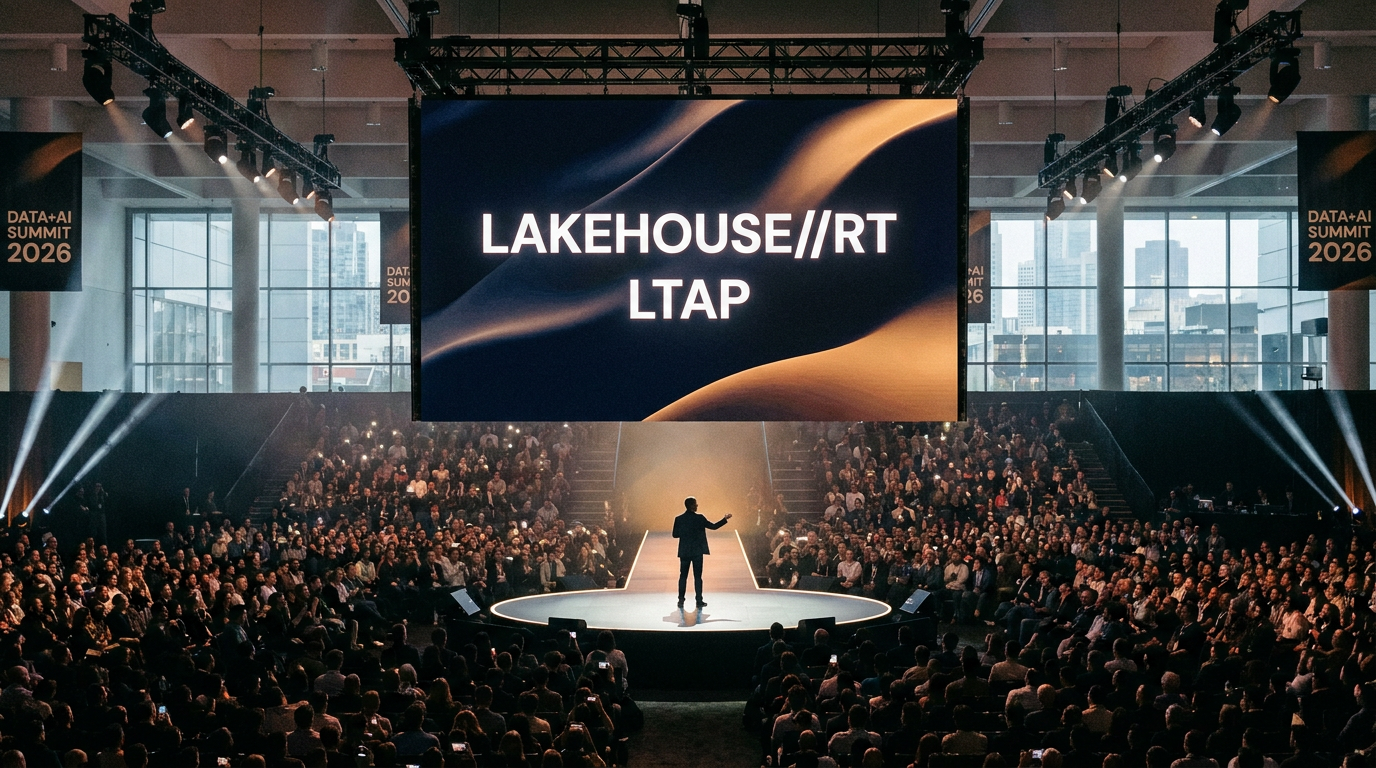
At its annual Data + AI Summit in San Francisco on Tuesday, Databricks announced a fundamental redesign of this architecture. The cloud data giant unveiled two new products—Lake Transactional/Analytical Processing (LTAP) and Lakehouse//RT—aimed at collapsing the historical divide between the databases that run a business and the databases that analyze it.[2][3]
To understand the magnitude of this shift, one must look at how enterprise data has been managed for the last thirty years. Traditionally, organizations have strictly separated their data into two distinct environments to prevent heavy analytical queries from crashing live applications.[3][4]

The first environment is Online Transaction Processing (OLTP). These are the operational databases—often built on systems like PostgreSQL—that handle high-frequency, day-to-day business operations. When a customer buys a pair of shoes online, or a warehouse scans a barcode, the OLTP system records that transaction instantly.[4][5]
The second environment is Online Analytical Processing (OLAP). These are the massive data warehouses and data lakes used for reporting, business intelligence, and historical trend analysis. They hold petabytes of data, allowing executives to ask complex questions like how shoe sales in the Midwest compare to the previous quarter.[4]
Because these two systems are separated, data must constantly be moved from the operational side to the analytical side. This movement is handled by Extract, Transform, and Load (ETL) pipelines and change data capture tools. However, ETL pipelines take time to run, meaning the analytical database is almost always looking at data that is minutes, hours, or even days old.[2][4]
For human workers, this latency was largely acceptable. A financial analyst building a quarterly revenue dashboard does not need up-to-the-millisecond inventory data. But AI agents do not behave like human analysts.[3][4]

A financial analyst building a quarterly revenue dashboard does not need up-to-the-millisecond inventory data.
Autonomous agents are designed to read live context, reason about it, and immediately write an action back to the system, looping through this process thousands of times a minute. If an AI agent is tasked with dynamically rerouting supply chain shipments based on weather patterns and current warehouse capacity, it cannot rely on stale data. Acting on an analytical database that is an hour behind reality leads to poor decisions and operational chaos.[1][3]
"Agents need the best data," Shanku Niyogi, Databricks' vice president of product management, explained at the summit. "If they're getting stale or wrong data, they act poorly." He noted that traditional architectures featuring separate systems and pipelines are simply not a platform capable of supporting millions of concurrent AI agents.[2]
This is the problem LTAP is designed to solve. LTAP unifies operational and analytical workloads on a single copy of data stored in open formats like Delta and Iceberg. It allows Postgres-native transactional data to be stored directly in the data lake from the moment it is written, effectively eliminating the need for the ETL pipelines that have historically bridged the gap.[1][2]

By storing data once in a shared lakehouse layer, dedicated compute engines can handle both transactional and analytical workloads independently without moving or duplicating the underlying information. This unified approach gives AI agents simultaneous access to live operational data and deep historical context in real time.[3][4]
The second piece of the puzzle is Lakehouse//RT, a real-time analytics engine that delivers millisecond query latency directly on those governed tables. Historically, enterprises had to maintain a dedicated, expensive real-time serving tier to achieve this kind of speed. Databricks claims Lakehouse//RT can serve data directly out of the warehouse to tens of thousands of concurrent users—or agents—with virtually no delay.[1][2]

The industry is already moving to support this consolidated architecture. Business intelligence platform Sigma announced it was joining as a launch partner for Lakehouse//RT, highlighting the ability to deliver millisecond query latency at massive concurrency without data movement. Microsoft has also detailed how this unified approach, which it refers to as Lakebase, simplifies development and extends robust security governance across the entire data estate.[4][5]
Industry analysts agree that the pressure to collapse the gap between production and analytics is real. Michael Leone, a principal analyst at Moor Insights and Strategy, noted that because agents read for context, try things, and write back at unpredictable volumes, the constant bouncing between separated systems becomes a fatal bottleneck.[3]

Reynold Xin, co-founder of Databricks, described this simplified, unified data stack as "the holy grail for agents." As developers write more code and deploy more autonomous applications, the underlying infrastructure must get out of the way. By ending the era of the ETL pipeline, Databricks is betting that the future of enterprise AI relies on a single, real-time source of truth.[1]
How we got here
1990s-2010s
Enterprises strictly separate operational (OLTP) and analytical (OLAP) databases to optimize performance.
2020-2023
The rise of the 'lakehouse' architecture begins combining data lakes and data warehouses, but transactional data remains separate.
2024-2025
Generative AI evolves from chatbots to autonomous agents, exposing the latency bottlenecks of traditional ETL pipelines.
June 16, 2026
Databricks announces LTAP and Lakehouse//RT at the Data + AI Summit, unifying operational and analytical data.
Viewpoints in depth
Databricks Leadership
Argues that unifying transactional and analytical data is the necessary evolution for the agentic era.
Executives like Reynold Xin and Shanku Niyogi contend that the traditional data stack is fundamentally incompatible with autonomous AI. Because agents read context and execute actions thousands of times faster than humans, they cannot wait for batch-processed pipelines. Databricks views LTAP as the 'holy grail' that removes infrastructure bottlenecks, allowing developers to build faster, more reliable agents that act on a single source of truth.
Industry Analysts
Views the traditional separation of databases as a growing liability that enterprises must address.
Analysts monitoring the enterprise data space note that the shift from human-speed analytics to machine-speed operations is forcing a structural reckoning. Experts like Michael Leone point out that AI agents do not behave like traditional applications; their unpredictable, high-volume read/write loops cause the gap between production and analytics systems to buckle. Analysts see unified architectures as a necessary, albeit complex, transition for companies wanting to deploy reliable AI.
Ecosystem Partners
Focuses on the benefits of simplified governance and real-time application building.
Partners integrating with the new architecture emphasize the reduction in operational overhead. By eliminating the need to duplicate data across multiple silos, platforms can offer robust security and governance through a single control plane. Companies building business intelligence and real-time serving tools argue that querying data directly from the lakehouse without movement unlocks a new class of high-concurrency, low-latency applications that were previously cost-prohibitive.
What we don't know
- How quickly legacy enterprises will be willing to deprecate their existing, deeply entrenched ETL pipelines.
- Whether competing data warehouse providers will adopt a similar unified transactional/analytical architecture.
- The exact pricing and compute costs associated with running high-frequency LTAP workloads at scale.
Key terms
- OLTP (Online Transaction Processing)
- Database systems optimized for running high-frequency, day-to-day business operations like order processing and inventory updates.
- OLAP (Online Analytical Processing)
- Database systems designed for large-scale analytical queries, reporting, and historical trend analysis.
- ETL (Extract, Transform, Load)
- The traditional data pipeline process used to move and format data from operational systems into analytical data warehouses.
- AI Agent
- An autonomous software system that can continuously read live context, reason about a problem, and take independent actions.
- LTAP (Lake Transactional/Analytical Processing)
- A new architecture that unifies both operational and analytical workloads on a single copy of data, eliminating the need for pipelines.
Frequently asked
Why do AI agents need a different data architecture than human analysts?
Human analysts typically review historical data to spot trends, making delays of minutes or hours acceptable. AI agents, however, execute live operational decisions thousands of times a minute and require real-time context to avoid making errors based on stale information.
What is an ETL pipeline?
ETL stands for Extract, Transform, and Load. It is the traditional method of copying data from a company's live operational databases, reformatting it, and moving it into a separate analytical warehouse for reporting.
Does LTAP replace traditional databases like PostgreSQL?
Rather than replacing them entirely, LTAP allows Postgres-native transactional data to be stored directly in open data lake formats from the moment it is written, merging the operational and analytical storage layers.
Sources
Source coverage
5 outlets
3 viewpoints surfaced





[1]VentureBeatDatabricks Leadership
Databricks says it solved the decades-old data pipeline problem that's been slowing AI agents
Read on VentureBeat →[2]SiliconANGLEDatabricks Leadership
Databricks declares the end of pipelines with a unified platform for operational and analytical data
Read on SiliconANGLE →[3]InfoWorldIndustry Analysts
Databricks pitches LTAP as a new foundation for agentic applications
Read on InfoWorld →[4]MicrosoftEcosystem Partners
Databricks Lakebase: The operational database for AI agents and apps
Read on Microsoft →[5]FinanzNachrichtenEcosystem Partners
Sigma Named 2026 Databricks ISV Business Intelligence Partner of the Year and Joins as Launch Partner for Lakehouse//RT
Read on FinanzNachrichten →

Every angle. Every day.
Get technology stories with full source coverage and perspective breakdowns delivered to your inbox.