
SpaceX Acquires AI Coding Startup Cursor for $60 Billion Following Record-Breaking IPO
Days after its historic public market debut, SpaceX has agreed to acquire AI development platform Cursor for $60 billion, signaling a massive expansion into software infrastructure.
By Factlen Editorial Team
- Growth Investors
- View the $2.7 trillion valuation as justified by SpaceX expanding into the multi-trillion dollar AI software market.
- Value Analysts
- Caution that the core business is worth $1.2 trillion and the $60 billion Cursor deal is an expensive attempt to justify the IPO premium.
- Tech Industry Observers
- Focus on the strategic integration of AI into aerospace and the implications for the broader software development ecosystem.
What's not represented
- · Open-source AI advocates
- · Competitors in the AI coding space
Why this matters
This acquisition bridges the gap between aerospace hardware and generative AI, indicating that the world's most valuable space company views AI-assisted software engineering as critical to its future infrastructure. For the broader market, it sets a new benchmark for AI startup valuations and highlights the immense financial rewards for tools that tangibly enhance human productivity.
Key points
- SpaceX has acquired AI coding platform Cursor for $60 billion shortly after its IPO.
- The acquisition doubles the net worth of Cursor's four cofounders to $2.7 billion each.
- SpaceX's market capitalization reached $2.7 trillion on its third day of public trading.
- The deal aims to accelerate SpaceX's internal software development for Starlink and aerospace operations.
- Analysts note the acquisition helps justify the massive AI premium priced into SpaceX's stock.
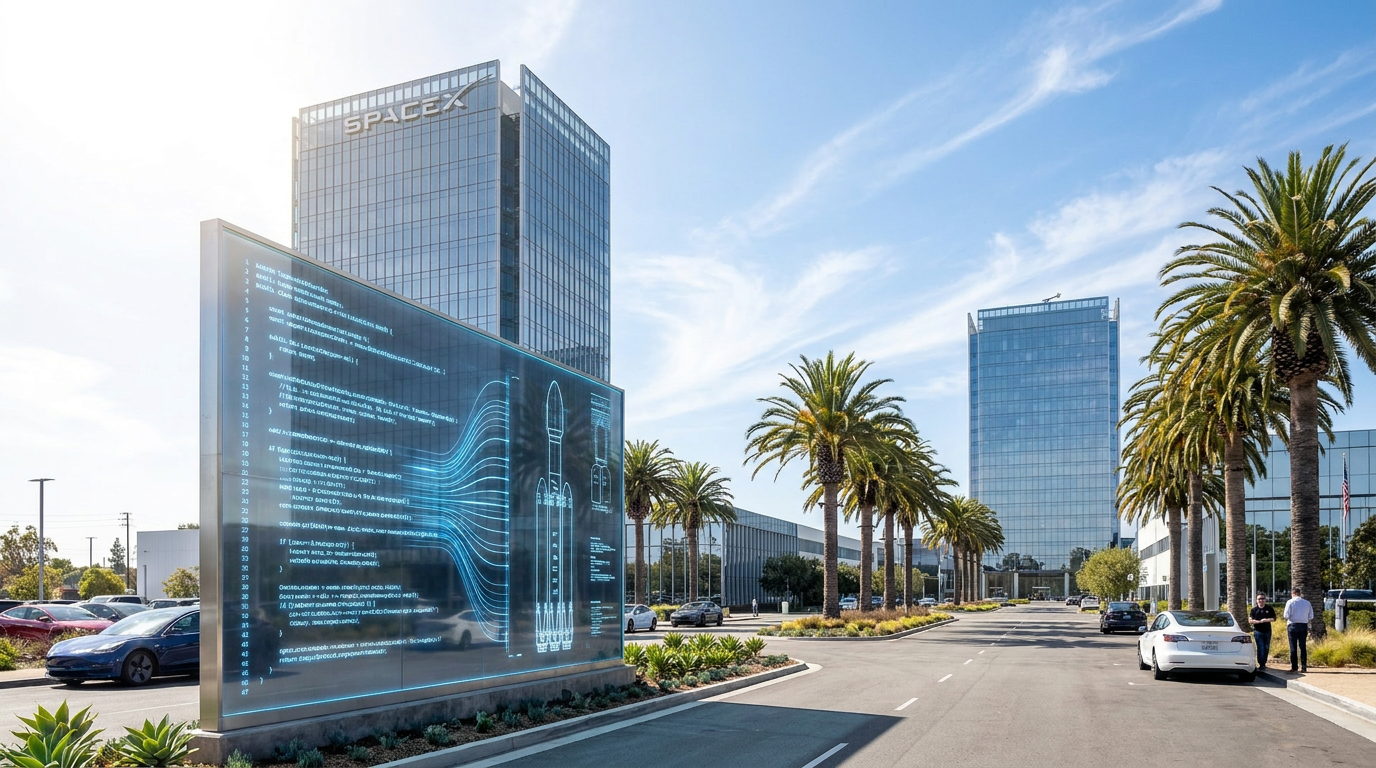
SpaceX has cemented its blockbuster entry into the public markets with a massive strategic pivot, announcing the acquisition of artificial intelligence coding platform Cursor for $60 billion. The deal, which comes just days after the aerospace giant's historic initial public offering, underscores a broader ambition to dominate not just physical space infrastructure, but the software ecosystem that powers it. By bringing Cursor's advanced AI-assisted development tools in-house, SpaceX is signaling that the future of orbital logistics and satellite communications will rely heavily on generative artificial intelligence.[1][4]
The acquisition arrives amid a euphoric week for SpaceX on Wall Street. On its third day of trading, the company's market capitalization surged to approximately $2.7 trillion, positioning it to surpass tech stalwarts like Amazon in overall market value. This blistering start has captivated investors, though financial analysts caution that the stock has yet to face true price discovery in a normalized trading environment. The immediate deployment of capital for a $60 billion software acquisition demonstrates that leadership intends to leverage this massive new public valuation aggressively to secure foundational technologies.[2][3]
For Cursor, the deal represents one of the fastest and most lucrative exits in Silicon Valley history. The platform, which revolutionized software engineering by deeply integrating large language models into the coding environment, has become ubiquitous among developers worldwide. The acquisition will double the net worth of Cursor's four 20-something cofounders, bringing their individual fortunes to an estimated $2.7 billion each. Their rapid ascent highlights the immense premium the market is currently placing on functional, revenue-generating AI applications that solve immediate workflow bottlenecks.[1][5]

The strategic rationale behind a rocket manufacturer purchasing a code editor lies in the immense software complexity of SpaceX's operations. Managing the Starlink satellite constellation, coordinating autonomous docking sequences, and modeling atmospheric reentry require millions of lines of flawless, highly optimized code. By integrating Cursor's AI capabilities, SpaceX aims to exponentially accelerate its internal software development cycles. Industry insiders suggest that Cursor's technology will be customized to assist SpaceX engineers in writing, debugging, and optimizing aerospace-grade software at unprecedented speeds.[4][6]
However, the sheer scale of SpaceX's valuation and its subsequent spending spree has sparked intense debate among financial experts. Aswath Damodaran, Professor of Finance at NYU Stern School of Business, recently estimated SpaceX's core enterprise value at around $1.2 trillion—roughly half of its current market capitalization. Damodaran suggests that the remaining premium reflects the market pricing in SpaceX as a dominant player in future AI and software ecosystems, making the Cursor acquisition a high-stakes, necessary move to justify those towering expectations.[2][7]

However, the sheer scale of SpaceX's valuation and its subsequent spending spree has sparked intense debate among financial experts.
The broader artificial intelligence sector is undergoing a period of rapid maturation and consolidation, providing a backdrop for this mega-deal. As companies grapple with the rising costs of deploying AI agents and shift their open-source strategies, the focus has moved from foundational models to applied, workflow-specific tools. Cursor has proven to be one of the most successful applications of generative AI in a professional setting, making it a highly coveted asset for any technology conglomerate looking to solidify its software dominance.[5][6]
Market reaction to the acquisition has been largely optimistic, though tinged with the caution typical of such massive capital outlays. Proponents argue that controlling the premier AI development environment gives SpaceX an unparalleled advantage in recruiting top-tier engineering talent, as developers naturally gravitate toward organizations with the best internal tooling. Conversely, some institutional investors worry that integrating a consumer-facing software startup could distract from the company's core missions of lunar exploration and Mars colonization, serving as a key test for the stock's long-term stability.[3][4][7]
A lingering question is the future of Cursor's public availability. Millions of independent developers and enterprise teams currently rely on the platform for their daily workflows. While early reports indicate that SpaceX plans to maintain Cursor as a standalone product for the broader developer community, the underlying proprietary models will likely be bifurcated to serve SpaceX's classified and highly sensitive internal projects. This dual-track approach mirrors strategies employed by other tech giants following major open-source and developer-tool acquisitions.[5][6]

The Cursor buyout also sets a new benchmark for venture capital and startup valuations in the AI era. It proves that tools enhancing human productivity can command premiums previously reserved for social networks or foundational hardware companies. For the next generation of software founders, the deal serves as a powerful validation that building highly specific, user-loved AI utilities can lead to historic financial outcomes without needing to build a foundational language model from scratch.[1][5]
Ultimately, SpaceX's first week as a public company has fundamentally altered its corporate identity. No longer just an aerospace and telecommunications firm, it has aggressively positioned itself at the vanguard of the artificial intelligence revolution. As the dust settles on the $60 billion Cursor acquisition, the tech industry will be watching closely to see how effectively SpaceX can merge the bleeding edge of software engineering with the physical realities of spaceflight.[4][7]
How we got here
2023
Cursor is founded, quickly gaining traction among developers for its AI-native coding environment.
Early 2026
Cursor reaches widespread industry adoption, becoming a staple in enterprise software development.
June 2026
SpaceX completes its highly anticipated Initial Public Offering, surging to a $2.7 trillion valuation.
June 16, 2026
SpaceX announces the $60 billion acquisition of Cursor to integrate AI into its aerospace software infrastructure.
Viewpoints in depth
Growth Investors
View the $2.7 trillion valuation as justified by SpaceX expanding into the multi-trillion dollar AI software market.
Growth-focused institutional investors argue that SpaceX is no longer just a hardware company, but a foundational infrastructure provider for the next century. By acquiring Cursor, SpaceX secures the premier tool for software creation, allowing them to iterate on complex aerospace and satellite code faster than any competitor. These investors believe the $60 billion price tag is a necessary strategic premium to lock down top AI talent and ensure that SpaceX's internal software capabilities match its hardware ambitions.
Value Analysts
Caution that the core business is worth $1.2 trillion and the $60 billion Cursor deal is an expensive attempt to justify the IPO premium.
Financial analysts focused on fundamentals, such as NYU's Aswath Damodaran, point out a massive disconnect between SpaceX's core enterprise value and its trading price. They estimate the actual launch and Starlink businesses are worth roughly $1.2 trillion. The remaining $1.5 trillion in market capitalization is built on euphoric expectations of future AI and software dominance. From this perspective, the Cursor acquisition is seen as a high-pressure move by leadership to quickly buy revenue-generating AI assets to support a stock price that has outpaced its physical business.
Software Developers
Excited about the founders' success but concerned about whether Cursor will remain an accessible, open tool.
Within the tech community, the reaction is a mix of celebration and apprehension. Developers are thrilled to see a purely utility-focused coding tool achieve a $60 billion exit, validating the massive impact of applied AI. However, there is widespread concern that integrating Cursor into a defense and aerospace contractor like SpaceX could lead to the platform becoming a walled garden. Developers are closely watching to see if the public version of Cursor will continue to receive cutting-edge updates or if the best features will be reserved exclusively for SpaceX engineers.
What we don't know
- Whether the public version of Cursor will eventually be deprecated in favor of an internal-only SpaceX tool.
- How the integration of Cursor will tangibly impact the timeline for SpaceX's Mars colonization software.
- If regulatory bodies will scrutinize the acquisition given SpaceX's extensive government defense contracts.
Key terms
- Cursor
- An AI-powered code editor that assists software developers by generating, debugging, and optimizing code using large language models.
- Market Capitalization
- The total value of a publicly traded company's outstanding shares of stock, calculated by multiplying the share price by the number of shares.
- Enterprise Value
- A comprehensive measure of a company's total value, often used as a more accurate alternative to equity market capitalization that includes debt and cash.
- Initial Public Offering (IPO)
- The process of offering shares of a private corporation to the public in a new stock issuance, allowing the company to raise capital from public investors.
Frequently asked
How much did SpaceX pay for Cursor?
SpaceX acquired the AI coding platform Cursor for $60 billion.
What is SpaceX's market capitalization?
On its third day of trading, SpaceX's market capitalization surged to approximately $2.7 trillion.
Will Cursor still be available to the public?
Early reports suggest SpaceX will maintain Cursor as a standalone product for developers while building a proprietary, bifurcated version for internal aerospace projects.
How much are the Cursor founders worth now?
The acquisition doubles the net worth of the four 20-something cofounders to an estimated $2.7 billion each.
Sources
Source coverage
7 outlets
3 viewpoints surfaced







[1]ForbesGrowth Investors
SpaceX’s $60 Billion Cursor Acquisition Doubles 20-Something Cofounders’ Net Worths
Read on Forbes →[2]BloombergValue Analysts
Damodaran: AI Shaky, High-Potential Business for SpaceX
Read on Bloomberg →[3]CNBCValue Analysts
SpaceX's blistering start still faces key tests that will determine the stock's true value
Read on CNBC →[4]The Wall Street JournalTech Industry Observers
SpaceX Pivots to Software With $60 Billion Cursor Buyout
Read on The Wall Street Journal →[5]TechCrunchGrowth Investors
What SpaceX's Cursor Acquisition Means for the Future of AI Coding
Read on TechCrunch →[6]ReutersTech Industry Observers
SpaceX integrates AI into core operations with Cursor deal
Read on Reuters →[7]Financial TimesValue Analysts
Markets React to SpaceX's Trillion-Dollar Debut and Immediate M&A Spree
Read on Financial Times →

Every angle. Every day.
Get business stories with full source coverage and perspective breakdowns delivered to your inbox.