
How Solid-State Batteries Are Rewriting the Rules of Electric Vehicles in 2026
After a decade of laboratory development, solid-state batteries are entering commercial production, promising to double EV ranges and eliminate fire risks.
By Factlen Editorial Team
- Battery Innovators
- Argue that solid-state technology is the definitive solution to EV limitations, prioritizing energy density and charging speed.
- Legacy Automakers
- Value the safety and stability of solid-state cells, viewing them as a necessary evolution for mass consumer trust.
- Manufacturing Skeptics
- Emphasize the immense engineering challenges of the 'interface problem' and the high costs of scaling production.
What's not represented
- · Raw material suppliers
- · Grid infrastructure operators
Why this matters
Solid-state batteries solve the two biggest hurdles to electric vehicle adoption: range anxiety and safety concerns. By doubling energy density and enabling 10-minute charging, this technology makes EVs as convenient as gas-powered cars while eliminating the risk of catastrophic battery fires.
Key points
- Solid-state batteries replace flammable liquid electrolytes with rigid, non-flammable materials like ceramics or polymers.
- The solid structure prevents the growth of metallic dendrites, allowing for the use of pure lithium-metal anodes.
- This architectural shift effectively doubles the energy density of the battery, enabling ranges exceeding 600 miles.
- Major players like QuantumScape and Toyota are launching pilot production lines in 2026, targeting initial vehicle integration by 2027.
The electric vehicle industry has been chasing a technological holy grail for the better part of a decade. In 2026, that chase is finally yielding commercial results. After years of delayed promises and laboratory experiments, solid-state batteries are crossing the threshold into real-world production. This shift represents the most significant leap in energy storage since the commercialization of the lithium-ion cell in the early 1990s. For consumers, the transition promises to solve the two most persistent anxieties associated with electric mobility: range limitations and the rare but highly publicized risk of battery fires.[6]
To understand why this breakthrough is so transformative, one must first look inside the architecture of a standard lithium-ion battery. Today's electric vehicles rely on a liquid electrolyte—a chemical solution that acts as a microscopic river connecting the battery's two halves. When a car is driving, lithium ions swim through this liquid river from the negative anode to the positive cathode, releasing the electrical energy that powers the motor. When the car is plugged into a station, the charger forces the ions to swim back upstream to be stored for the next trip.[4]
While highly effective and responsible for the modern electric vehicle revolution, this liquid river has a fundamental flaw. The organic solvents used in conventional electrolytes are highly volatile and flammable. If a battery is physically punctured in a severe crash, or if it overheats due to a microscopic manufacturing defect, the liquid can quickly ignite. This triggers a cascading chain reaction known as thermal runaway, resulting in intense, self-sustaining fires that are notoriously difficult for emergency responders to extinguish using standard methods.[3][4]
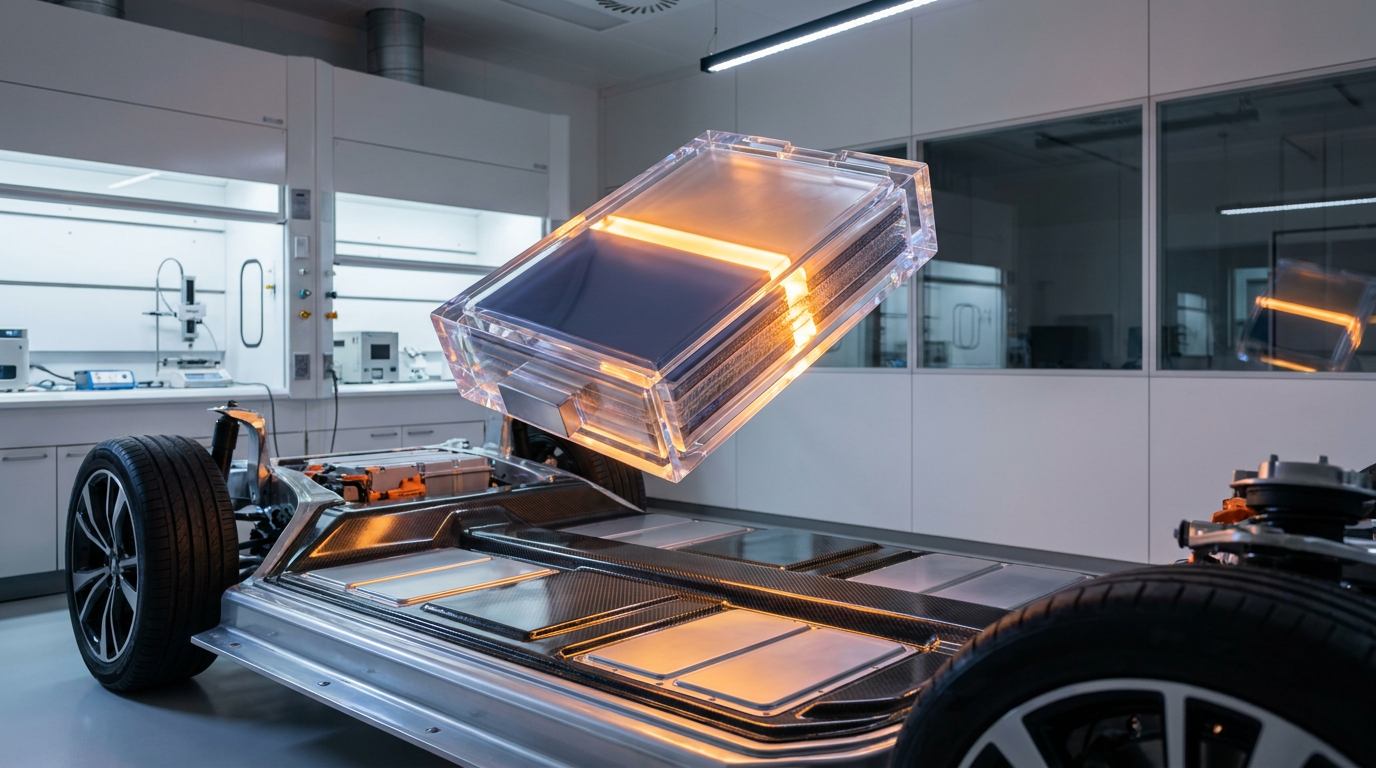
Solid-state batteries eliminate this risk entirely by replacing the flammable liquid river with a solid bridge. Engineers use advanced materials—typically ceramics, sulfides, or specialized polymers—to create a rigid, non-flammable electrolyte. Because there is no liquid to boil or ignite, solid-state cells can withstand extreme temperatures and physical trauma. Comparative testing has shown that thermal events in solid-state systems do not begin until temperatures reach nearly 250 degrees Celsius, compared to just 90 degrees for conventional lithium-ion cells.[3][6]

But safety is only half of the equation when it comes to this new technology. The rigid nature of the solid electrolyte unlocks an even greater prize for automotive engineers: the ability to fundamentally redesign the battery's anode. In a liquid battery, charging too quickly causes lithium ions to pile up unevenly and form microscopic, needle-like metallic spikes called dendrites. If these dendrites grow long enough, they can puncture the internal plastic separator and cause a catastrophic short circuit within the cell.[3][4]
To prevent dendrite growth, conventional batteries use a bulky graphite anode to safely absorb and house the lithium ions, much like a sponge soaking up water. This graphite adds significant weight and volume to the battery pack without contributing any actual energy. A solid electrolyte, however, acts as an impenetrable physical wall. It is mechanically strong enough to suppress dendrite growth entirely, rendering the heavy graphite "sponge" obsolete.[3][4]
By removing the dead weight of the graphite, engineers can use a pure lithium-metal anode. This architectural shift dramatically increases the battery's overall energy density—the amount of electrical power it can hold relative to its physical weight and volume. While the absolute best lithium-ion batteries on the market today max out at roughly 250 to 300 watt-hours per kilogram, next-generation solid-state cells are targeting a massive leap to 400 to 500 watt-hours per kilogram.[4][6]

By removing the dead weight of the graphite, engineers can use a pure lithium-metal anode.
For the driver, this doubling of energy density translates to profound real-world benefits. Automakers can either keep the battery the same size and double the vehicle's range—pushing it well past 600 miles on a single charge—or they can cut the battery size in half, making the vehicle lighter, more efficient, and cheaper to manufacture. Furthermore, the robust solid structure can absorb energy at a much faster rate, allowing a car to recharge in under ten minutes, closely mirroring the time spent at a traditional gas pump.[2][6]
The year 2026 marks the critical inflection point where these theoretical benefits finally become tangible products. In February, California-based battery developer QuantumScape inaugurated its highly anticipated "Eagle Line" in San Jose, a heavily automated pilot facility designed to crank out anode-free, lithium-metal cells. This facility officially moves the company's technology out of the laboratory phase and into scaled production, producing standardized cells specifically for automotive manufacturers to sample, test, and integrate into their upcoming vehicle prototypes.[1][5]
Legacy automakers are also making their definitive moves after years of quiet research. Toyota, which currently holds thousands of patents related to solid-state technology, has validated plans with the Japanese government to begin limited production of solid-state batteries this year. Working alongside petroleum and materials giant Idemitsu Kosan, Toyota is constructing a large-scale pilot plant specifically for solid electrolytes, aiming to launch its first solid-state-equipped passenger vehicles in limited batches by 2027. This represents a massive shift for a company that has historically favored hybrid technology over pure battery-electric vehicles.[2]

The momentum is equally fierce in Asia's broader manufacturing sector, where the race for battery supremacy is viewed as a matter of national economic security. Chinese battery makers, backed by massive state investment, are rapidly scaling their own solid-state architectures. Companies like Greater Bay Technology have recently rolled their first "A-sample" all-solid-state cells off production lines, successfully passing rigorous needle-penetration and thermal shock tests without any signs of ignition or structural failure. These milestones indicate that the technology is ready to leave the controlled environment of the research lab.[6]
Despite the rapid progress across the globe, the transition to solid-state dominance is not without friction. The greatest engineering hurdle remaining is known in the battery industry as the "interface problem." Liquid electrolytes easily seep into every microscopic crevice of an electrode, ensuring perfect chemical contact at all times. Solid electrolytes, however, are rigid materials. Maintaining perfect, continuous contact between two solid surfaces as the battery naturally expands and contracts during charging cycles is notoriously difficult. If the materials pull apart even slightly, the battery stops functioning efficiently.[3]
If microscopic gaps form between the solid electrolyte and the electrodes, the flow of ions is choked off, drastically increasing internal resistance and degrading the battery's overall performance. To solve this, some current designs require the battery pack to be held under high mechanical pressure, while others rely on high-temperature manufacturing processes to fuse the materials together permanently. Both of these engineering solutions add significant complexity and cost to the final manufactured product. Engineers are currently racing to find manufacturing techniques that can produce these cells cheaply and reliably at a massive scale.[3][6]

Consequently, the consumer rollout of solid-state batteries will be a gradual evolution rather than an overnight revolution. Early production volumes will be low and manufacturing costs will be high, meaning the technology will initially be reserved for flagship luxury vehicles, high-performance electric motorcycles, and specialized aerospace applications like drones. It will likely take several years of manufacturing refinement and economies of scale before the technology trickles down to affordable, mass-market commuter cars. Industry analysts expect the premium segment to serve as the proving ground for the technology's long-term durability.[5][6]
Yet, the trajectory of the technology is now firmly set in stone. The global automotive industry has committed billions of dollars in capital to retooling supply chains, securing raw materials, and constructing advanced pilot plants. Just as the lithium-ion battery revolutionized consumer electronics and made the modern smartphone possible, solid-state technology is poised to rewrite the fundamental rules of electric mobility, turning range anxiety and battery fires into relics of the past. For drivers, the future of transportation is about to become significantly lighter, faster to charge, and undeniably safer.[6]
How we got here
1991
The first commercial lithium-ion battery is introduced by Sony, revolutionizing portable electronics.
2012
Volkswagen makes its first major investment in solid-state startup QuantumScape.
2020
Toyota announces initial plans for solid-state technology, which are later delayed due to manufacturing hurdles.
2023
Major breakthroughs in solid electrolyte materials increase theoretical battery ranges by 20 percent.
Feb 2026
QuantumScape inaugurates its Eagle Line pilot production facility in California to supply automotive OEMs.
2027
Projected launch of the first limited-production passenger vehicles equipped with solid-state batteries.
Viewpoints in depth
Battery Innovators
Argue that solid-state technology is the definitive solution to EV limitations, prioritizing energy density and charging speed.
Startups and specialized battery developers view solid-state architecture as the ultimate 'holy grail' of energy storage. By successfully implementing pure lithium-metal anodes, these innovators argue that the industry can finally break the 300 Wh/kg ceiling that has constrained liquid lithium-ion technology for decades. For this camp, the primary focus is on maximizing performance metrics—specifically, achieving 10-minute fast-charging and pushing vehicle ranges past the 600-mile mark to permanently eliminate consumer range anxiety.
Legacy Automakers
Value the safety and stability of solid-state cells, viewing them as a necessary evolution for mass consumer trust.
Traditional automotive giants approach solid-state technology through the lens of safety and brand reputation. While they welcome the increased range, their primary motivation is the elimination of thermal runaway and the associated PR disasters of battery fires. Legacy automakers are willing to accept a slower, more deliberate rollout—often partnering with established chemical and petroleum companies to build massive pilot plants—ensuring that the new cells can survive hundreds of thousands of miles of real-world abuse before being placed in mass-market commuter cars.
Manufacturing Skeptics
Emphasize the immense engineering challenges of the 'interface problem' and the high costs of scaling production.
Materials scientists and manufacturing analysts caution against overhyping the immediate impact of solid-state batteries. This camp points to the 'interface problem'—the physical difficulty of maintaining perfect contact between rigid solid materials as the battery expands and contracts. They argue that the engineering solutions required to fix this, such as high-pressure packaging or extreme-temperature annealing, will keep manufacturing costs prohibitively high for years. Consequently, they predict solid-state cells will remain a niche luxury product rather than a mass-market standard for the foreseeable future.
What we don't know
- Exactly how much a solid-state battery pack will cost at mass-market scale compared to current lithium-ion packs.
- How well the solid-solid interfaces will hold up after a decade of real-world expansion and contraction in consumer vehicles.
- Whether the supply chain for specialized solid electrolytes can scale quickly enough to meet global automotive demand.
Key terms
- Electrolyte
- The chemical medium that allows ions to flow between the positive and negative sides of a battery, generating electrical current.
- Anode
- The negative electrode of a battery where current flows in from the outside circuit during charging.
- Dendrites
- Microscopic, needle-like metallic growths that can form inside liquid batteries, potentially puncturing internal components and causing short circuits.
- Energy Density
- The amount of energy a battery can store relative to its physical weight or volume, typically measured in watt-hours per kilogram (Wh/kg).
- Thermal Runaway
- A dangerous, cascading chain reaction where a battery overheats and catches fire, often difficult for emergency responders to extinguish.
Frequently asked
What exactly is a solid-state battery?
A solid-state battery replaces the liquid electrolyte found in conventional lithium-ion batteries with a solid material, such as a ceramic, sulfide, or polymer. This allows ions to flow without the need for flammable liquids.
Why are solid-state batteries considered safer?
Because they contain no highly volatile organic solvents, solid-state batteries are virtually immune to thermal runaway. They will not easily catch fire or explode, even if punctured in a severe car crash.
How fast can a solid-state battery charge?
Due to their structural stability, solid-state batteries can absorb energy much faster than liquid batteries. Current prototypes aim to deliver a full charge in under 10 minutes.
When will solid-state cars be available to buy?
Early luxury models and specialized electric motorcycles are expected to hit the market in limited numbers between 2026 and 2027. Mass-market adoption in affordable commuter cars will likely take several more years.
Sources
Source coverage
6 outlets
3 viewpoints surfaced






[1]QuantumScapeBattery Innovators
QuantumScape Inaugurates Eagle Line Pilot for Solid-State Battery Production
Read on QuantumScape →[2]ElectrekManufacturing Skeptics
Toyota and Idemitsu advance all-solid-state EV batteries
Read on Electrek →[3]Volta FoundationManufacturing Skeptics
The State of Solid-State Batteries: Mechanisms and Challenges
Read on Volta Foundation →[4]Flash BatteryBattery Innovators
What are solid-state batteries and how do they work
Read on Flash Battery →[5]InsideEVsLegacy Automakers
QuantumScape Kicks Off Pilot Production Of Its Solid-State Batteries
Read on InsideEVs →[6]Factlen Editorial Team
Synthesis by Factlen editorial team
Read on Factlen Editorial Team →
Every angle. Every day.
Get automotive stories with full source coverage and perspective breakdowns delivered to your inbox.