
How Local AI Became a Mainstream Reality on Consumer Laptops
Advances in model compression and user-friendly software have made running powerful AI locally—without cloud subscriptions or internet access—a practical reality for everyday users in 2026.
By Factlen Editorial Team
- Open-Source Developers
- Value customization, offline access, and building software without reliance on corporate APIs.
- Privacy & Enterprise Users
- Focus on data sovereignty, compliance, and protecting proprietary information from third-party servers.
- Everyday Consumers
- Seek cost savings, easy-to-use interfaces, and freedom from monthly subscription fees.
What's not represented
- · Hardware Manufacturers (Nvidia/AMD/Apple)
- · Cybersecurity Researchers analyzing local AI vulnerabilities
Why this matters
Running AI locally gives users complete ownership over their data, eliminates recurring subscription fees, and allows for offline use in secure or remote environments. It represents a fundamental shift in power from centralized tech giants back to individual users and small businesses.
Key points
- Local AI allows users to run powerful language models entirely on their own hardware without internet access.
- Data privacy is guaranteed because prompts and responses never leave the user's machine.
- Quantization techniques compress massive AI models so they can run efficiently on standard 16GB laptops.
- Tools like Ollama and LM Studio have replaced complex command-line setups with user-friendly interfaces.
- Running models locally eliminates recurring cloud API costs, offering significant savings for heavy users.
- While highly capable, local models still trail the absolute cutting-edge cloud models in complex reasoning.
The AI landscape of 2024 was defined by massive cloud dependencies, with users paying monthly subscriptions to send their prompts and data to centralized servers. By mid-2026, a quiet revolution has inverted that dynamic. Running large language models (LLMs) directly on consumer hardware—laptops, desktops, and workstations—has transitioned from a frustrating hobbyist experiment into a seamless, mainstream alternative.[1][3]
The appeal is straightforward: complete data privacy, zero recurring costs, and the ability to work entirely offline. For years, the assumption was that artificial intelligence required warehouse-scale supercomputers. Today, a standard office laptop can run models that rival the performance of early cloud-based systems, processing text, code, and even images without ever connecting to the internet.[4][7]
To understand how this became possible, one must look at the mechanics of model compression, specifically a technique known as quantization. In their raw state, frontier AI models are massive, requiring hundreds of gigabytes of Video RAM (VRAM) to hold their neural weights in memory. Quantization mathematically compresses these weights—often reducing their precision from 16-bit to 4-bit formats—sacrificing a tiny fraction of accuracy to shrink the model's footprint by up to 75 percent.[3][8]
This compression means that a highly capable 8-billion to 12-billion parameter model, such as Google's Gemma 4 or Meta's Llama family, can now fit comfortably inside the 16 gigabytes of unified memory found in standard consumer laptops. The underlying engine powering much of this efficiency is llama.cpp, an open-source project that rewrote the rules of AI inference to run optimally on standard computer processors (CPUs) and integrated graphics, rather than requiring expensive, specialized data-center GPUs.[4][5]

But the real catalyst for mainstream adoption in 2026 has been the software layer built on top of these engines. Tools like Ollama and LM Studio have abstracted away the complex command-line configurations that previously kept non-developers out of the local AI ecosystem.[3][8]
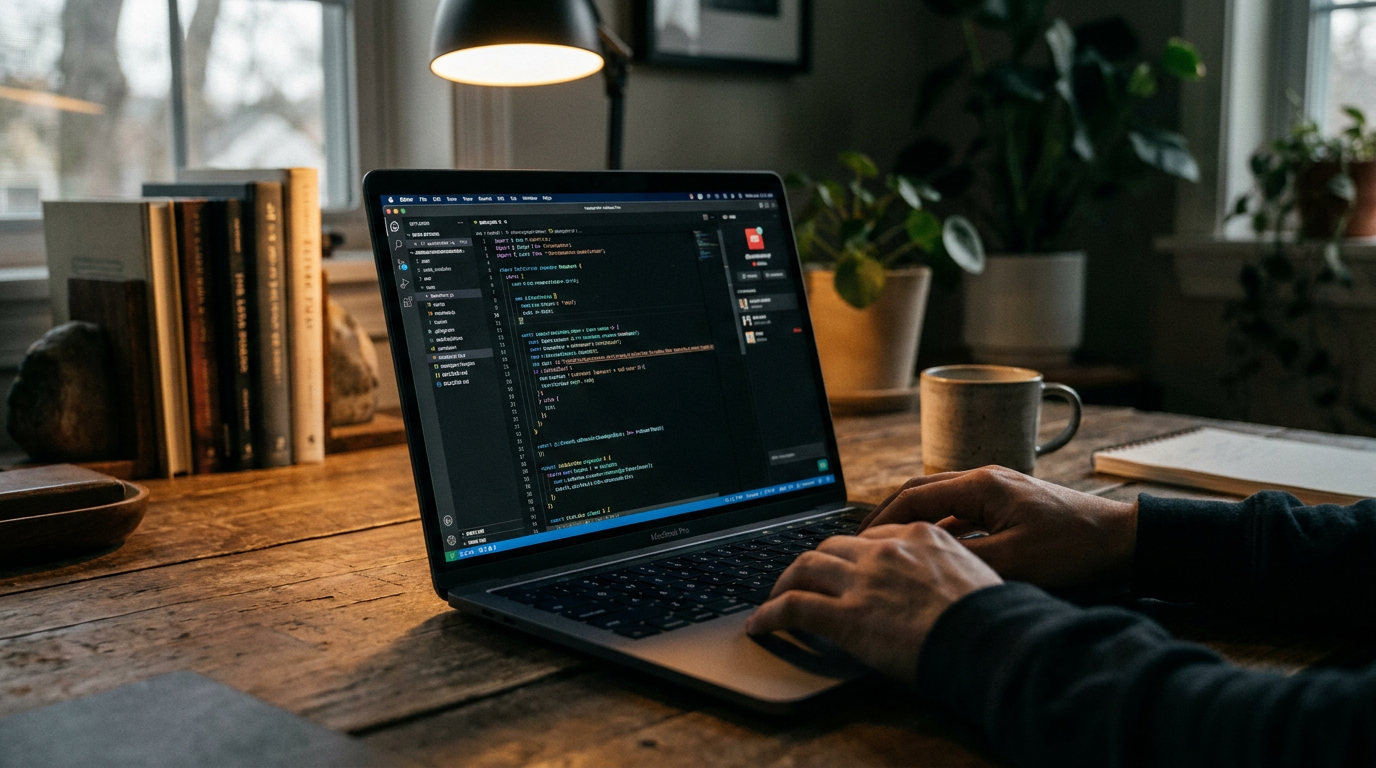
Ollama operates as a lightweight background service, allowing users to download and run models with a single terminal command, much like installing a standard software package. It instantly provisions a local API that mimics cloud services, meaning developers can plug local models directly into their existing coding environments, such as Visual Studio Code, without rewriting their applications.[3][6]
For users who prefer a graphical interface, LM Studio provides a polished, desktop-app experience. It allows users to search a directory of open-source models, download them with a click, and chat with them in a familiar window. Crucially, LM Studio runs entirely offline by default, ensuring that no telemetry or prompt data is ever transmitted to external servers.[5][8]
For users who prefer a graphical interface, LM Studio provides a polished, desktop-app experience.
The privacy implications of this architecture are profound, particularly for small and medium-sized businesses. When a user pastes proprietary code, sensitive financial data, or protected health information into a cloud AI, that data leaves the corporate network. Local inference solves this completely; the prompts and the generated responses never leave the physical machine.[1][7]
This local-first approach has become a major asset for regulatory compliance. With frameworks like the EU AI Act enforcing strict data governance, organizations can use local models to maintain perfect audit trails and guarantee that third-party vendors are not using their internal data to train future commercial models.[6][7]
Cost is the other driving factor. Cloud API pricing scales linearly—the more you use it, the more you pay. Local inference flips this to a fixed-cost model. Once the hardware is purchased, the marginal cost of generating a million tokens of text or code is effectively zero, limited only by the electricity required to run the machine. For heavy users, the break-even point against cloud subscriptions can be reached in a matter of months.[6][8]

The open-weight model ecosystem has risen to meet this hardware capability. In 2026, developers have access to a staggering variety of highly optimized models. Alibaba's Qwen 3.5, Mistral's Large 3, and specialized coding models like DeepSeek V3.2-Exp offer performance that routinely beats the cloud models of just a year prior. Users can swap between a fast, lightweight model for drafting emails and a heavier, reasoning-focused model for debugging complex software.[4][6]
Despite these massive leaps, local AI is not without its trade-offs and uncertainties. The most capable open-weight models still lag roughly three to six months behind the absolute cutting edge of proprietary cloud models in complex reasoning and multi-step logic. If a task requires the absolute highest tier of AI cognition, cloud APIs remain the necessary standard.[1][2]
Hardware constraints also dictate the user experience. While a 16GB laptop can run a mid-sized model, generating text locally is computationally intensive and will drain a laptop battery significantly faster than browsing the web. Furthermore, running massive 70-billion parameter models still requires specialized workstation hardware with multiple expensive GPUs, keeping the true frontier experience out of reach for the average consumer.[2][8]

Security is another double-edged sword. While local models protect data from corporate surveillance, they also lack the centralized safety guardrails and content filters enforced by cloud providers. The responsibility for managing model hallucinations, securing the local API endpoints from network intrusion, and updating the software falls entirely on the user.[3][8]
Looking ahead, the gap between local and cloud AI is expected to blur further as hardware manufacturers embed dedicated Neural Processing Units (NPUs) directly into standard consumer chips. For now, the local AI movement has successfully democratized access to machine intelligence, proving that the future of computing doesn't have to be entirely rented from the cloud.[1][6]
How we got here
Early 2023
The release of LLaMA by Meta sparks the open-weight AI movement, though running it requires complex setups.
Late 2023
The llama.cpp project gains traction, allowing models to run efficiently on standard CPUs and Apple Silicon.
2024
Tools like Ollama and LM Studio launch, providing user-friendly interfaces for downloading and running local models.
2025
Major tech companies release highly capable, smaller models (8B-12B parameters) specifically optimized for consumer hardware.
Mid-2026
Local AI becomes a mainstream workflow for developers and privacy-conscious businesses, driven by advanced quantization and powerful open-weight models.
Viewpoints in depth
Privacy Advocates & SMBs
Prioritize local AI for data security and regulatory compliance.
For privacy advocates and small-to-medium businesses, local AI is a necessary defense against corporate data harvesting. They argue that sending proprietary code, financial records, or customer data to third-party cloud providers introduces unacceptable security risks and complicates GDPR compliance. By keeping inference on-premises, these users maintain perfect control over their data lifecycle, ensuring that their sensitive inputs are never used to train future commercial models.
Cloud AI Providers
Emphasize the performance, convenience, and safety of centralized models.
Companies building frontier cloud models maintain that centralized infrastructure will always offer superior performance. They point out that cloud APIs provide access to trillion-parameter models that simply cannot run on consumer hardware, delivering better reasoning, fewer hallucinations, and multimodal capabilities. Furthermore, cloud providers argue that centralized models benefit from continuous updates and robust safety guardrails that protect users from generating harmful or biased content—protections that are often stripped out of open-weight local models.
Open-Source Developers
Value the freedom to tinker, customize, and build without vendor lock-in.
The open-source community views local AI as a fundamental democratization of technology. Developers in this camp prioritize the ability to fine-tune models for specific niche tasks, inspect the underlying architecture, and build applications without relying on a corporate API that could change its pricing or terms of service overnight. For them, tools like Ollama and llama.cpp represent freedom from vendor lock-in and a return to the decentralized ethos of the early internet.
What we don't know
- How quickly dedicated Neural Processing Units (NPUs) in consumer laptops will close the performance gap with cloud GPUs.
- Whether future regulations will attempt to restrict the distribution of powerful open-weight models.
- How the business models of companies building open-weight models will evolve as local inference becomes more popular.
Key terms
- Local Inference
- The process of running an AI model directly on your own computer or device, rather than sending data to a remote cloud server.
- Quantization
- A mathematical compression technique that reduces the precision of an AI model's weights, allowing massive models to fit into smaller amounts of computer memory.
- Open-Weight Model
- An AI model whose underlying parameters (weights) are made publicly available, allowing anyone to download, run, and modify it.
- VRAM (Video RAM)
- The specialized memory found on graphics cards, crucial for loading and running large AI models efficiently.
- GGUF
- A popular file format designed specifically for running quantized AI models quickly on consumer hardware.
Frequently asked
Do I need an expensive graphics card to run local AI?
Not necessarily. While a dedicated GPU improves speed, modern tools and quantization allow highly capable models to run on standard laptop CPUs or integrated graphics, provided you have at least 8GB to 16GB of system RAM.
Is local AI completely free to use?
Yes. Once you own the hardware, downloading open-weight models and running them locally incurs no subscription fees or API token costs.
Can local AI models connect to the internet?
By default, local models run entirely offline. However, developers can configure them to access the internet or local files if they want the AI to perform web searches or read specific documents.
Are local models as smart as ChatGPT or Claude?
The best local models are highly capable and often match the performance of cloud models from 6 to 12 months ago. However, the absolute cutting-edge cloud models still maintain an edge in complex reasoning and massive knowledge retrieval.
Sources
Source coverage
8 outlets
3 viewpoints surfaced








[1]MindStudioPrivacy & Enterprise Users
Local AI vs Cloud AI in 2026: When to Run Models on Your Own Hardware
Read on MindStudio →[2]Visual Studio MagazineOpen-Source Developers
Going Local (& a Bit Loco) with Open-Source AI in VS Code
Read on Visual Studio Magazine →[3]daily.devOpen-Source Developers
Running LLMs Locally in 2026: Ollama, llama.cpp, and Self-Hosted AI for Developers
Read on daily.dev →[4]PinggyOpen-Source Developers
Top 5 Local LLM Tools and Models in 2026
Read on Pinggy →[5]IPRoyalEveryday Consumers
Best Local LLMs for Offline Use in 2026: A Complete Comparison
Read on IPRoyal →[6]AI MagicxOpen-Source Developers
Local AI in 2026: The Best Models to Run on Your Own Hardware
Read on AI Magicx →[7]Done Web AgencyPrivacy & Enterprise Users
AI without cloud: a practical guide for SMBs in 2026
Read on Done Web Agency →[8]Sesame DiskEveryday Consumers
How to Run AI Models Locally in 2026: Hardware, Tools & Setup
Read on Sesame Disk →

Every angle. Every day.
Get ai stories with full source coverage and perspective breakdowns delivered to your inbox.