
OLED vs. Mini-LED TVs: Which Display Technology Wins in 2026?
While OLED remains the gold standard for infinite contrast and perfect blacks, Mini-LED has closed the gap with blinding peak brightness and immunity to burn-in, making the choice highly dependent on your viewing environment.
By Factlen Editorial Team
- Home Theater Purists
- Argues that perfect black levels and infinite contrast are the most important metrics for visual fidelity, strongly favoring OLED.
- Bright-Room Viewers
- Prioritizes peak brightness, sustained full-screen luminance, and glare reduction for daytime viewing, favoring Mini-LED.
- Value & Scale Analysts
- Focuses on the price-to-size ratio, noting that Mini-LED offers a more economical path to massive 85-inch and 98-inch screens.
What's not represented
- · Projector Enthusiasts
- · Micro-LED Early Adopters
Why this matters
A premium TV is a multi-year investment often exceeding $1,000. Choosing the wrong panel technology for your living room's lighting conditions can lead to washed-out daytime viewing or distracting light bleed during movie nights.
The era of the standard LED television is effectively over for premium buyers. As we navigate the 2026 television market, the decision for anyone upgrading their living room has narrowed to a heavyweight bout between two dominant panel technologies: OLED and Mini-LED. Both have seen massive iterative improvements over the last few years, pushing the boundaries of what home entertainment can look like.[2][3]
The stakes for consumers are higher than ever because screens are getting larger. With 75-inch and 85-inch models becoming the new normal for primary living spaces, the underlying technology powering those millions of pixels dictates the entire viewing experience. A flaw that might be invisible on a 55-inch screen becomes glaringly obvious when stretched across an entire wall.[4][6]
To understand the comparison, one must first understand how OLED (Organic Light-Emitting Diode) works. OLED is a self-emissive technology, meaning each of its 8.3 million pixels generates its own light and color. There is no backlight. When an OLED television needs to display black, it simply turns off the power to those specific pixels, resulting in absolute, perfect darkness.[1][7]

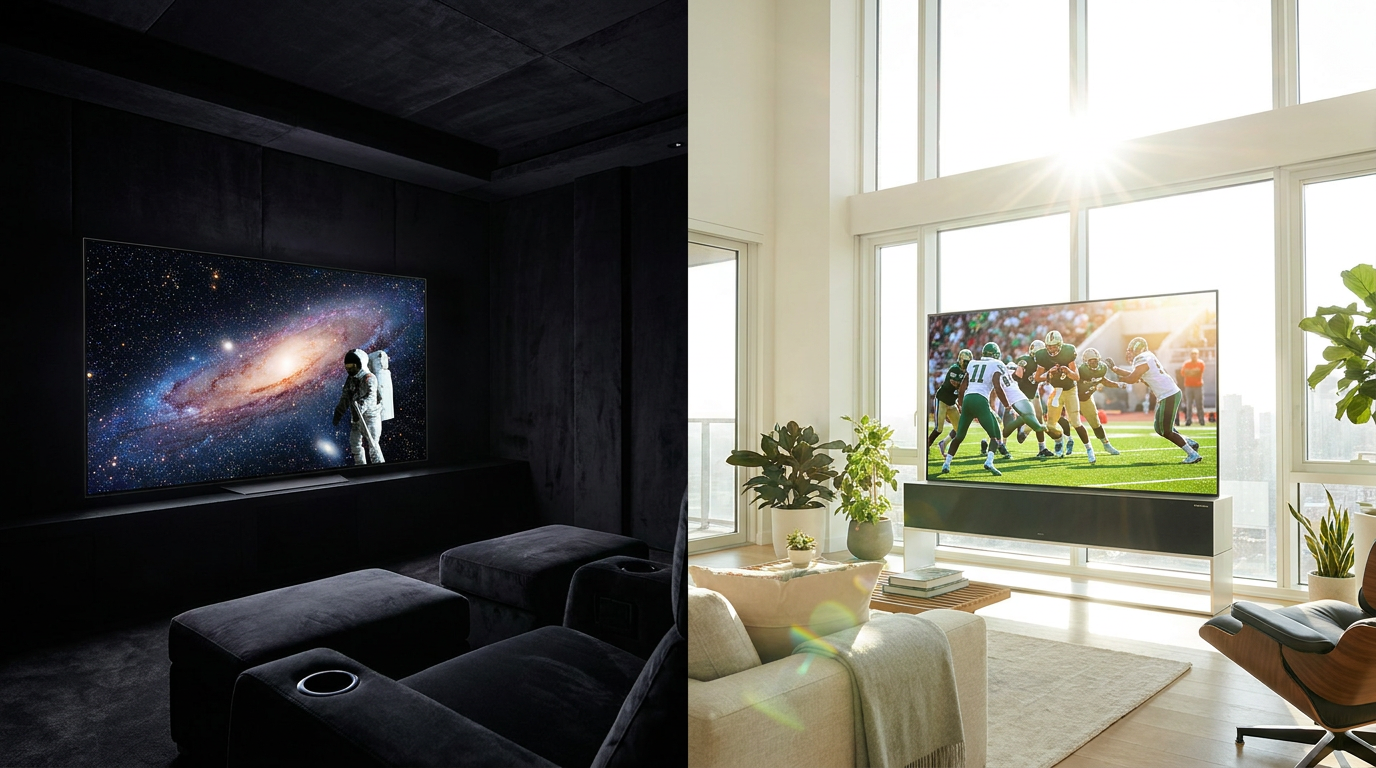
This self-emissive nature gives OLED an infinite contrast ratio, which remains its greatest superpower. In a dark room, a starfield in a sci-fi movie looks exactly as the director intended—pinpricks of brilliant light against a canvas of pure black, with zero light bleeding into the surrounding darkness. This pixel-level precision also grants OLED TVs exceptionally wide viewing angles, ensuring the picture doesn't wash out for people sitting on the edges of the couch.[1][3]
However, OLED has historical drawbacks, primarily concerning brightness. Because each pixel generates its own light, driving them all to maximum brightness simultaneously generates excessive heat and consumes massive power. To protect the panel, OLEDs use an Auto Brightness Limiter (ABL). If a scene is overwhelmingly bright—like a hockey game or a snow-covered landscape—the TV automatically dims the entire screen, which can be distracting in a sunlit room.[1][5]
Enter Mini-LED, the transmissive challenger. Mini-LED televisions still use an LCD panel to create colors, but they have revolutionized the backlight. Instead of a few dozen large LEDs illuminating the screen from the edges, Mini-LEDs pack thousands of microscopic diodes directly behind the screen. These are grouped into thousands of "dimming zones" that can be controlled independently.[4][5]
Mini-LED televisions still use an LCD panel to create colors, but they have revolutionized the backlight.
The primary advantage of Mini-LED is sheer, blinding power. High-end 2026 Mini-LED models can push peak brightness levels up to 3,000 nits, easily doubling or tripling the sustained full-screen brightness of a standard OLED. If your living room features large windows, skylights, or heavy daytime glare, a Mini-LED television can punch through the ambient light, delivering a vibrant, saturated image where an OLED might look dim and reflective.[2][7]

The trade-off for this brightness is the "blooming" or "halo" effect. Because Mini-LEDs rely on dimming zones rather than individual pixels, a bright object on a dark background—like white subtitles on a black cinematic letterbox bar—will inevitably illuminate the pixels immediately surrounding it. While 2026 algorithms have aggressively minimized this, it remains a physical limitation of the technology.[1][6]
For gamers, the comparison becomes even more nuanced. Both technologies now universally support 120Hz and 144Hz refresh rates, Variable Refresh Rate (VRR), and Auto Low Latency Mode (ALLM). However, OLED holds a distinct advantage in pixel response time. Because OLED pixels change state almost instantaneously (often under 0.1 milliseconds), fast-moving games exhibit virtually zero motion blur, making it the darling of competitive console players.[1][8]
Yet, Mini-LED strikes back with peace of mind. OLED panels carry a slight, albeit heavily mitigated, risk of permanent image retention, commonly known as burn-in. For PC gamers who use their TV as a massive monitor, leaving static UI elements like taskbars or health meters on screen for thousands of hours can degrade the organic compounds. Mini-LEDs are entirely immune to burn-in, making them the safer long-term bet for static content.[6][8]
Pricing dynamics in 2026 also heavily influence the decision. While 55-inch and 65-inch OLEDs have become highly competitive in price, manufacturing massive OLED panels remains expensive. If a buyer is looking to cross the 83-inch threshold, Mini-LED offers a significantly more accessible price-to-size ratio, allowing consumers to prioritize sheer scale without sacrificing premium features.[2][4]
The gap between the two is narrowing every year. New OLED panels utilizing Micro Lens Array (MLA) and Quantum Dot (QD-OLED) technologies are achieving brightness levels previously thought impossible for organic panels. Simultaneously, Mini-LED manufacturers are increasing their dimming zone counts into the tens of thousands, drastically reducing blooming and inching closer to OLED's contrast precision.[3][7]

Ultimately, OLED fits best when placed in light-controlled environments. It is the undisputed champion for dedicated home theaters, cinematic purists who watch movies in the dark, and competitive gamers who demand instantaneous pixel response times. If you want the picture to look exactly as the colorist mastered it in a dark studio, OLED remains the benchmark.[1][2][6]
Conversely, Mini-LED fits best when placed in bright, multi-use living spaces. It is the superior choice for sports fans who host daytime watch parties, viewers battling heavy window glare, PC gamers worried about static UI burn-in, and buyers who want an 85-inch or larger screen without paying a massive premium. It delivers a punchy, vibrant image that refuses to be washed out by the sun.[4][5][7]
How we got here
2013
The first consumer OLED TVs hit the market, offering unprecedented contrast but at massive price points.
2019
Mini-LED technology is introduced to the consumer market, bridging the gap between standard LED and OLED.
2022
QD-OLED panels launch, combining OLED's perfect blacks with quantum dot color brightness.
2026
Mini-LEDs reach tens of thousands of dimming zones, while OLEDs utilize Micro Lens Arrays to push past historical brightness limits.
Viewpoints in depth
Home Theater Purists
Argues that perfect black levels and infinite contrast are the most important metrics for visual fidelity.
For cinematic purists, the conversation begins and ends with contrast. This camp argues that a director masters a film in a pitch-black studio, and the only way to faithfully reproduce that intent at home is with a self-emissive display. They point out that while Mini-LEDs can get incredibly bright, the inevitable blooming around letterbox bars or bright highlights compromises the integrity of dark scenes. To them, OLED's ability to place a blindingly bright star directly next to a perfectly black pixel without light bleed is the ultimate benchmark of picture quality.
Bright-Room Viewers
Prioritizes peak brightness, sustained full-screen luminance, and glare reduction for daytime viewing.
This perspective reflects the reality of how most people actually live. Not everyone has a dedicated, light-controlled basement theater. For those with open-concept living rooms, skylights, or large windows, OLED's perfect blacks are immediately washed out by ambient light. This camp champions Mini-LED because its massive peak brightness—often exceeding 2,500 nits—can punch through daytime glare. They argue that a TV is useless if you have to draw the curtains just to watch a Sunday afternoon football game, making Mini-LED the superior choice for real-world living spaces.
Value & Scale Analysts
Focuses on the price-to-size ratio, noting that Mini-LED offers a more economical path to massive screens.
As consumer demand shifts toward massive displays, this camp evaluates the technologies through an economic lens. While 65-inch OLEDs have become affordable, scaling organic panels up to 83, 85, or 98 inches results in exponential price jumps due to manufacturing yields. Analysts point out that Mini-LED scales much more cost-effectively. For the price of a premium 77-inch OLED, a consumer can often purchase a high-end 85-inch Mini-LED. They argue that for the average viewer, the immersive impact of an extra 10 inches of screen real estate far outweighs the nuanced contrast advantages of OLED.
What we don't know
- Whether Micro-LED (which combines the best of both technologies) will become affordable enough to replace both OLED and Mini-LED in the consumer market before 2030.
- Exactly how long the organic compounds in the newest generation of ultra-bright MLA OLED panels will last before degrading under heavy use.
Key terms
- Nits
- A measurement of brightness. One nit is roughly equivalent to the light of one candle per square meter.
- Dimming Zones
- Specific clusters of LEDs in a Mini-LED backlight that can be turned on or off independently to improve contrast.
- Auto Brightness Limiter (ABL)
- A protective feature in OLED TVs that automatically dims the screen when a large portion of the image is bright white, preventing overheating.
- Variable Refresh Rate (VRR)
- A gaming feature that allows the TV to sync its refresh rate with the console's frame rate, eliminating screen tearing and stuttering.
Frequently asked
Does OLED still suffer from burn-in?
While the risk is never zero, 2026 OLEDs use advanced pixel-shifting, heatsinks, and logo-dimming algorithms that make burn-in highly unlikely for normal varied viewing. It is primarily a concern only if used as a PC monitor with static taskbars for thousands of hours.
What is blooming on a Mini-LED TV?
Blooming, or the 'halo effect,' occurs when the backlight zones behind a bright object (like white text) bleed light into the surrounding dark pixels, creating a faint glow around the object.
Which is better for PS5 and Xbox Series X?
Both are excellent, but OLED generally has the edge for console gaming due to its near-instantaneous pixel response time, which eliminates motion blur in fast-paced games.
Is QD-OLED different from standard OLED?
Yes. QD-OLED combines standard OLED technology with a Quantum Dot layer, resulting in significantly higher color brightness and wider color volume than traditional WRGB OLED panels.
Sources
Source coverage
8 outlets
3 viewpoints surfaced








[1]RTINGSHome Theater Purists
OLED vs LED/Mini-LED: Which is better?
Read on RTINGS →[2]CNETValue & Scale Analysts
OLED vs. Mini-LED: The Ultimate TV Buying Guide for 2026
Read on CNET →[3]The VergeHome Theater Purists
Why the OLED vs. Mini-LED debate is closer than ever
Read on The Verge →[4]Tom's GuideBright-Room Viewers
OLED vs Mini-LED: Which TV technology wins?
Read on Tom's Guide →[5]TechRadarBright-Room Viewers
Mini-LED vs OLED: the premium TV panel technologies compared
Read on TechRadar →[6]WIREDValue & Scale Analysts
How to Choose Between an OLED and a Mini-LED TV
Read on WIRED →[7]Digital TrendsHome Theater Purists
The great TV debate: OLED's perfect blacks vs. Mini-LED's massive brightness
Read on Digital Trends →[8]IGNValue & Scale Analysts
Best Gaming TVs: Should you buy OLED or Mini-LED for PS5 and Xbox?
Read on IGN →

More in shopping
See all 5 stories →

Every angle. Every day.
Get shopping stories with full source coverage and perspective breakdowns delivered to your inbox.