
How to Run Powerful AI Locally: The 2026 Guide to On-Device LLMs
Running large language models on personal hardware has shifted from a developer experiment to a mainstream productivity hack. With tools like Ollama and LM Studio, anyone can run models like Llama 4 locally for free, ensuring complete privacy and zero API costs.
By Factlen Editorial Team
- Open-Source Advocates
- Argue that AI must be democratized and decentralized so no single corporation controls the world's reasoning engines.
- Enterprise IT & Security
- Value local models primarily as a risk-mitigation tool to keep proprietary data and customer information within company firewalls.
- Cloud AI Providers
- Maintain that while local models are useful for basic tasks, true frontier intelligence and complex agentic workflows will always require massive data centers.
What's not represented
- · Hardware Manufacturers
- · Non-technical Consumers
Why this matters
Cloud AI subscriptions and API costs are soaring, and sending sensitive corporate data or personal code to external servers remains a security risk. Local AI gives you the reasoning power of advanced models entirely offline, forever free, and completely private.
Key points
- Local LLMs allow users to run powerful AI models entirely offline, ensuring complete data privacy.
- Tools like Ollama and LM Studio have simplified the setup process to a single click or command.
- Quantization techniques compress massive models to fit within the memory of standard consumer laptops.
- In 2026, local models like Llama 4 and Gemma 4 rival GPT-4 in everyday coding and writing tasks.
- Enterprise adoption of on-premises AI inference has surged to 55% due to cost and security benefits.
The era of renting artificial intelligence by the token is facing a quiet but massive rebellion. While frontier models from major cloud providers continue to dominate mainstream headlines, a parallel ecosystem has fully matured in 2026: running powerful large language models (LLMs) entirely on local hardware.[1][7]
This shift is being driven by a combination of soaring cloud API costs, strict corporate data privacy requirements, and massive leaps in open-weight model efficiency. Today, an estimated 55% of enterprise AI inference happens on-premises, representing a staggering increase from just 12% in 2023.[1]
For developers, researchers, and hobbyists, the barrier to entry has effectively vanished. Tools that once required complex Python environments and deep technical knowledge have been replaced by seamless, one-click installers that get an AI running in minutes.[2][3]
Ollama has emerged as the dominant engine for this local revolution. Operating as a lightweight, developer-first command-line tool, it runs quietly in the background and exposes an API that local applications can easily plug into, making it the backbone for countless offline AI workflows.[6]

For those who prefer a graphical interface, LM Studio offers a highly polished, ChatGPT-like desktop application. Users can browse a built-in directory of models, download them with a single click, and adjust technical parameters through simple visual sliders without ever touching a terminal.[6]
The secret mathematical sauce making this possible on consumer laptops is known as "quantization." This technique compresses a model's neural weights—typically shrinking them from 16-bit floating-point numbers down to highly efficient 4-bit integers.[1][2]
Think of quantization like compressing a massive, lossless audio file into a lightweight MP3. A 4-bit quantized model uses 75% less memory while retaining roughly 97% of its original reasoning capability, allowing massive neural networks to fit comfortably inside the RAM of a standard computer.[1]
Think of quantization like compressing a massive, lossless audio file into a lightweight MP3.
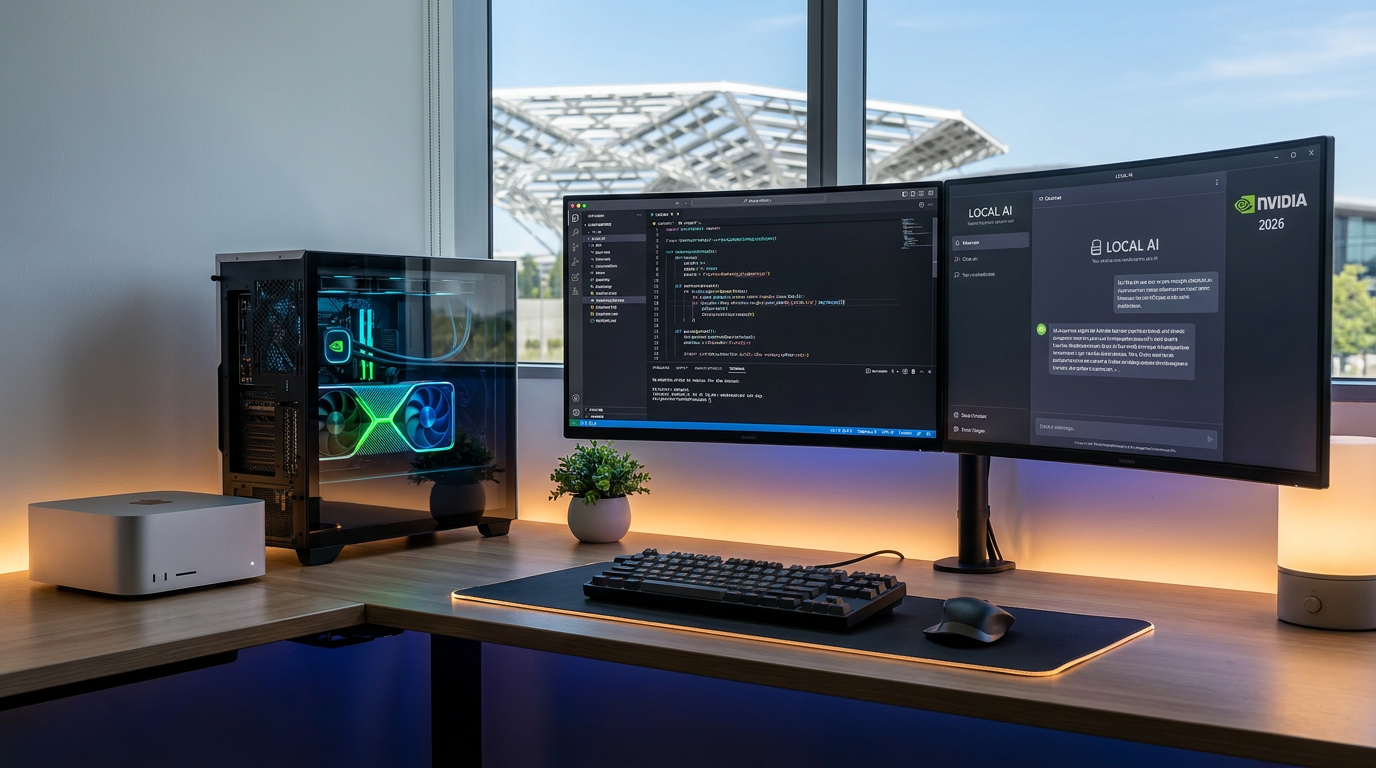
Hardware requirements have consequently become surprisingly accessible for the average professional. To run a highly capable 8-billion parameter model, users only need about 8 GB of Video RAM (VRAM) on a PC graphics card, or 16 GB of unified memory on an Apple Silicon Mac.[4]

For heavier workloads, such as Meta's Llama 4 Scout—a 109-billion parameter Mixture-of-Experts (MoE) model—enthusiasts and enterprise teams are utilizing 24 GB consumer cards like the RTX 4090, or Mac Studios equipped with abundant unified memory.[4]
The 2026 open-weight model landscape is fiercely competitive and incredibly capable. Models like Meta's Llama 4, Google's Gemma 4, and Alibaba's Qwen 3.5 are routinely matching or beating GPT-4-class models on coding, summarization, and structured data extraction benchmarks.[3][4]
Apple has also aggressively entered the local AI space at the operating system level. With the release of iOS 26 and macOS 17, Apple's Foundation Models framework allows third-party developers to natively access a 20-billion parameter sparse on-device model without requiring users to download third-party tools.[5]
This native integration means iPhone and Mac applications can perform complex text and image reasoning entirely offline. Developers can route tasks through the device's Neural Engine, ensuring zero API costs and near-instantaneous latency for the end user.[5]

The primary advantage of this entire local ecosystem is absolute privacy. Because the prompt never leaves the machine, developers can safely feed proprietary codebases, financial documents, and personal health data into the model without violating compliance frameworks like GDPR or HIPAA.[2]
Cost control is the other major driver accelerating adoption. Heavy API users and enterprise teams can easily rack up thousands of dollars in monthly inference fees. With a local setup, the cost drops to exactly zero after the initial hardware investment, allowing for infinite, unmetered experimentation.[2]
Speed also consistently surprises first-time users. Because local inference skips the network round-trip entirely, a well-configured local model can deliver first-token latency under 40 milliseconds—significantly faster than waiting for a cloud server to process and return a response.[1]
However, local AI is not a complete replacement for the cloud. For the hardest, multi-step reasoning tasks, massive frontier models running in centralized data centers still hold a distinct edge over what can fit on a laptop.[4][5]

How we got here
Early 2023
llama.cpp is released, proving that large language models can run efficiently on consumer CPU hardware.
Mid 2024
Tools like Ollama and LM Studio launch, replacing complex Python setups with simple, one-click installers.
Late 2025
GGUF quantization becomes the industry standard, allowing massive models to fit into standard laptop RAM.
June 2026
Apple integrates on-device LLMs natively into iOS 26, while Meta's Llama 4 MoE models push local performance to GPT-4 levels.
Viewpoints in depth
Open-Source Advocates
AI must be democratized and decentralized so no single corporation controls the world's reasoning engines.
This camp views local LLMs as a fundamental defense against corporate monopolies. By ensuring that powerful models can run on consumer hardware, they argue that developers and individuals can build tools without relying on the permission, pricing, or censorship guidelines of massive tech conglomerates. The open-source community actively collaborates to compress and optimize these models, pushing the boundaries of what a standard laptop can achieve.
Enterprise IT & Security
Local models are primarily a risk-mitigation tool to keep proprietary data within company firewalls.
For corporate security teams, the appeal of local AI has nothing to do with ideology and everything to do with compliance. Sending sensitive customer data, proprietary source code, or internal financial documents to a cloud API introduces unacceptable security risks and potential GDPR violations. By running models on-premises, enterprises can leverage the productivity boosts of AI while maintaining absolute control over their data.
Cloud AI Providers
Frontier intelligence and complex agentic workflows will always require massive data centers.
While acknowledging the utility of local models for basic tasks, cloud providers emphasize the physical limits of consumer hardware. They argue that true frontier reasoning—such as complex multi-step logic, massive context windows, and advanced agentic loops—requires the compute power of thousands of synchronized GPUs. In their view, local AI is a useful edge-computing complement, but the most transformative AI breakthroughs will remain firmly in the cloud.
What we don't know
- Whether future frontier models will become too large to effectively quantize for consumer hardware.
- How upcoming AI regulations might impact the open-source distribution of powerful local models.
- The exact timeline for when neural processing units (NPUs) will fully replace GPUs for local AI inference.
Key terms
- Quantization
- A compression technique that reduces the precision of an AI model's weights, allowing it to run on hardware with significantly less memory.
- GGUF
- The standard file format for storing quantized language models, optimized for fast loading and execution on consumer hardware.
- VRAM (Video RAM)
- The dedicated memory on a graphics card, which is the primary bottleneck for running AI models quickly.
- Mixture of Experts (MoE)
- An AI architecture that only activates a small portion of its neural network for any given prompt, drastically improving speed and reducing memory usage.
- Inference
- The actual process of an AI model generating text or analyzing data, as opposed to the initial 'training' phase.
Frequently asked
Do I need an internet connection to use a local LLM?
No. Once you download the model weights to your machine, the AI runs entirely offline without pinging any external servers.
Can I run these models on a Mac?
Yes. Apple Silicon Macs (M1 and newer) are exceptionally good at running local AI because their unified memory architecture allows the GPU to access all available system RAM.
Is Ollama better than LM Studio?
They serve different needs. Ollama is a command-line tool ideal for developers building apps, while LM Studio provides a user-friendly graphical interface similar to ChatGPT.
Are local models as smart as ChatGPT?
For most everyday tasks like coding, summarizing, and writing, 2026's local models match the performance of GPT-4. However, cloud models still win on highly complex, multi-step reasoning.
Sources
Source coverage
7 outlets
3 viewpoints surfaced







[1]techsy.ioEnterprise IT & Security
Run LLMs Locally 2026: The 5-Minute Setup for Any GPU
Read on techsy.io →[2]daily.devEnterprise IT & Security
Running LLMs Locally in 2026: Ollama, llama.cpp, and Self-Hosted AI
Read on daily.dev →[3]pinggy.ioOpen-Source Advocates
Top 5 Local LLM Tools in 2026
Read on pinggy.io →[4]osher.com.auCloud AI Providers
Choosing a Llama Model in 2026: Hardware Requirements
Read on osher.com.au →[5]ofox.aiCloud AI Providers
Apple's AFM 3 lineup at WWDC 2026
Read on ofox.ai →[6]contabo.comOpen-Source Advocates
Ollama vs LM Studio: Local LLM Runtime Comparison
Read on contabo.com →[7]Factlen Editorial TeamOpen-Source Advocates
Synthesis by Factlen editorial team
Read on Factlen Editorial Team →

Every angle. Every day.
Get ai stories with full source coverage and perspective breakdowns delivered to your inbox.