
How Next-Generation Geothermal Energy is Unlocking 24/7 Clean Power
By borrowing drilling techniques from the oil and gas industry, engineers are manufacturing artificial geothermal reservoirs in hot, dry rock. This breakthrough technology could soon provide massive amounts of carbon-free electricity anywhere on the map.
By Factlen Editorial Team
- Geothermal Developers
- Argue that with oil and gas drilling techniques, geothermal can rapidly scale to provide massive amounts of dispatchable clean power.
- Energy System Analysts
- Emphasize the critical grid need for 24/7 clean firm power to complement intermittent renewables like wind and solar.
- Geosciences & Research
- Focus on the physical mechanics, extreme-environment monitoring, and next-generation drilling technologies required to safely tap superhot rock.
What's not represented
- · Local communities living near proposed EGS sites
- · Fossil fuel workers transitioning to the geothermal sector
Why this matters
As the world transitions to renewable energy, the grid desperately needs power sources that run 24/7 to back up intermittent wind and solar. Next-generation geothermal has the potential to provide massive amounts of this 'clean firm power' anywhere on the map, fundamentally solving the hardest part of decarbonization.
Key points
- Next-generation geothermal uses oil and gas drilling techniques to create artificial reservoirs in hot, dry rock.
- The technology allows geothermal plants to be built almost anywhere, bypassing the need for natural volcanic hot springs.
- Fervo Energy's Cape Station in Utah will bring the first 53 megawatts of commercial EGS power online in June 2026.
- Drilling costs have plummeted by 70% since 2022, making the technology increasingly competitive with fossil fuels.
- The U.S. Department of Energy estimates advanced geothermal could provide 90 gigawatts of clean, firm power by 2050.
The grid's biggest challenge isn't generating clean energy; it's generating it at 2 a.m. on a windless night. For decades, the holy grail of the energy transition has been "clean firm power"—electricity that is carbon-free but available 24/7.[4][5][9]
Historically, geothermal energy fit that bill perfectly, but it came with a massive geographic catch. Conventional geothermal plants rely on naturally occurring underground reservoirs of hot water and steam, restricting them to volcanic regions or tectonic fault lines like those in Iceland or California.[1][4][5]
But a quiet revolution has been brewing beneath the surface. By borrowing horizontal drilling and hydraulic fracturing techniques from the oil and gas shale boom, engineers have figured out how to manufacture geothermal reservoirs where none naturally exist.[1][3][4]
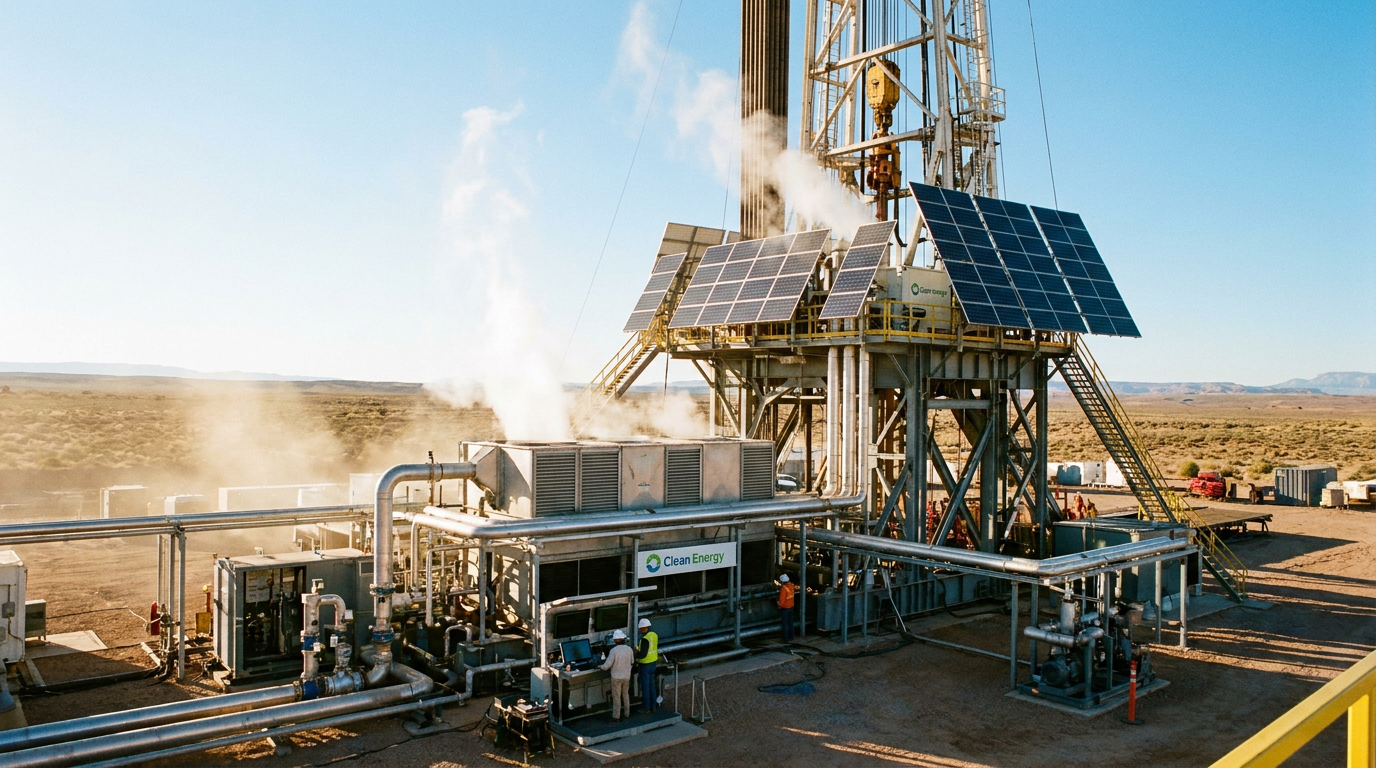
This technology, known as Enhanced Geothermal Systems (EGS), is now crossing the threshold from experimental pilot to commercial reality. In June 2026, Fervo Energy is scheduled to bring the first phase of its Cape Station project online in Utah, delivering 53 megawatts of continuous power to the grid.[1][7][8]
The mechanism behind EGS is elegantly brute-force. Instead of hunting for natural underground aquifers, developers drill thousands of feet into hot, dry, impermeable rock. They inject fluid under high pressure to create a network of millimeter-thick fractures, essentially building an artificial subterranean radiator.[3][4][7]

Cold water is pumped down an injection well, forced through the newly created hot rock fractures where it absorbs the earth's heat, and then drawn back up a production well to spin a turbine at the surface.[3][7]
The commercial momentum is accelerating rapidly. Fervo Energy recently filed for a $1.33 billion initial public offering, targeting a valuation of up to $6.5 billion. The company enters the public market armed with 658 megawatts of binding power purchase agreements and a 3-gigawatt framework agreement with Google.[7]
This financial backing is driven by hard operational data. In April 2026, developers released two years of production data from Project Red, the world's longest-running EGS site in Nevada. The data confirmed zero thermal decline, validating the fundamental physics of EGS at a commercial scale.[8]
In April 2026, developers released two years of production data from Project Red, the world's longest-running EGS site in Nevada.
The economics are also shifting favorably. Between 2022 and 2025, the industry saw drilling times plummet by 75% and per-foot drilling costs drop by 70%. By standardizing well designs and applying iterative learning from the oil patch, EGS is shedding its reputation as a prohibitively expensive science experiment.[3]

The potential scale of this resource is staggering. The U.S. Department of Energy estimates that next-generation geothermal could cost-effectively grow to 90 gigawatts by 2050—enough to power tens of millions of homes. High-end estimates suggest it could eventually reach 300 gigawatts, fundamentally rewiring the American energy mix.[3][4]
Beyond EGS, researchers are already looking toward the next frontier: superhot rock geothermal. This involves drilling even deeper to reach rock exceeding 400 degrees Celsius, where water enters a "supercritical" state that can carry significantly more energy per well.[2][3]
Reaching those depths requires entirely new technologies. MIT spinout Quaise Energy is developing millimeter-wave drilling, which uses directed microwave energy to literally vaporize rock, potentially bypassing the mechanical limits of traditional drill bits.[2]
Despite the optimism, the industry faces substantial hurdles. Capital expenditures remain daunting; a next-generation geothermal project can cost upwards of $8.7 million per megawatt to build, compared to roughly $1.8 million for onshore wind.[5]
Furthermore, the process of fracturing deep rock—known as induced seismicity—requires rigorous monitoring. To address this, geophysicists at the Lawrence Berkeley National Laboratory recently achieved a major breakthrough, successfully deploying a custom seismometer 7,000 feet underground at 338 degrees Fahrenheit for seven continuous months.[6]

This high-temperature monitoring ensures that the micro-fractures created during EGS development remain safe and contained, providing regulators and local communities with the data needed to confidently expand operations.[6]
Permitting also remains a bottleneck. Because many of the most promising geothermal resources in the U.S. are located on federal lands, projects often face lengthy environmental reviews and overlapping agency jurisdictions that can delay deployment by years.[3][4]
How we got here
2023
Fervo Energy begins delivering power to the grid from Project Red, an early EGS pilot in Nevada.
March 2024
The U.S. Department of Energy releases a report estimating EGS could provide 90 gigawatts of power by 2050.
February 2026
Lawrence Berkeley National Laboratory completes a record-breaking 7-month continuous seismic monitoring at 338°F.
April 2026
Fervo Energy releases two years of production data proving zero thermal decline at its Project Red site.
June 2026
The first 53-megawatt phase of the Cape Station EGS project is scheduled to come online in Utah.
Viewpoints in depth
Geothermal Developers' View
Scaling through oil and gas technology.
Companies like Fervo Energy argue that the fastest way to scale clean energy is to repurpose the workforce and technology of the fossil fuel industry. By applying horizontal drilling and hydraulic fracturing—techniques perfected during the shale boom—developers believe they can drive down costs exponentially. They point to recent data showing a 70% reduction in drilling costs as proof that EGS is following the same rapid learning curve that made solar and wind economically dominant.
Energy System Analysts' View
Solving the 'clean firm' grid problem.
Grid operators and energy analysts view next-generation geothermal as the missing puzzle piece in the energy transition. While wind and solar are cheap, their intermittency requires massive battery storage or fossil-fuel backups. Analysts argue that a grid powered by 100% clean energy is mathematically impossible without 'firm' sources that run 24/7. They emphasize that even if EGS has higher upfront capital costs than solar, its high capacity factor and low land-use footprint make it highly valuable to the overall system.
Geosciences & Research View
Pushing the boundaries of extreme environments.
Researchers are focused on the physical limits of the earth's crust. While current EGS taps rock at around 200 degrees Celsius, scientists at institutions like MIT and national laboratories are looking toward 'superhot rock' exceeding 400 degrees. They emphasize that safely reaching these depths requires entirely new paradigms, such as millimeter-wave drilling that vaporizes rock, and advanced seismometers that can survive extreme heat to monitor induced micro-earthquakes and ensure the structural integrity of the artificial reservoirs.
What we don't know
- Whether the massive upfront capital costs of EGS can be reduced enough to compete directly with cheap natural gas without subsidies.
- How quickly federal and state agencies can streamline the permitting process for geothermal projects on public lands.
- If experimental 'superhot rock' drilling technologies, like millimeter-wave vaporization, can successfully transition from the lab to the field.
Key terms
- Enhanced Geothermal Systems (EGS)
- A technology that creates artificial underground reservoirs by injecting fluid into hot, dry rock to extract heat for electricity generation.
- Clean Firm Power
- Electricity that is both carbon-free and available 24/7, regardless of weather conditions.
- Induced Seismicity
- Minor, typically imperceptible earthquakes caused by human activity, such as the hydraulic fracturing used to create EGS reservoirs.
- Superhot Rock Geothermal
- An experimental frontier of geothermal energy that involves drilling into rock exceeding 400 degrees Celsius to extract exponentially more energy.
- Capacity Factor
- The ratio of an energy plant's actual electrical output over a period of time to its maximum possible output, which is exceptionally high for geothermal.
Frequently asked
What is the difference between conventional and next-generation geothermal?
Conventional geothermal relies on naturally occurring underground pools of hot water, which are geographically rare. Next-generation geothermal, or EGS, creates artificial reservoirs by injecting water into deep, hot, dry rock, allowing it to be built almost anywhere.
Does enhanced geothermal cause earthquakes?
The fracturing process creates 'microseismic' events, which are typically too small to be felt at the surface. Projects use advanced deep-underground seismometers to continuously monitor the rock and ensure the fractures remain safe and contained.
Why is geothermal energy important if we have wind and solar?
Wind and solar are intermittent, meaning they only generate power when the sun shines or the wind blows. Geothermal provides 'clean firm power,' meaning it runs 24/7, providing a reliable baseload to stabilize the grid.
Is next-generation geothermal expensive?
Currently, the upfront capital costs are high—roughly $8.7 million per megawatt compared to $1.8 million for wind. However, developers have reduced drilling costs by 70% in recent years, and the technology is expected to become highly cost-competitive as it scales.
Sources
Source coverage
9 outlets
3 viewpoints surfaced









[1]U.S. Energy Information AdministrationEnergy System Analysts
Enhanced geothermal systems could expand geothermal power generation
Read on U.S. Energy Information Administration →[2]MIT NewsGeosciences & Research
Next-generation geothermal energy: Promise, progress, and challenges
Read on MIT News →[3]Information Technology and Innovation FoundationGeosciences & Research
Advanced Geothermal Energy Is Widely Available, Clean, and Maybe Cheap Enough to Make a Big Impact
Read on Information Technology and Innovation Foundation →[4]World Resources InstituteEnergy System Analysts
Next-Generation Geothermal Can Help Unlock 100% Clean Power
Read on World Resources Institute →[5]BloombergNEFEnergy System Analysts
Next-Generation Geothermal Technologies Are Heating Up
Read on BloombergNEF →[6]Lawrence Berkeley National LaboratoryGeosciences & Research
Scientists Develop New Technology to Continuously Monitor Geothermal Energy Operations
Read on Lawrence Berkeley National Laboratory →[7]CarbonCredits.comGeothermal Developers
Fervo Energy's $1.3 Billion IPO Signals a Geothermal Breakthrough
Read on CarbonCredits.com →[8]Fervo EnergyGeothermal Developers
Enhanced Geothermal Has Been Proven at Scale. Here's What Two Years of Production Data Show.
Read on Fervo Energy →[9]Factlen Editorial Team
Synthesis by Factlen editorial team
Read on Factlen Editorial Team →
Every angle. Every day.
Get energy stories with full source coverage and perspective breakdowns delivered to your inbox.