
Hardside vs. Softside Luggage: The Complete Trade-Off Analysis
Choosing between a rigid shell and a flexible fabric suitcase dictates how you pack, how you navigate the airport, and how your belongings survive the journey.
By Factlen Editorial Team
- Durability Advocates
- Travelers who prioritize safeguarding fragile items and weather resistance over packing flexibility.
- Capacity Maximizers
- Travelers who value expandability, exterior pockets, and the ability to squeeze bags into tight spaces.
- Material Pragmatists
- Analysts who focus on the specific chemical and structural trade-offs of polycarbonate versus nylon.
What's not represented
- · Luggage Repair Technicians
- · Airline Baggage Handlers
Why this matters
Luggage is the foundational tool of travel, and selecting the wrong material can lead to gate-checked bags, crushed electronics, or a frustrating lack of space in cramped hotel rooms. Understanding this trade-off directly impacts the ease, cost, and security of your next journey.
Key points
- Hardside luggage, typically made of polycarbonate or ABS, offers superior impact protection and weather resistance.
- Softside luggage, crafted from nylon or polyester, provides greater packing flexibility and exterior pockets for quick access.
- Hardside suitcases almost exclusively use a clamshell design, requiring double the floor space to open fully.
- Softside bags usually feature a top-lid opening, making them easier to pack and unpack in cramped hotel rooms.
- Weight differences have largely equalized, with premium hardside and softside carry-ons both averaging around seven to nine pounds.
The modern traveler faces a dizzying array of luggage options, but the foundational choice happens long before selecting a brand, color, or wheel count: hardside versus softside. This single decision dictates how you pack, how you navigate the airport, and how your belongings survive the journey.[1][2]
The market has shifted dramatically over the last decade. Hardshell suitcases, once a luxury niche dominated by heavy aluminum, have exploded in popularity thanks to the advent of lightweight plastics. Yet softside luggage remains the quiet workhorse of the travel industry, heavily favored by flight crews and chronic overpackers alike.[4][6]
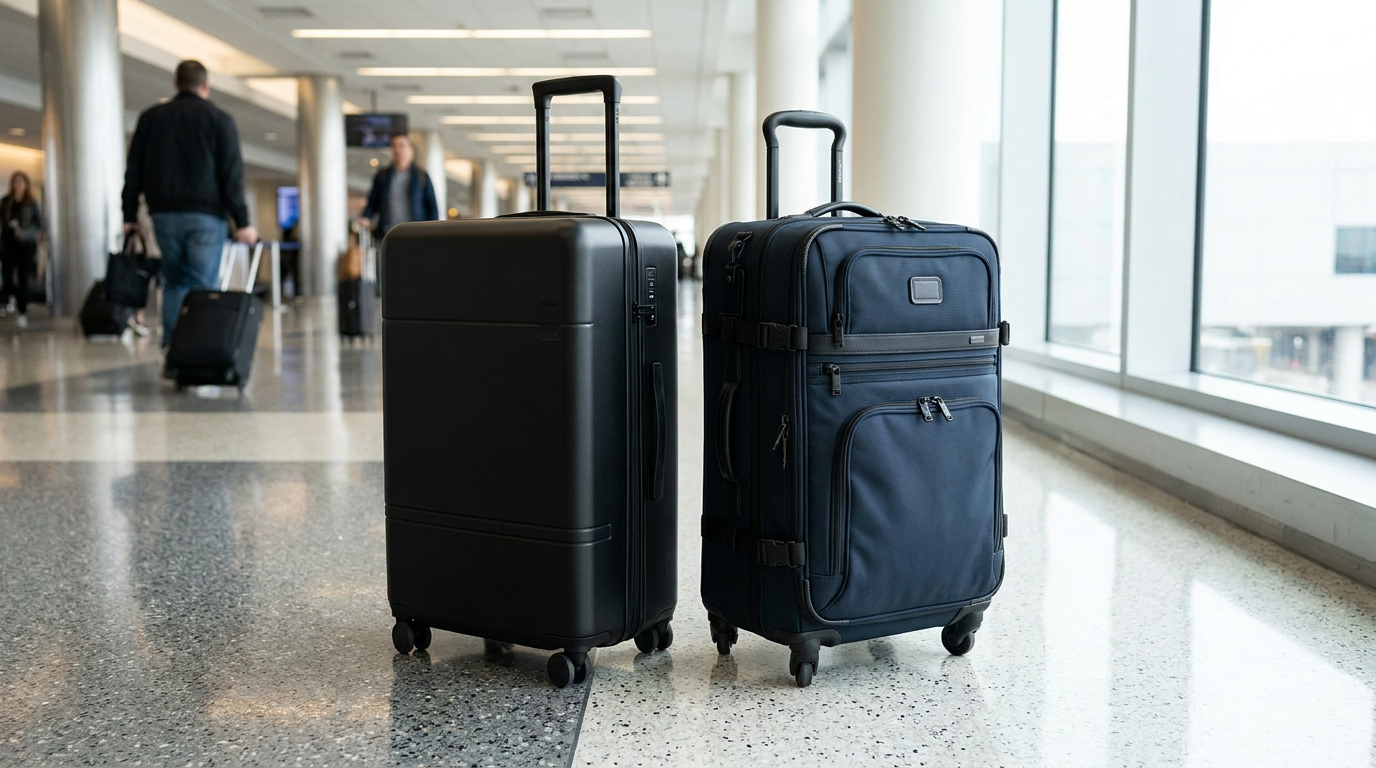
To understand the trade-offs, one must first look at the materials. Hardside luggage is typically constructed from ABS plastic, polycarbonate, or aluminum. Polycarbonate is currently the industry gold standard, offering a molecular structure that flexes under pressure rather than shattering, effectively absorbing the blunt force of a baggage carousel drop.[3][5]

Softside luggage, conversely, relies on woven fabrics—most commonly ballistic nylon, Cordura, or polyester. High-denier nylon provides exceptional tear resistance and a lightweight profile. While it lacks the rigid armor of a plastic shell, a high-quality nylon bag utilizes a hidden internal frame to maintain its shape while allowing the fabric to stretch.[3][8]
When evaluating hardside luggage, the argument for it centers on absolute protection and weather resistance. The rigid exterior acts as a fortress for fragile items, from laptops to glass souvenirs. Furthermore, a polycarbonate shell is inherently waterproof, allowing the bag to sit on a rain-soaked tarmac without compromising the clothing inside.[2][7]
The argument against hardside luggage revolves around spatial inefficiency and exterior wear. Because the shell cannot stretch, the packing volume is strictly capped. Additionally, while the material protects the contents, the glossy or matte finishes are highly susceptible to visible scratches, scuffs, and permanent dents.[4][6]
The evidence from consumer testing labs confirms that while hardside bags survive crush tests better, they fail at accommodating last-minute additions. A rigid suitcase that is slightly overpacked simply will not zip shut, forcing travelers to leave items behind or upgrade to a larger checked bag.[4][5]

Conversely, the case for softside luggage is built on flexibility, expandability, and accessibility. Fabric bags can stretch to accommodate an extra pair of shoes, and many feature zippered expansion gussets that add up to two inches of depth. Crucially, softside bags almost universally feature exterior pockets, allowing travelers to instantly access passports, liquids, or tablets without exposing their underwear to the entire departure lounge.[1][6]
Conversely, the case for softside luggage is built on flexibility, expandability, and accessibility.
The argument against softside highlights its vulnerability to the elements and blunt impact. Fabric can absorb spills, hold onto odors, and eventually fray at the seams. If a softside bag is crushed under heavier suitcases in the cargo hold, the pressure transfers directly to the items inside, risking damage to anything delicate.[3][7]
The evidence regarding softside longevity shows a mixed reality. While the fabric itself resists the cosmetic scratches that plague hardshells, a tear from a sharp conveyor belt edge is often fatal to the bag's structural integrity. However, premium ballistic nylon has proven resilient enough to last decades under heavy use.[5][8]
Beyond the exterior material, the two styles dictate fundamentally different packing philosophies. Hardside luggage almost exclusively utilizes a clamshell design, splitting the storage volume into two equal halves. This requires opening the suitcase completely flat like a book, which demands significant floor space—a luxury rarely found in boutique hotel rooms or cruise ship cabins.[1][4]

Softside luggage typically employs a top-lid design, featuring one deep main compartment accessed by unzipping a front panel. This allows travelers to place the suitcase on a luggage rack or against a wall and easily dig through their belongings without sprawling across the entire room.[4][6]
Weight is another critical metric in the trade-off analysis. Historically, softside luggage was significantly lighter. However, modern polycarbonate has closed the gap. Today, a premium hardside carry-on might weigh between seven and eight pounds, while a comparable softside bag weighs roughly the same, as the heavy internal metal frames required to support the fabric offset the weight savings of the nylon.[3][5]
For travelers navigating strict international weight limits, where carry-ons are often capped at seven to eight kilograms total, every empty ounce matters. In these scenarios, ultra-lightweight softside bags without heavy internal framing still hold a slight mathematical advantage, allowing for an extra outfit or heavier electronics.[3][7]

Ultimately, the hardside suitcase fits well when your itinerary involves checking bags, transporting fragile items, or traveling to destinations with unpredictable, wet weather. It is the optimal choice for the business traveler who prioritizes a sleek, professional aesthetic and needs absolute assurance that their presentation materials will arrive uncrushed.[2][7]
Hardside luggage does not fit well when you are traveling exclusively with a carry-on and need to squeeze the bag into a crowded overhead bin on a regional jet. The rigid frame will not compress, meaning a bag that is even half an inch too thick will be gate-checked.[5][6]
The softside suitcase fits well when you are a chronic overpacker, a souvenir hunter, or someone who relies heavily on exterior pockets for airport navigation. It thrives on road trips where bags must be wedged into the trunk of a car, and in tight accommodations where a top-lid opening is a logistical necessity.[1][6]
Viewpoints in depth
Durability Advocates
Travelers who prioritize safeguarding fragile items and weather resistance over packing flexibility.
This camp argues that the primary function of luggage is to act as a protective vault. They point to the rise of 100% polycarbonate shells as a turning point, offering a material that flexes under the weight of other bags in the cargo hold but snaps back into shape without crushing the contents. For these travelers, the inability to overpack is seen as a feature, not a bug, enforcing packing discipline while ensuring that laptops, camera gear, and souvenirs survive the brutal reality of automated baggage handling systems and rain-soaked airport tarmacs.
Capacity Maximizers
Travelers who value expandability, exterior pockets, and the ability to squeeze bags into tight spaces.
Advocates for softside luggage view rigid shells as an unnecessary constraint. They emphasize the practical realities of modern travel: overhead bins are shrinking, and the ability to compress a nylon bag by half an inch can be the difference between carrying on and gate-checking. Furthermore, this group heavily values accessibility. The presence of exterior pockets allows them to navigate security checkpoints and retrieve in-flight entertainment without exposing their personal items to the public, making softside the undisputed champion of convenience.
Material Pragmatists
Analysts who focus on the specific chemical and structural trade-offs of polycarbonate versus nylon.
This camp focuses strictly on the engineering and chemical properties of the luggage. They argue that the debate is meaningless without specifying the exact materials. A cheap ABS hardshell will crack faster than a premium ballistic nylon softside will tear, making the broad 'hard vs. soft' debate reductive. They advocate for evaluating the denier count of fabrics and the flexibility of thermoplastic polymers, noting that high-grade polycarbonate and high-denier nylon both offer exceptional, albeit different, forms of longevity.
What we don't know
- How airlines might adjust overhead bin size regulations in the future, which could disproportionately affect rigid hardside carry-ons.
- Whether emerging sustainable materials, such as recycled ocean plastics or plant-based polymers, will match the durability of virgin polycarbonate.
- The exact impact threshold where a premium nylon fabric outperforms a budget ABS plastic shell in real-world baggage handling.
Key terms
- Polycarbonate
- A highly durable, flexible thermoplastic polymer used in premium hardside luggage that bends under impact rather than cracking.
- ABS (Acrylonitrile Butadiene Styrene)
- A cheaper, more rigid plastic used in budget hardside luggage that is lighter but more prone to shattering under stress.
- Ballistic Nylon
- A thick, synthetic nylon fabric originally developed for military body armor, prized in softside luggage for its extreme tear and abrasion resistance.
- Clamshell Design
- A suitcase configuration that opens perfectly in half, splitting the packing volume into two equal, shallow compartments.
- Denier
- A unit of measurement used to determine the fiber thickness of individual threads in fabric; a higher denier indicates a thicker, more durable material.
Frequently asked
Is hardside luggage completely waterproof?
While the polycarbonate or ABS shell itself is waterproof, the zippers and fabric seams are usually only water-resistant. In heavy rain, water can still seep through the zipper track unless it features a specialized rubberized seal.
Why do flight attendants usually use softside luggage?
Flight crews often prefer softside rollaboards because the fabric can compress to fit into tight crew storage areas, and the exterior pockets provide quick access to manuals, tablets, and travel documents during a flight.
Can a cracked hardside suitcase be repaired?
It depends heavily on the material. Cheaper ABS plastic tends to shatter or crack permanently and is difficult to patch. Polycarbonate is more resilient and flexes, but if it suffers a severe puncture, it usually requires a professional repair or a complete shell replacement.
Does softside luggage weigh less than hardside?
Historically yes, but modern advancements have leveled the field. A premium polycarbonate carry-on can weigh as little as 7 pounds, which is comparable to a structured ballistic nylon bag that requires a heavy internal metal frame to hold its shape.
Sources
Source coverage
8 outlets
3 viewpoints surfaced







[1]TravelproCapacity Maximizers
Hardside vs Softside Luggage - What's Best for You?
Read on Travelpro →[2]ForbesDurability Advocates
Hardside Vs. Softside Luggage: Overview
Read on Forbes →[3]Delsey ParisDurability Advocates
What's the Difference Between Hardside and Soft-Side Luggage?
Read on Delsey Paris →[4]BestReviewsCapacity Maximizers
Hardside vs. softside luggage: Which is best?
Read on BestReviews →[5]Traveler's ChoiceMaterial Pragmatists
Hard Shell vs Soft Shell Luggage: Side-by-Side Comparison
Read on Traveler's Choice →[6]Reader's DigestCapacity Maximizers
What to consider when deciding between hard vs. soft luggage
Read on Reader's Digest →[7]Explorer LuggageDurability Advocates
Pros and Cons of Hardside Luggage
Read on Explorer Luggage →[8]Luggage GuideMaterial Pragmatists
Polycarbonate vs. Nylon: A Quick Spec Showdown
Read on Luggage Guide →

More in shopping
See all 5 stories →


Every angle. Every day.
Get shopping stories with full source coverage and perspective breakdowns delivered to your inbox.