
The Rise of Institutional Forecasting: How Prediction Markets and 'Superforecasters' Are Revolutionizing Decision-Making
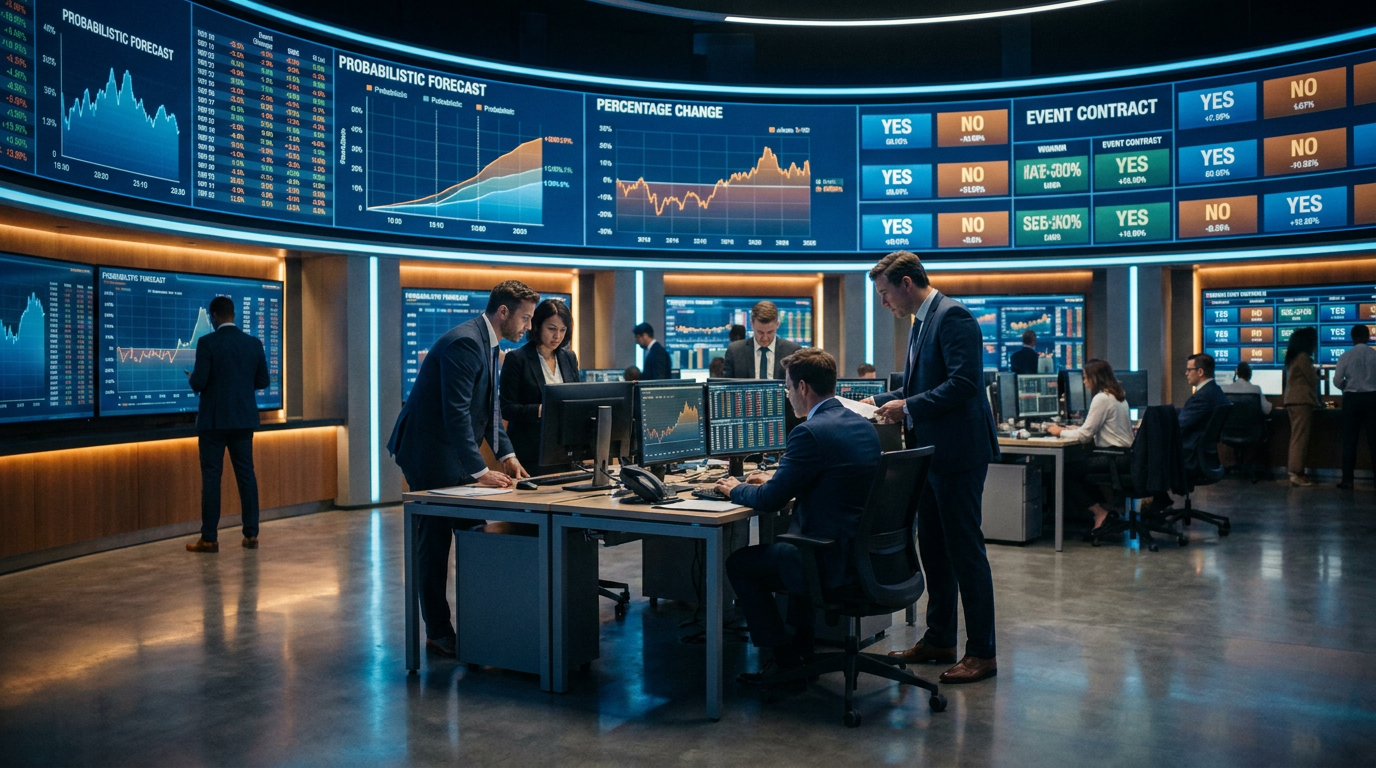
Driven by the explosive growth of prediction markets and structured forecasting tournaments, probabilistic forecasting is moving from a niche academic pursuit to a central pillar of global decision-making.
By Factlen Editorial Team
- Financial & Institutional Adopters
- Views prediction markets as a legitimate new asset class for hedging macroeconomic and geopolitical tail risks.
- Scientific Forecasters
- Values forecasting primarily as a scientific tool to generate accurate public knowledge, preferring reputation over financial speculation.
- Market Skeptics & Academics
- Warns that highly visible, high-volume markets can become decoupled from reality, attracting manipulation and 'dumb money.'
What's not represented
- · Traditional pollsters whose business models are threatened
- · Retail traders who use unregulated offshore platforms
Why this matters
By replacing vague punditry with precise, accountable probabilities, forecasting platforms are allowing institutions to allocate capital, fund scientific research, and manage geopolitical risks with unprecedented accuracy.
Key points
- Prediction market trading volume surged past $40 billion in 2025.
- Regulated platforms are building institutional trading terminals for hedge funds.
- Scientific platforms are using forecasting to allocate research funding.
- Superforecasters consistently outperform traditional experts and financial futures.
- The CFTC is shifting toward accommodating event contracts as legitimate financial tools.
For decades, the future was the domain of pundits, pollsters, and talking heads who traded in vague language and unaccountable predictions. But over the last two years, a quiet revolution in collective intelligence has fundamentally altered how institutions anticipate tomorrow. Driven by the explosive growth of prediction markets and the refined algorithms of structured forecasting tournaments, probabilistic forecasting has moved from a niche academic pursuit to a central pillar of global decision-making.[6]
The core mechanism is simple but profound: by aggregating the independent judgments of thousands of individuals—whether through financial 'skin in the game' or rigorous reputation tracking—these platforms consistently outperform traditional expert models. From anticipating central bank rate cuts to predicting the timeline of artificial general intelligence, the 'wisdom of the crowd' is proving to be a highly calibrated instrument.[3][6]
The definitive public test case arrived during the 2024 U.S. presidential election. While traditional polling aggregators struggled with systemic misses in swing states, prediction markets demonstrated remarkable precision. Polymarket, the largest crypto-based prediction platform, correctly called 49 of 50 states, pricing in the final outcome hours before major television networks.[3]
Academic research covering two decades of elections had long suggested that markets outperform polls, but the sheer scale of the 2024 cycle forced mainstream institutions to pay attention. The data proved that when thousands of individuals wager their own capital on a specific outcome, the resulting probability is often the most accurate signal available.[3][7]

That attention has translated into explosive financial growth. In 2025, combined trading volume across major platforms like Kalshi and Polymarket exceeded $40 billion—a staggering 400 percent year-over-year increase. This surge was driven not just by political events, but by a widening array of contracts covering economic indicators, corporate earnings, and cultural milestones.[1][4]
Kalshi, which operates as a federally regulated exchange under the Commodity Futures Trading Commission (CFTC), is now leading the push to institutionalize this asset class. In 2026, the company began developing a specialized trading terminal—described by insiders as a 'Bloomberg Terminal' for prediction markets. This infrastructure aims to provide hedge funds and asset managers with the real-time data feeds, advanced charting, and direct market access needed to hedge against specific macroeconomic or geopolitical tail risks.[4]
The regulatory environment is also shifting to accommodate this new reality. In early 2026, the CFTC withdrew a proposed rule that would have strictly prohibited political and sports-based event contracts, directing staff instead to draft clear standards for the burgeoning industry. This pivot reflects a growing recognition among regulators that event contracts provide economically useful information and serve as a legitimate tool for risk management, rather than mere gambling.[1]
The regulatory environment is also shifting to accommodate this new reality.
But financial markets are only half the story. In the realm of science and technology, reputation-based platforms like Metaculus are proving that you don't need money on the line to generate highly accurate forecasts. Founded by physicists, Metaculus operates as a public benefit corporation that rewards users with points and leaderboard rankings for their predictive accuracy over time.[2][6]

Metaculus excels at long-range, complex questions that financial markets struggle to price. The platform has been utilized to track the shifting timelines of artificial intelligence development, with the community's median estimate for the arrival of artificial general intelligence plummeting from 50 years away in 2020 to just five years by late 2024. The platform's historical accuracy is rigorously tracked using Brier scores—a metric where 0 is perfect accuracy—with Metaculus achieving an elite 0.107 on resolved questions through 2021.[2]
This epistemic rigor is now being applied to the allocation of scientific funding. In a recent collaboration with the Federation of American Scientists, Metaculus hosted a 'FRO-casting tournament' to evaluate proposals for Focused Research Organizations. By asking subject-matter experts and professional forecasters to score the tractability and potential impact of various scientific projects, the initiative aims to turn the notoriously opaque grant-making process into a quantifiable portfolio optimization problem.[2]
The underlying science of these platforms traces back to the Good Judgment Project, a research initiative led by University of Pennsylvania psychologist Philip Tetlock. Tetlock's work demonstrated that a small subset of individuals—dubbed 'superforecasters'—possess a unique cognitive profile that allows them to consistently predict geopolitical and economic events with astonishing accuracy.[5]

These superforecasters do not rely on insider information or deep domain expertise. Instead, they excel at breaking complex questions into manageable parts, updating their beliefs incrementally as new data emerges, and actively guarding against their own cognitive biases. In recent tracking, Good Judgment's superforecasters performed three times better than CME futures markets at predicting the U.S. Federal Reserve's target interest rate, doing so with significantly less volatility.[5]
The secret weapon of both Metaculus and the Good Judgment Project is the 'extremizing' algorithm. Rather than simply taking the median of all predictions, these platforms weight the forecasts of historically accurate users more heavily, and then push the aggregated probability slightly closer to 0 percent or 100 percent. This mathematical tweak compensates for the natural under-confidence of crowds, consistently producing a signal that beats both the average forecaster and elite intelligence analysts.[5][6]
Despite these successes, the ecosystem faces significant structural challenges. A recent cross-platform analysis of the 2024 election cycle revealed a troubling paradox: the most socially visible and highly capitalized prediction markets actually produced the least accurate forecasts compared to smaller, tightly capped platforms. This suggests that as markets become public spectacles, they can attract 'dumb money' or ideologically motivated traders who distort the epistemic signal.[7]
Furthermore, the line between a valuable public information good and an unregulated speculative casino remains fiercely contested. While platforms like Kalshi enforce strict compliance and ban insider trading, decentralized alternatives operate outside U.S. jurisdiction, raising concerns about market manipulation and the gamification of global crises.[1][4]
Yet, the trajectory is undeniable. The era of the unaccountable pundit is ending, replaced by a transparent, score-kept ecosystem where accuracy is the only currency that matters. As institutional capital flows into event contracts and scientific bodies integrate probabilistic forecasting into their strategic planning, collective intelligence is no longer just predicting the future—it is actively shaping how we navigate it.[4][6]
How we got here
2011–2015
The Good Judgment Project wins the IARPA forecasting tournament, proving the efficacy of 'superforecasters.'
2020
The CFTC grants Kalshi regulatory approval to operate as a Designated Contract Market in the U.S.
Nov 2024
Prediction markets successfully call 49 of 50 states in the U.S. presidential election, outperforming traditional polls.
2025
Combined trading volume across major prediction platforms surges past $40 billion.
Early 2026
The CFTC withdraws a proposed ban on political event contracts, signaling a shift toward industry accommodation.
Viewpoints in depth
Financial & Institutional Adopters
Views prediction markets as a legitimate new asset class for hedging macroeconomic and geopolitical tail risks.
This camp, which includes hedge funds, asset managers, and regulated exchanges like Kalshi, argues that event contracts provide a highly efficient mechanism for pricing risk. By allowing institutions to trade directly on the outcomes of economic data releases, central bank decisions, or geopolitical conflicts, these markets offer a way to hedge against specific tail risks that traditional equities or bonds cannot isolate. They advocate for clear regulatory frameworks that integrate prediction markets into the mainstream financial system.
Scientific Forecasters
Values forecasting primarily as a scientific tool to generate accurate public knowledge, preferring reputation over financial speculation.
Led by platforms like Metaculus and the Good Judgment Project, this perspective emphasizes the epistemic value of forecasting over its financial utility. They argue that financial incentives can sometimes distort predictions by encouraging market manipulation or short-term speculation. Instead, they rely on rigorous scoring systems, such as Brier scores, to identify and elevate the most accurate forecasters. This camp is actively working to integrate probabilistic forecasting into public policy, pandemic preparedness, and the allocation of scientific research funding.
Market Skeptics & Academics
Warns that highly visible, high-volume markets can become decoupled from reality, attracting manipulation and 'dumb money.'
While acknowledging the historical accuracy of prediction markets, this camp points to recent data suggesting that scale does not always equal precision. Academic researchers have found that as prediction markets become highly visible public spectacles, they often attract ideologically motivated traders who wager based on desired outcomes rather than objective probabilities. These skeptics caution against treating high-volume market prices as infallible truth, noting that smaller, tightly regulated platforms often produce more robust epistemic signals.
What we don't know
- Whether the CFTC will ultimately allow the full integration of political event contracts into mainstream brokerage accounts.
- How effectively prediction markets can resist coordinated manipulation by well-funded ideological actors as trading volumes grow.
- Whether the 'extremizing' algorithms that work well for geopolitical events can accurately price unprecedented scientific breakthroughs.
Key terms
- Prediction Market
- An exchange where users trade contracts based on the outcome of future events, using financial incentives to aggregate information.
- Brier Score
- A mathematical metric used to measure the accuracy of probabilistic forecasts, where a score of 0 indicates perfect accuracy and 1 indicates perfect inaccuracy.
- Superforecaster
- An individual who consistently demonstrates superior accuracy in predicting future events by using structured, bias-aware reasoning.
- Event Contract
- A financial derivative that pays out based on whether a specific real-world event, such as an election or economic data release, occurs.
- Calibration
- The degree to which a forecaster's assigned probabilities match the actual frequency of outcomes (e.g., events predicted to happen 70% of the time actually happen 70% of the time).
Frequently asked
Are prediction markets just a form of gambling?
While they share mechanics with betting, federally regulated prediction markets are classified as financial derivatives. They are increasingly used by institutions to hedge against real-world risks like inflation or supply chain disruptions.
How do superforecasters beat experts?
Superforecasters succeed not through insider knowledge, but through process. They break complex questions into smaller parts, constantly update their predictions with new data, and actively work to minimize their own cognitive biases.
Can prediction markets be manipulated?
Yes. High-volume markets can sometimes attract ideologically motivated traders who attempt to shift the odds. However, platforms combat this by imposing trading limits and using algorithms that weight the most historically accurate forecasters.
Sources
Source coverage
7 outlets
3 viewpoints surfaced







[1]KPMGFinancial & Institutional Adopters
U.S. prediction markets have undergone a dramatic transformation
Read on KPMG →[2]MetaculusScientific Forecasters
Forecasting Science and Technology: Asking $3 Trillion Questions
Read on Metaculus →[3]FuturattyFinancial & Institutional Adopters
Prediction Markets vs Traditional Forecasting: 2024-2025 Track Record
Read on Futuratty →[4]CNBCFinancial & Institutional Adopters
Kalshi Develops Prediction Markets Terminal for Institutional Traders, Source Says
Read on CNBC →[5]Built InScientific Forecasters
How the Good Judgment Project's Superforecasters Use Data to Make Predictions
Read on Built In →[6]Factlen Editorial TeamScientific Forecasters
Synthesis by Factlen editorial team
Read on Factlen Editorial Team →[7]arXivMarket Skeptics & Academics
Prediction markets as public information infrastructure: The decoupling of social authority from epistemic robustness
Read on arXiv →


Every angle. Every day.
Get meta stories with full source coverage and perspective breakdowns delivered to your inbox.