
How Massive New Wildlife Crossings Are Reconnecting North America's Ecosystems
A surge in infrastructure investment has led to the completion of record-breaking wildlife crossings across North America, dramatically reducing vehicle collisions and saving isolated animal populations.
By Factlen Editorial Team
- Conservation Ecologists
- Focus on genetic diversity and species survival, arguing that connecting landscapes is the only way to prevent localized extinctions.
- Transportation & Safety Officials
- Focus on human safety and economic efficiency, emphasizing that reducing wildlife collisions saves billions in damage and human lives.
- Public & Philanthropic Supporters
- Focus on community coexistence, highlighting massive grassroots fundraising efforts as proof that the public actively wants to heal the natural landscape.
What's not represented
- · Automotive Insurance Industry
- · Urban Developers
Why this matters
Wildlife-vehicle collisions cost billions of dollars and thousands of human injuries annually. By integrating ecological bridges into standard highway infrastructure, North America is solving a massive public safety crisis while preventing the extinction of local apex predators.
Key points
- Colorado completed North America's largest wildlife overpass over I-25 in late 2025.
- California's $114 million Wallis Annenberg crossing over the 101 freeway opens in December 2026.
- The Yellowstone to Yukon region now features 204 wildlife crossings, shrinking grizzly bear isolation gaps.
- Crossings can reduce wildlife-vehicle collisions by up to 90%, saving billions in economic damages.
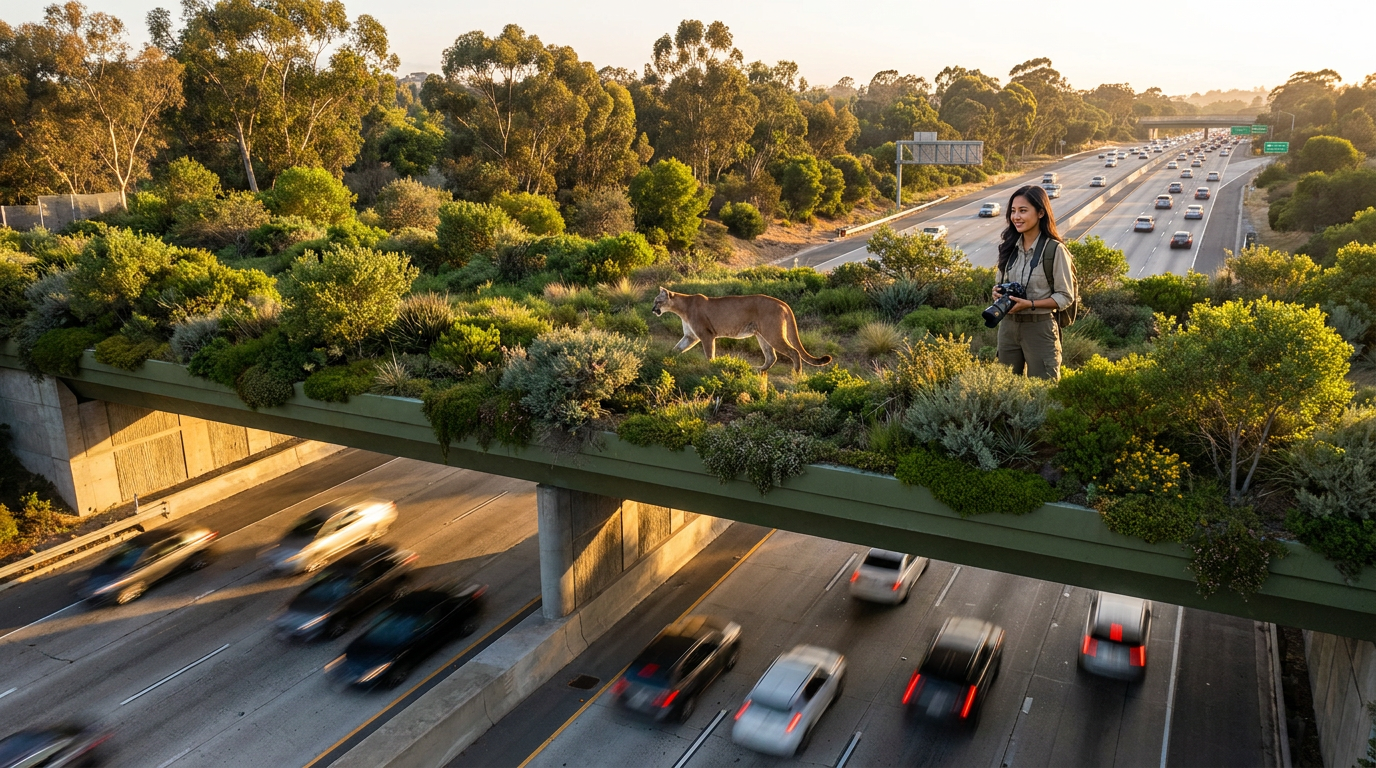
Driving down Interstate 25 in Colorado or the 101 freeway in Los Angeles, motorists are increasingly passing under massive new structures that look like floating forests. These are not pedestrian walkways or standard overpasses, but highly engineered ecological bridges designed to solve one of the modern era's most persistent infrastructure problems.[3][5]
The years 2025 and 2026 have marked a watershed moment for North American wildlife infrastructure. From the jagged peaks of the Canadian Rockies to the congested corridors of the Pacific coast, a quiet revolution in highway engineering is successfully reconnecting ecosystems that were severed decades ago.[4][7]
For nearly a century, multi-lane highways have acted as impenetrable concrete walls for wildlife. This barrier effect does more than just cause roadkill; it fundamentally isolates animal populations, preventing them from migrating, finding food, or seeking new mates, which inevitably leads to localized extinctions.[1][6]
The genetic crisis is perhaps most visible in Southern California, where the mountain lion population in the Santa Monica Mountains has been trapped by a perimeter of freeways. Biologists have documented severe signs of inbreeding among the isolated cats, including kinked tails and deformed reproductive organs, warning that the local population could face total collapse without immediate human intervention.[1]

Enter the modern wildlife crossing. These structures are not simple concrete slabs dotted with a few planters. They are complex, highly engineered landscapes designed to perfectly mimic the surrounding terrain, complete with deep native soil, carefully selected vegetation, and specialized sound barriers that block the roar and headlight glare of the traffic below.[5][8]
Different species require entirely different architectural approaches. While black bears and cougars will happily navigate tunnel-like underpasses, ungulates—large, hoofed prey animals like elk, moose, and pronghorn—instinctively fear enclosed spaces due to restricted mobility and poor sightlines. To feel safe from predators, they require wide, open-sky overpasses.[6][7]
However, a bridge alone is rarely enough to change animal behavior. The secret to a crossing's success lies in miles of eight-foot-high fencing stretching in both directions along the highway. This fencing acts as a gentle funnel, blocking dangerous ground-level crossings and guiding wandering animals directly toward the safe passage.[2][6]
The scale of these solutions is expanding rapidly. In December 2025, Colorado completed the I-25 Greenland Wildlife Overpass near Larkspur. Spanning six lanes of interstate traffic, it currently holds the title of the largest wildlife overpass in North America.[3][7]
In December 2025, Colorado completed the I-25 Greenland Wildlife Overpass near Larkspur.
Built specifically to accommodate the open-sky preferences of elk and pronghorn, the nearly one-acre Greenland structure connects 39,000 acres of habitat. Early data from the broader I-25 South Gap project demonstrates that these comprehensive crossing systems can reduce wildlife-vehicle collisions by up to 90 percent.[3]

Meanwhile, in Southern California, an even more ambitious project is nearing the finish line. The Wallis Annenberg Wildlife Crossing is preparing for its grand opening on December 2, 2026. Spanning ten lanes of the 101 freeway and adjacent Agoura Road, it is a $114 million public-private marvel.[1][8]
The Annenberg project has faced some public scrutiny over its price tag, which swelled due to inflation, labor constraints, and heavy rains. Yet, supporters argue the cost is entirely justified by the sheer scale of the endeavor—nearly 56,000 square feet of crossing over a corridor that carries 300,000 vehicles daily. To ensure the animals feel secure, there will be no public hiking trails or human access on the bridge.[5][8]
Remarkably, animals do not wait for the ribbon-cutting ceremonies. Even before these structures are fully vegetated, wildlife begins exploring them. In Northern California, a similar under-construction bridge in Siskiyou County saw mule deer successfully crossing just 15 hours after construction crews left for the day.[2]
The philosophy driving these massive infrastructure investments traces back to the 1993 Yellowstone to Yukon (Y2Y) Conservation Initiative. This collaborative effort pioneered the concept of "large landscape conservation," arguing that protecting isolated national parks was insufficient if the corridors between them remained severed.[4][6]
Y2Y's recent impact reports reveal staggering progress over the last three decades. There are now 204 wildlife crossings spanning busy roads across the Yellowstone to Yukon region, dramatically reducing collisions and allowing ecosystems to function as a cohesive whole.[4]
The ultimate metric of this success is genetic flow. In 1993, grizzly bear populations in the lower 48 states were separated by 150 miles of hostile, fragmented terrain. Today, thanks to strategic land purchases and the proliferation of highway crossings, that gap has shrunk to just 45 miles.[4]

Beyond the clear conservation victories, these crossings make undeniable economic sense. Wildlife-vehicle collisions cost North Americans billions of dollars annually in property damage, medical bills, and lost lives. Transportation officials note that a $20 million bridge effectively pays for itself in prevented accidents over its lifespan.[2][3]
How we got here
1993
The Yellowstone to Yukon Conservation Initiative is launched, pioneering the concept of large landscape conservation.
Earth Day 2022
Groundbreaking takes place for the Wallis Annenberg Wildlife Crossing over the 101 freeway in California.
December 2025
Colorado completes the I-25 Greenland Wildlife Overpass, the largest of its kind in North America.
December 2026
The Wallis Annenberg Wildlife Crossing is scheduled to officially open to wildlife.
Viewpoints in depth
Conservation Ecologists
Advocates for genetic diversity and species survival.
Biologists and ecologists argue that isolated parks are fundamentally insufficient for long-term ecological health. Without connected landscapes, apex predators like mountain lions and grizzly bears suffer from severe genetic isolation, leading to inbreeding and physical deformities. They view wildlife crossings not as a luxury, but as the only viable mechanism to prevent the localized extinction of these species in heavily developed regions.
Transportation & Safety Officials
Focused on human safety and infrastructure efficiency.
For highway engineers and state transportation departments, the primary metric of success is the reduction of wildlife-vehicle collisions. These accidents cost North Americans billions of dollars annually in property damage, medical bills, and lost lives. From this perspective, multi-million-dollar bridges are a net-positive financial investment, as a single crossing can reduce local collision rates by up to 90 percent, effectively paying for itself over its operational lifespan.
Public & Philanthropic Supporters
Champions of community coexistence and grassroots funding.
Advocates in the philanthropic space highlight the massive public enthusiasm for these projects as proof that communities actively want to heal the natural landscape. The Wallis Annenberg crossing, for example, received over $34 million in private donations from citizens and foundations. This camp argues that wildlife infrastructure represents a rare, unifying public good that bridges the gap between urban development and environmental stewardship.
What we don't know
- How long it will take for highly isolated populations, like the Santa Monica mountain lions, to fully recover their genetic diversity once the crossings open.
- Whether future federal infrastructure budgets will mandate wildlife crossings as a standard requirement for all new highway construction.
Key terms
- Ungulates
- Large, hoofed mammals such as elk, deer, and pronghorn, which typically require wide, open-sky crossings due to their prey instincts.
- Habitat Fragmentation
- The process by which large, continuous areas of natural environment are broken up into smaller, isolated patches, usually by human infrastructure like highways.
- Genetic Isolation
- A condition where a small population of animals cannot breed with outside groups, leading to inbreeding, physical deformities, and increased risk of extinction.
- Large Landscape Conservation
- An ecological strategy that focuses on connecting vast, multi-state or multi-national regions rather than just protecting small, isolated national parks.
Frequently asked
Do animals actually know to use the bridges?
Yes. Animals naturally follow terrain and vegetation. Miles of high fencing along the highway funnel them toward the crossing, and over time, mothers teach their young the safe routes.
Why do some crossings cost over $100 million?
Projects like the Wallis Annenberg crossing span 10 lanes of one of the world's busiest freeways. The cost includes seismic engineering, sound-dampening walls, engineered soil, and millions in utility relocations.
Why not just build tunnels instead of bridges?
While bears and cougars will use underpasses, large prey animals like elk and pronghorn fear enclosed spaces with poor sightlines. They require open-sky overpasses to feel safe from predators.
Sources
Source coverage
8 outlets
3 viewpoints surfaced







[1]Los Angeles TimesPublic & Philanthropic Supporters
The Wallis Annenberg Wildlife Crossing to open this December
Read on Los Angeles Times →[2]Smithsonian MagazinePublic & Philanthropic Supporters
The 'World's Largest Wildlife Crossing' Will Help Animals Walk Safely Over Eight Lanes of California Traffic
Read on Smithsonian Magazine →[3]Colorado Department of TransportationTransportation & Safety Officials
I-25 Greenland Wildlife Overpass completed ahead of schedule
Read on Colorado Department of Transportation →[4]Yellowstone to Yukon Conservation InitiativeConservation Ecologists
2025 Impact Report: Reconnecting fragmented landscapes
Read on Yellowstone to Yukon Conservation Initiative →[5]California Governor's OfficeTransportation & Safety Officials
Governor Newsom Announces Funding to Complete Wallis Annenberg Wildlife Crossing
Read on California Governor's Office →[6]Rewilding MagazineConservation Ecologists
How interconnected corridors are making a massive impact on multiple species
Read on Rewilding Magazine →[7]Born Free USAConservation Ecologists
Early 2026 Wildlife News Features Major Conservation Wins
Read on Born Free USA →[8]OK DiarioPublic & Philanthropic Supporters
The world's largest wildlife crossing finally has an opening date
Read on OK Diario →
Every angle. Every day.
Get world stories with full source coverage and perspective breakdowns delivered to your inbox.