
The Science of Pilates: How Low-Impact Core Training Reshapes Muscular Endurance and Longevity
Advanced biomechanical imaging reveals how Pilates thickens deep stabilizing muscles, offering a clinically proven pathway to reduce chronic back pain and improve functional mobility.
By Factlen Editorial Team
- Clinical Rehabilitation Specialists
- Value the Reformer as a therapeutic tool for isolating deep core muscles without overloading the spine.
- Functional Fitness Advocates
- Emphasize Mat Pilates for its accessibility and reliance on internal body awareness and unassisted gravity.
- Biomechanics Researchers
- Focus on quantifiable physiological changes, using imaging to prove Pilates increases muscle thickness.
What's not represented
- · Cardiovascular conditioning experts
- · High-intensity strength athletes
Why this matters
Chronic lower back pain is one of the leading causes of global disability. Understanding the mechanical differences between Mat and Reformer Pilates empowers individuals to choose the right evidence-based intervention for their specific mobility and rehabilitation needs.
Key points
- Pilates is clinically proven to reduce chronic lower back pain by strengthening deep stabilizing muscles.
- Ultrasound imaging shows Pilates increases the thickness of the transversus abdominis and multifidus.
- Reformer Pilates uses spring resistance to assist or challenge movements, making it ideal for rehabilitation.
- Mat Pilates relies entirely on body weight, demanding higher internal core control and spatial awareness.
Pilates is no longer just a boutique fitness trend; it has crossed the threshold into evidence-based medicine. With millions seeking relief from chronic back pain and postural decline, researchers are using advanced imaging to understand exactly how these precise movements remodel the human body. What was once considered an alternative practice is now a primary prescription in modern physical therapy.[8]
At the heart of the method is a concept known as core stability—the ability to activate deep trunk muscles before moving the extremities. Biomechanics researchers have discovered that Pilates specifically targets the transversus abdominis (TrA) and the lumbar multifidus, the deep muscular architecture responsible for bracing the spine against external loads.[2]
Recent studies utilizing rehabilitative ultrasound imaging (RUSI) have provided quantitative proof of this mechanism. After just six weeks of targeted Pilates training, participants demonstrate significant increases in the thickness and contraction timing of these deep stabilizing muscles. This physiological adaptation means the body learns to automatically protect the spine during everyday loaded movements, reducing the risk of sudden injury.[2]

This internal remodeling is why general practitioners and physiotherapists increasingly prescribe Pilates for chronic low back pain. Systematic reviews analyzing dozens of randomized controlled trials conclude that Pilates significantly decreases pain perception and functional disability compared to no exercise, offering a non-pharmacological pathway to relief.[3][4]
In structured clinical programs, meaningful improvements typically appear after four to eight weeks of practicing two to three times per week. The spring-resistance system of the Pilates reformer is widely used for this back pain rehabilitation, as it allows patients to build strength without overloading compromised joints.[5][7]

As patients and fitness enthusiasts explore the practice, they inevitably encounter the primary divide in the Pilates world: Mat versus Reformer. Both modalities share the same foundational principles of breath, control, and precision, but they apply mechanical stress to the body in fundamentally different ways.[1][6]
As patients and fitness enthusiasts explore the practice, they inevitably encounter the primary divide in the Pilates world: Mat versus Reformer.
Mat Pilates requires no equipment, relying entirely on gravity and body weight. Because there is no external mechanical assistance, practitioners must generate all their core control internally. This places a high demand on proprioception—the body's spatial awareness—and requires significant muscular endurance to execute classic, unassisted movements.[7]
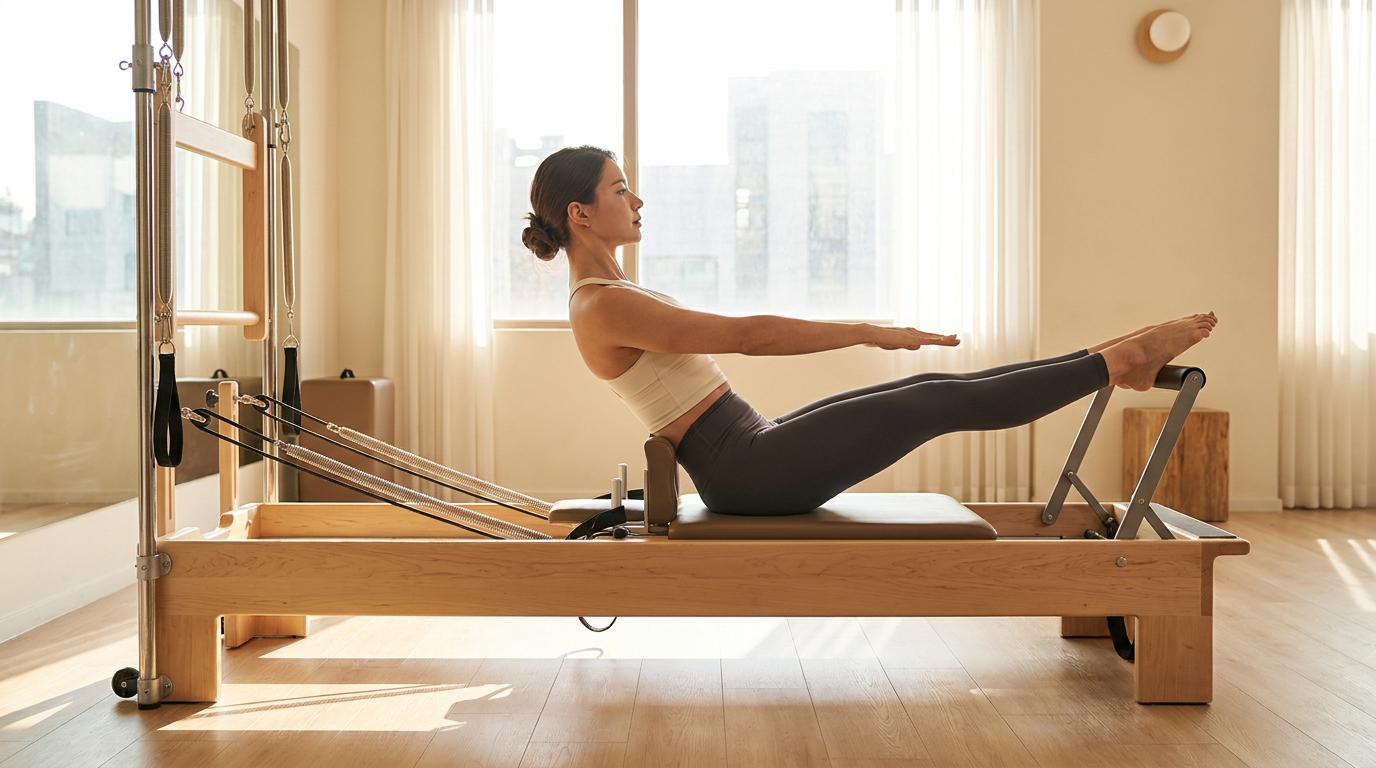
Reformer Pilates, conversely, utilizes a specialized machine featuring a sliding carriage and a system of adjustable springs. This spring-resistance system is a double-edged sword: it can provide external support to assist a movement, or it can add heavy resistance to challenge the muscles further.[1][5]

For individuals recovering from injury or managing severe back pain, the Reformer often provides a safer entry point. The machine's support makes it easier to maintain proper spinal alignment, and the lying or seated positions reduce compressive loads on the vertebrae. The springs can literally hold the weight of a patient's legs while they focus entirely on isolating their deep core.[5]
The Reformer also offers distinct advantages for flexibility. The sliding nature of the carriage allows practitioners to achieve deeper, assisted stretches under tension—such as lunges and splits—that are difficult to replicate on a static mat.[6][7]
Studies show that this "loaded mobility" translates to highly usable flexibility. Rather than just passively stretching a muscle, the nervous system learns to control the newly acquired range of motion against the resistance of the springs, improving agility, balance, and precise coordination in daily life.[1][8]

Despite the Reformer's clinical advantages, Mat Pilates remains highly effective and accessible. Many successful rehabilitation programs use the Reformer to build initial strength and body awareness, eventually transitioning patients to Mat work once their stabilizing muscles are sufficiently developed to handle unassisted gravity.[5][7]
While the clinical evidence is overwhelmingly positive, experts caution that Pilates is not a universal cure-all. It is most effective when integrated into a broader pain management or fitness strategy, and it is not a substitute for cardiovascular conditioning or medical evaluation for acute injuries.[5][7]
Ultimately, the science confirms what practitioners have claimed for decades: controlled, mindful movement heals. Whether on a mat or a machine, the systematic strengthening of the body's deepest architecture offers a proven pathway to longevity, resilience, and a life with less pain.[8]
How we got here
1920s
Joseph Pilates develops 'Contrology' as a rehabilitation system using specialized spring-based equipment.
1990s
The method gains mainstream popularity among dancers and athletes for injury prevention and core strength.
2010s
'Clinical Pilates' emerges as physiotherapists broadly integrate the equipment into formal physical therapy protocols.
2020s
Advanced ultrasound and electromyography studies provide quantitative proof of Pilates' effect on deep muscle thickness.
Viewpoints in depth
Clinical Rehabilitation Specialists
Focus on the Reformer as a highly controlled therapeutic tool.
Physical therapists and clinical researchers value the Reformer for its ability to isolate deep core muscles without overloading the spine. They point to the adjustable spring tension, which can hold the weight of a patient's limbs, allowing them to safely rebuild the transversus abdominis and multifidus after an injury. For this camp, the machine is an essential bridge between acute pain and functional movement.
Functional Fitness Advocates
Emphasize the real-world applicability of Mat Pilates.
Advocates of unassisted Mat Pilates argue that while the Reformer is excellent for rehabilitation, true functional fitness requires mastering one's own body weight against gravity. They highlight that Mat work forces the practitioner to develop intense internal proprioception and muscular endurance, skills that translate directly to everyday activities where there are no springs or pulleys to assist movement.
Biomechanics Researchers
Focus on the quantifiable physiological changes induced by the practice.
Rather than debating equipment, biomechanics researchers look at the objective data. Using rehabilitative ultrasound imaging (RUSI) and electromyography (EMG), they have proven that Pilates—regardless of the modality—objectively increases the thickness of deep stabilizing muscles and improves their contraction timing, providing a scientific basis for its efficacy in treating chronic back pain.
What we don't know
- Whether the muscular adaptations gained from a short-term Pilates intervention persist long-term if the practice is reduced to less than twice a week.
- The exact optimal dosage and spring-tension progression required to maximize flexibility gains without risking joint hypermobility.
Key terms
- Transversus Abdominis (TrA)
- The deepest layer of abdominal muscle that wraps around the torso like a corset, crucial for spinal stability.
- Lumbar Multifidus
- A series of small, deep muscles attached directly to the spinal column that help extend and rotate the spine.
- Proprioception
- The body's subconscious ability to sense its movement, action, and spatial location.
- Electromyography (EMG)
- A diagnostic technique used in biomechanics to measure the electrical activity produced by skeletal muscles during movement.
Frequently asked
Is Reformer Pilates better than Mat Pilates?
Neither is universally better. The reformer provides external support and variable resistance, making it ideal for rehabilitation and assisted stretching, while mat work requires more independent body control and proprioception.
Can Pilates cure my lower back pain?
While not a cure-all, systematic reviews show Pilates significantly reduces pain and improves function for chronic lower back pain sufferers by thickening the deep stabilizing muscles that support the spine.
How often should I do Pilates to see results?
Clinical studies and fitness professionals generally recommend two to three sessions per week, with measurable changes in muscle thickness and pain reduction typically appearing within 4 to 8 weeks.
Sources
Source coverage
8 outlets
3 viewpoints surfaced








[1]Medical News TodayBiomechanics Researchers
What to know about reformer vs. mat Pilates
Read on Medical News Today →[2]MDPIBiomechanics Researchers
Effects of Pilates-Based Core Stabilization Training on Deep Stabilizing Muscles
Read on MDPI →[3]PLOS ONEClinical Rehabilitation Specialists
Effectiveness of Pilates Exercise in Treating People with Chronic Low Back Pain
Read on PLOS ONE →[4]Disability and RehabilitationClinical Rehabilitation Specialists
Effectiveness of Pilates exercise on low back pain: a systematic review
Read on Disability and Rehabilitation →[5]Peak Primal WellnessClinical Rehabilitation Specialists
Pilates Reformer for Back Pain: Does It Actually Help?
Read on Peak Primal Wellness →[6]Women's HealthFunctional Fitness Advocates
Reformer Pilates Vs. Mat Pilates: Which Is The Best Workout For You?
Read on Women's Health →[7]Core Flow TechFunctional Fitness Advocates
Reformer Pilates vs Mat Pilates: Which is Better?
Read on Core Flow Tech →[8]Factlen Editorial TeamBiomechanics Researchers
Synthesis by Factlen editorial team
Read on Factlen Editorial Team →


Every angle. Every day.
Get fitness stories with full source coverage and perspective breakdowns delivered to your inbox.