
Real-Time AI Sign Language Translation Reaches Public Spaces in Major Accessibility Breakthrough
A new generation of multimodal AI tools is moving from the lab into retail and public transit, enabling seamless two-way conversations between Deaf individuals and non-signers without human interpreters.
By Factlen Editorial Team
- Accessibility Advocates
- Focus on the autonomy and independence these tools provide for daily tasks.
- Enterprise Operators
- View AI translation as a scalable, cost-effective solution to inclusivity mandates.
- AI Technologists
- Highlight the architectural leap from text-based LLMs to multimodal spatial processing.
What's not represented
- · Human Sign Language Interpreters
- · Regulatory Bodies
Why this matters
For decades, the Deaf community has faced friction in everyday interactions due to the scarcity and cost of live interpreters. This technology bridges that gap instantly, transforming public accessibility, workplace inclusion, and independent mobility.
Key points
- Multimodal AI models can now process the spatial grammar and facial expressions required for accurate sign language translation.
- Sorenson Communications has launched a two-way AI translation platform for retail and hospitality environments.
- Singapore's SBS Transit deployed 'Silvia,' an AI avatar that translates public announcements and answers commuter questions in real time.
- Experts emphasize that while AI is ideal for everyday interactions, human interpreters remain necessary for high-stakes medical and legal settings.
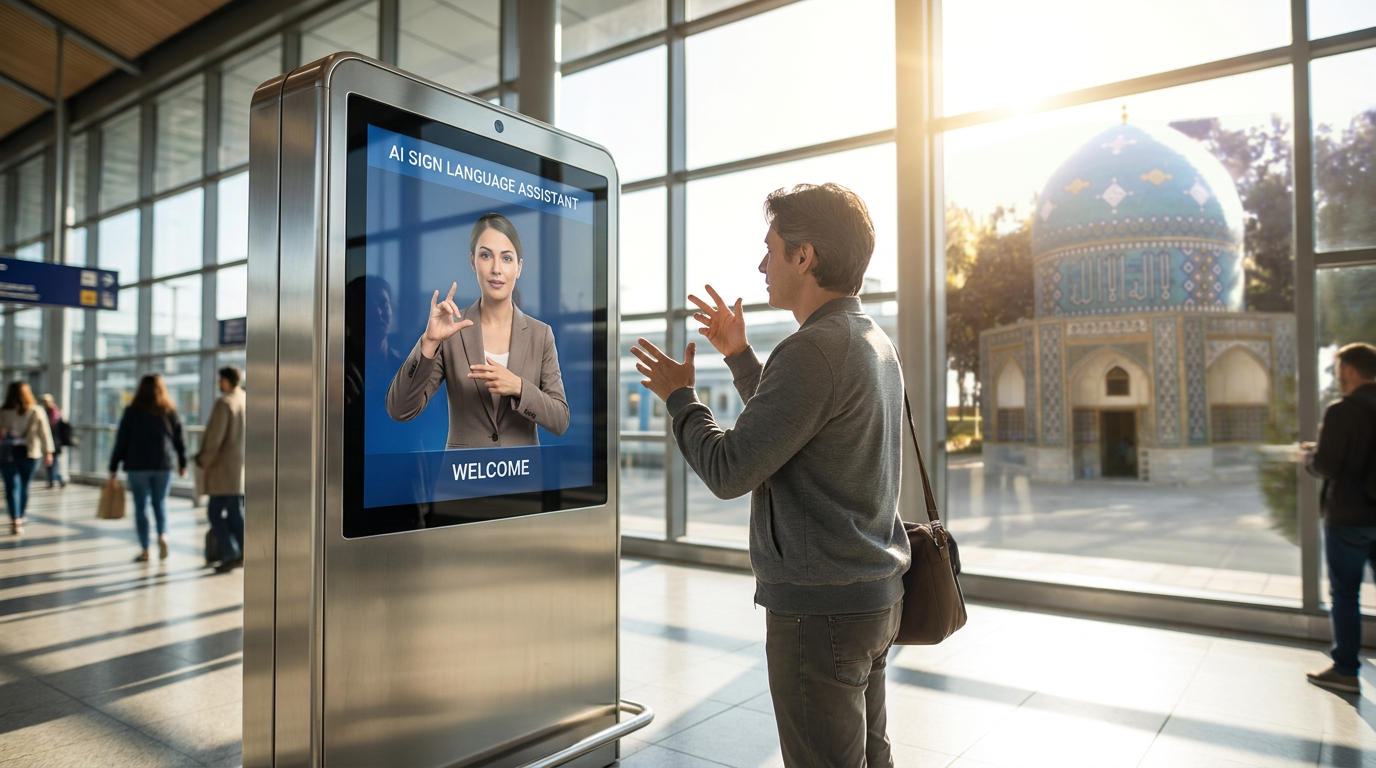
For decades, the Deaf and Hard of Hearing community has navigated a public sphere built primarily for spoken language, relying on expensive and often scarce human interpreters for everyday interactions. But in mid-2026, a wave of multimodal artificial intelligence has moved out of the laboratory and into train stations, retail stores, and corporate offices. These new systems are capable of translating sign language into spoken text—and vice versa—in real time, fundamentally reshaping public accessibility.[1][2]
The breakthrough centers on AI's newfound ability to process meaning across different modalities simultaneously. Older translation tools were strictly text-based, making them useless for languages that rely heavily on spatial grammar, facial expressions, and body movement. Today's multimodal models can "watch" a user sign through a standard camera, interpret the nuanced physical context, and generate culturally adapted, grammatically accurate translations rather than literal, word-for-word outputs.[4]
Leading this charge is Sorenson Communications, a global giant in accessibility services, which recently unveiled a two-way AI Sign Language Translation platform. Designed for the short, frequent interactions that define daily life—ordering at a restaurant, checking into a hotel, or asking a question at a retail desk—the system recognizes American Sign Language (ASL) and translates it into English text instantly.[1][5]

The result is a fluid, back-and-forth conversation between a non-signing employee and a Deaf customer, entirely bypassing the need for a live human interpreter. Sorenson has also deployed a companion system that converts pre-recorded videos or text documents into ASL using a natural, human-looking avatar, ensuring that corporate training materials and public broadcasts are functionally equivalent for Deaf employees.[1]
This technology is already managing massive logistical scale in public infrastructure. In Singapore, SBS Transit has deployed "Silvia," the country's first real-time AI sign-language assistant, across a rail network that handles over 1.2 million daily riders. Displayed on platform screens as an expressive, lifelike avatar, Silvia instantly translates public service announcements into grammatically accurate sign language.[2]
This technology is already managing massive logistical scale in public infrastructure.
Developed in collaboration with the Singapore Association of the Deaf, Silvia goes beyond one-way broadcasting. The system is engineered for active two-way communication, processing sign language as a natural input and allowing commuters to ask questions and receive real-time, expressive signing in return. The initiative recently beat out more than 230 international entries to win the Global Rail Innovation Award.[2]

The rapid deployment of these tools is being driven by specialized AI startups like Signapse, which uses generative AI to blend large libraries of qualified sign language videos. Rather than relying solely on computer-generated avatars, their software seamlessly stitches together footage of real Deaf translators with natural transitions, allowing enterprises to embed highly accurate sign language into live experiences and digital content at scale.[3]
For the retail and service sectors, this represents a massive operational shift. Industry analysts note that conversational AI is becoming the new standard for customer engagement, removing friction for visually impaired and Deaf consumers alike. By automating accessibility in high-volume environments, companies can reduce wait times, meet stringent inclusivity mandates, and offer a level of independent service that was previously impossible to staff.[5][6]

Despite the technological leap, developers and accessibility advocates are clear that AI is augmenting, not replacing, human interpreters. While an AI avatar is perfect for navigating a transit delay or a retail checkout, high-stakes environments—such as medical diagnoses, legal proceedings, and complex emotional counseling—still require the empathy, deep cultural context, and ethical judgment of a professional human interpreter.[1][4]
Yet, the trajectory for everyday accessibility is unmistakably global. Because these AI systems are built on modular architectures, they can be rapidly localized for different regions. SBS Transit, for example, is already adapting its Silvia system for Emirati Sign Language to be deployed in Abu Dhabi. As these multimodal models continue to scale, the barrier between spoken and signed worlds is steadily, and permanently, dissolving.[2]
How we got here
March 2021
Early AI databases for sign language translation are developed by research institutions.
April 2025
SBS Transit begins piloting early versions of its AI assistant in Singapore.
April 2026
Sorenson Communications unveils its two-way AI Sign Language Translation platform for retail and enterprise.
June 2026
AI sign language tools see widespread deployment across global transit and customer service sectors.
Viewpoints in depth
Accessibility Advocates
Focus on the autonomy and independence these tools provide.
Advocates within the Deaf and Hard of Hearing community celebrate the immediate, frictionless access these AI tools offer for daily tasks like ordering food or navigating an airport. However, they maintain a firm boundary: AI should be viewed as a supplement for casual interactions, not a replacement for human interpreters in critical medical, legal, or emotional contexts where cultural nuance and empathy are paramount.
Enterprise Operators
View AI translation as a scalable solution to inclusivity mandates.
For large-scale retailers and public transit authorities, staffing live interpreters at every customer touchpoint is logistically and financially impossible. Enterprise leaders view AI sign language assistants as a breakthrough in operational efficiency, allowing them to meet accessibility standards, reduce customer wait times, and provide equitable service around the clock without bottlenecking human resources.
AI Technologists
Highlight the architectural leap from text to multimodal processing.
Engineers and linguists emphasize that translating sign language is fundamentally different from translating spoken word. It requires the AI to interpret three-dimensional space, body language, and facial expressions simultaneously. The success of these 2026 models proves that multimodal neural networks can now process complex visual grammar in real time, a massive leap over the text-bound large language models of previous years.
What we don't know
- How well these AI systems handle highly idiosyncratic or regional slang within sign languages outside of controlled environments.
- The long-term impact on the employment market for human sign language interpreters as AI handles more routine interactions.
Key terms
- Multimodal AI
- Artificial intelligence systems capable of processing and generating multiple types of data simultaneously, such as video, text, and audio.
- Spatial Grammar
- The use of physical space, facial expressions, and body movement to convey grammatical meaning in sign languages.
- Machine Translation Post-Editing (MTPE)
- A workflow where AI generates a first draft of a translation, which is then reviewed and refined by a human expert.
Frequently asked
Can AI completely replace human sign language interpreters?
No. While AI is highly effective for everyday interactions like retail checkouts or transit announcements, human interpreters remain essential for high-stakes medical, legal, and emotional situations.
Does the AI understand different regional sign languages?
Yes. Modern systems are modular and can be localized. For example, systems are currently being adapted for both American Sign Language (ASL) and Emirati Sign Language.
How does the AI generate the sign language?
It uses either generative AI to seamlessly blend pre-recorded videos of human signers or renders a highly realistic, human-looking digital avatar to perform the signs.
Sources
Source coverage
6 outlets
3 viewpoints surfaced






[1]MultiLingualAccessibility Advocates
Sorenson Communications Unveils AI Sign Language Translation (AST) Proofs-of-Concept
Read on MultiLingual →[2]The Business TimesEnterprise Operators
SBS Transit breaks communication barrier with Singapore's first AI sign-language assistant
Read on The Business Times →[3]SignapseAccessibility Advocates
AI Instant Sign Language Translator
Read on Signapse →[4]GetFunlingoAI Technologists
How AI is revolutionizing translation in 2026
Read on GetFunlingo →[5]Language Industry ReviewEnterprise Operators
The Language Industry in Motion: AI Sign Language Translation
Read on Language Industry Review →[6]Insider OneEnterprise Operators
AI in Retail: 10 Breakthrough Trends That Will Define 2026
Read on Insider One →

More in ai
See all 6 stories →On-Device AI
How Local LLMs and NPUs Are Bringing AI Offline in 2026
0 sources
On-Device AI
The Rise of Local AI: How On-Device Models Are Changing Privacy and Computing
0 sources

Open Source AI
Open-Source AI Reaches Frontier Parity with MiniMax M3 Release
0 sources

Autonomous Systems
How AI Agents Work: The Shift from Chatbots to Autonomous Action
0 sources

Every angle. Every day.
Get ai stories with full source coverage and perspective breakdowns delivered to your inbox.