
How Mass Timber is Replacing Concrete and Steel in the Skyscraper Race
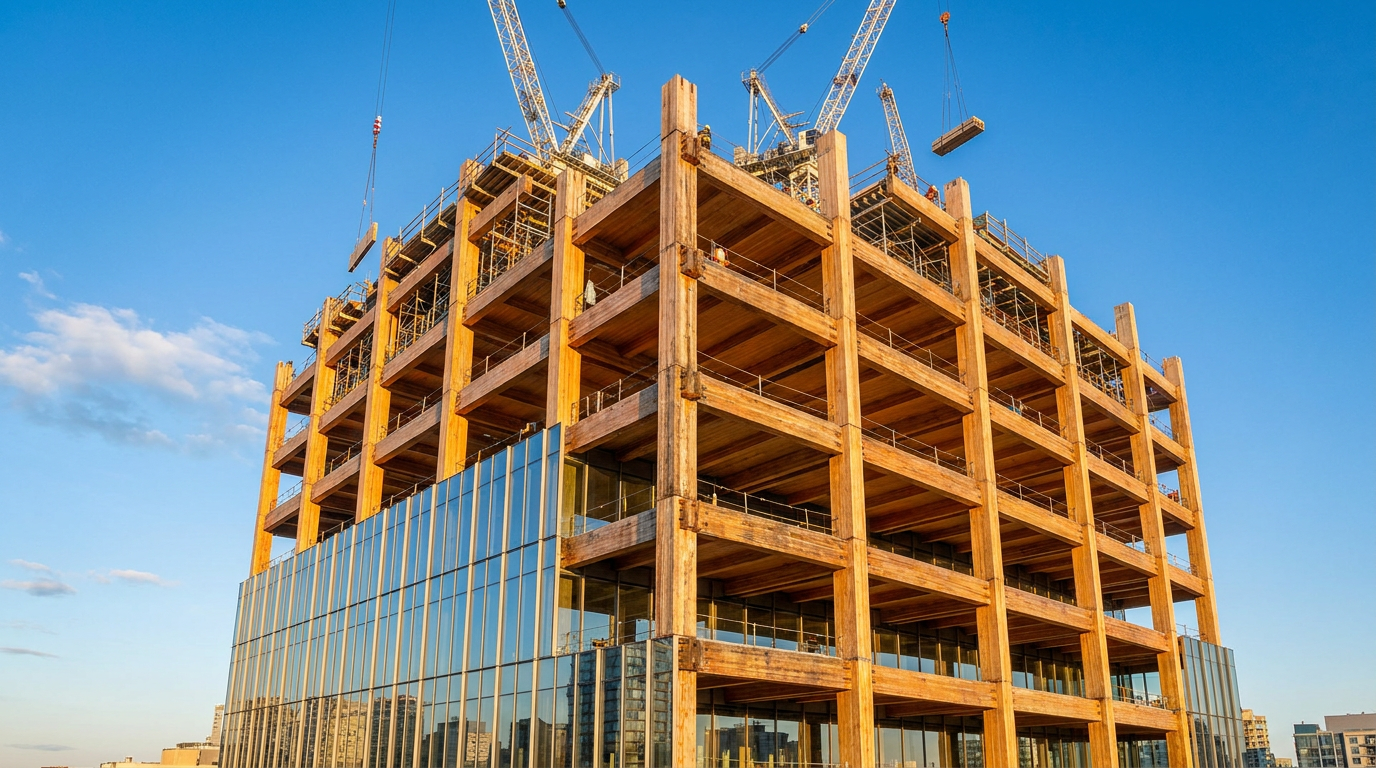
Engineered wood panels known as mass timber are allowing architects to build 30-story skyscrapers that sequester carbon and resist fire, fundamentally changing how cities are constructed.
By Factlen Editorial Team
- Forestry & Timber Advocates
- See the mass timber boom as a vital economic engine for rural communities and sustainable forest management.
- Sustainable Architects & Developers
- View mass timber as the key to decarbonizing the construction industry while improving building aesthetics.
- Fire Safety Engineers
- Focus on the predictable charring behavior of heavy timber and the necessity of hybrid structural designs.
What's not represented
- · Traditional Concrete & Steel Industries
- · Insurance Underwriters
Why this matters
The construction industry is one of the world's largest carbon emitters, largely due to concrete and steel production. The mainstream adoption of mass timber means the buildings we live and work in are transforming from climate liabilities into massive carbon sinks, while offering warmer, healthier indoor environments.
Key points
- Mass timber uses engineered wood panels, like CLT, to replace concrete and steel in high-rise construction.
- Milwaukee's upcoming Neutral Edison tower will be the world's tallest mass timber building at 31 stories.
- Prefabricated timber components can reduce construction time and on-site labor by roughly 30 percent.
- Mass timber acts as a carbon sink, significantly lowering a building's embodied carbon footprint.
- In a fire, heavy timber chars on the outside, creating an insulating layer that protects the structural core.
- Modern building codes have been updated to allow mass timber structures to reach up to 18 stories without special waivers.
For over a century, the modern city skyline has been defined by the heavy, carbon-intensive silhouettes of concrete and steel. But a quiet revolution is taking root in commercial architecture, replacing the roar of cement mixers with the precision of engineered wood. Mass timber construction, once viewed as a niche environmental statement, has rapidly matured into a mainstream structural system capable of reaching skyscraper heights.[8]
The most visible symbol of this shift is rising in Milwaukee, Wisconsin. Construction is currently underway on the Neutral Edison, a 31-story mixed-use tower that will reach 362 feet and become the tallest mass timber building in the world when completed in 2027. The $133 million project will surpass Milwaukee's own Ascent tower, a 25-story timber structure completed in 2022, signaling that engineered wood is now competing directly with conventional materials for high-rise dominance.[1][2]
To understand how wood can support a 31-story tower, it is necessary to define what mass timber actually is. Unlike the light-frame two-by-fours used in residential homebuilding, mass timber relies on massive, solid panels engineered for immense load-bearing strength. The most common variant utilized in these high-rises is Cross-Laminated Timber, or CLT.[4][5]
The mechanism behind CLT is elegantly simple but structurally profound. Manufacturers take dimensional lumber—standard boards of pine or spruce—and glue them together in alternating, perpendicular layers. By crossing the grain at right angles, the resulting panel achieves extraordinary rigidity in both directions, neutralizing wood's natural tendency to warp or split. These panels, which can be up to a foot thick and forty feet long, offer a strength-to-weight ratio that rivals concrete while weighing significantly less.[4][5][6]

This lighter weight translates to a fundamentally different construction site. Because CLT panels and glue-laminated columns are prefabricated in off-site factories using computer-controlled routers, they arrive at the job site ready to be slotted into place. Builders report that mass timber projects require roughly 30 percent less time to erect and 30 percent fewer on-site workers compared to traditional concrete pours. The process is frequently compared to assembling flat-pack furniture on a massive scale, resulting in a cleaner, quieter, and highly predictable build.[4][6]
The primary driver behind the mass timber boom, however, is its environmental math. The traditional construction sector is a massive climate liability, with cement and steel production accounting for a significant portion of global greenhouse gas emissions. Mass timber flips this equation. Trees naturally absorb carbon dioxide as they grow; when that wood is harvested and locked into a building's structure, the building effectively becomes a long-term carbon sink.[5][7]
The embodied carbon savings are substantial. Developers of the Neutral Edison tower estimate that their hybrid timber approach will result in a 54 percent reduction in embodied carbon compared to a conventional concrete high-rise. Furthermore, forestry experts note that creating a high-value commercial market for timber incentivizes landowners to sustainably manage and replant their forests, rather than selling the land for carbon-intensive real estate sprawl.[2][6]

Despite these benefits, the concept of a wooden skyscraper inevitably triggers a primal question: What happens in a fire? For decades, outdated assumptions about wood's combustibility kept timber buildings capped at just a few stories. However, fire safety engineers have demonstrated that mass timber behaves entirely differently than light-frame wood when exposed to extreme heat.[3][7]
Despite these benefits, the concept of a wooden skyscraper inevitably triggers a primal question: What happens in a fire?
The secret to mass timber's fire resistance lies in a mechanism known as self-charring. When a massive, solid block of wood is exposed to fire, the outermost layer burns and turns to char. This charred layer acts as a highly effective thermal insulator, starving the fire of oxygen and protecting the unburned structural core inside. Unlike steel, which can rapidly lose its strength and buckle under high temperatures, or concrete, which can explosively spall as trapped moisture boils, mass timber maintains its structural integrity for a predictable duration.[3][7]
Extensive large-scale fire testing has validated this charring effect. In one rigorous test, a seven-inch-thick wall of exposed CLT was subjected to a continuous blaze and lasted for over three hours—exceeding stringent building code requirements by a full hour. Because the char rate of heavy timber is mathematically predictable, engineers can simply oversize the wooden beams by a few inches, ensuring that even after a severe fire, the remaining uncharred core is thick enough to support the building's weight.[3][7]

To reach extreme heights like 31 stories, architects do not rely on wood alone. The tallest mass timber buildings utilize a hybrid structural system. In the Neutral Edison, the cross-laminated timber floors and glued-laminated columns carry the gravity loads, while a central concrete elevator core provides lateral stability against wind and earthquakes, as well as a non-combustible fire separation zone.[1][2]
Regulatory bodies are rapidly catching up to the science. In 2021, the International Building Code (IBC) introduced sweeping updates that allowed mass timber structures to reach up to 18 stories without requiring special experimental waivers. Regional governments are pushing even further; British Columbia recently expanded its building codes to permit mass timber construction for a wider variety of commercial and institutional buildings, aiming to foster a robust local manufacturing ecosystem.[2][5]
Beyond the structural and environmental metrics, mass timber offers a distinct psychological advantage known as biophilic design. By leaving the structural wood exposed on the interior ceilings and columns, architects create spaces that feel inherently warmer and more connected to nature. Occupants of mass timber office buildings frequently report lower stress levels, improved acoustics, and a more inspiring environment compared to the sterile feel of drywall and dropped ceilings.[4][8]

The industry still faces growing pains. Managing moisture during the construction phase is critical, as prolonged exposure to rain before the building is sealed can damage the engineered panels. Additionally, the supply chain is still developing; while Europe has a mature CLT manufacturing base, North America needs more regional factories to meet surging demand and reduce transportation costs.[6][8]
Insurance premiums also remain a hurdle. Because mass timber is still relatively new to many underwriters, developers sometimes face higher builder's risk insurance rates during construction, requiring early and extensive collaboration with fire safety consultants to prove the building's resilience.[7]
Yet the trajectory is clear. As carbon taxes become more prevalent and the construction industry seeks ways to offset its massive environmental footprint, engineered wood is transitioning from an experimental novelty to a foundational material of the 21st century. With structures like the Neutral Edison proving that timber can safely scrape the sky, the future of sustainable architecture is increasingly taking root in the forest.[1][8]
How we got here
2015
Construction begins on Brock Commons at the University of British Columbia, an early pioneer in tall wood buildings.
2021
The International Building Code (IBC) is updated to allow mass timber structures to reach up to 18 stories.
2022
The 25-story Ascent tower is completed in Milwaukee, setting the record for the world's tallest mass timber building.
2025
Construction breaks ground on the Neutral Edison in Milwaukee, designed to reach 31 stories and claim the new height record.
2027
The Neutral Edison is scheduled to open to residents, featuring a hybrid timber-and-concrete structural system.
Viewpoints in depth
Sustainable Architects & Developers
View mass timber as the key to decarbonizing the construction industry while improving building aesthetics.
This camp emphasizes that the built environment is responsible for nearly 40% of global carbon emissions, largely due to cement and steel production. By switching to engineered wood, developers can turn buildings into massive carbon sinks. They also highlight the speed of prefabrication, noting that faster build times and smaller crews offset the currently higher upfront material costs of CLT panels.
Fire Safety Engineers
Focus on the predictable charring behavior of heavy timber and the necessity of hybrid structural designs.
While acknowledging the public's instinctual fear of wooden high-rises, fire engineers point to decades of data proving that mass timber does not suddenly collapse or melt under extreme heat. They advocate for strict code compliance, emphasizing that true high-rises must still rely on non-combustible concrete elevator cores and oversized timber beams that mathematically guarantee a surviving structural core even after hours of direct fire exposure.
Forestry & Timber Advocates
See the mass timber boom as a vital economic engine for rural communities and sustainable forest management.
For the forestry sector, the rise of CLT represents a high-value market for smaller-diameter trees and beetle-killed timber that might otherwise fuel wildfires. They argue that creating a strong economic incentive to harvest and replant trees ensures that private landowners keep their properties forested, preventing the land from being sold off for permanent, carbon-intensive concrete development.
What we don't know
- How quickly North American manufacturing capacity can scale to meet the surging demand for CLT panels.
- Whether insurance premiums for mass timber buildings will normalize as underwriters become more familiar with the material's fire performance.
Key terms
- Cross-Laminated Timber (CLT)
- An engineered wood panel made by gluing layers of dimensional lumber together at right angles to create immense structural rigidity.
- Embodied Carbon
- The total greenhouse gas emissions generated by the extraction, manufacturing, transportation, and assembly of building materials.
- Self-Charring
- The natural mechanism where the outer layer of heavy timber burns and turns to charcoal, insulating the unburned wood inside from extreme heat.
- Hybrid Structural System
- A building design that combines different materials—such as mass timber for floors and concrete for the elevator core—to maximize safety and stability.
- Biophilic Design
- An architectural approach that seeks to connect building occupants more closely to nature, often by incorporating natural lighting and exposed wood.
Frequently asked
Is mass timber the same as the wood used to build houses?
No. Traditional homes use light-frame dimensional lumber (like 2x4s). Mass timber uses massive, solid panels of wood glued together under high pressure, giving it the strength to support high-rise buildings.
Won't a wooden skyscraper easily burn down?
Mass timber is highly fire-resistant due to a process called self-charring. In a fire, the outside of the thick wood panels chars, creating an insulating layer that protects the inner core and maintains the building's structural integrity.
How tall can mass timber buildings get?
Currently, the tallest completed mass timber building is the 25-story Ascent tower in Milwaukee. A new 31-story tower, the Neutral Edison, is under construction and will reach 362 feet by 2027.
Does cutting down trees for buildings hurt the environment?
When sourced from sustainably managed forests, harvesting timber and locking it into a building actually sequesters carbon. It also provides an economic incentive for landowners to replant and maintain forests rather than developing the land.
Sources
Source coverage
8 outlets
3 viewpoints surfaced







[1]Construction DiveSustainable Architects & Developers
World's tallest mass timber building breaks ground in Wisconsin
Read on Construction Dive →[2]DextallSustainable Architects & Developers
Neutral Edison Tower Milwaukee: Mass Timber High-Rise Goes to 31 Stories
Read on Dextall →[3]Think WoodFire Safety Engineers
Fire Resistance of Wood Construction
Read on Think Wood →[4]Cornerstone Timber FramesForestry & Timber Advocates
Mass Timber, Explained Simply
Read on Cornerstone Timber Frames →[5]British Columbia GovernmentForestry & Timber Advocates
Understand mass timber
Read on British Columbia Government →[6]The BattalionForestry & Timber Advocates
Cross laminated timber: Where forestry, architecture meet for sustainability
Read on The Battalion →[7]J.S. HeldFire Safety Engineers
What Is Mass Timber?
Read on J.S. Held →[8]Factlen Editorial TeamSustainable Architects & Developers
Synthesis by Factlen editorial team
Read on Factlen Editorial Team →
Every angle. Every day.
Get home stories with full source coverage and perspective breakdowns delivered to your inbox.