
OLED vs. Mini-LED in 2026: The Premium TV Technology Trade-Off
The gap between OLED and Mini-LED has narrowed significantly in 2026, with Tandem OLEDs boosting brightness and Mini-LEDs mastering contrast. Choosing the right panel now comes down to room lighting, viewing habits, and gaming needs rather than just budget.
By Factlen Editorial Team
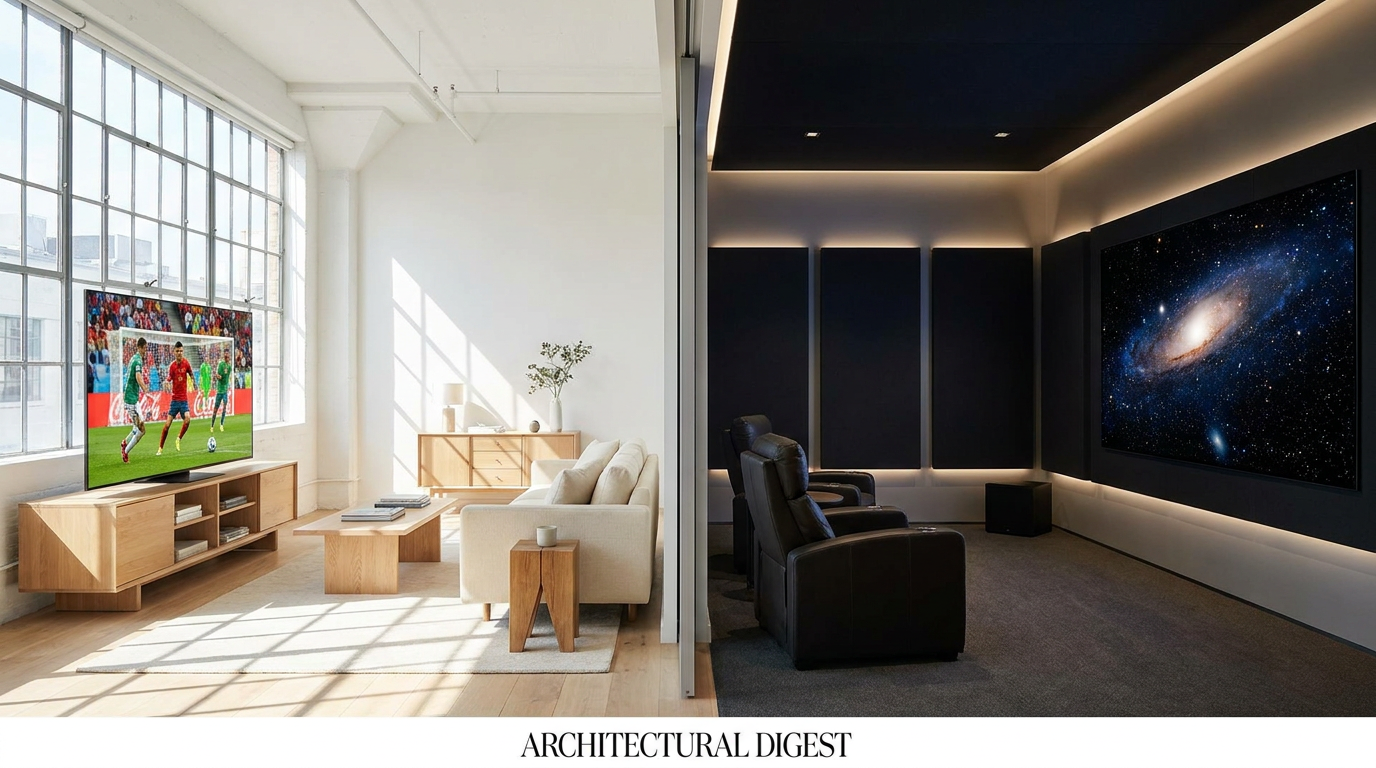
- Cinematic Purists
- Advocates for absolute picture perfection in controlled lighting environments.
- Bright-Room Pragmatists
- Users who prioritize raw brightness and usability in sunlit living spaces.
- Power Users & Gamers
- Consumers who demand longevity and immunity to static-image burn-in.
What's not represented
- · Budget-Conscious Consumers
- · Environmental Sustainability Advocates
Why this matters
Buying a flagship TV is a decade-long investment. Understanding the chemical and structural differences between organic pixels and inorganic backlights ensures you don't spend premium prices on a screen that fights your living room's natural light or your daily viewing habits.
Key points
- Tandem OLED technology has pushed organic panel brightness past 2,000 nits.
- Flagship Mini-LEDs now feature up to 20,000 dimming zones to eliminate blooming.
- OLED remains the undisputed leader for dark rooms and infinite contrast.
- Mini-LED is the superior choice for bright rooms and static PC gaming HUDs.
- Both technologies now command flagship prices, eliminating the old budget hierarchy.
The 2026 television market has officially abandoned the old hierarchy where OLED was the undisputed premium king and Mini-LED was merely a budget compromise. Today, both technologies command flagship prices and represent divergent, highly refined engineering philosophies. Consumers are no longer choosing between "good" and "best," but rather between two distinct approaches to light management, chemical longevity, and visual presentation. The decision requires a side-by-side trade-off analysis of how these panels actually perform outside of carefully curated showroom demonstration loops.[1][5]
The case for OLED rests entirely on its self-emissive organic pixels. In 2026, the introduction of Tandem OLED and QD-OLED architectures—which stack multiple light-emitting layers and utilize deuterium stabilization—has pushed peak brightness past 2,000 nits in small highlights. The primary argument for this technology remains its infinite contrast. Because each individual pixel can turn off completely, the panel delivers perfect black levels without relying on a backlight. Evidence from cinematic purists and display engineers confirms that in a dark room, this micro-contrast creates an unmatched sense of depth and three-dimensionality.[2][5][6]
The argument against OLED continues to center on its organic chemistry and thermal limitations. While independent testing by organizations like RTINGS shows that modern OLED panels can survive 10,000 hours of heavy use with minimal degradation, they still rely heavily on an Automatic Brightness Limiter. When displaying a bright, full-screen image—such as a sunlit hockey game or a snowy landscape—the television's processor intentionally dims the entire screen to protect the organic compounds from overheating. Furthermore, the cumulative risk of permanent image retention, or burn-in, remains a factor for users who display static elements for hours on end.[2][3][4]

On the other side of the aisle, the case for Mini-LED is built on brute-force inorganic engineering. Utilizing microscopic Gallium Nitride diodes, 2026 flagship Mini-LED televisions boast up to 20,000 local dimming zones and peak brightness levels ranging from 5,000 to an astonishing 10,000 nits. The primary argument for Mini-LED is its sustained, full-screen brightness and absolute immunity to burn-in. These panels can hold a blindingly white screen indefinitely without dimming, making them uniquely capable of punching through the heavy glare of a sunlit living room.[1][3][4]
On the other side of the aisle, the case for Mini-LED is built on brute-force inorganic engineering.
The historical argument against Mini-LED focused on "blooming"—a distracting halo effect visible around bright objects set against dark backgrounds. However, evidence from the 2026 generation of displays indicates that this issue has been largely engineered out of existence. With 20,000 individual dimming zones, the backlight control is so precise that blooming is now nearly imperceptible to the human eye in standard viewing conditions. The remaining trade-off is viewing angle degradation; unlike OLEDs, which look perfect from extreme side angles, Mini-LED panels still suffer from slight color shifting when viewed from the far edges of a wide seating arrangement.[4][5][6]

Gaming performance presents another fascinating split in the evidence. OLED panels offer a near-instantaneous response time of 0.03 milliseconds, completely eliminating motion blur for competitive esports players. However, the static heads-up displays, health bars, and minimaps in games act as a stress test for organic pixels. Mini-LED panels, while slightly slower with a 1-millisecond response time, offer complete peace of mind for gamers who play the same title for thousands of hours, as the inorganic backlight cannot burn in.[1][6]
Power consumption and thermal management also diverge sharply between the two formats. OLED panels are incredibly thin and highly efficient when displaying dark, cinematic scenes, as the black pixels draw zero power. However, their thin chassis leaves very little room for airflow. Mini-LED televisions are generally thicker and draw more peak wattage, but this bulk allows for massive internal heat sinks. Because the brightness is distributed across tens of thousands of diodes, the overall thermal stress is lower, contributing to an industry-standard lifespan of up to 100,000 hours for the backlight system.[3][6]

Ultimately, the synthesis of this data leads to clear environmental guidance. OLED fits perfectly when the television is placed in a light-controlled home theater, when seating is arranged in a wide horseshoe shape that requires extreme off-axis viewing, or when the user prioritizes absolute pixel-level contrast for cinematic viewing. It does not fit well when the screen will be subjected to direct sunlight, or when it will display static news tickers, sports scoreboards, or PC taskbars for eight hours a day.[4][5]
Conversely, Mini-LED fits perfectly when the living room features massive windows and heavy daytime glare, or when the display doubles as a high-usage PC monitor where static interfaces are unavoidable. It is the definitive choice for daytime sports fans and users who want maximum HDR impact without babysitting their panel. It does not fit well for buyers who demand the absolute deepest, inky blacks in a pitch-black room, or those who are highly sensitive to minor color wash-out from side-angle seating.[1][2][4]
How we got here
2013
The first commercial OLED TVs hit the market, establishing a new standard for perfect black levels but struggling with low brightness.
2019
Mini-LED technology is introduced to consumer televisions, shrinking backlight diodes to dramatically improve LCD contrast.
2024
OLED manufacturers introduce Micro Lens Array (MLA) and QD-OLED tech, finally pushing peak brightness past the 1,500-nit barrier.
2026
Flagship Mini-LEDs reach 20,000 dimming zones and 10,000 nits, while Tandem OLEDs match them in price, creating a true choice of engineering paths.
Viewpoints in depth
Cinematic Purists
Advocates for absolute picture perfection in controlled lighting environments.
For home theater enthusiasts and color-grading professionals, the conversation begins and ends with pixel-level control. This camp argues that the infinite contrast of OLED—where a completely black pixel can sit directly next to a 2,000-nit highlight without a single millimeter of light bleed—creates a three-dimensional depth that no backlight can replicate. They point out that while Mini-LED has reduced blooming, it still relies on algorithms to guess which zones to dim, whereas OLED offers true, uncompromised artistic intent.
Bright-Room Pragmatists
Users who prioritize raw brightness and usability in sunlit living spaces.
This perspective argues that perfect black levels are irrelevant if the television cannot overpower the glare of a sunny afternoon. Bright-room pragmatists champion Mini-LED for its sheer horsepower, noting that a 5,000-nit panel maintains its color volume and punch even with the curtains wide open. They emphasize that the Automatic Brightness Limiter on OLEDs ruins the experience of watching daytime sports like hockey or cricket, making Mini-LED the only viable choice for open-concept homes.
Power Users & PC Gamers
Consumers who demand longevity and immunity to static-image burn-in.
For those who use their displays as massive PC monitors or play the same HUD-heavy video games for thousands of hours, peace of mind is the ultimate metric. This camp points to the inorganic nature of Gallium Nitride LEDs as the definitive advantage. They argue that while OLED burn-in mitigations have improved, the underlying chemistry still degrades unevenly over time. For these users, sacrificing a fraction of a millisecond in response time is a worthy trade-off for a panel that will never permanently retain a static taskbar or health meter.
What we don't know
- How the long-term degradation curve of Tandem OLEDs compares to traditional single-layer OLEDs over a 10-year lifespan.
- Whether Micro-LED technology will eventually become affordable enough to replace both OLED and Mini-LED in the consumer market.
Key terms
- Tandem OLED
- A display architecture that stacks multiple organic light-emitting layers to increase overall brightness and extend the panel's lifespan.
- Local Dimming Zones
- Specific areas of a Mini-LED backlight that can independently dim or turn off to create deeper blacks and improve contrast.
- Automatic Brightness Limiter (ABL)
- A software protection mechanism in OLED TVs that automatically dims the screen when too much of the image is bright, preventing overheating.
- Blooming
- A visual artifact where light bleeds from a bright object into the surrounding dark areas of the screen, creating a hazy halo effect.
- Nits
- A standard unit of measurement for display brightness, roughly equivalent to the light of one candle per square meter.
Frequently asked
Will an OLED TV get burn-in from normal viewing?
Under normal, varied viewing conditions, the risk is extremely low. Modern OLEDs use pixel-shifting and deuterium stabilization to prevent damage, though static elements like news tickers still pose a long-term risk.
Why does my OLED TV suddenly get dimmer during bright scenes?
This is the Automatic Brightness Limiter (ABL) at work. The TV's processor intentionally dims full-screen bright images, like a snowy landscape, to protect the organic pixels from overheating.
Does Mini-LED still have the 'blooming' halo effect?
While older LED TVs suffered heavily from blooming, 2026 flagship Mini-LEDs utilize up to 20,000 local dimming zones, making the halo effect nearly invisible to the human eye.
Which TV is better for a bright living room with windows?
Mini-LED is the superior choice for bright rooms. Its inorganic backlight can sustain massive full-screen brightness to punch through daytime glare without dimming.
Sources
Source coverage
6 outlets
3 viewpoints surfaced






[1]PCWorldBright-Room Pragmatists
OLED is old news. Mini-LED is the future
Read on PCWorld →[2]KTC PlayPower Users & Gamers
Tandem OLED vs. Mini-LED: Choosing the Best HDR Panel in 2026
Read on KTC Play →[3]BGRPower Users & Gamers
Here's How Long You Can Expect Your Mini LED TV To Last
Read on BGR →[4]HomeCineSolutionsBright-Room Pragmatists
OLED or Mini LED, how to choose
Read on HomeCineSolutions →[5]Data Wire SolutionsCinematic Purists
Best TVs for 2026: 10 OLED and Mini-LED Picks
Read on Data Wire Solutions →[6]EcoPicksGoCinematic Purists
OLED vs Mini LED TVs
Read on EcoPicksGo →


Every angle. Every day.
Get shopping stories with full source coverage and perspective breakdowns delivered to your inbox.