
SpaceX's Record $75 Billion IPO Vaults Valuation Past $2 Trillion, Reshaping Wall Street's Tech Hierarchy
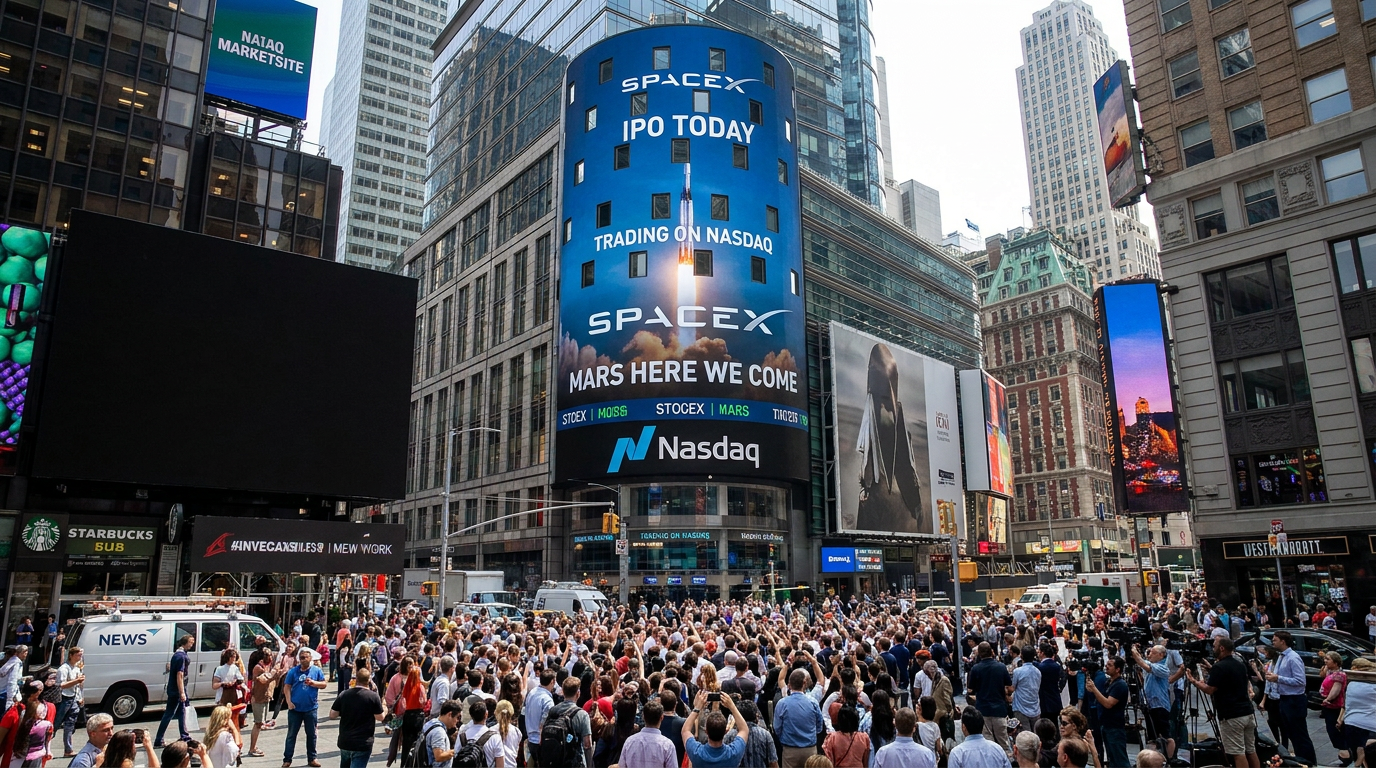
SpaceX's historic public debut has minted the world's first trillionaire and sparked a Wall Street rebrand, as the new 'MANGOS' acronym replaces the Magnificent 7.
By Factlen Editorial Team
- Growth and Retail Investors
- Excited about the opportunity to invest in a generational tech company.
- Passive Index Managers
- Focused on the mechanical challenges of replicating indices that fast-track a massive, low-float company.
- Market Traditionalists
- Skeptical of the multi-trillion-dollar valuation for an unprofitable company.
What's not represented
- · Competitors in the aerospace and satellite internet sectors who now face a publicly funded behemoth.
- · Regulators monitoring the unprecedented concentration of wealth and market influence.
Why this matters
SpaceX's graduation to the public markets fundamentally alters the tech investing landscape, introducing a new multi-trillion-dollar heavyweight that will automatically flow into the retirement accounts and passive index funds of millions of everyday investors.
Key points
- SpaceX raised $75 billion in its IPO, the largest in stock market history.
- Shares surged 19% on the first day, pushing the company's valuation past $2 trillion.
- The debut has minted CEO Elon Musk as the world's first trillionaire.
- Wall Street is replacing the 'Magnificent 7' acronym with 'MANGOS' to include SpaceX, OpenAI, and Anthropic.
- Nasdaq and FTSE Russell fast-tracked SpaceX into their indices, forcing billions in passive buying.
- The S&P 500 refused to alter its rules, excluding SpaceX until at least mid-2027.
SpaceX’s historic public debut has shattered financial records, raising $75 billion and immediately vaulting the aerospace and artificial intelligence giant's valuation past the $2 trillion mark. Listing on the Nasdaq exchange under the ticker SPCX on June 12, the company priced its shares at $135. Demand from both institutional and retail investors was so overwhelming that the stock surged 19% on its first day of trading, closing at $160.95. The sheer scale of the offering makes it the largest initial public offering in stock market history, easily eclipsing the $29 billion raised by Saudi Aramco in 2019.[3][4]
The momentum did not stop after the opening bell. By Tuesday, the rally had extended even further, pushing SpaceX’s market capitalization to roughly $2.75 trillion. This rapid ascent allowed the rocket manufacturer to overtake Amazon as the fifth-most valuable company in the world, trailing only a handful of established tech titans. The monumental listing has also officially minted CEO Elon Musk, who retains overwhelming voting control through a dual-class share structure, as the world's first trillionaire. Early investors and long-time employees have similarly seen their stakes transform into massive fortunes overnight.[4][6]

Beyond the staggering wealth milestones, SpaceX’s arrival is forcing a fundamental rebranding of Wall Street’s technology leadership. For the past several years, the "Magnificent 7"—Apple, Microsoft, Alphabet, Amazon, Tesla, Nvidia, and Meta—defined the market's heavyweights and drove the bulk of major index gains. Now, with SpaceX instantly surpassing the market caps of Tesla and Meta, analysts and strategists are scrambling to retire the outdated moniker. It has become increasingly difficult to use the old term as a clean shorthand for market leadership when one of the most important companies in the world sits outside the label.[1][2]
The viral replacement gaining the most traction across trading desks and social media is "MANGOS," an acronym standing for Meta, Anthropic, Nvidia, Google, OpenAI, and SpaceX. This new grouping deliberately swaps out older consumer-internet and hardware giants in favor of companies building the frontier artificial intelligence and space infrastructure stack. The shift reflects a broader market rotation toward AI-native assets and next-generation compute platforms. ETF issuers are already filing prospectuses to launch MANGOS-themed funds, eager to capitalize on the hype even as marquee members Anthropic and OpenAI remain private for the time being.[1][2]

The shift reflects a broader market rotation toward AI-native assets and next-generation compute platforms.
The mega-IPO is also triggering a massive mechanical disruption in the passive investing landscape, as major index providers bend their long-standing rules to accommodate the behemoth. Nasdaq recently amended its methodology to allow mega-IPOs into the flagship Nasdaq-100 index after just 15 trading days, while simultaneously eliminating previous minimum float requirements. The rule change was widely seen as a direct accommodation for SpaceX, which floated only a small percentage of its total shares to the public. FTSE Russell and MSCI have similarly fast-tracked SpaceX’s inclusion into their respective benchmarks.[5][7]
This accelerated timeline means that index-tracking funds and exchange-traded funds benchmarked to these indices will be forced to buy billions of dollars of SPCX shares by late June to accurately reflect the market. Analysts estimate that Nasdaq-100 inclusion alone could generate approximately $8 billion in forced passive buying within the first month of listing. Because the number of freely traded shares is relatively small, this wave of mandatory purchasing is expected to create a powerful technical tailwind for the stock, potentially driving the price higher regardless of immediate fundamental business performance.[5][7]

However, not all index providers are willing to rewrite their rulebooks for the space giant. S&P Dow Jones Indices firmly declined to alter its strict eligibility criteria, which require a 12-month seasoning period and four consecutive quarters of GAAP profitability. Because SpaceX reported an $8.7 billion loss between early 2025 and March 2026 as it heavily invested in its Starship rocket program and Starlink satellite network, the company will remain excluded from the S&P 500 until at least mid-2027.[3][7]
This stark divergence in index rules means investors holding Nasdaq-100 ETFs will gain immediate exposure to SpaceX's growth, while traditional S&P 500 passive investors will sit on the sidelines for at least a year. With Anthropic and OpenAI also preparing for highly anticipated public offerings later this year at valuations potentially north of $1 trillion, SpaceX’s debut is serving as a critical stress test. It highlights how public markets and passive funds must adapt to absorb a new generation of massive, capital-intensive tech graduates that are reshaping the global economy.[1][7]
How we got here
April 2026
SpaceX confidentially files IPO paperwork with the SEC.
May 2026
Nasdaq and FTSE Russell amend their index inclusion rules to allow fast-track entry for mega-IPOs.
June 4, 2026
S&P Dow Jones Indices confirms it will not alter its strict eligibility criteria, keeping SpaceX out of the S&P 500.
June 12, 2026
SpaceX officially lists on the Nasdaq, raising $75 billion and closing its first day up 19%.
June 16, 2026
SpaceX's market capitalization surpasses Amazon, reaching $2.75 trillion.
Viewpoints in depth
Growth and Retail Investors
Enthusiastic about the opportunity to invest in a generational tech company.
For retail investors and growth-focused funds, SpaceX's IPO represents a long-awaited chance to own a piece of the space economy and the expanding AI infrastructure stack. Proponents argue that the company's $2.75 trillion valuation is justified by its near-monopoly on global launch capabilities, the rapid expansion of the Starlink satellite internet network, and its strategic integration with xAI. They view the stock as a foundational asset for the next decade of technological advancement.
Passive Index Managers
Focused on the mechanical challenges of replicating indices that fast-track a massive, low-float company.
Index fund managers are navigating unprecedented logistical hurdles. Because Nasdaq and FTSE Russell altered their rules to allow SpaceX fast-track entry, passive funds must rapidly acquire billions of dollars in SPCX shares. However, because SpaceX only floated a small percentage of its total equity, the available supply of shares is tight. Managers warn this dynamic could create intense price volatility and force them to sell off holdings in other major tech companies to fund their mandatory SpaceX purchases.
Market Traditionalists
Skeptical of the multi-trillion-dollar valuation for an unprofitable company.
Traditional value investors and conservative strategists express caution over the sheer scale of SpaceX's debut. They point out that the company reported an $8.7 billion loss over a recent 15-month period, making its multi-trillion-dollar valuation highly speculative compared to highly profitable tech giants like Apple or Microsoft. This camp strongly supports the S&P 500's decision to maintain its strict 12-month seasoning and profitability requirements, arguing that benchmark indices should protect passive investors from the volatility of newly listed, unprofitable mega-caps.
What we don't know
- How the stock will perform once the initial wave of forced passive buying from index funds subsides.
- Whether upcoming IPOs from OpenAI and Anthropic will face similar fast-track index inclusion.
- When SpaceX will achieve consistent GAAP profitability to qualify for the S&P 500.
Key terms
- Initial Public Offering (IPO)
- The process of offering shares of a private corporation to the public in a new stock issuance.
- Market Capitalization
- The total dollar market value of a company's outstanding shares of stock.
- Passive Investing
- An investment strategy that tracks a market-weighted index or portfolio, rather than relying on active stock picking.
- Float
- The regular shares a company has issued to the public that are available for investors to trade, excluding restricted shares held by insiders.
- Dual-Class Share Structure
- A corporate structure where a company issues two different classes of shares, typically giving founders or executives significantly more voting power than public investors.
Frequently asked
What is the MANGOS acronym?
MANGOS stands for Meta, Anthropic, Nvidia, Google, OpenAI, and SpaceX, representing the new cohort of AI and space infrastructure leaders replacing the Magnificent 7.
Why isn't SpaceX in the S&P 500 yet?
The S&P 500 requires a company to be publicly traded for 12 months and report four consecutive quarters of profitability, criteria SpaceX does not currently meet.
How much did SpaceX raise in its IPO?
SpaceX raised $75 billion, making it the largest initial public offering in stock market history, surpassing Saudi Aramco.
What is SpaceX's ticker symbol?
SpaceX trades on the Nasdaq exchange under the ticker symbol SPCX.
Sources
Source coverage
7 outlets
3 viewpoints surfaced







[1]ForbesMarket Traditionalists
SpaceX's Public Debut Marks The End Of Big Tech's 'Magnificent 7' Era
Read on Forbes →[2]ReutersPassive Index Managers
Mag 7? MANGOS? SpaceX forces name rethink on Wall Street's tech-stock moniker
Read on Reuters →[3]CBS NewsMarket Traditionalists
SpaceX stock soars 19% on first day of trading following record-breaking $75 billion IPO
Read on CBS News →[4]The GuardianMarket Traditionalists
Elon Musk becomes world's first trillionaire as SpaceX ends trading day with valuation of $2.1tn
Read on The Guardian →[5]BNN BloombergGrowth and Retail Investors
SpaceX set to extend rally after record Wall Street debut
Read on BNN Bloomberg →[6]Business InsiderGrowth and Retail Investors
SpaceX IPO: SPCX stock rises 19% in its first day of trading, cementing Musk as the first-ever trillionaire
Read on Business Insider →[7]MorningstarPassive Index Managers
The SpaceX IPO: How Index Funds Are Adapting
Read on Morningstar →


Every angle. Every day.
Get business stories with full source coverage and perspective breakdowns delivered to your inbox.