
At-Home Brain Implant Allows Man With ALS to Communicate Independently for Two Years
A groundbreaking brain-computer interface has enabled a man with severe paralysis from ALS to speak and use a computer at home without researcher assistance. The device, which translates neural signals into text and speech with 97.5% accuracy, marks a major milestone in transitioning neurotechnology from the lab to daily life.
By Factlen Editorial Team
- Neurotechnology Researchers
- Scientists emphasize the technical milestone of transitioning BCIs from controlled labs to independent, real-world environments.
- ALS Patients and Advocates
- Patient communities focus on the profound restoration of dignity, autonomy, and human connection.
- Clinical Skeptics
- Medical ethicists and cautious clinicians highlight the limitations of single-patient trials and the risks of invasive hardware.
What's not represented
- · Health Insurance Providers
- · Medical Ethicists
Why this matters
For decades, brain-computer interfaces required a team of lab scientists to operate, making them impractical for daily life. This breakthrough proves that severely paralyzed individuals can use the technology independently at home, offering a realistic path toward restoring communication and autonomy for millions suffering from neurodegenerative diseases.
Key points
- A 47-year-old man with ALS successfully used a brain-computer interface at home for nearly two years without researcher assistance.
- The system decodes intended speech at 56 words per minute with 97.5% accuracy across a 125,000-word vocabulary.
- The patient communicated over two million words, using the device to work, send emails, and speak with his family.
- While highly successful, the study relies on a single patient, and the hardware still requires invasive brain surgery.
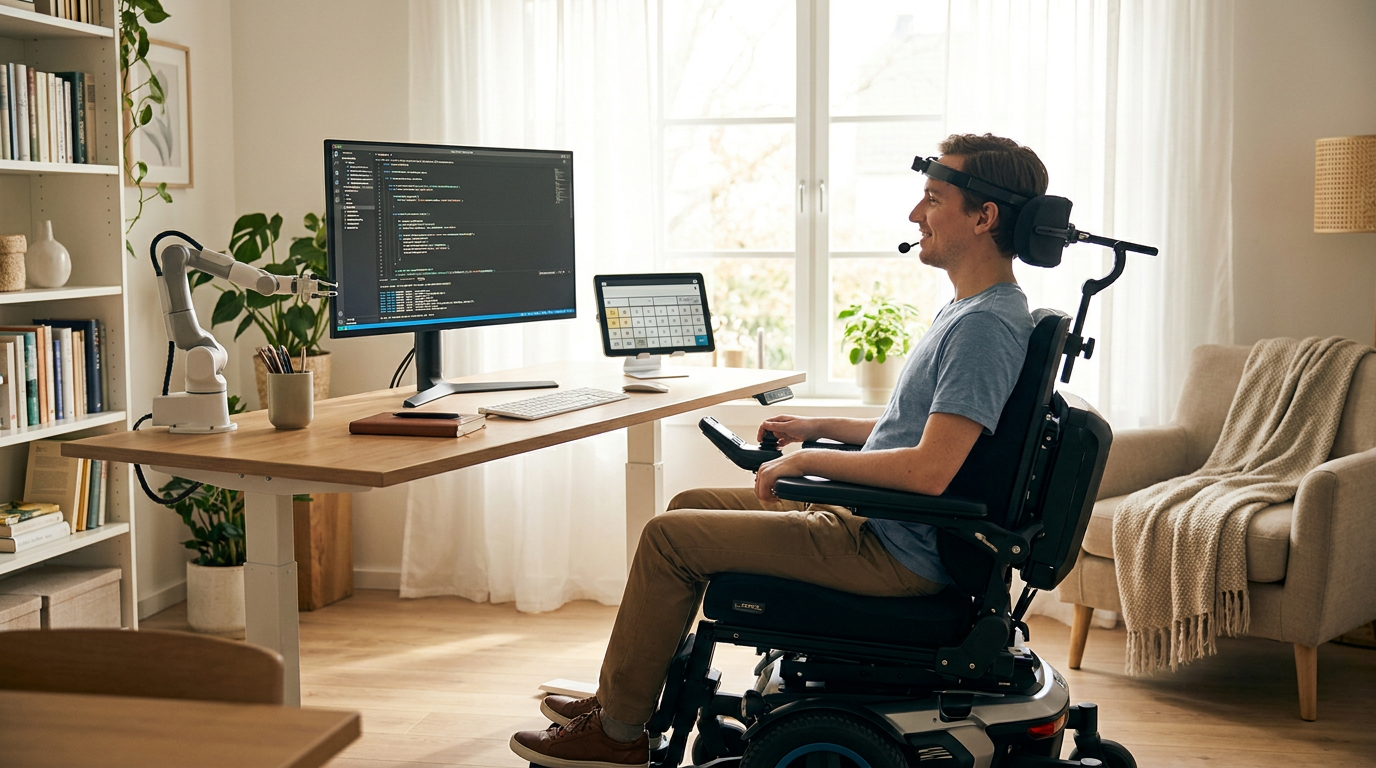
For decades, brain-computer interfaces (BCIs) have been confined to highly controlled laboratory environments, requiring teams of specialized engineers to calibrate and operate the equipment. That paradigm has fundamentally shifted. According to a landmark study published in Nature Medicine, a 47-year-old man with severe paralysis from amyotrophic lateral sclerosis (ALS) has successfully used an implanted BCI in his own home for nearly two years, completely independent of researcher assistance.[1][2]
The patient, Casey Harrell, participated in the BrainGate2 clinical trial led by researchers at UC Davis, Brown University, and Mass General Brigham. Diagnosed with ALS—a progressive neurodegenerative disease that destroys motor neurons and strips away the ability to move and speak—Harrell had lost his natural voice. The newly developed system has allowed him to bypass his damaged nerves, translating his neural intentions directly into text and synthesized speech.[2][4][5]
The evidence for the system's real-world viability is robust, anchored by unprecedented usage data. Over a period of 22.6 months, Harrell utilized the BCI for more than 3,800 hours. The Nature Medicine paper details that he operated the device on 364 out of 397 monitored days, marking the most extensive and prolonged independent use of a speech-focused BCI ever recorded.[1][3][7]

To achieve this, neurosurgeons implanted four microelectrode arrays into Harrell's left precentral gyrus, a region of the brain's motor cortex responsible for coordinating speech. These arrays contain 256 microscopic electrodes that penetrate the outer layer of the brain to listen to the electrical firing of individual neurons. When Harrell attempts to speak, the electrodes capture the distinct neural patterns associated with the intended words.[2][5]
The raw neural data is then fed into advanced machine-learning decoding algorithms. These algorithms were trained to recognize the specific neural signatures of Harrell's attempted speech and translate them into digital text. The system also includes a movement BCI component, allowing Harrell to control a computer cursor by imagining hand movements, giving him full navigational control over a personal computer.[2][5][6]
The performance metrics reported in the study represent a significant leap forward for the field. The system decoded Harrell's intended speech at an average rate of 56 words per minute. This speed, while still slower than the typical human conversational rate of 120 to 150 words per minute, is vastly superior to traditional eye-tracking communication devices.[3][5][7]

Crucially, the system maintained a 97.5% accuracy rate while utilizing a massive 125,000-word vocabulary. Previous BCI trials have often struggled with high error rates or were limited to small, pre-defined sets of words. Harrell's ability to communicate freely and accurately across a vast lexicon demonstrates the sophistication of the underlying decoding algorithms.[2][4][5][7]
Crucially, the system maintained a 97.5% accuracy rate while utilizing a massive 125,000-word vocabulary.
The human impact of this technological achievement is profound. Harrell has used the system to communicate over two million words, earning him the moniker of the world's first BCI power user. He uses the interface to send emails, continue his professional work, and, most importantly, converse with his friends and family. Harrell noted that the device has allowed him to live a life full of dynamic action, enabling him to communicate in a way that feels natural.[3][4][5][7]
Despite the overwhelming success of this specific case, researchers maintain transparent uncertainty regarding the immediate broader applicability of the technology. The Nature Medicine publication is an N=1 study, meaning the data is derived from a single patient. While the results are highly encouraging, neural architecture and disease progression vary significantly from person to person, and the algorithms may require different calibration protocols for other individuals.[1][2][6]
Furthermore, the hardware itself carries inherent risks and limitations. The implantation requires invasive brain surgery, which always carries a risk of infection or hemorrhage. Additionally, the long-term viability of intracortical microelectrodes remains a known challenge in the neurotechnology field; the brain's immune response can cause scar tissue to form around the electrodes, potentially degrading the signal quality over several years.[1][2][3]
The requirement for a physical connection is also a current limitation. While Harrell uses the device independently, the system still relies on pedestals attached to his skull that connect via cables to external processing units. The ultimate goal for the industry is to develop fully implantable, wireless systems that eliminate the risk of infection at the pedestal site and offer greater physical freedom.[2][4][7]

Other companies and research institutions are racing to solve these hardware challenges. Neuralink, for example, has recently expanded its PRIME program to evaluate a fully implantable, wireless BCI in patients with motor neuron disease, while Ability Neurotech has received approval for trials of a sub-scalp sensor system in the Netherlands. These parallel efforts underscore a massive influx of investment and scientific focus on restoring agency to paralyzed individuals.[4][6]
Looking ahead, the UC Davis and Brown University teams are not resting on their current metrics. They are actively developing brain-to-voice technology. Rather than simply outputting text to a screen or a robotic voice synthesizer, this next-generation system aims to decode the intended emotional cadence, inflection, and tone directly from the brain's activity.[7]
This would allow the BCI to produce a natural-sounding voice that could express happiness, anger, or sarcasm, fully restoring the nuances of human conversation. For patients who have had their voices stolen by neurodegenerative diseases, the prospect of regaining not just the ability to transmit information, but to express their true personality, is the ultimate objective.[5][7]
For now, the successful transition of a high-performance BCI from the laboratory to the living room marks a historic threshold. It provides the strongest evidence to date that direct brain interfaces can serve as reliable, long-term assistive devices, offering a tangible lifeline to those locked inside their own bodies.[2][5]
How we got here
2023
Casey Harrell undergoes surgery to implant the BCI device into his left precentral gyrus.
Late 2023
Harrell begins using the device in a laboratory setting with the assistance of researchers.
Early 2024
Harrell transitions to using the BCI independently at home after 40 weeks of training.
June 2026
Researchers publish the results of Harrell's 22-month at-home usage in Nature Medicine.
Viewpoints in depth
Neurotechnology Researchers
Scientists emphasize the technical milestone of transitioning BCIs from controlled labs to independent, real-world environments.
For the scientific community, the true breakthrough is not just the decoding speed, but the system's stability and independence. Researchers point out that previous BCIs required constant recalibration by a team of engineers to maintain accuracy. The fact that this system maintained a 97.5% accuracy rate over 3,800 hours of unassisted home use proves that the machine-learning algorithms are robust enough to handle the daily fluctuations of human neural activity. This crosses a critical threshold in proving that BCIs can be viable consumer medical devices.
ALS Patients and Advocates
Patient communities focus on the profound restoration of dignity, autonomy, and human connection.
For individuals locked inside their own bodies by neurodegenerative diseases, the technical specifications are secondary to the human impact. Advocates highlight that the loss of communication is often described as the most devastating aspect of ALS. By enabling a patient to read to his daughter, send emails, and converse naturally, the technology restores a fundamental sense of agency. Patient groups view this not just as a medical treatment, but as a vital tool for preserving identity and participating actively in family life.
Clinical Skeptics
Medical ethicists and cautious clinicians highlight the limitations of single-patient trials and the risks of invasive hardware.
While celebrating the achievement, clinical skeptics caution against premature optimism for the broader patient population. They emphasize that this is an 'N=1' study, and neural architecture varies wildly between individuals; what works flawlessly for one patient may require years of tweaking for another. Furthermore, they point to the inherent risks of open-brain surgery and the historical tendency for the brain's immune system to build scar tissue around microelectrodes, which can degrade signal quality over time. They argue that true accessibility will require fully wireless, less invasive systems.
What we don't know
- How long the implanted microelectrode arrays will maintain their signal quality before the brain's immune response degrades them.
- Whether the decoding algorithms will require significantly different calibration times for patients with different neurological architectures.
- When fully wireless, implantable versions of the system will be ready for widespread clinical use without the need for skull pedestals.
Key terms
- Brain-Computer Interface (BCI)
- A system that translates brain activity into commands for external devices, bypassing normal neuromuscular pathways.
- Amyotrophic Lateral Sclerosis (ALS)
- A progressive neurodegenerative disease that affects nerve cells in the brain and spinal cord, leading to a loss of muscle control.
- Motor Cortex
- The region of the cerebral cortex involved in the planning, control, and execution of voluntary movements.
- Microelectrode Array
- A tiny grid of microscopic needles that penetrate the brain tissue to record the electrical activity of individual neurons.
- Decoding Algorithm
- A machine-learning program trained to recognize specific patterns of neural activity and translate them into intended actions or words.
Frequently asked
What is the main breakthrough of this study?
The patient was able to use the brain-computer interface at home, independently, for nearly two years without needing scientists present to operate or calibrate it.
How fast can the patient communicate?
The system decodes his intended speech at an average rate of 56 words per minute with 97.5% accuracy.
Does the device require brain surgery?
Yes, the system requires the surgical implantation of microelectrode arrays directly into the brain's motor cortex.
Is this technology available to the general public?
Not yet. It is currently part of an investigational clinical trial and requires further testing across more patients before widespread clinical approval.
Sources
Source coverage
7 outlets
3 viewpoints surfaced







[1]NatureNeurotechnology Researchers
At-home brain implant gives man with motor neuron disease his daily life back
Read on Nature →[2]UC Davis HealthNeurotechnology Researchers
Brain-computer interface enables independent, accurate communication for man living with ALS
Read on UC Davis Health →[3]MIT Technology ReviewClinical Skeptics
This man with ALS is 'the first power user' of a brain implant that lets him speak
Read on MIT Technology Review →[4]The Washington PostALS Patients and Advocates
Two years, 2 million words: How a brain implant transformed an ALS patient's life
Read on The Washington Post →[5]Tomorrow's World TodayALS Patients and Advocates
A new study shows how the BCI system allows a man with ALS to independently 'speak' accurately
Read on Tomorrow's World Today →[6]Medical XpressNeurotechnology Researchers
Brain-computer interface enables independent, accurate communication for man living with ALS
Read on Medical Xpress →[7]SL GuardianALS Patients and Advocates
Casey Harrell's long-term use of a brain-computer interface marks a major milestone
Read on SL Guardian →

Every angle. Every day.
Get science stories with full source coverage and perspective breakdowns delivered to your inbox.