
How Assumable Mortgages Are Unlocking the 2026 Housing Market
With new mortgage rates hovering above 6%, homebuyers are increasingly taking over sellers' existing 3% loans to save thousands. Here is how the assumable mortgage process works, what it costs, and the hurdles buyers face.
By Factlen Editorial Team
- Homebuyers & Real Estate Agents
- View assumable mortgages as a rare 'time machine' to 2021 interest rates, providing a competitive edge for sellers and a lifeline for buyers priced out of 6.5% debt.
- Housing Policy Analysts
- Argue that expanding assumability or introducing portable mortgages could solve the 'lock-in' effect that has frozen housing inventory and cost the economy billions.
- Mortgage Lenders & Servicers
- Note that processing assumptions is labor-intensive, less profitable than new originations, and often complicated by buyers who underestimate the cash required to bridge the equity gap.
What's not represented
- · First-time buyers without large cash reserves
- · Sellers who need immediate closing timelines
Why this matters
Securing a 3% interest rate in a 6% market can save a homebuyer over $100,000 in lifetime interest and lower monthly payments by hundreds of dollars. Understanding how to find and execute an assumable mortgage gives buyers a massive financial advantage in a frozen housing market.
Key points
- An assumable mortgage allows a buyer to take over a seller's existing home loan, keeping the original interest rate and repayment schedule.
- Only government-backed loans—such as FHA, VA, and USDA mortgages—are legally assumable, representing about 23% of the U.S. market.
- Buyers must cover the 'equity gap' between the home's purchase price and the remaining loan balance, often requiring significant cash or a second mortgage.
- Assuming a 3% mortgage in a 6% rate environment can save a buyer hundreds of dollars monthly and over $100,000 in lifetime interest.
The 2026 housing market presents a daunting math problem for prospective buyers. With average 30-year fixed mortgage rates hovering in the mid-6% range and home prices remaining stubbornly high, affordability has hit a historic bottleneck. Buyers feel priced out of neighborhoods they could have easily afforded just a few years ago, while sellers are hesitant to list their properties and abandon the cheap debt they secured during the pandemic. But a quiet workaround is gaining unprecedented traction: the assumable mortgage.[1][3]
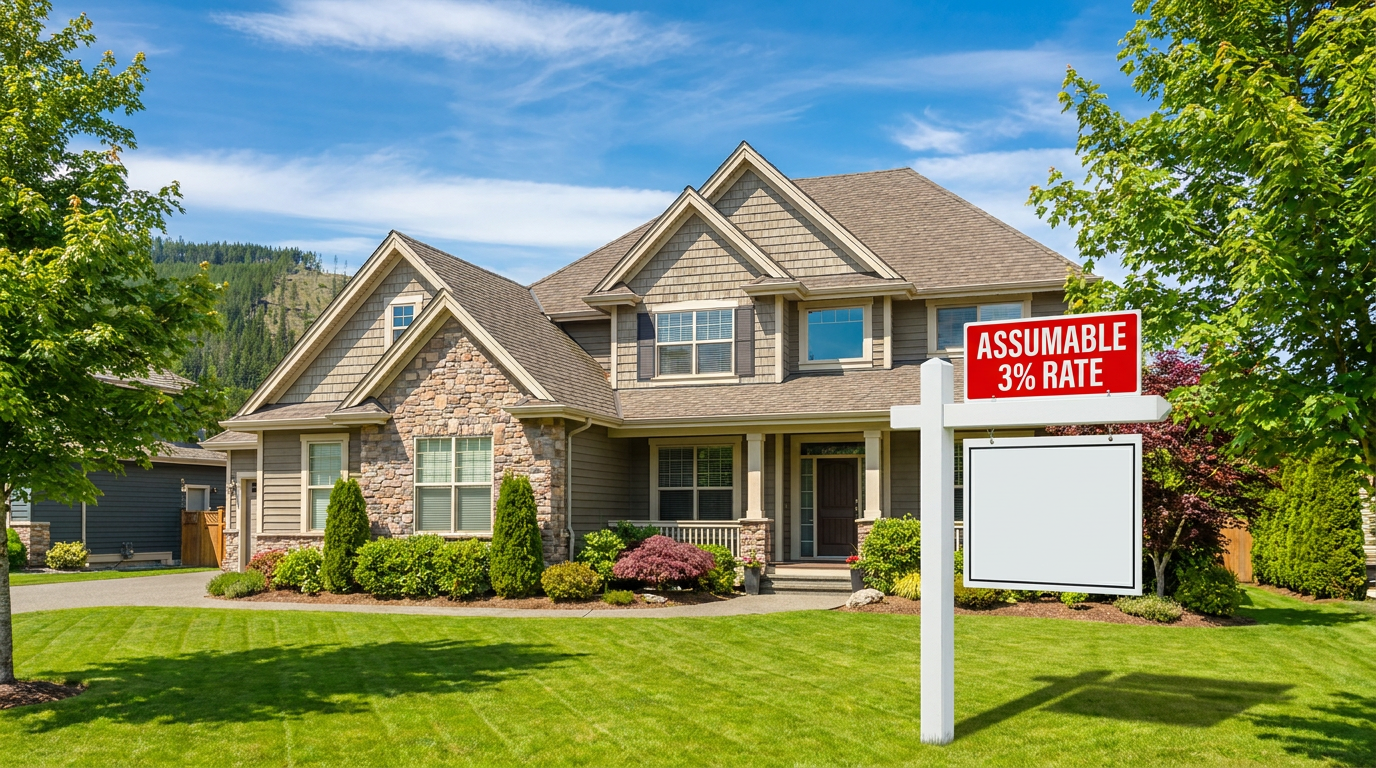
Rather than applying for a brand-new loan at today’s elevated market rates, an assumable mortgage allows a buyer to literally take over the seller’s existing home loan. The buyer inherits the original interest rate, the remaining principal balance, and the exact repayment schedule. If the seller locked in a 3% rate in 2021, the buyer gets to keep that 3% rate in 2026. It operates as a financial time machine, bypassing the Federal Reserve's rate hikes and offering a backdoor to the affordability of the past.[1][3][6]
The financial stakes of this maneuver are staggering. In early 2026, the average rate on a newly originated mortgage sits at roughly 6.16%. Meanwhile, the average interest rate across all existing, outstanding U.S. mortgages is just 4.4%. Even more strikingly, approximately 20% of all outstanding mortgages carry an interest rate below 3%. For a buyer, stepping into one of those sub-3% loans instead of taking on 6.5% debt fundamentally alters their financial trajectory.[2][5]
The Bipartisan Policy Center calculates that on a standard $400,000 loan, the difference between a 4.4% rate and a 6.16% rate amounts to roughly $350 in monthly savings. Over the full 30-year life of that loan, the buyer saves more than $125,000 in interest payments. When comparing a 6.5% rate to a 2.75% rate, the monthly savings can easily exceed $800. That reduction in monthly overhead can be the difference between a buyer qualifying for a family home or being relegated to a smaller property.[2][3][5]

This massive gap between old rates and new rates has created what economists call the "lock-in effect." Because homeowners are financially disincentivized from selling and taking on a new, more expensive mortgage, housing inventory has plummeted. The National Bureau of Economic Research estimates that this lock-in effect reduced household mobility by 16% in recent years, costing the U.S. economy roughly $20 billion in lost value as workers became less willing to relocate for better jobs. Assumable mortgages offer a rare mechanism to unfreeze this gridlock.[2][5][6]
For sellers, an assumable low-rate mortgage transforms from a reason to stay put into a highly marketable premium asset. In a sluggish market where high rates scare off traditional buyers, a home advertised with a 3% assumable rate stands out immediately. Sellers can often command a higher purchase price or secure a faster sale because the buyer is factoring in the massive long-term interest savings. It creates a rare win-win dynamic in an otherwise adversarial housing market.[3][5]
However, there is a significant catch: not all mortgages are assumable. The vast majority of conventional loans—those backed by Fannie Mae and Freddie Mac—contain a strict "due-on-sale" clause. This legal provision requires the mortgage to be paid off in full the moment the property changes hands, legally preventing any transfer of the loan to a new buyer. Therefore, buyers looking for this loophole must focus entirely on government-backed debt.[1][3]
The loans that are legally assumable are those insured by the Federal Housing Administration (FHA), the Department of Veterans Affairs (VA), and the United States Department of Agriculture (USDA). Together, these government-backed loans make up about 23% of the roughly 52 million outstanding mortgages in the United States. While that is a minority of the market, it still represents millions of properties nationwide that hold the potential for a low-rate transfer.[2][5]

VA loans are particularly prized in the assumption market. Guaranteed by the Department of Veterans Affairs, these loans often feature some of the lowest interest rates available. Crucially, a buyer does not need to be a military veteran to assume a VA loan. As long as the non-veteran buyer meets the lender's creditworthiness standards, they can take over the debt. However, the original veteran seller must be willing to leave their VA entitlement tied to the property until the loan is eventually paid off, which can complicate their ability to buy another home using a VA loan.[3][7]
Guaranteed by the Department of Veterans Affairs, these loans often feature some of the lowest interest rates available.
FHA loans are the most common type of assumable mortgage. To take over an FHA loan, the buyer must meet standard FHA underwriting criteria. This typically requires a minimum credit score of 580 and a debt-to-income ratio that the servicer deems acceptable, often capped around 43% to 50%. The buyer must also intend to use the property as their primary residence, as FHA rules generally prohibit investors from assuming these loans to build rental portfolios.[4][7]
Even if a buyer finds an assumable loan and meets the credit requirements, they face the largest structural hurdle of the process: the equity gap. When a buyer assumes a mortgage, they are only taking over the remaining balance of the loan, not the full purchase price of the home. Because home values have surged over the last decade, and because the seller has been paying down their principal, the difference between the home's current price and the loan balance can be massive.[3][4][5]
Consider a home currently listed for $500,000, where the seller holds an assumable mortgage with a remaining balance of $350,000 at a 2.875% interest rate. The buyer can assume that $350,000 loan, but they must still compensate the seller for the $150,000 difference. That $150,000 equity gap must be paid at closing. For many buyers, especially first-time homebuyers accustomed to putting down just 3% to 9%, coming up with a six-figure cash sum is entirely prohibitive.[3][5]

To bridge this equity gap, buyers who lack massive cash reserves must turn to secondary financing. This usually means taking out a second mortgage or a home equity loan to cover the difference. While the interest rate on that second loan will reflect today's higher market rates, the blended rate—combining the large 3% first mortgage and the smaller 7% second mortgage—often still results in a significantly lower overall payment than financing the entire $500,000 at 6.5%.[3][6]
The logistical friction of the assumption process also deters many buyers and real estate agents. Unlike a traditional home purchase, which can often close in 30 days, an assumption requires the buyer to apply directly with the seller's current mortgage servicer. The servicer must manually underwrite the buyer's finances to ensure they can handle the payments before releasing the seller from liability.[1][4]
Because mortgage servicers make very little money processing assumptions—federal rules cap the fees they can charge, often around $900 to $1,800—these files rarely receive priority treatment. Consequently, the assumption timeline frequently stretches from 45 to 120 days. Buyers and sellers must be prepared for a drawn-out escrow period, requiring patience that is often in short supply in competitive real estate markets.[6][7]
Despite these hurdles, consumer demand for assumable mortgages has skyrocketed. In response, a new ecosystem of real estate technology has emerged to help buyers find these hidden gems. Historically, finding an assumable home required manually scouring listing descriptions or knocking on doors near military bases. Today, specialized platforms like Roam, AssumeList, and Assumable.io aggregate FHA and VA listings, allowing buyers to filter homes specifically by their underlying interest rate and remaining loan balance.[7]

Real estate agents are also adapting to the trend. Savvy listing agents now prominently feature "Assumable 2.9% FHA Loan" in their primary marketing copy, knowing it will drive significantly more foot traffic to an open house. Buyer's agents are learning to navigate the complex secondary financing options required to close the equity gap, turning what was once a niche transaction into a mainstream strategy.[3][7]
Looking forward, housing policy experts are urging the government to streamline the assumption process to help thaw the frozen market. The Bipartisan Policy Center has even explored the concept of "portable mortgages"—a system common in Canada and the UK where a homeowner can take their low interest rate with them to a new property. While portable mortgages do not yet exist in the U.S., their discussion highlights the urgent need for creative financing solutions.[2][5]
Until broader structural changes occur, the assumable mortgage remains a powerful, if cumbersome, tool. It requires a specific alignment of variables: a government-backed loan, a patient seller, a creditworthy buyer, and a solution to the equity gap. When those pieces fall into place, the financial reward is unparalleled in modern real estate.[1][6]
For buyers willing to navigate the paperwork and the waiting periods, stepping into a seller's old mortgage is the closest thing to turning back the clock. In a 2026 market defined by high costs and limited inventory, the ability to inherit a 3% interest rate is not just a neat trick—it is a life-changing financial advantage that can secure a family's wealth for decades to come.[3][6]
How we got here
1982
The Garn-St. Germain Depository Institutions Act enforces due-on-sale clauses, largely ending assumptions for conventional loans.
2020–2021
Mortgage rates drop to historic lows, allowing millions of homeowners to lock in rates below 3%.
2023–2024
As rates surge past 7%, assumable mortgages see a 139% year-over-year increase in transaction volume.
2026
Specialized tech platforms like Roam and Assumable.io gain mainstream traction to help buyers find hidden low-rate listings.
Viewpoints in depth
Homebuyers & Real Estate Agents
Focuses on the massive affordability unlock and competitive advantages of assumable loans.
For buyers and their agents, assumable mortgages are viewed as the ultimate real estate hack in a high-rate environment. They argue that the upfront hassle of secondary financing and longer closing times is a small price to pay for securing a 3% interest rate. Real estate agents increasingly use assumable loans as a premier marketing tool, noting that homes advertised with these rates often sell faster and closer to asking price than comparable properties with conventional financing.
Housing Policy Analysts
Focuses on macroeconomic mobility and unfreezing the housing market.
Economists and policy think tanks look at assumable mortgages through the lens of the 'lock-in effect.' They argue that millions of Americans are currently trapped in homes that no longer fit their needs simply because they cannot afford to give up their pandemic-era mortgage rates. By expanding the awareness and efficiency of assumable mortgages—or even introducing 'portable' mortgages that travel with the homeowner—analysts believe the government could unlock stagnant housing inventory and restore billions of dollars in lost economic mobility.
Mortgage Servicers
Focuses on the logistical friction and low profitability of processing assumptions.
From the perspective of the banks and servicers managing these loans, assumptions are a logistical headache. Servicers point out that underwriting an assumption requires nearly as much labor as originating a brand-new loan, but federal regulations cap the fees they can charge at a fraction of standard origination costs. Consequently, servicers argue they lack the financial incentive to prioritize these files, which leads to the notoriously long 45-to-120-day processing times that frustrate buyers and sellers.
What we don't know
- Whether federal regulators will step in to mandate faster processing times for mortgage servicers handling assumption requests.
- If the U.S. housing market will ever adopt 'portable mortgages,' which would allow homeowners to transfer their low rates to new properties.
Key terms
- Assumable Mortgage
- A home loan that allows a buyer to take over the seller's existing interest rate, remaining balance, and repayment schedule.
- Equity Gap
- The difference between a home's purchase price and the remaining balance of the assumable loan, which the buyer must cover in cash or with a second mortgage.
- Lock-in Effect
- An economic phenomenon where homeowners refuse to sell their properties because they do not want to give up their historically low mortgage rates.
- Due-on-Sale Clause
- A standard provision in conventional mortgages requiring the loan to be paid in full when the property is sold, preventing the loan from being assumed.
- FHA Loan
- A mortgage insured by the Federal Housing Administration, designed for low-to-moderate-income borrowers, which is generally assumable.
Frequently asked
Can I assume a conventional mortgage?
Generally, no. Most conventional mortgages have a due-on-sale clause that requires the loan to be paid in full upon sale. Assumptions are primarily limited to government-backed FHA, VA, and USDA loans.
Do I need to be a veteran to assume a VA loan?
No. Non-veterans can assume a VA loan as long as they meet the lender's credit and income requirements, though the seller's VA entitlement may remain tied up until the loan is paid off.
Do I still have to qualify for the loan if I assume it?
Yes. You must apply with the seller's current mortgage servicer and meet their underwriting standards for credit score, income, and debt-to-income ratio.
Why do assumable mortgages take so long to close?
The seller's original loan servicer must process the assumption. Because these transactions are less common and less profitable for the servicer than originating a new loan, the timeline can stretch from 45 to 120 days.
Sources
Source coverage
7 outlets
3 viewpoints surfaced







[1]KiplingerHomebuyers & Real Estate Agents
Assumable Mortgages: A Creative Way to Buy a Home in 2026
Read on Kiplinger →[2]Bipartisan Policy CenterHousing Policy Analysts
Assumable and Portable Mortgages: Potential Solutions to Improve Affordability
Read on Bipartisan Policy Center →[3]HAR.comHomebuyers & Real Estate Agents
Assumable Interest Rates Explained (2026 Guide)
Read on HAR.com →[4]SoFiMortgage Lenders & Servicers
Are FHA Loans Assumable?
Read on SoFi →[5]National Mortgage ProfessionalHousing Policy Analysts
BPC Explores Assumable Mortgages To Unlock Market
Read on National Mortgage Professional →[6]Factlen Editorial TeamHousing Policy Analysts
Synthesis by Factlen editorial team
Read on Factlen Editorial Team →[7]HomeLightHomebuyers & Real Estate Agents
How to Find Assumable Mortgages in 2026
Read on HomeLight →

Every angle. Every day.
Get finance stories with full source coverage and perspective breakdowns delivered to your inbox.