
The Rise of Local AI: How to Run Large Language Models on Your Own Device
In 2026, running powerful AI models locally on consumer laptops has shifted from a hobbyist experiment to a mainstream reality. Thanks to dedicated neural processors and streamlined software, users can now access GPT-4-level intelligence with zero latency and absolute privacy.
By Factlen Editorial Team
- Privacy & Security Advocates
- Argue that local AI is essential for protecting proprietary code, enterprise data, and personal information from cloud data breaches.
- Open-Source Developers
- Value the freedom, zero latency, and lack of censorship provided by running open-weight models on personal hardware.
- Cloud Infrastructure Pragmatists
- Maintain that while local AI is useful, cloud APIs remain necessary for frontier-level reasoning, massive context windows, and real-time web access.
What's not represented
- · Hardware manufacturers struggling to source enough NPUs to meet the new Copilot+ PC standards.
- · Everyday non-technical consumers who may find even GUI-based local AI tools too complex to manage.
Why this matters
Relying entirely on cloud-based AI means trading your personal data, proprietary code, and monthly subscription fees for intelligence. Local AI returns control to the user, offering absolute privacy, offline capability, and zero latency for daily tasks.
Key points
- Local AI allows users to run Large Language Models entirely offline, ensuring zero data leakage.
- Hardware advancements like NPUs and Apple Silicon have made consumer laptops powerful enough for AI inference.
- Software tools like LM Studio and Ollama have eliminated the technical barriers to installing local models.
- While local models handle 95% of daily tasks, cloud APIs still lead in complex reasoning and real-time web access.
For the past few years, the tech industry has conditioned users to believe that artificial intelligence must live in the cloud. We traded our most sensitive data, proprietary code, and private notes for the convenience of a chat box hosted on centralized servers. But a quiet revolution has reached critical mass in 2026: the rise of local AI.[1]
Running Large Language Models (LLMs) directly on consumer hardware is no longer a clunky, hobbyist experiment. Today, local inference is a legitimate daily driver for developers, founders, and everyday users who want the power of AI without the privacy risks or subscription fees of cloud giants.[2][4]
This transition from cloud-first to local-first AI is driven by a convergence of three major shifts: the maturation of open-weight models, the integration of dedicated AI chips into consumer laptops, and the arrival of frictionless software tools. Together, they have closed the gap between what a massive data center can do and what a standard laptop can achieve.[2][5]
The hardware revolution is anchored by the Neural Processing Unit (NPU). Unlike traditional CPUs or GPUs, NPUs are purpose-built to execute machine learning tasks with high efficiency and low power consumption. Microsoft has formalized this with its "Copilot+ PC" standard, requiring Windows laptops to feature an NPU capable of at least 40 Trillion Operations Per Second (TOPS) and a minimum of 16 GB of RAM.[7]

Apple has taken a similar, deeply integrated approach with Apple Intelligence. By leveraging the unified memory architecture of Apple Silicon (M-series chips), Apple processes the vast majority of AI requests—like summarization, writing assistance, and photo search—entirely on-device. Only when a task exceeds local capabilities does it securely ping Apple's Private Cloud Compute.[8]
But hardware is only half the equation. The models themselves have become astonishingly efficient. Open-weight models like Meta's Llama 4, Alibaba's Qwen 3.5, and Mistral have reached performance parity with the cloud-based GPT-4 models of just 18 months ago. These models can handle 95% of daily tasks, from drafting emails to writing complex code.[2][5]
Open-weight models like Meta's Llama 4, Alibaba's Qwen 3.5, and Mistral have reached performance parity with the cloud-based GPT-4 models of just 18 months ago.
The mechanism that makes this possible is called "quantization." In simple terms, quantization compresses the massive neural networks of an LLM—often hundreds of gigabytes in size—down to a fraction of their original footprint. This allows a highly capable 14-billion or even 70-billion parameter model to fit comfortably within the 16 GB to 32 GB of RAM found in modern laptops.[4]
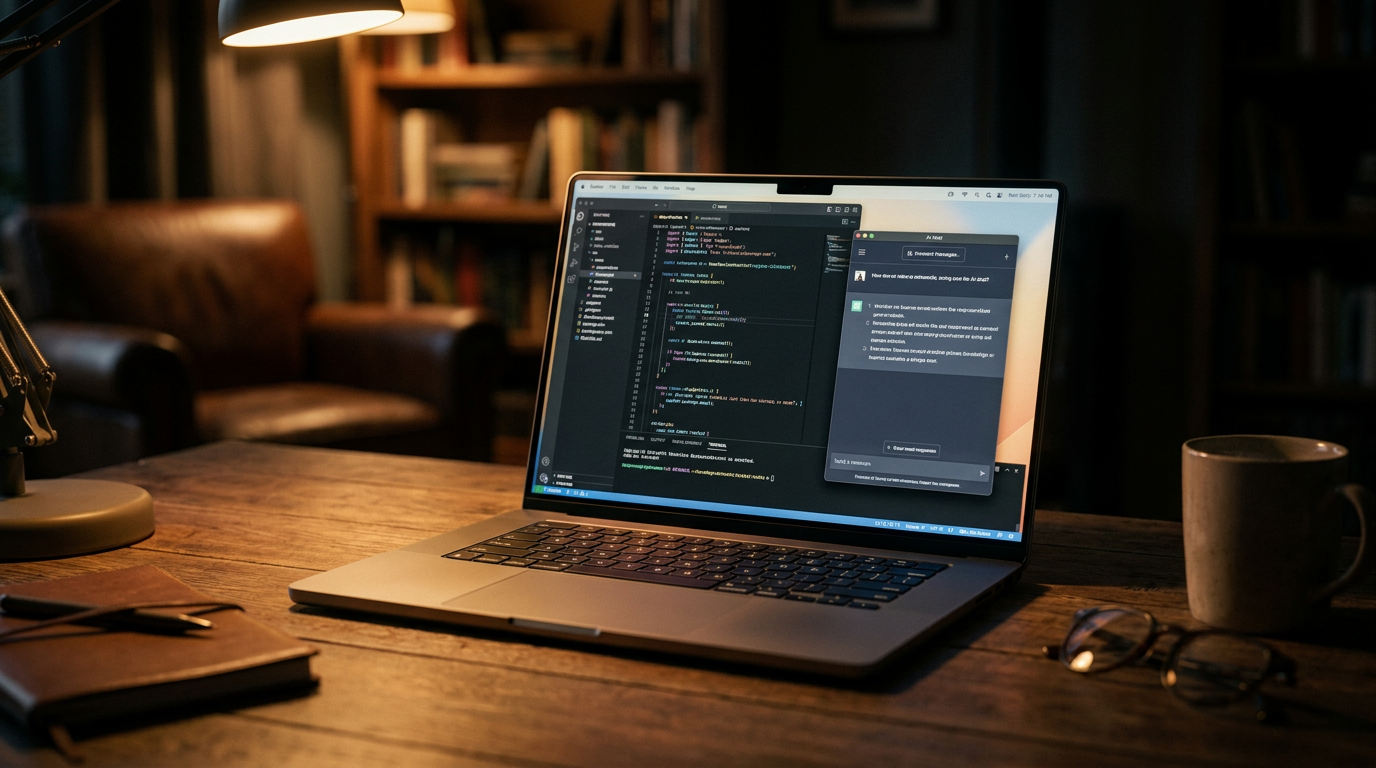
For users, the software layer has completely eliminated the command-line barrier to entry. The gold standard for graphical interfaces is LM Studio, a desktop application that feels exactly like using ChatGPT but runs 100% offline. Users can browse a directory of models, click download, and start chatting within minutes, while monitoring exactly how much RAM and CPU the model is consuming.[1][6]
For developers and power users, Ollama has become the dominant tool. Operating primarily as a command-line interface, Ollama acts like "Docker for LLMs," allowing users to download and run models with a single command. It is optimized for speed—running 10% to 20% faster than GUI alternatives—and is easily integrated into automated workflows and local coding assistants.[1][6]

The primary driver pushing users toward these local tools is the "Privacy Paradox." High-profile data breaches and shifting terms of service have made enterprise buyers and stealth startups wary of pasting proprietary information into cloud APIs. Local AI creates a closed-loop system: prompts, documents, and code never leave the solid-state drive.[2][4]
Beyond absolute data confidentiality, local AI offers zero latency. Because the model does not need to wait for a busy server to respond over the internet, the text generation is instantaneous. This offline advantage also means productivity is no longer tethered to a Wi-Fi connection, allowing users to work seamlessly on airplanes or in remote locations.[1][4]
However, local AI is not a complete replacement for frontier cloud models. As of mid-2026, the most advanced cloud APIs—like OpenAI's GPT-5.5 or Anthropic's Claude 4.6—still hold a meaningful 10% to 20% lead in multi-step, complex reasoning tasks. Cloud models also benefit from massive context windows and real-time web search capabilities that local models struggle to match.[3][5]

Speed can also be a limiting factor depending on the hardware. While an NPU or an Apple Silicon chip can generate text at a highly readable pace, older CPUs without dedicated AI accelerators will struggle, producing a sluggish 10 to 25 tokens per second compared to the 100+ tokens per second typical of cloud APIs.[3]
Despite these limitations, the trajectory is clear. The future of artificial intelligence is ambient, private, and on-device. As open-weight models continue to shrink and consumer hardware continues to scale, the default behavior for computing will be to process intelligence locally, reserving the cloud only for the most monumental of tasks.[5][9]
How we got here
2023
Running LLMs locally is largely restricted to hobbyists with expensive, power-hungry desktop GPUs.
2024
Apple introduces Apple Intelligence and Microsoft announces the Copilot+ PC standard, laying the hardware groundwork.
2025
Open-weight models like Llama 3 and Mistral drastically improve, making local inference viable for daily tasks.
Early 2026
Tools like LM Studio and Ollama mature, offering one-click installations that bring local AI to mainstream users.
Viewpoints in depth
Privacy Advocates & Enterprise IT
Argue that local AI is essential for protecting proprietary code and enterprise data.
For enterprise IT departments and privacy advocates, the cloud represents an unacceptable vulnerability. High-profile data breaches and opaque training agreements have made companies wary of allowing employees to paste proprietary code or financial data into cloud-based chatbots. This camp views local AI not just as a convenience, but as a mandatory compliance measure. By keeping inference strictly on-device, organizations can leverage the productivity boosts of AI without exposing their 'Hidden Risk Architecture' to third-party servers.
Open-Source Developers
Value the freedom, zero latency, and lack of censorship provided by running open-weight models.
The open-source community champions local AI for its democratization of intelligence. Developers in this camp appreciate that local models are immune to sudden API deprecations, unexpected subscription price hikes, and the heavy-handed safety filters often applied by corporate cloud providers. For these builders, tools like Ollama provide the ultimate sandbox—a zero-latency environment where they can rapidly prototype agentic workflows, test new quantization methods, and build personalized tools without asking a tech giant for permission.
Cloud API Providers
Maintain that cloud APIs remain necessary for frontier-level reasoning and real-time capabilities.
While acknowledging the rise of local inference, cloud infrastructure providers argue that the most transformative AI applications still require data center scale. They point out that local models are inherently constrained by the thermal and memory limits of consumer hardware. For tasks requiring massive context windows (like analyzing entire books at once), real-time web search, or multi-step logical reasoning, this camp insists that frontier cloud models like GPT-5.5 will always maintain a significant performance edge over local alternatives.
What we don't know
- How quickly open-weight models will close the final 10% reasoning gap with frontier cloud models like GPT-5.5.
- Whether future operating system updates will restrict third-party local AI tools in favor of first-party integrations like Apple Intelligence.
- How the battery life of ultra-thin laptops will hold up under continuous, heavy NPU inference over several years.
Key terms
- NPU (Neural Processing Unit)
- A specialized hardware chip designed specifically to accelerate artificial intelligence and machine learning tasks efficiently.
- Quantization
- A compression technique that reduces the memory footprint of an AI model so it can run on consumer hardware without losing significant accuracy.
- Open-Weight Model
- An AI model whose core architecture and trained parameters are publicly available for anyone to download and run.
- Inference
- The process of a trained AI model generating a response or prediction based on a user's prompt.
- TOPS
- Trillions of Operations Per Second; a metric used to measure the processing power of an NPU.
Frequently asked
Do I need an internet connection to use local AI?
No. Once the model is downloaded to your device, tools like LM Studio and Ollama run entirely offline, ensuring absolute privacy.
Can my current laptop run these models?
It depends on your RAM. You generally need a minimum of 16 GB of RAM and ideally a dedicated NPU or Apple Silicon chip to run models at a readable speed.
Is local AI as smart as ChatGPT?
For about 95% of daily tasks like drafting emails and summarizing text, yes. However, frontier cloud models still hold an edge in highly complex, multi-step reasoning.
Are local AI tools free?
Yes. The open-weight models and the primary software tools (like Ollama and LM Studio) are free to download and use, with no subscription fees.
Sources
Source coverage
9 outlets
3 viewpoints surfaced









[1]MediumPrivacy & Security Advocates
Why I moved my most important AI tasks off the grid
Read on Medium →[2]Patrick GawronOpen-Source Developers
Why Local LLMs Matter in 2026
Read on Patrick Gawron →[3]Prompt QuorumCloud Infrastructure Pragmatists
Local LLM vs Cloud API: When to Use Each
Read on Prompt Quorum →[4]Silver Scoop BlogPrivacy & Security Advocates
The Rise of Privacy-First AI: Why 2026 is the Year of the Local-Only LLM
Read on Silver Scoop Blog →[5]MindStudioCloud Infrastructure Pragmatists
The Gap Between Local and Cloud AI Is Closing
Read on MindStudio →[6]Contra CollectiveOpen-Source Developers
LM Studio vs Ollama: The Local AI Inference Space
Read on Contra Collective →[7]MicrosoftCloud Infrastructure Pragmatists
What is a Copilot+ PC?
Read on Microsoft →[8]ApplePrivacy & Security Advocates
Apple Intelligence Architecture
Read on Apple →[9]Factlen Editorial TeamOpen-Source Developers
Synthesis by Factlen editorial team
Read on Factlen Editorial Team →
More in ai
See all 8 stories →On-Device AI
How Small Language Models Brought AI Out of the Cloud and Onto Your Devices
0 sources

Local AI
How Open-Source AI Models Are Running Locally on Consumer Hardware in 2026
0 sources

On-Device AI
How Local LLMs and NPUs Are Bringing AI Offline in 2026
0 sources
On-Device AI
The Rise of Local AI: How On-Device Models Are Changing Privacy and Computing
0 sources

Every angle. Every day.
Get ai stories with full source coverage and perspective breakdowns delivered to your inbox.