
Evidence Pack: Do Wearable Sleep Trackers Actually Improve Sleep Quality?
Consumer wearables like Oura, Whoop, and Apple Watch excel at detecting when you fall asleep, but clinical evidence shows they struggle to accurately map specific sleep stages.
By Factlen Editorial Team
- Clinical Sleep Specialists
- Medical professionals who emphasize the diagnostic limitations of consumer devices.
- Quantified Self Advocates
- Data-driven users who leverage wearables for behavioral optimization.
- Wearable Researchers
- Scientists evaluating the technical accuracy and algorithmic performance of the devices.
What's not represented
- · Individuals with chronic insomnia who may be disproportionately affected by tracker inaccuracies.
- · Health insurance providers evaluating whether to subsidize wearables for preventative care.
Why this matters
Millions of consumers rely on daily 'sleep scores' to dictate their training, productivity, and mood. Understanding the scientific limits of these devices prevents unnecessary anxiety and helps users focus on the metrics that actually drive better rest.
Key points
- Consumer wearables detect sleep versus wake states with over 95% sensitivity.
- Accuracy for classifying specific sleep stages (light, deep, REM) drops to between 50% and 86%.
- Trackers often overestimate total sleep time because they confuse lying still with actual sleep.
- Wearable SpO2 sensors show roughly 93% sensitivity for detecting moderate-to-severe sleep apnea.
- Tracking can improve habits, but obsessing over sleep scores can trigger anxiety-induced insomnia.
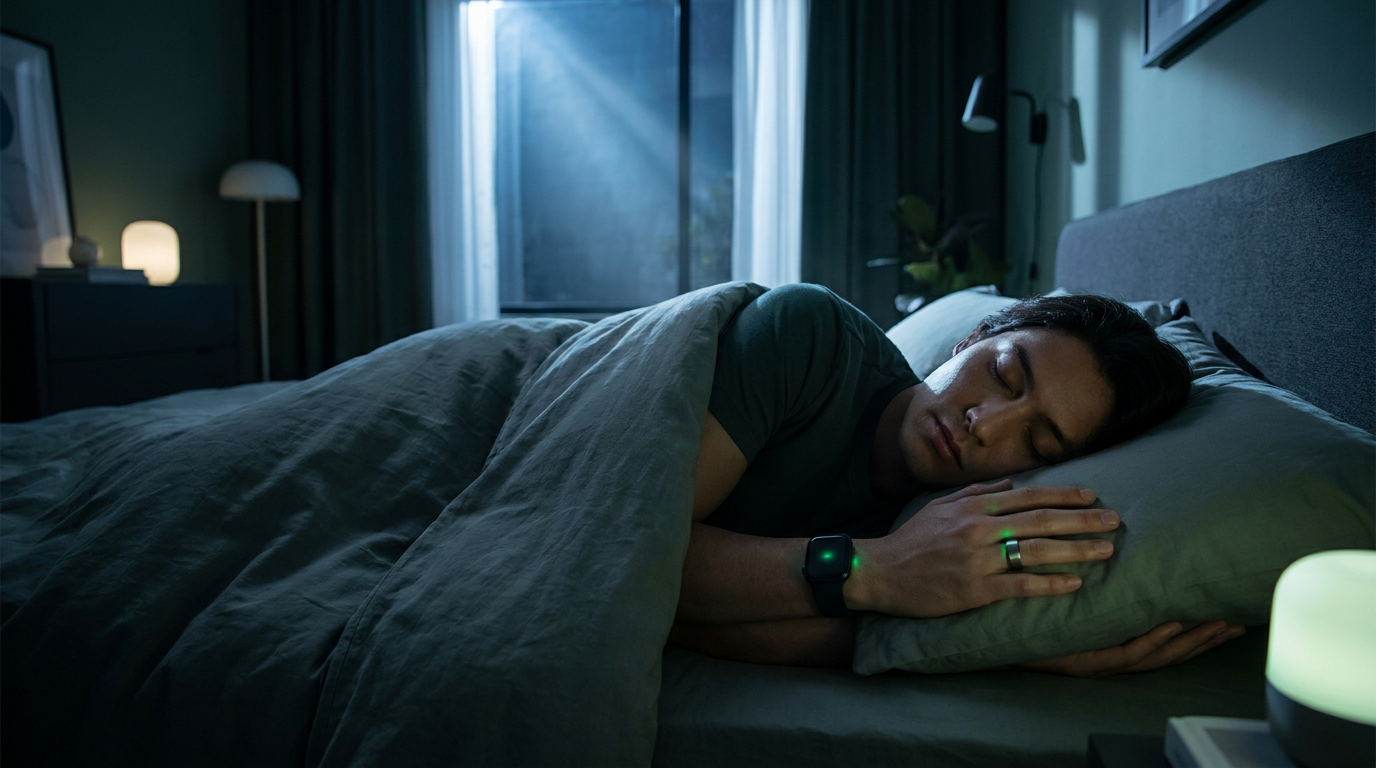
The morning routine for millions of people now begins before they even leave the bed: checking a screen to find out how well they slept. Consumer sleep trackers—ranging from wrist-worn devices like the Apple Watch and Whoop to smart rings like Oura—have transformed sleep from a subjective feeling into a quantified daily score. These devices promise to map our nights, breaking down our rest into precise percentages of light, deep, and REM sleep. But as the market for sleep technology explodes, clinical researchers have been quietly testing these consumer gadgets against the gold standard of sleep science.[7]
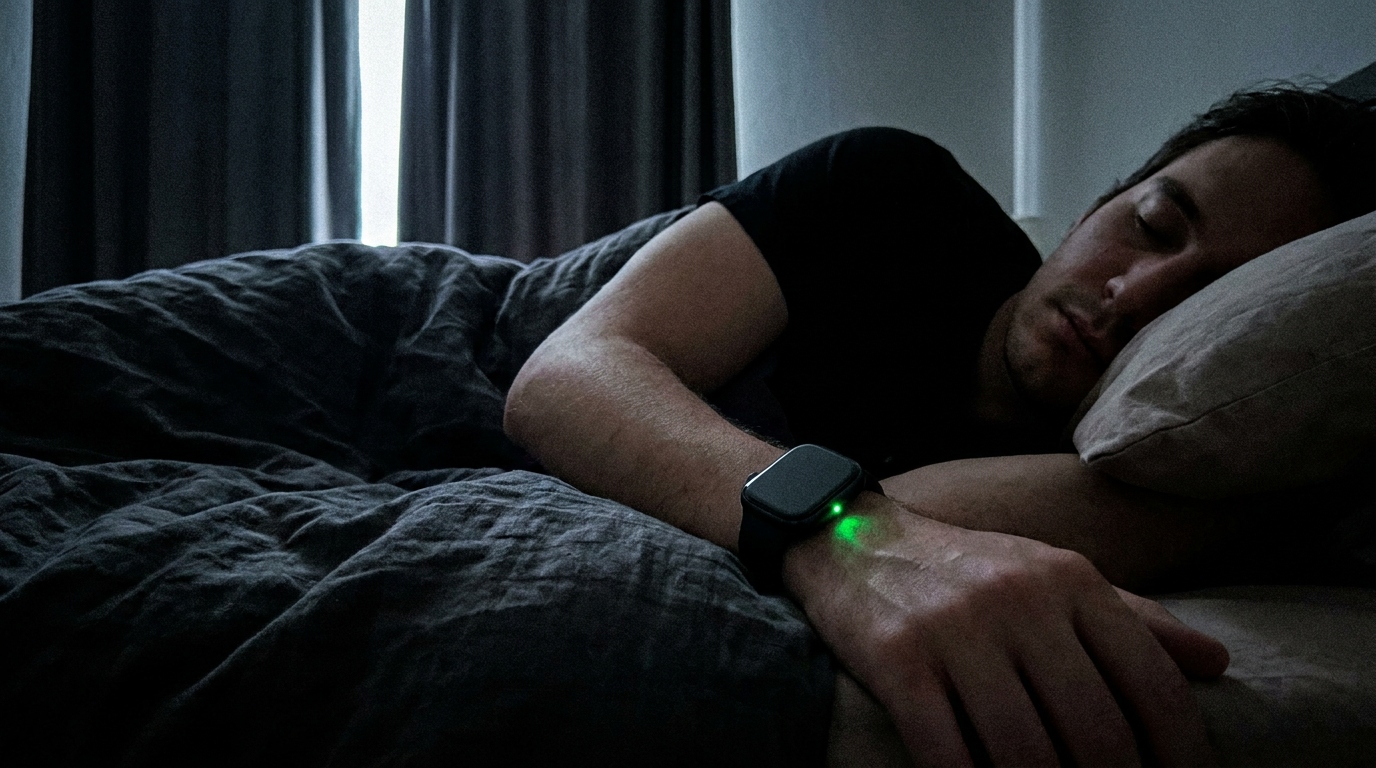
To understand the accuracy of a consumer wearable, it must be compared to polysomnography (PSG). PSG is the intensive, multi-sensor sleep study conducted in clinical labs. It measures brain waves (EEG), eye movements (EOG), muscle tone (EMG), and respiratory airflow. Consumer trackers, by contrast, rely primarily on just two sensors: an accelerometer to measure movement, and photoplethysmography (PPG)—the green and red LEDs flashing against the skin—to measure heart rate and blood oxygen. The core scientific challenge of wearable sleep tracking is attempting to infer brain states using only cardiovascular and movement data.[5][7]
When it comes to the most basic binary question—are you asleep or awake?—modern wearables perform exceptionally well. A 2024 multicenter validation study published in JMIR mHealth and uHealth evaluated 11 different consumer sleep trackers against clinical PSG. The researchers found that the devices achieved a sensitivity greater than 95% for detecting sleep states. If you are genuinely asleep, your smartwatch or ring almost certainly knows it. This makes them highly effective tools for tracking broad longitudinal patterns, such as your average bedtime or total time spent in bed over a month.[1]

However, the evidence weakens significantly when devices attempt to classify specific sleep stages. A 2025 meta-analysis in the Journal of Clinical Sleep Medicine, which reviewed 24 studies encompassing nearly 800 patients, concluded that wrist-worn trackers are not as reliable as PSG for precise parameters. Depending on the device and the specific stage being measured, accuracy for four-stage classification (light, deep, REM, and wake) ranges broadly from 50% to 86%. Because wearables cannot detect the specific brainwave signatures that define REM or deep sleep, their algorithms are making educated guesses based on heart rate variability and stillness.[2][7]
However, the evidence weakens significantly when devices attempt to classify specific sleep stages.
This algorithmic guesswork leads to a well-documented phenomenon: consumer trackers consistently overestimate total sleep time by roughly 2% to 10%. The primary culprit is 'motionless wake.' A 2024 study in Sleep Health found that wearables frequently misclassify periods where a user is lying perfectly still but awake—such as scrolling through a smartphone in bed or struggling with insomnia—as light sleep. The specificity for detecting wakefulness often falls below 60%. For a healthy sleeper, this slight overestimation is negligible. But for someone suffering from insomnia, a tracker that insists they slept for eight hours when they were awake for three can be deeply frustrating.[4][7]

Despite these limitations in staging, wearables are proving highly valuable as early-warning screening tools for respiratory issues. Many modern devices feature SpO2 sensors that track blood oxygen saturation overnight. A 2025 systematic review in Sleep Medicine Reviews found that consumer-grade oxygen monitors achieved an average sensitivity of approximately 93% for detecting moderate-to-severe obstructive sleep apnea (OSA). While they produce false positives and cannot replace a clinical diagnosis, these devices are successfully flagging thousands of users who might otherwise never have realized they stop breathing during the night.[3]
Beyond the hardware accuracy, researchers are increasingly focused on the psychological impact of sleep tracking. Does wearing a device actually improve your sleep? The evidence suggests a conditional 'yes.' A study published in BMC Public Health found that 30% to 50% of users reported that sleep apps increased their awareness of sleep hygiene. The real value of the data lies in behavioral nudges. When users see concrete evidence that late-night alcohol consumption or a late-afternoon coffee demonstrably tanks their resting heart rate and sleep efficiency, they are far more likely to change those habits.[6][7]

Yet, this increased awareness carries a documented risk. Sleep specialists have coined the term 'orthosomnia' to describe an unhealthy preoccupation with achieving perfect sleep metrics. For some users, the pressure to achieve a high 'sleep score' creates performance anxiety at bedtime, which ironically triggers the exact hyperarousal that prevents deep sleep. Furthermore, users may experience a nocebo effect—waking up feeling refreshed, checking their app, seeing a low recovery score, and subsequently feeling fatigued simply because the algorithm told them they should.[5][7]
The consensus among sleep researchers is that consumer wearables are powerful tools when used with the right mindset. They are not clinical diagnostic instruments, and their nightly breakdowns of REM versus deep sleep should be treated as estimates rather than gospel. However, as behavioral mirrors, they are unparalleled. By shifting focus away from nightly stage percentages and toward long-term trends—consistency of bedtimes, total duration in bed, and the lifestyle factors that disrupt resting heart rate—users can harness the data to make genuinely positive changes to their health.[2][5][7]
Viewpoints in depth
Clinical Sleep Specialists
Medical professionals who emphasize the diagnostic limitations of consumer devices.
Clinicians stress that consumer wearables are fundamentally limited because they do not measure brain activity (EEG), which is the only definitive way to classify sleep stages. They frequently warn against 'orthosomnia,' noting that patients increasingly arrive at clinics anxious about their wearable data rather than their actual symptoms. While they welcome the devices as screening tools for severe issues like sleep apnea, they caution users against making medical decisions based on algorithmic sleep scores.
Quantified Self Advocates
Data-driven users who leverage wearables for behavioral optimization.
For fitness enthusiasts and biohackers, the absolute clinical accuracy of a single night's sleep stage breakdown is less important than the longitudinal trends. This camp values wearables as behavioral mirrors. By tracking how resting heart rate and heart rate variability respond to late meals, alcohol, or intense training, they use the data to run personal experiments. To them, the tracker is a tool for accountability and lifestyle modification rather than a medical diagnostic device.
Wearable Researchers
Scientists evaluating the technical accuracy and algorithmic performance of the devices.
Device makers and researchers point to the rapid year-over-year improvement in sensor technology and machine learning algorithms. They argue that while a wearable may not match a clinical sleep study, it provides 365 nights of continuous data, offering a holistic picture that a single night in a strange laboratory bed cannot capture. Researchers are increasingly focusing their validation studies on population-scale health screening, arguing that these devices can flag widespread, undiagnosed issues like sleep apnea at an unprecedented scale.
What we don't know
- How the proprietary, closed-source algorithms of major tech companies weigh different sensor inputs to generate their sleep scores.
- Whether long-term reliance on sleep trackers permanently alters a user's natural ability to subjectively assess their own rest.
- How accurately next-generation sensors will be able to infer brainwave activity purely from advanced cardiovascular metrics.
Key terms
- Polysomnography (PSG)
- The clinical gold standard for sleep studies, which measures brain waves, blood oxygen, heart rate, and breathing in a laboratory setting.
- Photoplethysmography (PPG)
- An optical technology used in smartwatches and rings that shines light into the skin to measure blood flow and heart rate.
- Orthosomnia
- An unhealthy obsession with achieving perfect sleep metrics, which can paradoxically cause anxiety and worsen sleep quality.
- Motionless Wake
- Periods where a person is awake but lying perfectly still, which wearables frequently misclassify as light sleep.
- Sleep Architecture
- The cyclical pattern of sleep as it shifts between different stages, including light sleep, deep sleep, and REM.
Frequently asked
Can a smartwatch diagnose sleep apnea?
No. While devices with SpO2 sensors are excellent at screening for potential breathing interruptions, a formal diagnosis requires a clinical sleep study.
Why does my tracker say I slept when I was awake?
Wearables rely heavily on movement sensors. If you are lying perfectly still in bed—such as when reading or struggling to fall asleep—the device often misinterprets this lack of movement as light sleep.
Are smart rings more accurate than smartwatches?
Both use similar PPG and accelerometer sensors. Some studies show premium smart rings perform slightly better due to the finger being an ideal location for measuring heart rate, but neither matches clinical accuracy.
Should I worry if my deep sleep score is low?
Not necessarily. Because wearables estimate sleep stages based on heart rate rather than brain waves, their deep sleep measurements are prone to error. Focus on how you feel rather than the specific percentage.
Sources
Source coverage
7 outlets
3 viewpoints surfaced




[1]JMIR mHealth and uHealthWearable Researchers
Accuracy of 11 Wearable, Nearable, and Airable Consumer Sleep Trackers Versus Polysomnography: Multicenter Validation Study
Read on JMIR mHealth and uHealth →[2]Journal of Clinical Sleep MedicineClinical Sleep Specialists
Meta-Analysis of Wrist-Worn Sleep Tracking Devices Against Clinical Polysomnography
Read on Journal of Clinical Sleep Medicine →[3]Sleep Medicine ReviewsClinical Sleep Specialists
Oximetry-based devices in diagnosis of obstructive sleep apnea: A systematic review and meta-analysis
Read on Sleep Medicine Reviews →[4]Sleep HealthWearable Researchers
Wearable devices poorly classify motionless wake during simulated real-world smartphone use
Read on Sleep Health →[5]Johns Hopkins MedicineClinical Sleep Specialists
Do Sleep Trackers Really Work?
Read on Johns Hopkins Medicine →[6]BMC Public HealthQuantified Self Advocates
The impact of sleep tracking apps on self-awareness and sleep hygiene habits
Read on BMC Public Health →[7]Factlen Editorial TeamQuantified Self Advocates
Synthesis by Factlen editorial team
Read on Factlen Editorial Team →

Every angle. Every day.
Get shopping stories with full source coverage and perspective breakdowns delivered to your inbox.