
The Analog Renaissance: Why Gen Z is Rebuilding the Offline World
Driven by digital fatigue, a new generation is trading smartphones for film cameras and reviving physical community spaces to reclaim their attention.
By Factlen Editorial Team
- Digital Minimalists
- Advocates for reclaiming attention and mental health through offline experiences.
- Analog Economy Investors
- Market analysts and brands capitalizing on the financial shift toward physical goods.
- Urban Sociologists
- Researchers focused on the revival of physical community infrastructure.
What's not represented
- · Major technology executives and social media platform developers
- · Older generations who may feel alienated by the rapid shifts in youth culture
Why this matters
As the first fully digitally native generation actively chooses friction and tangibility over algorithmic convenience, they are fundamentally reshaping the retail economy, urban planning, and the future of human connection.
Key points
- A growing segment of Gen Z is adopting analog hobbies like film photography and vinyl records to combat digital fatigue.
- The 'analog economy' has grown into a multi-billion-dollar market, driven by a desire for tactile, offline experiences.
- Physical retail spaces, including traditional malls, are being repurposed as essential social hubs rather than purely transactional environments.
- Sociologists note a massive revival of the 'Third Place'—community spaces outside of home and work—as young people seek genuine, in-person connection.
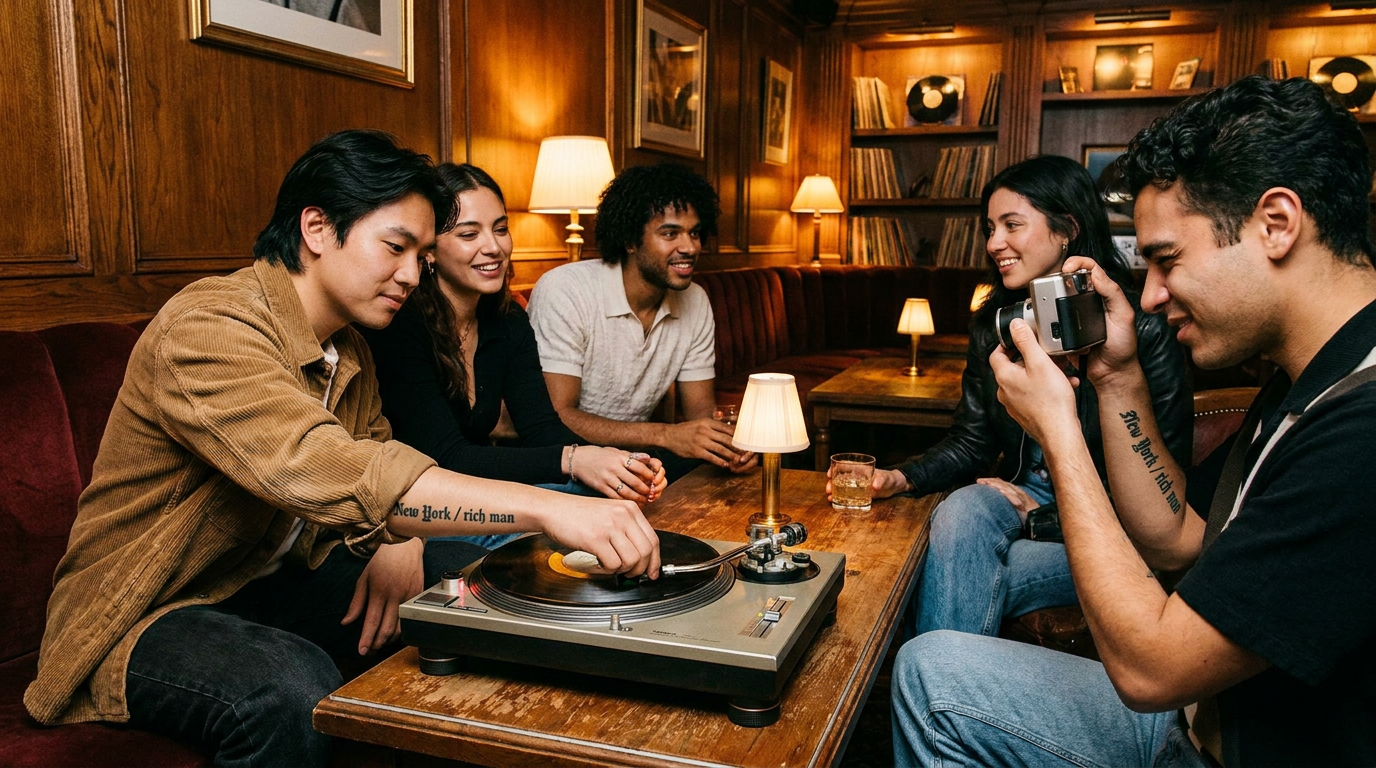
The most technologically saturated generation in history is orchestrating a quiet rebellion against the screen. In 2026, the cultural vanguard of Generation Z is not clamoring for the latest augmented reality headset or fully immersive metaverse. Instead, they are buying point-and-shoot film cameras, threading yarn, spinning vinyl records, and trading their smartphones for stripped-down "dumbphones."
This phenomenon, widely dubbed the "Analog Renaissance," is no longer a fringe aesthetic or a fleeting TikTok trend. It has matured into a measurable economic and sociological shift. Young adults who grew up with algorithms curating their every waking moment are deliberately seeking out friction, tangibility, and offline presence.
The data paints a stark picture of digital fatigue. According to industry research, a significant portion of Gen Z consumers globally report taking up analog hobbies specifically as a remedy for digital exhaustion [1]. Broader demographic data indicates that nearly half of teenagers now view social media's impact as mostly negative, a sharp increase from just a few years prior [5].
For years, the technology sector operated on the assumption that convenience and connectivity were the ultimate consumer desires. But convenience has a cost: the erosion of attention and the atomization of community. The internet, once heralded as the ultimate global village, has increasingly become a landscape of isolated scrolling and algorithmic echo chambers.

In response, young people are reclaiming their "attention agency." This means deciding what gets access to their minds rather than defaulting to the infinite scroll. The shift is not necessarily about abandoning the internet entirely—Gen Z remains highly digitally literate—but rather about moving from an overstimulated state to a grounded one.
The financial implications of this shift are staggering. The broader "analog economy"—encompassing physical media, experiential retail, and digital detox tools—is now estimated to be at least a multi-billion-dollar market [1]. Investors are looking beyond obvious nostalgia plays and funding niche manufacturing, experiential services, and physical community spaces.
Consider the resurgence of film photography. Market analysts report that reusable film cameras now command over half of the film camera market share, driven almost entirely by Gen Z and Millennial hobbyists [2]. These consumers are willing to pay for the ongoing cost of film and development because they value the tactile intentionality and organic aesthetic of the medium over the disposable perfection of a smartphone camera.
The music industry is experiencing a similar reversion. Vinyl sales have not only surpassed CDs but have become a primary mode of music consumption for a demographic that already pays for streaming services. A staggering majority of Gen Z vinyl buyers state they purchase records specifically to own a physical copy of the music, treating the medium as a form of digital detox that requires active listening [1].

Vinyl sales have not only surpassed CDs but have become a primary mode of music consumption for a demographic that already pays for streaming services.
But the Analog Renaissance extends far beyond consumer goods; it is fundamentally reshaping how and where young people gather. This brings us to the revival of the "Third Place"—a term coined by sociologist Ray Oldenburg in 1989 to describe the informal public spaces outside of home and work [4].
During the pandemic, digital platforms and group chats attempted to serve as virtual third places. However, the lack of physical proximity and serendipity left many feeling more isolated than ever. Now, there is a concerted effort to rebuild physical community infrastructure, prioritizing real-world interaction over digital content.
The traditional shopping mall is perhaps the most surprising beneficiary of this trend. While e-commerce was supposed to render the mall obsolete, it is experiencing a cultural resurrection as a town square. Recent consumer research found that nearly three-quarters of Gen Z consumers visit a mall monthly, and a striking 82% of them go primarily to socialize rather than to shop [3].
Brands are adapting to this reality by transforming retail spaces into environments designed for lingering. The transactional model is being replaced by the relational. Listening bars, run clubs, community gardens, and independent newsstands are flourishing as young people seek out spaces that offer sensory richness and genuine community without the pressure to perform for an online audience.

Psychologically, these analog activities serve as a form of nervous system regulation. Hobbies like knitting, crocheting, and journaling force the brain to slow down and focus on a single, tactile task. This provides a stark contrast to the rapid-fire dopamine hits of short-form video platforms, helping to alleviate the anxiety and depression often associated with heavy screen time.
Furthermore, the rise of generative artificial intelligence has inadvertently accelerated the analog push. As the digital world becomes flooded with synthetic content and AI companions that offer the illusion of a relationship, the premium on authentic human friction has skyrocketed. People are craving interactions that cannot be optimized, automated, or faked.
The analog shift reintroduces limits. A roll of film only has 36 exposures. A vinyl record requires the listener to physically flip it halfway through. A conversation in a coffee shop cannot be paused or edited. These limitations, rather than being seen as drawbacks, are precisely what make the experiences valuable. They demand full presence.
Yet, the movement is not without its contradictions. Many of these analog hobbies are discovered, popularized, and shared via the very social media platforms they seek to escape. The movement to revive film photography has billions of views on social video platforms, and digital tools are frequently used to organize offline run clubs and supper clubs.

This hybrid approach suggests that the future is not a binary choice between a fully digital or fully analog existence. Instead, it is about intentionality. Gen Z is attempting to cherry-pick the best aspects of technology—using it as a tool for logistics and inspiration—while fiercely protecting their leisure time and social lives from algorithmic interference.
Whether this trend can scale sustainably remains an open question. Analog experiences are inherently slower and less scalable than digital products, presenting a challenge for venture-backed companies looking for exponential growth. However, for local businesses, community organizers, and individuals seeking a more balanced life, the Analog Renaissance offers a hopeful blueprint for the future [6].
How we got here
1989
Sociologist Ray Oldenburg coins the term 'Third Place' to describe essential community spaces outside of home and work.
2022
Global social media usage peaks before beginning a slow, steady decline as digital fatigue sets in.
2024
Pew Research reveals that nearly half of teenagers view social media's effects as mostly negative.
2025
The #FilmIsNotDead movement goes viral, driving a massive resurgence in the reusable film camera market.
2026
The 'Analog Renaissance' solidifies into a multi-billion-dollar economy as Gen Z actively rebuilds physical community spaces.
Viewpoints in depth
Digital Minimalists
Advocates for reclaiming attention and mental health through offline experiences.
This camp views the analog renaissance not as a nostalgic aesthetic, but as a necessary mental health intervention. By swapping smartphones for dumbphones and algorithmic feeds for physical media, they argue that young people are actively reclaiming their 'attention agency.' They point to rising rates of digital fatigue and the psychological toll of infinite scrolling as the primary catalysts for this shift, emphasizing that true connection requires the friction of the physical world.
Analog Economy Investors
Market analysts and brands capitalizing on the financial shift toward physical goods.
For this group, the rejection of digital ubiquity represents a massive, multi-billion-dollar market opportunity. They track the surging sales of reusable film cameras, vinyl records, and experiential retail concepts. Rather than viewing analog hobbies as fleeting fads, these analysts see a sustainable 'analog economy' where consumers are willing to pay a premium for tangibility, durability, and experiences that cannot be easily replicated or pirated online.
Urban Sociologists
Researchers focused on the revival of physical community infrastructure.
Sociologists and community organizers focus on the spatial implications of the analog trend, specifically the revival of the 'Third Place.' They argue that the internet fundamentally failed to provide the serendipity and deep connection of physical town squares. This camp studies how malls, cafes, and run clubs are being repurposed as essential social infrastructure, noting that the desire for in-person belonging is reshaping urban planning and retail design.
What we don't know
- Whether the analog movement will scale broadly across all demographics or remain concentrated among younger, urban populations.
- How major technology companies will adapt their platforms to retain users who are actively seeking to reduce their screen time.
- If the revival of physical 'Third Places' can be sustained economically without relying heavily on traditional retail sales.
Key terms
- Third Place
- A sociological concept describing informal public spaces—like cafes, parks, or community centers—where people gather outside of their home and workplace.
- Analog Economy
- The growing market for physical goods and offline experiences, including film cameras, vinyl records, and in-person events, driven by digital fatigue.
- Attention Agency
- The conscious choice and ability to control what information, apps, or platforms get access to one's time and mental focus.
- Digital Detox
- A deliberate period of time spent away from smartphones, social media, and computers to reduce stress and reconnect with the physical world.
Frequently asked
What is the Analog Renaissance?
It is a cultural movement, largely driven by Gen Z, that embraces physical media, offline hobbies, and tangible experiences as a reaction against digital fatigue and constant connectivity.
Why are young people buying 'dumbphones'?
Many are swapping smartphones for basic keypad phones to reduce screen time, combat algorithmic addiction, and reclaim their 'attention agency' without disconnecting entirely.
What is a 'Third Place'?
Coined by sociologist Ray Oldenburg, a third place is an informal public space outside of home (first place) and work or school (second place) where people gather to socialize and build community.
Is the analog trend hurting the tech industry?
While it reflects a pushback against social media and infinite scrolling, it hasn't replaced tech entirely. Instead, it has created a hybrid lifestyle where digital tools are used intentionally to organize offline experiences.
Sources
Source coverage
6 outlets
3 viewpoints surfaced






[1]KavoutAnalog Economy Investors
Is Gen Z Really Ditching Digital for an Analog Future?
Read on Kavout →[2]Verified Market ResearchAnalog Economy Investors
Film Cameras Market Size and Forecast 2026
Read on Verified Market Research →[3]LA GuestlistUrban Sociologists
The New 'Third Place': How Gen Z Is Redefining Where We Belong
Read on LA Guestlist →[4]Seen and UnseenDigital Minimalists
Third Places are evolving as Gen Z heads offline
Read on Seen and Unseen →[5]The SheafDigital Minimalists
Going Analogue: Gen Z's Return to Physical Media
Read on The Sheaf →[6]Factlen Editorial TeamUrban Sociologists
Synthesis by Factlen editorial team
Read on Factlen Editorial Team →



Every angle. Every day.
Get culture stories with full source coverage and perspective breakdowns delivered to your inbox.