
The High-Tech Sails Bringing Wind Power Back to Commercial Shipping
Modern cargo ships are increasingly being fitted with towering rigid wings and spinning rotor sails to cut fuel consumption and emissions. The technology offers an immediate decarbonization bridge while the industry waits for alternative green fuels to become viable.
By Factlen Editorial Team
- Shipowners & Operators
- Focusing on the immediate economic payback and regulatory compliance.
- Maritime Engineers
- Focusing on aerodynamic efficiency, materials science, and hybrid integration.
- Supply Chain Managers
- Focusing on route reliability, weather routing, and port compatibility.
What's not represented
- · Port Authorities
- · Seafarers & Crew Unions
Why this matters
Shipping accounts for nearly 3% of global greenhouse gas emissions, and the industry's shift back to wind power proves that heavy transport can achieve massive, immediate carbon reductions using existing technology rather than waiting decades for alternative fuels.
Key points
- Modern commercial ships are increasingly being fitted with high-tech sails to reduce fuel consumption.
- Technologies include rigid wing sails, spinning rotor sails, and automated kites.
- Wind-assisted propulsion can reduce a vessel's fuel use and emissions by 5% to 30%.
- The technology provides an immediate decarbonization solution while the industry waits for green fuels to become affordable.
- Over 100 large commercial vessels are expected to be equipped with wind technology by the end of 2026.
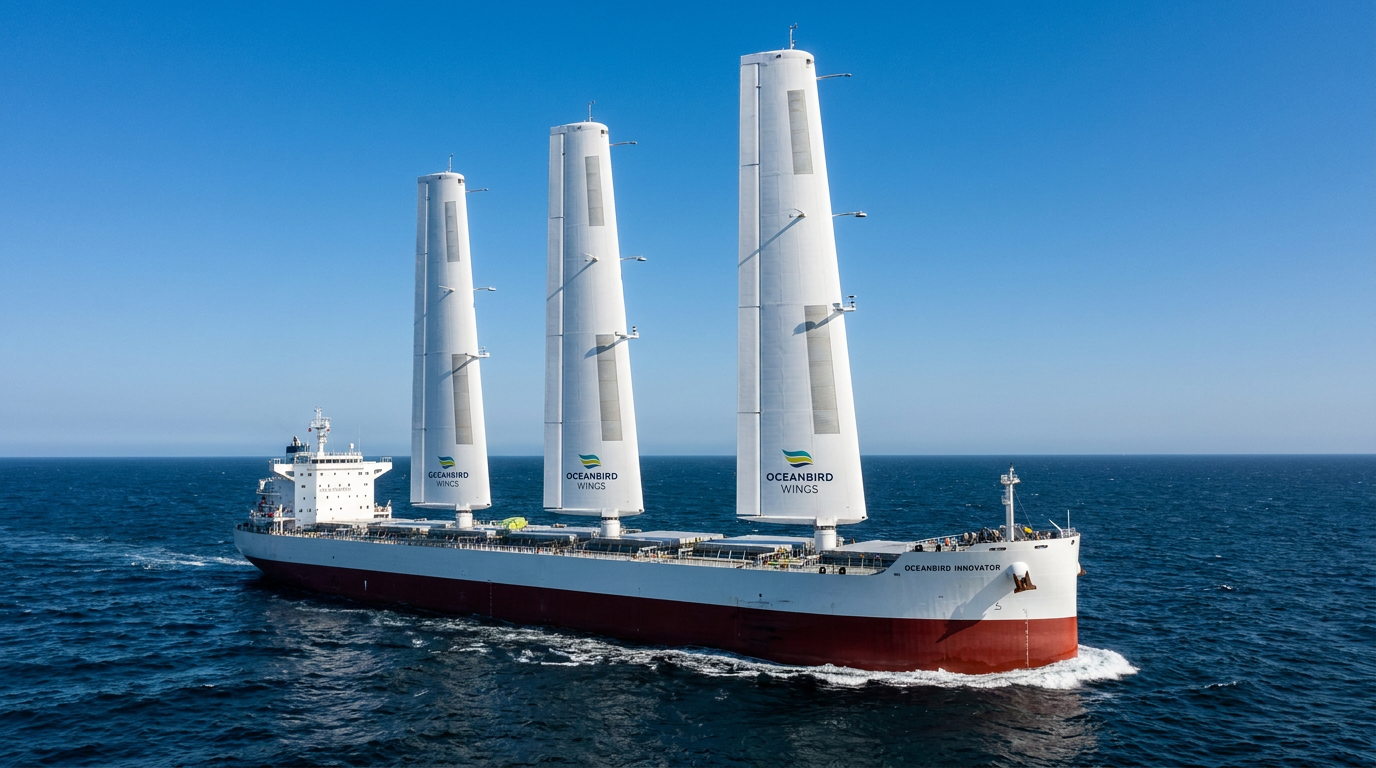
For more than a century, the silhouette of global trade has been defined by diesel exhaust stacks and the low hum of heavy fuel oil engines. But across the world's major shipping lanes, a distinctly historical profile is returning to the horizon. Modern commercial vessels—massive bulk carriers and tankers stretching the length of several football fields—are increasingly being fitted with towering, high-tech sails. This is not a nostalgic revival of the clipper ships of the 1800s, but rather a highly engineered response to the most pressing crisis in modern maritime logistics: decarbonization. Wind-assisted ship propulsion has rapidly transitioned from a fringe environmental concept to a commercially validated technology, driven by a combination of tightening international emissions regulations and the stark economic realities of alternative green fuels.[1][6]
The maritime shipping industry is the invisible backbone of the global economy, transporting roughly ninety percent of the world's traded goods. However, this massive logistical network relies almost entirely on bunker fuel, a thick, carbon-dense byproduct of crude oil refining. Consequently, commercial shipping accounts for nearly three percent of global greenhouse gas emissions—a footprint roughly equivalent to that of the entire aviation sector or the nation of Japan. For decades, the industry operated with minimal environmental oversight, but the regulatory tide has definitively turned. The International Maritime Organization has mandated a transition to net-zero emissions by or around 2050, while the European Union has aggressively integrated shipping into its Emissions Trading System, forcing shipowners to pay directly for their carbon pollution starting in 2024 and scaling up through 2026.[3][4]
Faced with these mandates, the industry initially placed its hopes entirely on alternative marine fuels, such as green methanol and green ammonia. While these fuels promise near-zero carbon propulsion when produced using renewable energy, their practical rollout has collided with harsh economic and infrastructural realities. In 2026, green methanol and ammonia remain three to five times more expensive than conventional marine fuels. Furthermore, the global bunkering infrastructure required to safely store and distribute these volatile new fuels is still in its infancy, available at only a handful of major ports. Shipowners are caught in a difficult position: they must reduce emissions immediately to avoid crippling regulatory fines, but the ultimate technological solutions remain economically prohibitive and logistically scarce.[3][6]

This is the exact gap that wind-assisted propulsion is filling. Unlike synthetic fuels, wind is universally available, entirely free, and requires no complex supply chain or port infrastructure. As maritime engineers point out, the shipping industry is unique within the heavy transport sector in having access to an abundant, zero-emission energy resource directly along its operational routes. By harnessing ambient wind energy to supplement conventional engine thrust, shipowners can achieve immediate, documented fuel savings. The technology does not replace the main engines, but rather acts in a hybrid capacity, allowing the vessel to throttle down its fuel consumption while maintaining its scheduled cruising speed.[3][4]
The engineering behind modern wind propulsion bears little resemblance to the canvas rigging of the past. The most visually striking systems are rigid wing sails, which operate on the exact same aerodynamic principles as airplane wings, simply mounted vertically on the ship's deck. Constructed from robust steel and glass composites—materials borrowed from the wind turbine industry—these multi-element wings can tower up to 120 feet high. They are fully automated, utilizing onboard sensors and computer systems to constantly adjust their angle of attack to maximize lift and forward thrust. When a vessel encounters severe weather or needs to navigate under a bridge or port crane, the wings can be folded flat against the deck at the push of a button.[2][5]
Another leading technology, which currently dominates the market, is the rotor sail. These are large, spinning vertical cylinders that propel the ship forward using a phenomenon known as the Magnus effect. As the wind hits the rotating cylinder, the air pressure on one side drops while the pressure on the other side increases, creating a powerful aerodynamic thrust perpendicular to the wind direction—the same physics that causes a curveball to swerve in baseball. Finnish company Norsepower has emerged as a major player in this space, installing rotor sails on dozens of bulk carriers, tankers, and even passenger ferries. Because they have a smaller deck footprint than rigid wings, rotor sails are particularly popular for retrofitting existing vessels.[2][3]

Another leading technology, which currently dominates the market, is the rotor sail.
Beyond rigid wings and rotor sails, the industry is experimenting with a variety of other aerodynamic solutions. Suction wing sails, for example, use internal fans to draw in boundary-layer air, delaying aerodynamic separation and generating massive lift from a relatively compact profile. This allows them to achieve the same thrust output as larger rotor sails while taking up less space. Meanwhile, companies like France's Airseas are developing automated kite systems. These massive parafoils are deployed hundreds of feet into the air, where wind speeds are significantly higher and more consistent than at sea level. The kite flies in dynamic figure-eight patterns, towing the ship forward and reducing the load on the main engines.[2][5]
The performance data from these systems has moved beyond theoretical models into hard, commercial reality. Depending on the vessel type, the specific technology installed, and the route sailed, wind-assisted propulsion is delivering fuel and emissions savings of between five and thirty percent. For a massive bulk carrier burning dozens of tons of fuel per day, a fifteen percent reduction translates to thousands of dollars in daily fuel savings, alongside a proportional drop in carbon emissions. In the context of the European Union's Emissions Trading System, where every ton of carbon emitted carries a direct financial penalty, these savings fundamentally alter the operating economics of a vessel, often paying back the initial capital cost of the wind system within three to five years.[2][4]
The adoption curve is accelerating rapidly. In 2021, only a handful of experimental vessels featured modern wind propulsion. By early 2026, the number of large commercial ships operating with wind-assist technology has surged past sixty, with nearly one hundred more on order at shipyards globally. Major agricultural and mining conglomerates, such as Cargill and Vale, are chartering wind-equipped vessels to decarbonize their massive supply chains. The technology is primarily being deployed on bulk carriers and oil tankers, which have the expansive, unobstructed deck space necessary to mount towering sails or spinning rotors without interfering with cargo operations.[1][3]

However, the wind renaissance is not without its limitations. The most obvious constraint is the inherent unpredictability of the weather. Wind power cannot be stored in a battery; it must be used instantaneously. If a vessel sails into a prolonged calm, the sails become dead weight, and the ship must rely entirely on its conventional engines. Furthermore, wind propulsion is highly route-dependent. Ships operating on the notoriously windy North Atlantic or trans-Pacific routes see massive benefits, while those navigating the calmer equatorial regions or confined coastal waters see diminishing returns. The technology is a geographic optimizer, not a universal panacea.[2][5]
There are also significant logistical hurdles regarding vessel types. While bulkers and tankers are ideal candidates, container ships present a massive engineering challenge. The entire business model of a container ship relies on stacking standardized steel boxes as high as possible across every square inch of the deck. Installing large sails or rotors would displace hundreds of lucrative cargo containers, and the sails themselves would interfere with the massive gantry cranes used to load and unload the ships in port. Until engineers can develop highly compact or fully retractable systems that do not cannibalize cargo space, the container shipping sector—one of the largest emitters in the maritime industry—will largely remain on the sidelines of the wind revolution.[2][3]

To maximize the utility of wind systems, the maritime industry is undergoing a digital operational shift known as weather routing. Historically, cargo ships sailed the shortest possible straight-line distance between two ports to minimize transit time. Now, vessels equipped with wind propulsion use advanced algorithmic routing software to deliberately chase the wind. A ship might sail a longer geographic distance to catch a favorable weather system, knowing that the massive fuel savings generated by the sails will more than offset the extra miles traveled. This requires a fundamental shift in how logistics managers and charterers think about supply chain timing, prioritizing fuel efficiency and emissions reductions over absolute speed.[1][6]
Ultimately, maritime experts view wind-assisted propulsion not as a replacement for the internal combustion engine, but as a critical bridge technology and a permanent hybrid fixture of the future fleet. When green methanol and ammonia eventually reach commercial scale and price parity, they will still be significantly more expensive than the dirty bunker fuel used today. By pairing these expensive green fuels with free wind energy, shipowners can drastically reduce the total volume of synthetic fuel they need to purchase. In this sense, the high-tech sails of the twenty-first century are not a step backward into the past, but a necessary aerodynamic foundation for the zero-carbon shipping industry of the future.[4][6]
How we got here
2018
Early pilot projects begin testing modern rotor sails on passenger ferries and small cargo vessels.
2023
Cargill's Pyxis Ocean becomes the first large bulk carrier to be retrofitted with massive rigid wing sails, proving the technology on deep-sea routes.
Jan 2024
The European Union officially includes maritime shipping in its Emissions Trading System, forcing shipowners to pay for carbon emissions.
Mid 2025
The Global Centre for Maritime Decarbonisation validates real-world fuel savings data from suction sail trials, boosting industry confidence.
2026
The global order book for wind-assisted commercial vessels surges, with over 100 ships expected to be operational by year's end.
Viewpoints in depth
Shipowners & Operators
Focusing on the immediate economic payback and regulatory compliance.
For the companies that own and operate the global fleet, wind propulsion is primarily a financial equation. With the European Union's Emissions Trading System (ETS) now forcing ships to pay for their carbon output, and the IMO tightening global intensity rules, doing nothing is no longer an option. Shipowners view wind not as a romantic return to the past, but as a pragmatic hedge against the exorbitant costs of future synthetic fuels. If a multi-million dollar rotor sail installation can pay for itself in fuel and carbon tax savings within four years, it becomes a standard capital expenditure rather than an experimental risk.
Maritime Engineers
Focusing on aerodynamic efficiency, materials science, and hybrid integration.
Naval architects and engineers are focused on the physical realities of integrating massive aerodynamic structures onto vessels designed for maximum cargo capacity. Their primary challenge is deck space and structural integrity—ensuring that a 120-foot rigid wing can withstand hurricane-force winds without compromising the ship's stability. Engineers view wind as a permanent hybrid layer for the future fleet, working to seamlessly integrate automated sail controls with the ship's main engine management systems so that thrust is optimized second-by-second without crew intervention.
Supply Chain Managers
Focusing on route reliability, weather routing, and port compatibility.
For the logistics professionals responsible for ensuring goods arrive on time, wind propulsion introduces a new layer of complexity. Supply chains run on strict schedules, and wind is inherently unpredictable. These managers are pioneering the use of advanced weather routing software, shifting the industry's mindset from 'shortest distance' to 'most efficient route.' They must also navigate the logistical hurdles of port compatibility, ensuring that vessels equipped with towering sails can still clear bridges and safely interface with standard cargo-loading cranes.
What we don't know
- How quickly global port infrastructure can adapt to accommodate vessels with towering 120-foot sails without slowing down cargo operations.
- Whether engineers can develop compact enough wind systems to be viable for the space-constrained container shipping sector.
- How the long-term maintenance costs of these complex aerodynamic systems will compare to their fuel savings over a 25-year lifespan.
Key terms
- Wind-Assisted Ship Propulsion (WASP)
- The use of modern aerodynamic technologies, such as rotor sails or rigid wings, to supplement a commercial vessel's engine thrust and reduce fuel consumption.
- Magnus Effect
- An observable phenomenon where a spinning object drags air faster around one side, creating a pressure difference that generates a perpendicular aerodynamic force.
- Bunker Fuel
- A thick, heavy, and highly polluting grade of fuel oil traditionally used to power large commercial ships.
- Green Methanol
- A low-carbon alternative marine fuel produced using renewable energy, currently much more expensive than conventional fossil fuels.
- Weather Routing
- The practice of using advanced software to plot a ship's course based on weather forecasts, deliberately seeking favorable winds to maximize sail efficiency.
Frequently asked
Can wind power completely replace ship engines?
No. Modern wind-assisted propulsion systems are designed to supplement, not replace, a ship's main engines. They act as a hybrid system to reduce fuel consumption while maintaining consistent speeds.
What happens when there is no wind?
When wind speeds drop, the ship's automated systems detect the lack of aerodynamic thrust and seamlessly increase the power output of the conventional engines to maintain the scheduled speed.
Why don't container ships use these sails?
Container ships rely on stacking cargo boxes high across the entire deck, leaving very little room for massive sails or rotors. The sails would also interfere with the giant cranes used to load and unload the containers at ports.
How much fuel do these systems actually save?
Depending on the vessel type, the specific technology, and the weather on the route, wind-assisted systems typically deliver fuel and emissions savings of between 5% and 30%.
Sources
Source coverage
6 outlets
3 viewpoints surfaced






[1]ForbesShipowners & Operators
The New Era Of Wind-Powered Cargo Ships
Read on Forbes →[2]Riviera Maritime MediaShipowners & Operators
Wind-assisted propulsion: return of the age of sail?
Read on Riviera Maritime Media →[3]DNVMaritime Engineers
Wind-Assisted Ship Propulsion Market Outlook
Read on DNV →[4]American Bureau of ShippingMaritime Engineers
Potential of Wind-Assisted Propulsion for Shipping
Read on American Bureau of Shipping →[5]Earth.orgSupply Chain Managers
Are Wind-Powered Cargo Ships the Future of the Shipping Industry?
Read on Earth.org →[6]Factlen Editorial TeamSupply Chain Managers
Synthesis by Factlen editorial team
Read on Factlen Editorial Team →
Every angle. Every day.
Get transportation stories with full source coverage and perspective breakdowns delivered to your inbox.