
U.S. and Iran Reach Peace Framework to End War and Reopen Strait of Hormuz
The United States and Iran have electronically signed a 14-point memorandum of understanding to end their three-month conflict and reopen the Strait of Hormuz. The framework establishes a 60-day window to negotiate a final nuclear agreement, though the two sides immediately offered conflicting accounts over the release of billions in frozen Iranian funds.
By Factlen Editorial Team
- U.S. Administration
- Views the deal as a successful use of military and economic leverage to force Iranian nuclear disarmament.
- Iranian State Media
- Frames the agreement as a diplomatic victory that secures vital sanctions relief and reconstruction funds.
- Global Diplomats & Markets
- Prioritizes the immediate stabilization of global shipping and energy prices over the political optics of the deal.
- Skeptics & Hardliners
- Argues the framework gives up leverage too early and leaves Iran's proxy networks intact.
What's not represented
- · Lebanese and Israeli civilians affected by the ongoing proxy conflicts
- · Environmental groups monitoring the impact of naval warfare in the Persian Gulf
Why this matters
The reopening of the Strait of Hormuz immediately lowers global energy prices, easing inflation pressures worldwide. However, the fragile 60-day window to finalize Iran's nuclear status will determine whether the Middle East achieves lasting stability or plunges back into a conflict that has already killed thousands and disrupted global trade.
Key points
- The U.S. and Iran electronically signed a 14-point peace framework to end a 3.5-month conflict.
- The agreement immediately reopens the Strait of Hormuz, prompting global oil prices to drop below $80 a barrel.
- A 60-day negotiation window will determine the final status of Iran's highly enriched uranium stockpile.
- Iranian media claims the deal unlocks $24 billion in frozen funds, a figure the U.S. administration strongly denies.
- Vice President JD Vance will lead technical negotiations ahead of a formal signing ceremony in Geneva.
The United States and Iran have electronically signed a 14-point memorandum of understanding, establishing a fragile peace framework to end a devastating three-and-a-half-month war. The agreement, which halts active military operations and initiates a 60-day diplomatic window, marks a sudden de-escalation in a conflict that has reshaped the Middle East and choked global supply chains.[6][7]
At the center of the immediate global relief is the reopening of the Strait of Hormuz. Following the electronic signing on Sunday, President Donald Trump authorized an end to the U.S. naval blockade of Iranian ports, a move designed to restore the flow of commercial shipping through a waterway that handles roughly 20 percent of the world's daily oil consumption.[6][7]
Financial markets reacted instantly to the unblocking of the critical maritime chokepoint. Brent crude, the international oil benchmark, tumbled 3.8 percent to $79.99 a barrel, dipping below the $80 threshold for the first time since the conflict escalated in early March. U.S. stock indices also rallied on the prospect of stabilized energy costs and reduced geopolitical risk.[3]

Despite the market optimism, the framework is less a final treaty and more a structured pause designed to force a permanent resolution on Tehran's nuclear ambitions. The core mechanism of the deal grants negotiators 60 days to finalize the dismantling of Iran's highly enriched uranium stockpile. If the two sides fail to reach a comprehensive agreement within that window, the ceasefire could collapse.[1][6]
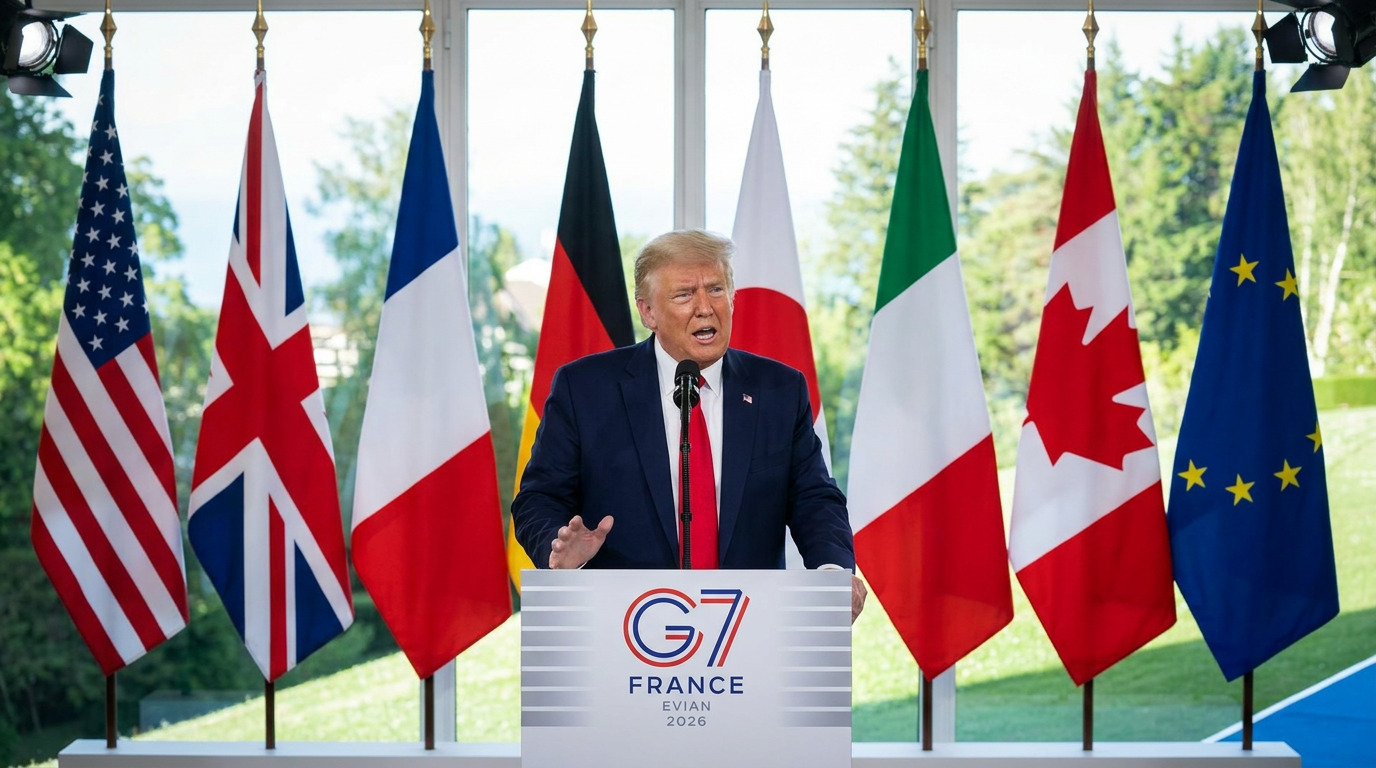
Speaking from the G7 summit in Evian-les-Bains, France, President Trump framed the agreement as a non-proliferation victory, emphasizing that the primary U.S. objective remains preventing a nuclear-armed Iran. "The only thing that really matters to me is Iran will never have a nuclear weapon," Trump told reporters, warning that severe military consequences would follow if Tehran violated the terms.[3][7]
The technical negotiations to finalize the nuclear provisions will be led by Vice President JD Vance, with formal talks scheduled to begin following a ceremonial signing in Geneva later this week. Vance's team is tasked with establishing a rigorous inspection regime with the International Atomic Energy Agency (IAEA) to verify the destruction of Iran's existing nuclear material.[5][7]
However, a fierce dispute over the financial terms of the ceasefire has already emerged, threatening to complicate the Geneva talks. Iranian state media and the Islamic Revolutionary Guard Corps have broadcast claims that the framework guarantees the immediate release of $24 billion in frozen Iranian assets during the 60-day window.[5][8]
However, a fierce dispute over the financial terms of the ceasefire has already emerged, threatening to complicate the Geneva talks.
According to the Iranian narrative, half of those funds must be made available before the final nuclear negotiations even begin. Tehran's outlets also claim the deal includes a U.S. commitment to help establish a $300 billion international reconstruction fund to rebuild infrastructure damaged during the war.[1][8]

The U.S. administration has aggressively pushed back against these financial claims. Appearing on national television, Vice President Vance explicitly denied the $24 billion figure, stating that it "just doesn't appear anywhere in any of the texts." U.S. officials clarified that exactly zero dollars of unfrozen assets have been released so far.[5][7]
While Vance acknowledged that the U.S. is "willing to talk about unfreezing assets" and broadly unsanctioning the Iranian economy, he insisted that any economic relief is strictly contingent upon Iran making verifiable, long-term commitments to dismantle its nuclear program. American diplomats have suggested that only "small gestures" of relief might be offered initially to keep Tehran at the table.[5][7]
The geopolitical backdrop of the negotiations is stark. The war, which began on February 28 with U.S. and Israeli strikes that killed Supreme Leader Ayatollah Ali Khamenei, has left thousands dead and devastated regional infrastructure. Khamenei's son has since assumed the role of supreme leader, and his approval was reportedly required to authorize Sunday's electronic signature.[6]

The framework also leaves several regional security questions unanswered, most notably the status of Lebanon. While Iranian negotiators reportedly sought a ceasefire that would include the Lebanese front, Israel has pushed its military operations deeper into the country to target Hezbollah. The current text reportedly focuses primarily on direct U.S.-Iran hostilities and maritime security.[6][8]
Domestically, the emerging deal faces scrutiny from both sides of the American political aisle. While some lawmakers express relief at the prospect of avoiding a prolonged occupation, critics argue the framework risks repeating the mistakes of the 2015 nuclear accord by providing economic lifelines before the nuclear infrastructure is physically dismantled.[2][6]
Internationally, however, the mood is one of cautious relief. European leaders at the G7 summit welcomed the ceasefire, prioritizing the stabilization of global trade and the avoidance of a wider regional conflagration. The immediate focus now shifts to Geneva, where the ceremonial signing will start the 60-day clock on one of the most consequential diplomatic negotiations of the decade.[3][7]
How we got here
Feb 28, 2026
The U.S. and Israel launch strikes against Iran, killing Supreme Leader Ayatollah Ali Khamenei and sparking a 3.5-month war.
Early March 2026
The Strait of Hormuz is effectively closed by conflict and naval blockades, spiking global energy prices.
June 14, 2026
The U.S. and Iran electronically sign a 14-point memorandum of understanding to halt hostilities.
June 16, 2026
Oil prices drop to a three-month low as President Trump announces the reopening of the Strait of Hormuz at the G7 summit.
June 19, 2026
The formal signing ceremony for the peace framework is scheduled to take place in Geneva.
Viewpoints in depth
The U.S. Administration
Focuses on the deal as a definitive end to Iran's nuclear ambitions through maximum leverage.
President Trump and Vice President JD Vance frame the framework as a victory of leverage, arguing that the three-month war and naval blockade forced Tehran to the table. They insist that no financial rewards—including the disputed $24 billion in frozen assets—will be granted until Iran verifiably dismantles its highly enriched uranium stockpile. The administration views the 60-day window as a strict probationary period, warning that military action remains on the table if Iran pursues a weapon.
Iranian State Leadership
Presents the agreement as a diplomatic victory that secures vital economic relief and reconstruction.
Iranian state media and the Revolutionary Guard are broadcasting a narrative of resilience, claiming the deal guarantees the immediate unfreezing of $24 billion and sets the stage for a $300 billion international reconstruction fund. For Tehran's domestic audience, the framework is framed not as a surrender of their nuclear rights, but as a necessary step to lift crippling sanctions, end the U.S. naval blockade, and rebuild an economy devastated by the recent conflict.
Global Energy Markets
Prioritizes the immediate reopening of shipping lanes over the long-term nuclear negotiations.
For energy importers and global shipping insurers, the political nuances of the nuclear timeline are secondary to the physical reopening of the Strait of Hormuz. The immediate drop in Brent crude prices reflects immense market relief. However, industry analysts remain cautious, noting that until the naval mines are fully cleared and the 60-day diplomatic window closes successfully, the risk of a sudden supply shock remains priced into long-term contracts.
What we don't know
- Whether Iran will agree to fully relinquish its stockpile of highly enriched uranium during the 60-day window.
- The exact mechanisms the IAEA will use to verify compliance in a post-war environment.
- How the ceasefire will affect Israel's ongoing military operations against Hezbollah in Lebanon.
- The specific 'small gestures' of sanctions relief the U.S. might offer to keep Iran at the negotiating table.
Key terms
- Strait of Hormuz
- A narrow, strategically critical waterway between the Persian Gulf and the Gulf of Oman through which roughly 20% of the world's oil supply passes.
- Highly Enriched Uranium (HEU)
- Uranium that has been processed to a purity level capable of being used in nuclear weapons, which the U.S. is demanding Iran relinquish.
- Sanctions Relief
- The lifting or suspension of economic penalties imposed by the U.S. and international bodies, allowing a country to trade and access global financial systems.
- Naval Blockade
- The use of naval forces to cut off a specific area—in this case, Iranian ports—from international maritime trade and military supply lines.
Frequently asked
Is the war between the U.S. and Iran officially over?
The two nations have signed a preliminary peace framework and ceased military operations, but a permanent end to the conflict depends on the outcome of a 60-day negotiation window.
Why did oil prices drop after the announcement?
The agreement includes the immediate reopening of the Strait of Hormuz, a critical chokepoint for global oil shipments that had been blocked during the conflict.
Is the U.S. giving Iran $24 billion?
Iranian state media claims $24 billion in frozen assets will be released, but the U.S. administration explicitly denies this, stating no funds will be unfrozen until Iran meets strict nuclear commitments.
What happens to Iran's nuclear program now?
The framework requires Iran to negotiate the dismantling of its highly enriched uranium stockpile over the next 60 days, with U.S. officials warning of severe consequences if they pursue a weapon.
Sources
Source coverage
8 outlets
4 viewpoints surfaced








[1]AxiosGlobal Diplomats & Markets
Breaking down the billions Iran could receive under Trump's deal
Read on Axios →[2]Fox NewsU.S. Administration
Republicans bat down bid to handcuff Trump’s war powers as peace deal nears
Read on Fox News →[3]NYTGlobal Diplomats & Markets
After a Bitter Split, European Leaders Play Nice With Trump
Read on NYT →[4]Al JazeeraIranian State Media
What has Iran won and lost from this war?
Read on Al Jazeera →[5]CBS NewsU.S. Administration
Vance denies that Iran will receive 'billions of dollars of assets' in deal
Read on CBS News →[6]PBSGlobal Diplomats & Markets
Deal is reached to end Iran war and Trump orders stop to U.S. naval blockade
Read on PBS →[7]The GuardianSkeptics & Hardliners
Trump declares US-Iran peace deal 'all signed' as G7 leaders battle to tie up loose ends
Read on The Guardian →[8]Al-MonitorIranian State Media
Iran-US draft deal would release $24B in funds, ensure Lebanon ceasefire: Iranian media
Read on Al-Monitor →
More in news politics
See all 5 stories →Indo-Pacific Defense
US Military to Build Permanent War-Ready Weapons Stockpile in Australia
0 sources
Immigration Enforcement
DOJ Charges 15 Minnesota Activists With Conspiracy Over Resistance to Immigration Crackdown
0 sources

US-Iran Relations
Senate Blocks War Powers Resolution as US-Iran Peace Deal Advances at G7
0 sources
Every angle. Every day.
Get news politics stories with full source coverage and perspective breakdowns delivered to your inbox.