
Meta Quest 3 vs. Quest 3S: The Complete 2026 Buyer's Guide
Meta's two standalone VR headsets share the exact same processor and game library, but their optical differences create a crucial trade-off between premium clarity and unbeatable value.
By Factlen Editorial Team
- Value Seekers
- Consumers and reviewers who prioritize the performance-to-price ratio.
- VR Enthusiasts
- Power users who spend hours in virtual reality for gaming or productivity.
- Hardware Developers
- Software creators building the next generation of spatial applications.
What's not represented
- · Apple Vision Pro users
- · Console-tethered PSVR2 gamers
Why this matters
Choosing the right virtual reality headset dictates whether spatial computing becomes a daily productivity habit or an expensive paperweight. Understanding the exact trade-offs between Meta's two identically powered but optically different headsets ensures buyers don't overspend on features they won't use, or under-buy on visual clarity they actually need.
Key points
- Both the Meta Quest 3 and Quest 3S use the identical Snapdragon XR2 Gen 2 processor, ensuring identical software performance.
- The $599 Quest 3 features premium pancake lenses, offering edge-to-edge clarity and a wider field of view.
- The $349 Quest 3S relies on older Fresnel lenses, which have a smaller sweet spot and lower overall resolution.
- Every game and application in the Meta ecosystem runs on both headsets without any exclusive titles.
- The Quest 3 includes a dedicated depth sensor for superior mixed reality, which the Quest 3S lacks.
The virtual reality landscape in 2026 is defined by a single, dominant ecosystem. Meta has effectively cornered the standalone spatial computing market, leaving consumers with a surprisingly difficult choice within the company's own hardware lineup. While ultra-premium devices like the Apple Vision Pro cater to a niche professional audience, the mainstream conversation has entirely consolidated around Meta's offerings.[7]
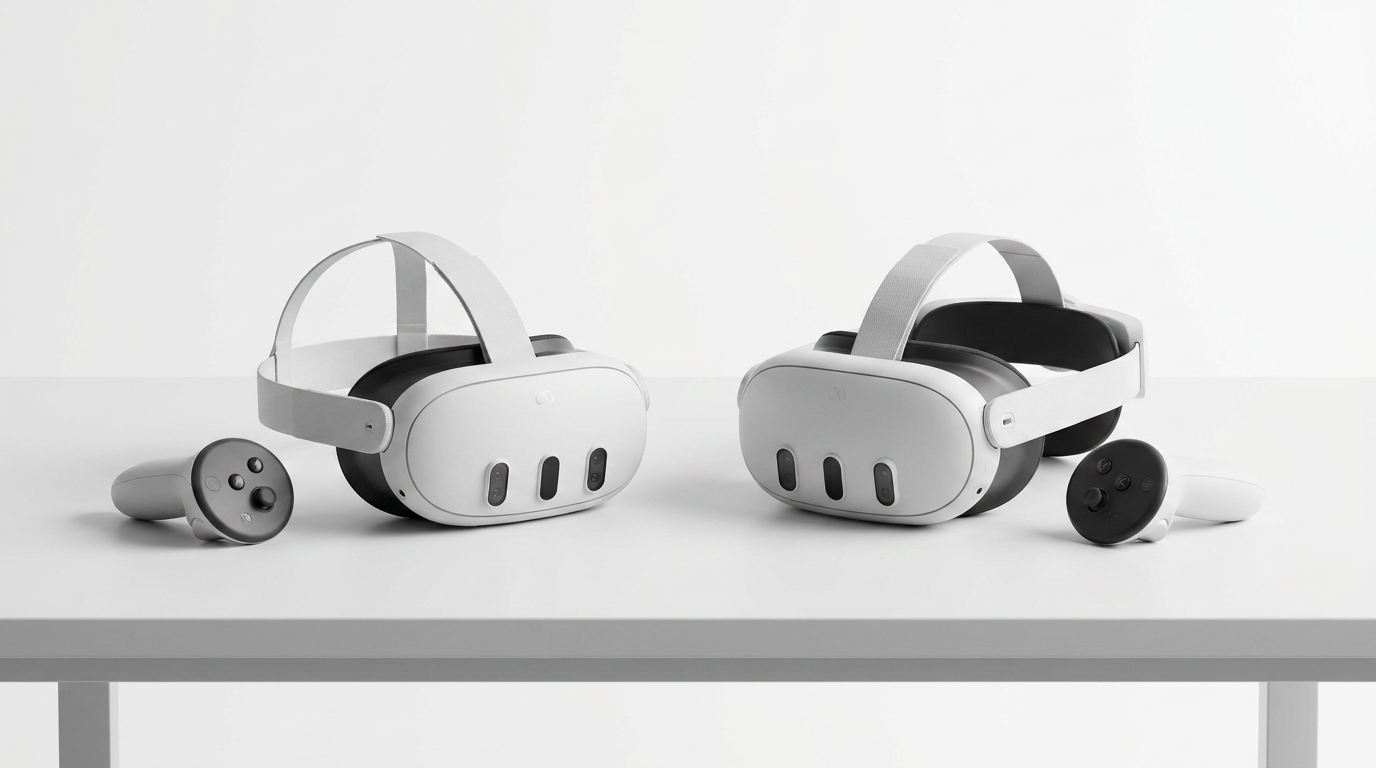
The core dilemma for buyers pits the premium Meta Quest 3 against the budget-friendly Meta Quest 3S. On paper, the price gap—$599 for the base Quest 3 versus $349 for the Quest 3S—suggests two entirely different tiers of hardware. However, the reality of how these devices operate is far more nuanced, creating one of the most compelling trade-off decisions in consumer electronics.[1][5]
The shared foundation between the two headsets is their most crucial characteristic. Both devices are powered by the exact same Qualcomm Snapdragon XR2 Gen 2 processor and feature 8GB of RAM. This means the computational brain inside the $349 headset is identical to the one inside the $599 headset, ensuring that raw performance, load times, and graphical processing power are completely indistinguishable.[2][4]
Because of this shared architecture, the software library is entirely unified. There are no "Quest 3 exclusives" that the Quest 3S cannot play. Every game, productivity application, and mixed-reality experience runs on both devices at the exact same frame rate. For consumers, this guarantees that buying the cheaper headset does not mean missing out on any future software releases.[1][6]

When evaluating the Meta Quest 3, the strongest argument for the premium headset lies entirely in its optical stack. It utilizes modern pancake lenses, a breakthrough in VR optics that provides edge-to-edge clarity. This technology eliminates the blurry periphery that plagued older headsets, allowing users to look around virtual environments simply by moving their eyes rather than turning their entire head.[3]
The visual evidence supporting the Quest 3 is striking. The headset boasts a resolution of 2064 by 2208 pixels per eye and a wide 110-degree field of view. In practice, this means text is incredibly crisp, virtual cinema screens look sharp, and the expansive field of view makes digital environments feel genuinely immersive rather than like looking through a pair of binoculars.[1][7]
The Quest 3 also holds a distinct advantage in mixed reality. It features a dedicated depth sensor and high-resolution color passthrough cameras. This hardware allows digital objects to anchor seamlessly behind real-world furniture, and the passthrough video is clear enough that users can comfortably read notifications on their physical smartphone without taking the headset off.[3][6]
The primary case against the Quest 3 is simply its barrier to entry. At $599 for the base model, it represents a significant financial investment for a device that many consumers still view as a secondary gaming console or experimental technology. For casual users who only play for thirty minutes at a time, the premium optics may not justify the premium price tag.[5]
The primary case against the Quest 3 is simply its barrier to entry.
Conversely, the case for the Meta Quest 3S is built on unprecedented value. For $349, buyers gain access to the exact same software ecosystem, the same advanced hand-tracking capabilities, and the same processing power as the premium model. It is widely considered the undisputed king of budget virtual reality, offering a frictionless entry point into spatial computing.[2][6]
The trade-offs required to hit that $349 price point are entirely optical. To save costs, the Quest 3S reverts to the older Fresnel lenses originally used in the discontinued Quest 2. These lenses are thicker, prone to glare in high-contrast scenes, and feature a much smaller "sweet spot"—meaning the headset must be perfectly positioned on the user's face to achieve a clear image.[1][3]

The visual evidence against the Quest 3S reveals the extent of these compromises. The resolution drops to 1832 by 1920 pixels per eye, representing roughly 28 percent fewer pixels than its premium sibling. Furthermore, the field of view narrows to 96 degrees, which slightly restricts peripheral vision and makes the digital world feel a bit more enclosed.[2][7]
Mixed reality on the Quest 3S is highly functional but visibly compromised. Because it lacks a dedicated depth sensor and relies on lower-resolution passthrough cameras, the real world appears grainier. Digital objects can occasionally jitter when placed in physical space, and reading a physical phone screen through the headset is significantly more difficult.[1][4]
Comfort and form factor also diverge based on the lens technology. The pancake lenses allow the Quest 3 to maintain a remarkably slim profile, keeping the center of gravity close to the user's face for better balance. The Quest 3S, burdened by the thicker Fresnel lenses, protrudes further outward, which can cause slightly more neck fatigue during marathon gaming sessions.[3]

From a developer's perspective, this dual-headset ecosystem creates a unique testing environment. Software studios are advised to build and debug their applications on the Quest 3 to take advantage of its visual clarity. However, they must rigorously playtest on the Quest 3S, as its narrower field of view and older optics represent the baseline experience for the vast majority of their consumer base.[4]
Ultimately, the Meta Quest 3 fits well when visual fidelity, long-term comfort, and productivity are the primary goals. It is the definitive choice for PC VR enthusiasts who want to stream high-end games wirelessly, users who plan to use virtual multi-monitor setups for work, and anyone who wants the best standalone mixed reality experience currently available.[2][7]
The Meta Quest 3 does not fit well for casual users, families looking to buy multiple headsets for multiplayer gaming, or those who only plan to use virtual reality for occasional, fast-paced fitness routines where optical edge-clarity is far less noticeable than the physical workout.[5]

Conversely, the Meta Quest 3S fits well when budget is the primary constraint, or when introducing younger users to virtual reality for the first time. It delivers 90 percent of the premium computing experience for roughly half the price, making it the smartest starting point for anyone curious about spatial computing.[1][6]
The Meta Quest 3S does not fit well for users who are highly susceptible to motion sickness, as the smaller optical sweet spot and edge-blur can exacerbate eye strain. It is also a poor fit for users who intend to read fine text, browse the web extensively, or watch feature-length films in a virtual cinema environment.[2]
How we got here
Oct 2020
Meta releases the Quest 2, which goes on to become the best-selling VR headset in history.
Oct 2023
The premium Meta Quest 3 launches at $499, introducing pancake lenses and high-resolution mixed reality.
Sep 2024
Meta unveils the budget-friendly Quest 3S at $299, officially phasing out the aging Quest 2.
Mid 2026
Both headsets dominate the standalone VR market, with the Quest 3 base model now priced at $599 and the 3S at $349.
Viewpoints in depth
Value Seekers
Consumers and reviewers who prioritize the performance-to-price ratio.
This camp argues that the optical differences between the two headsets are negligible when actively playing fast-paced games. Because the Quest 3S features the exact same Snapdragon XR2 Gen 2 processor, it loads games just as fast and maintains the same frame rates as the premium model. For families, casual gamers, or first-time buyers, spending nearly double the price for edge-to-edge lens clarity is viewed as an unnecessary luxury when the core gameplay experience remains fundamentally identical.
VR Enthusiasts
Power users who spend hours in virtual reality for gaming or productivity.
Enthusiasts maintain that the Quest 3's pancake lenses are a generational leap that cannot be ignored. They point out that the older Fresnel lenses in the Quest 3S cause eye strain over long sessions due to their smaller 'sweet spot' and tendency to produce glare in high-contrast scenes. For users who want to use their headset as a virtual multi-monitor setup for work, or who play visually dense PC VR games, this camp argues the $599 investment is mandatory for visual comfort and long-term viability.
Hardware Developers
Software creators building the next generation of spatial applications.
Developers view the dual-headset ecosystem pragmatically. While they appreciate the platform parity—meaning they only have to write code for one processor—they acknowledge a split in user experience. Developers generally prefer using the Quest 3 for visual debugging and long coding sessions due to its superior clarity. However, they emphasize that all applications must be rigorously playtested on the Quest 3S, as its narrower field of view and grainier mixed-reality passthrough represent the baseline experience for the vast majority of their paying customers.
What we don't know
- Whether Meta plans to introduce a true 'Quest 4' successor before 2028, potentially rendering current hardware obsolete.
- How upcoming mixed-reality software updates will perform on the Quest 3S without a dedicated depth sensor.
Key terms
- Pancake Lenses
- Modern, ultra-thin optical lenses that provide edge-to-edge visual clarity and allow the headset to maintain a much slimmer physical profile.
- Fresnel Lenses
- An older style of optical lens featuring concentric ridges; they are thicker and have a smaller 'sweet spot' where the image appears perfectly sharp.
- Mixed Reality (MR)
- Technology that blends digital objects and screens into your view of the real physical room around you.
- Passthrough
- The feature that uses the headset's exterior cameras to show you a real-time video feed of your actual surroundings.
- Field of View (FOV)
- The extent of the observable virtual world that is seen at any given moment; a wider FOV feels more immersive and less like looking through binoculars.
Frequently asked
Do both headsets play the same games?
Yes. Because both headsets use the exact same Snapdragon XR2 Gen 2 processor and 8GB of RAM, they share an identical software library with the same performance.
Can I connect these headsets to a PC?
Yes. Both the Quest 3 and Quest 3S support PC VR gaming via wireless Air Link, Steam Link, or a physical USB-C tether.
Is the Quest 3S just a repackaged Quest 2?
No. While the Quest 3S reuses the older lenses and display panels from the Quest 2, its internal processor, RAM, and color mixed-reality cameras are identical to the newer Quest 3.
Do I need to buy base stations or external cameras?
No. Both headsets feature 'inside-out' tracking, meaning all the cameras and sensors needed to track your movements are built directly into the headset itself.
Sources
Source coverage
7 outlets
3 viewpoints surfaced







[1]VR.orgHardware Developers
Meta Quest 3 vs Meta Quest 3S: Which VR headset should you buy in 2026?
Read on VR.org →[2]Nexra GearVR Enthusiasts
What Is the Difference Between Meta Quest 3 and 3S? Real Use Comparison
Read on Nexra Gear →[3]Space4GamesVR Enthusiasts
Meta Quest 3 Review 2026: Still the Best Wireless VR Headset?
Read on Space4Games →[4]Reality AtlasHardware Developers
Meta Quest 3 vs Quest 3S: A Developer's Guide to Hardware Differences
Read on Reality Atlas →[5]CNETValue Seekers
Best VR Headsets of 2026: My Favorite Hardware Right Now
Read on CNET →[6]PCMagValue Seekers
The Best VR Headsets for 2026
Read on PCMag →[7]Pulse RevOpsVR Enthusiasts
Top 10 VR Headsets of 2026: Standalone, PCVR, and Mixed Reality
Read on Pulse RevOps →

Every angle. Every day.
Get meta stories with full source coverage and perspective breakdowns delivered to your inbox.