
U.S. and Iran Reach Preliminary Peace Framework to End Conflict and Reopen Strait of Hormuz
The United States and Iran have signed a preliminary memorandum of understanding to end their three-month conflict, reopening the Strait of Hormuz and establishing a 60-day ceasefire to negotiate nuclear limits and sanctions relief.
By Factlen Editorial Team
- U.S. Administration & Negotiators
- The deal is a historic victory that secures a non-nuclear Iran without utilizing American taxpayer funds.
- Regional Mediators & Analysts
- The framework is a necessary diplomatic off-ramp, but its success depends on careful enforcement and regional cooperation.
- International & Critical Voices
- The agreement is fragile, complicated by unresolved regional conflicts and domestic political opposition in both countries.
- Economic & Market Watchers
- The reopening of the Strait of Hormuz is a massive relief for global supply chains and energy inflation.
What's not represented
- · Lebanese civilians affected by ongoing Israeli strikes
- · Global shipping companies navigating the Strait of Hormuz
Why this matters
This preliminary agreement pauses a major geopolitical conflict that has disrupted global shipping and inflated energy costs for months. If successful, the final treaty will reshape Middle Eastern security, lower global oil prices, and establish new boundaries for Iran's nuclear program.
Key points
- The U.S. and Iran signed a preliminary memorandum of understanding to end their three-month conflict.
- The agreement establishes a 60-day ceasefire and reopens the Strait of Hormuz.
- Iran agreed to halt its pursuit of nuclear weapons in exchange for phased sanctions relief.
- A proposed $300 billion private reconstruction fund, backed by Gulf states, aims to rebuild Iran's economy.
- Global oil prices dropped below $80 a barrel following the announcement.
- The U.S. House passed a War Powers Resolution to curb further unilateral military action by the president.
The United States and Iran have digitally signed a preliminary memorandum of understanding to halt a three-and-a-half-month conflict that has destabilized the Middle East and rattled global energy markets. The framework agreement, mediated by diplomats from Pakistan and Qatar, establishes a 60-day ceasefire and mandates the immediate, toll-free reopening of the Strait of Hormuz. The breakthrough comes after weeks of intense back-channel negotiations aimed at de-escalating a war that began with U.S. and Israeli strikes in February. By securing a pause in hostilities, the international community hopes to transition the temporary truce into a comprehensive peace treaty that addresses long-standing geopolitical grievances.[5][6]
The preliminary pact sets the stage for a formal signing ceremony in Geneva, Switzerland, scheduled for Friday. U.S. Vice President JD Vance and Iranian chief negotiator Mohammad-Bagher Ghalibaf are expected to attend the event, marking the highest-level public diplomatic engagement between the two nations in years. While the digital signatures have already initiated the ceasefire protocols, the Geneva summit will serve as the official launch of the 60-day negotiation window. During this period, technical teams from both sides will be tasked with hammering out the granular details of the agreement, transforming broad political commitments into enforceable international law.[2][3]
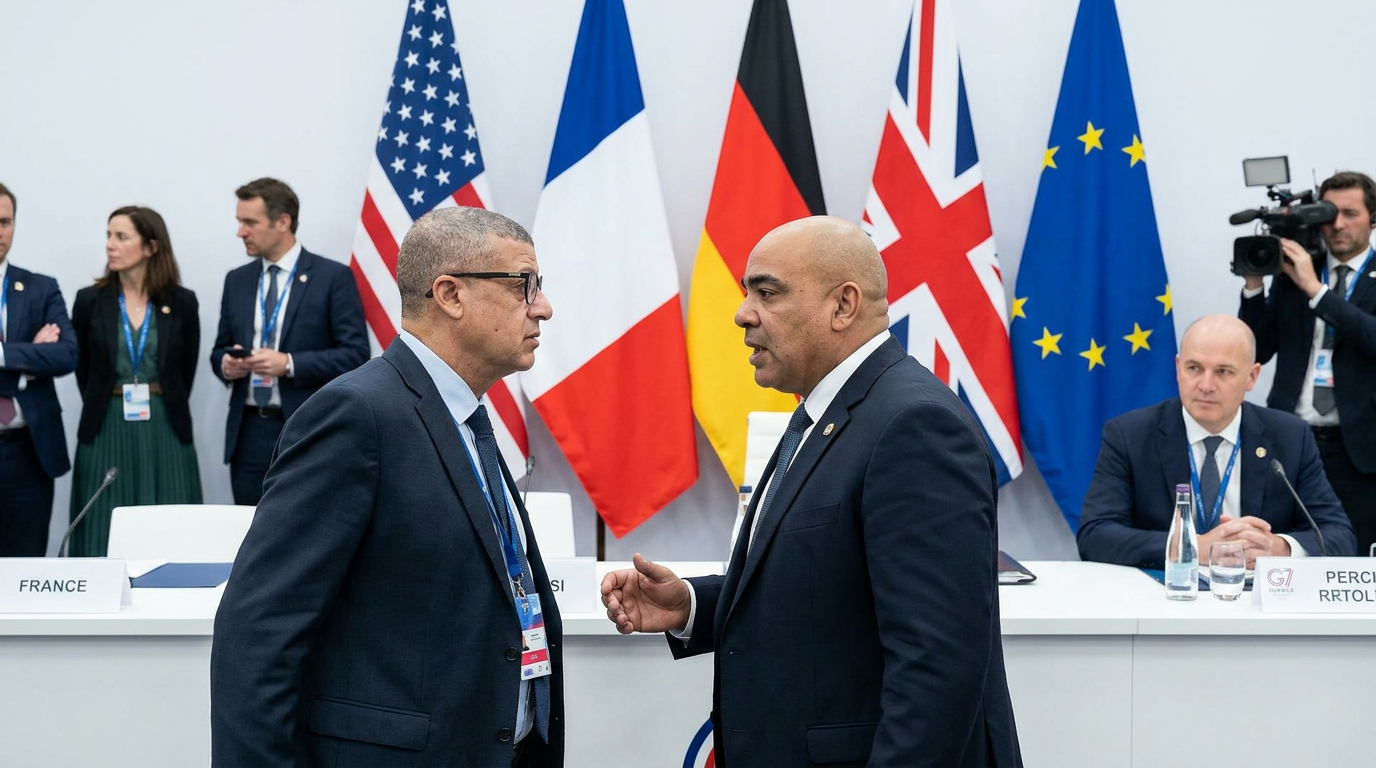
At the core of the framework is the future of Iran's nuclear program. Speaking from the sidelines of the G7 summit in France, President Donald Trump announced that Tehran has agreed to permanently abandon its pursuit of nuclear weapons. According to the administration, the deal includes stringent policing powers and a commitment to dismantle Iran's highly enriched uranium stockpile. However, the exact mechanisms for this dismantlement remain a significant point of contention. While U.S. officials have suggested that American forces might remove and destroy the material, Iranian state media has indicated that Tehran will dilute the stockpile domestically without foreign intervention.[2][3][8]

In exchange for verifiable nuclear compliance, Iran stands to gain substantial economic relief. The framework outlines a phased unfreezing of billions of dollars in Iranian assets currently held in overseas accounts. Additionally, negotiators have proposed the creation of a $300 billion private reconstruction and investment fund. Backed largely by Gulf states and international corporate interests, the fund is designed to rebuild Iran's war-torn infrastructure and modernize its energy sector. The financial incentives are structured to be released incrementally, ensuring that Tehran meets its non-proliferation benchmarks before gaining full access to the global financial system.[1][7]
The financial aspects of the deal have sparked intense domestic scrutiny and political maneuvering in the United States. President Trump vehemently denied reports that the U.S. government would directly pay Iran, taking to social media to call claims of a taxpayer-funded $300 billion payout "fake news." Vice President Vance further clarified the administration's stance, emphasizing that the reconstruction fund relies entirely on foreign and private investment. U.S. officials have repeatedly stressed that the economic benefits are strictly conditional, warning that any violation of the memorandum will result in the immediate reimposition of sanctions and potential military consequences.[7]
The financial aspects of the deal have sparked intense domestic scrutiny and political maneuvering in the United States.
The geopolitical breakthrough delivered an immediate and profound shock to global markets. Anticipating the end of the U.S. naval blockade and the resumption of commercial shipping through the Strait of Hormuz—a vital maritime chokepoint that facilitates nearly a fifth of the world's oil supply—crude prices plummeted below $80 a barrel. Major stock indices surged in response to the reduced risk of a broader regional war and the stabilization of energy costs. For global economists, the reopening of the strait removes a major inflationary pressure that had threatened to derail international growth projections for the remainder of the year.[3][8]

Despite the diplomatic progress abroad, the Trump administration faces significant pushback at home regarding its unilateral authorization of the initial conflict. The U.S. House of Representatives delivered a rare bipartisan rebuke, voting 215 to 208 to pass a War Powers Resolution aimed at curbing the president's ability to launch further strikes against Iran without explicit congressional approval. The legislative effort, supported by four Republicans who crossed party lines, underscores growing frustration on Capitol Hill over the financial and strategic costs of the president's foreign policy decisions.[4]
The House resolution highlights a deepening divide over executive war powers, with proponents arguing that the Constitution solely imbues Congress with the authority to declare war. However, a companion measure in the Senate was narrowly defeated by Republicans, preserving the administration's leverage as it finalizes the Geneva negotiations. The Senate vote effectively shields the White House from immediate legislative constraints, allowing the diplomatic team to present a unified front during the critical 60-day ceasefire window. Nevertheless, the congressional debate signals that any final treaty will face intense domestic scrutiny.[4][5]

Regional complications also threaten to unravel the fragile truce before the ink is dry. While the memorandum of understanding calls for the termination of military operations on all fronts, including Lebanon, Israeli Prime Minister Benjamin Netanyahu has explicitly stated that Israel does not consider itself bound by the Lebanon-related provisions. Israeli forces recently struck a Hezbollah command center in Beirut, prompting fierce warnings from Tehran. The strike drew a rare public rebuke from President Trump, who urged all sides to stand down and warned that isolated skirmishes could jeopardize the broader peace framework.[2][6]
The next 60 days will serve as a critical test for the durability of the framework. Negotiators must bridge the persistent gap between Washington's demand for immediate, verifiable nuclear dismantlement and Tehran's expectation of upfront sanctions relief. As international mediators from Qatar and Pakistan work to facilitate the technical discussions, the world watches closely. The success of the Geneva process hinges on whether the preliminary political commitments can withstand the pressures of regional rivalries, domestic political opposition, and the complex logistics of international nuclear enforcement.[4][8]
How we got here
February 2026
The United States and Israel launch military strikes against Iran, initiating a three-and-a-half-month conflict.
April 2026
A temporary two-week ceasefire is announced but ultimately fails to hold as hostilities resume.
June 14, 2026
U.S. and Iranian officials digitally sign a preliminary memorandum of understanding to halt the fighting.
June 19, 2026
A formal signing ceremony is scheduled to take place in Geneva, Switzerland, to initiate a 60-day negotiation period.
Viewpoints in depth
U.S. Administration's view
The deal is a historic victory that secures a non-nuclear Iran without utilizing American taxpayer funds.
The White House frames the memorandum of understanding as a triumph of its maximum-pressure military and diplomatic strategy. By forcing Iran to the negotiating table, the administration claims it has secured ironclad guarantees that Tehran will never develop a nuclear weapon. Officials emphasize that the proposed $300 billion reconstruction fund relies entirely on private and Gulf state investments, shielding U.S. taxpayers from the cost of rebuilding. For the administration, the immediate reopening of the Strait of Hormuz and the subsequent drop in global oil prices validate the aggressive tactics used to initiate the ceasefire.
Iranian Leadership's view
The agreement is a necessary step to lift crippling sanctions and secure massive international investment for national reconstruction.
Tehran views the framework as a pragmatic mechanism to end a devastating conflict and rescue its economy from international isolation. Iranian officials highlight the unfreezing of billions in overseas assets and the potential $300 billion investment fund as major diplomatic concessions extracted from the West. While agreeing to halt nuclear weapons development, hardline factions within Iran insist that the country retains the right to domestic civilian nuclear energy and reject the idea of U.S. forces dismantling their facilities. For Iran, the deal's success is entirely contingent on the rapid and verifiable lifting of economic sanctions.
Congressional Critics' view
The executive branch overstepped its constitutional authority by waging an unauthorized war that cost American consumers billions.
Lawmakers from both parties, particularly in the House of Representatives, argue that the administration bypassed Congress to launch a costly and dangerous conflict. Critics point to the economic toll of the war, noting that the closure of the Strait of Hormuz artificially inflated gas prices and burdened American households. While many welcome the ceasefire, they remain deeply skeptical of the administration's secretive negotiation process and the lack of congressional oversight regarding the final terms of the treaty. The passage of the War Powers Resolution in the House serves as a formal legislative protest against unilateral executive military action.
What we don't know
- How exactly Iran's highly enriched uranium stockpile will be dismantled or diluted.
- Whether Israel will comply with the ceasefire provisions regarding its operations in Lebanon.
- The specific corporate and state entities contributing to the proposed $300 billion reconstruction fund.
Key terms
- Memorandum of Understanding (MOU)
- A formal agreement outlining the broad terms of a deal before a final, detailed treaty is signed.
- Strait of Hormuz
- A critical maritime chokepoint between the Persian Gulf and the Gulf of Oman, through which nearly a fifth of global oil supplies pass.
- War Powers Resolution
- A U.S. law intended to check the president's power to commit the United States to an armed conflict without the consent of Congress.
- Highly Enriched Uranium
- Uranium that has been processed to a level where it can be used to create nuclear weapons, a key focus of the U.S.-Iran negotiations.
Frequently asked
Is the war between the U.S. and Iran completely over?
Not yet. The current agreement is a preliminary 60-day ceasefire framework, not a final peace treaty. Both sides must still negotiate long-term nuclear limits and sanctions relief.
Will the U.S. pay Iran $300 billion?
No. The proposed $300 billion is a private reconstruction and investment fund backed primarily by Gulf states and international investors, contingent on Iran's compliance.
How does this deal affect global oil prices?
The agreement mandates the immediate reopening of the Strait of Hormuz, a vital shipping lane. Anticipation of this reopening has already caused global crude oil prices to drop below $80 a barrel.
Does this agreement stop the fighting in Lebanon?
The memorandum calls for an end to hostilities on all fronts, including Lebanon. However, Israeli Prime Minister Benjamin Netanyahu has stated that Israel does not consider itself bound by the Lebanon-related provisions.
Sources
Source coverage
8 outlets
4 viewpoints surfaced








[1]AxiosEconomic & Market Watchers
Breaking down the billions Iran could receive under Trump's deal
Read on Axios →[2]The GuardianInternational & Critical Voices
Trump declares US-Iran peace deal 'all signed' as G7 leaders battle to tie up loose ends
Read on The Guardian →[3]Fox NewsU.S. Administration & Negotiators
Trump vows 'ultimate consequences' for Iran violations for reneging on ending nuclear aspirations
Read on Fox News →[4]Al JazeeraInternational & Critical Voices
World leaders welcome US-Iran 'peace deal' announcement
Read on Al Jazeera →[5]CBS NewsU.S. Administration & Negotiators
Iran peace deal to be signed Sunday and strait reopened immediately, Trump says
Read on CBS News →[6]TimeRegional Mediators & Analysts
Trump and Iranian Official Sign Agreement to Stop Fighting, Reopen Strait of Hormuz
Read on Time →[7]The Economic TimesEconomic & Market Watchers
Is Iran getting $300B? Trump calls claims 'fake news' as Vance explains Gulf fund
Read on The Economic Times →[8]Council on Foreign RelationsRegional Mediators & Analysts
What to Know About the U.S.-Iran Peace Deal Framework
Read on Council on Foreign Relations →
Every angle. Every day.
Get news politics stories with full source coverage and perspective breakdowns delivered to your inbox.