
US and Iran Reach Tentative Peace Agreement as G7 Leaders Work to Finalize Details
President Trump announced the signing of a memorandum of understanding to end the four-month conflict with Iran, centering on reopening the Strait of Hormuz and preventing Iranian nuclear armament. However, European allies and U.S. lawmakers are raising questions about unresolved maritime fees, regional ceasefires, and congressional war powers.
By Factlen Editorial Team
- U.S. Administration
- Argues that decisive military action forced Iran to the table, securing a non-nuclear pledge and reopening global shipping lanes.
- European Allies
- Relieved by the de-escalation but deeply concerned about Iran's proposed maritime tolls and the lack of clarity on nuclear inspections.
- Congressional Democrats
- Contend that the executive branch bypassed Congress to wage an illegal war, demanding legislative oversight regardless of the peace outcome.
- Iranian Leadership
- Views the lifting of the naval blockade as a necessary economic lifeline, while leveraging the Strait of Hormuz to maintain strategic influence.
What's not represented
- · Global shipping companies facing potential maritime tolls
- · Civilians displaced by the regional conflict
Why this matters
The tentative peace deal promises to stabilize global energy markets and end a deadly four-month conflict, but unresolved disputes over shipping lanes and congressional war powers could still derail the agreement.
Key points
- President Trump announced a signed memorandum of understanding with Iran at the G7 summit to end the four-month military conflict.
- The framework lifts the U.S. naval blockade and reopens the Strait of Hormuz in exchange for nuclear concessions from Tehran.
- European leaders welcomed the de-escalation but strongly oppose Iran's proposal to charge maritime tolls in the strait.
- Senate Democrats are pushing War Powers resolutions to assert congressional oversight over the conflict, though Republicans remain opposed.
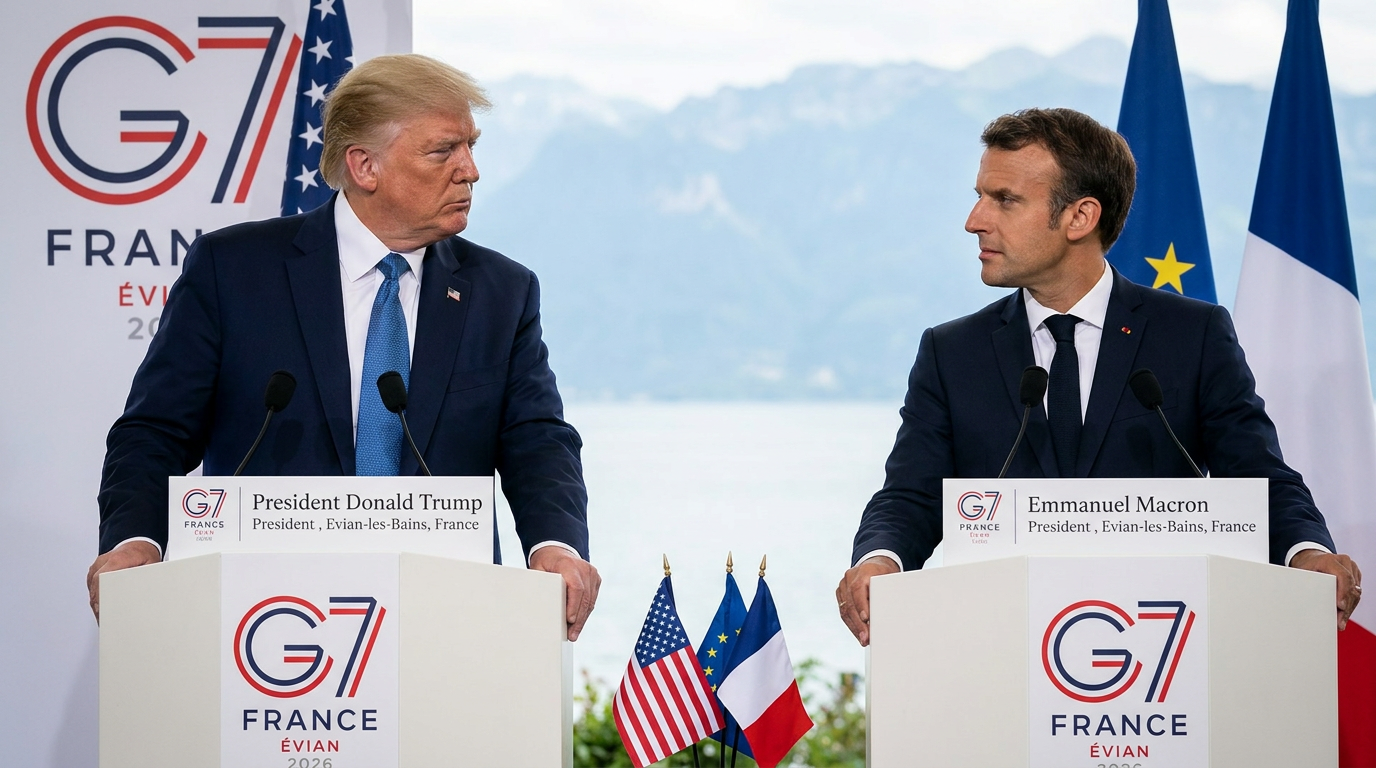
The four-month military conflict between the United States and Iran appears to be drawing to a close, marking a critical turning point in global geopolitics. Arriving at the Group of Seven (G7) summit in Évian-les-Bains, France, President Donald Trump announced that a memorandum of understanding with Tehran is "all signed," signaling an imminent halt to hostilities. The announcement represents a sudden diplomatic breakthrough following a volatile period of U.S. military strikes and naval blockades that deeply disrupted global energy markets and heightened fears of a broader, sustained regional war. For months, the international community has watched the escalation with growing alarm, making the prospect of a formalized truce a central focus of the summit.[2][4][5][6]
The tentative agreement centers on two primary pillars designed to restore regional stability: the reopening of the Strait of Hormuz and a renewed, verifiable commitment from Tehran to halt its nuclear weapons program. In exchange for Iran accepting international policing powers and allowing the return of nuclear inspectors to its facilities, the United States has agreed to lift its naval blockade in the region. Speaking to reporters alongside French officials, Trump touted the immediate economic benefits of the framework, noting that the partial reopening of the strait has already caused global oil prices to plummet and stabilized volatile stock markets. The administration views the blockade's end as a necessary concession to secure long-term non-proliferation guarantees.[4][5][6]
While the memorandum of understanding has been agreed upon in principle, the formal signing ceremony is scheduled to take place on Friday in Geneva. Vice President JD Vance and Iranian Parliament Speaker Mohammad-Bagher Ghalibaf are expected to ink the document on behalf of their respective governments. This ceremony will officially trigger a 60-day negotiation period dedicated to finalizing the highly complex technical details of a permanent treaty. This critical window will be used by diplomats and technical experts to determine exactly how enriched uranium currently in Iran's possession will be safely extracted or destroyed, and to establish the precise protocols for how international inspections will be conducted moving forward.[4][5][6]

European leaders attending the G7 summit, including French President Emmanuel Macron, publicly welcomed the sudden de-escalation of hostilities. After months of bitter divisions and diplomatic friction over the Trump administration's aggressive military posture in the Middle East, the prospect of a stabilized region and secure shipping lanes noticeably softened the tone of the gathering. Macron praised the framework as a vital step for global peace and immediately offered tangible European support to ensure its success. France has proposed sending naval assets, including mine search boats, frigates, and potentially the Charles de Gaulle aircraft carrier, to help secure the Strait of Hormuz and facilitate the safe resumption of commercial maritime traffic.[2][4][5]
Behind closed doors, however, Western allies are scrambling to address significant unresolved elements of the deal that could threaten its long-term viability. A primary sticking point is Iran's controversial assertion that it holds the sovereign right to charge maritime fees or tolls for commercial vessels transiting the Strait of Hormuz. European leaders, who are staunch defenders of international freedom of navigation, fiercely oppose any formulation that would allow Tehran to effectively tax global shipping. Diplomats warn that implementing a tolling system in one of the world's most critical energy choke points could set a dangerous precedent and undermine the economic relief the peace deal is supposed to deliver.[4]
Behind closed doors, however, Western allies are scrambling to address significant unresolved elements of the deal that could threaten its long-term viability.
Complex regional dynamics also threaten to complicate the fragile truce before the ink is fully dry. Iranian officials have publicly warned that the entire peace framework is contingent upon Israel adhering to a concurrent ceasefire in Lebanon, linking the U.S. agreement to broader Middle Eastern security issues. Furthermore, the four-month conflict has severely damaged Iran's diplomatic and economic relationships with its Gulf neighbors, who found themselves caught in the crossfire of the naval standoff. Rebuilding trust and establishing a sustainable security architecture in the Persian Gulf will leave a fractured geopolitical landscape that requires extensive, ongoing mediation to repair.[3][4]

As the administration negotiates the final terms in Europe, a fierce domestic battle over executive authority and constitutional limits is unfolding in Washington. Senate Democrats have launched a renewed, aggressive push to rein in the president's military powers, introducing a wave of War Powers resolutions aimed at forcing a mandatory congressional vote on U.S. involvement in Iran. Senator Raphael Warnock, a leading voice in the legislative effort, argued forcefully that the executive branch bypassed Congress to wage an illegal war. Proponents of the measure are demanding strict legislative oversight and a formal accounting of the administration's actions, regardless of whether the peace negotiations ultimately succeed.[7][8]
Advocates for the War Powers resolution point to the severe human and economic toll of the conflict as proof that unilateral military action requires congressional checks. The four-month war has resulted in the tragic deaths of 13 U.S. service members and reportedly claimed the lives of over 1,600 civilians in the region, drawing intense scrutiny from human rights organizations. Critics argue that the administration entered the hostilities without a clear strategic rationale or an articulated vision for a post-war resolution. By forcing a vote, lawmakers hope to reassert their constitutional authority over declarations of war and prevent future presidents from launching major military campaigns without explicit legislative approval.[7][8]

Senate Republicans, however, have largely blocked these legislative efforts, ensuring that the War Powers resolutions face a steep uphill climb. GOP lawmakers argue that attempting to handcuff the president's military authority while a delicate peace deal is actively taking shape would severely undermine American leverage at the negotiating table. They maintain that the administration's decisive, unapologetic military actions were the exact catalyst necessary to force Tehran into making significant nuclear concessions. From the Republican perspective, passing a restrictive resolution now would project internal division and weakness during a critical diplomatic window, potentially emboldening Iranian negotiators to demand better terms.[1]
The coming weeks will rigorously test whether the Geneva memorandum can evolve from a temporary ceasefire into a durable, legally binding geopolitical settlement. As diplomats and technical experts work around the clock to translate the broad framework into enforceable commitments, the international community remains intensely focused on the 60-day negotiation clock. Ultimate success will require skillfully navigating the competing demands of European navigational rights, Iranian economic desperation, and intense domestic scrutiny over how the United States wages war and secures peace. If the fragile coalition holds, the agreement could reshape Middle Eastern security for a generation; if it fractures, the region risks plunging back into open conflict.[2][4][6][8]
How we got here
February 2026
U.S. military strikes escalate into a broader conflict with Iran.
March 2026
The U.S. Senate rejects an initial War Powers resolution in a 53-47 vote.
Mid-June 2026
President Trump announces a signed memorandum of understanding at the G7 summit in France.
Late June 2026
A formal signing ceremony is scheduled in Geneva, triggering a 60-day negotiation window.
Viewpoints in depth
The U.S. Administration's View
Focuses on the economic and security victories of the deal.
The administration maintains that its aggressive military posture was the necessary catalyst to bring Iran to the negotiating table. By enforcing a strict naval blockade and conducting targeted strikes, officials argue they forced Tehran to accept international policing of its nuclear program. The White House points to plummeting oil prices and stabilized markets as immediate proof that their strategy of maximum pressure yielded tangible economic and security benefits for the United States and its allies.
European Navigational Concerns
Focuses on the Strait of Hormuz toll dispute and freedom of navigation.
While European leaders are deeply relieved by the de-escalation of a conflict they largely opposed, their focus has rapidly shifted to the fine print of the maritime agreement. Nations like France and the UK are staunch defenders of international freedom of navigation and view Iran's proposal to charge tolls in the Strait of Hormuz as a dangerous precedent. They argue that allowing Tehran to tax global shipping would effectively legitimize extortion in one of the world's most vital energy choke points.
The Congressional Oversight Push
Focuses on the constitutional argument regarding executive war powers.
For proponents of the War Powers resolution, the peace negotiations do not absolve the executive branch of its constitutional obligations. Lawmakers argue that the administration bypassed Congress to initiate a deadly conflict that cost American lives and billions of dollars. They contend that allowing the president to wage war unilaterally—even if it ends in a peace deal—sets a dangerous historical precedent that erodes the legislative branch's authority over matters of war and peace.
Tehran's Strategic Calculus
Focuses on Iran's regional positioning and desperate need for economic relief.
From Tehran's perspective, the memorandum of understanding is a pragmatic necessity to lift a crippling naval blockade that has suffocated its economy. However, Iranian leadership is attempting to leverage the reopening of the Strait of Hormuz to extract maximum financial concessions, including the proposed maritime tolls. Furthermore, by linking the peace framework to a ceasefire in Lebanon, Iran is signaling to its regional proxies and adversaries that it remains a central power broker in the Middle East despite the military setbacks of the past four months.
What we don't know
- How exactly Iran's existing enriched uranium will be extracted or destroyed during the 60-day negotiation window.
- Whether European nations will successfully block Iran's attempt to implement a tolling system in the Strait of Hormuz.
- If the peace framework will hold if regional ceasefires, particularly involving Israel and Lebanon, break down.
Key terms
- Memorandum of Understanding (MOU)
- A formal agreement between two or more parties that outlines the terms and details of a mutual understanding, often preceding a binding treaty.
- Strait of Hormuz
- A critical, narrow waterway between the Persian Gulf and the Gulf of Oman through which a significant portion of the world's oil supply passes.
- War Powers Resolution
- A federal law intended to check the U.S. president's power to commit the United States to an armed conflict without the consent of Congress.
- Group of Seven (G7)
- An intergovernmental political and economic forum consisting of seven major advanced economies, including the U.S., France, and the UK.
Frequently asked
What does the peace deal actually do?
The framework lifts the U.S. naval blockade and reopens the Strait of Hormuz in exchange for Iran accepting international policing of its nuclear program.
Is the war officially over?
A memorandum of understanding has been signed, but a formal ceremony and a 60-day negotiation period are required to finalize the binding treaty.
Why are U.S. senators pushing a War Powers resolution?
Proponents argue that the executive branch bypassed Congress to initiate the conflict, and they want to assert legislative oversight regardless of the peace negotiations.
Why are European leaders concerned about the Strait of Hormuz?
While they welcome the de-escalation, European nations strongly oppose Iran's proposal to charge maritime tolls for ships passing through the strait.
Sources
Source coverage
8 outlets
4 viewpoints surfaced








[1]Fox NewsU.S. Administration
Republicans bat down bid to handcuff Trump’s war powers as peace deal nears
Read on Fox News →[2]The New York TimesEuropean Allies
After a Bitter Split, European Leaders Play Nice With Trump
Read on The New York Times →[3]Al JazeeraIranian Leadership
What has Iran won and lost from this war?
Read on Al Jazeera →[4]The GuardianEuropean Allies
Trump declares US-Iran peace deal 'all signed' as G7 leaders battle to tie up loose ends
Read on The Guardian →[5]NPRU.S. Administration
Trump arrives in France for G7 leaders summit, touting peace deal with Iran
Read on NPR →[6]CBS NewsU.S. Administration
Trump in G7 summit in France as he touts signing of Iran memorandum
Read on CBS News →[7]U.S. Senator Reverend Raphael WarnockCongressional Democrats
Warnock Introduces War Powers Resolution to Stop President Trump's War in Iran
Read on U.S. Senator Reverend Raphael Warnock →[8]WSB RadioCongressional Democrats
Sen. Raphael Warnock questions U.S. strategy after Senate fails to pass war powers resolution
Read on WSB Radio →
More in news politics
See all 7 stories →Immigration Enforcement
DOJ Charges 15 Minnesota Activists With Conspiracy Over Resistance to Immigration Crackdown
0 sources

US-Iran Relations
Senate Blocks War Powers Resolution as US-Iran Peace Deal Advances at G7
0 sources
Anti-ICE Protests
DOJ Charges 15 Minnesota Activists With Conspiring to Block ICE Operations
0 sources

Middle East Security
U.S. and Iran Reach Preliminary Peace Framework to End Conflict and Reopen Strait of Hormuz
0 sources
Every angle. Every day.
Get news politics stories with full source coverage and perspective breakdowns delivered to your inbox.