
OLED vs. Mini-LED: The 2026 TV Technology Trade-Off Explained
As OLED panels get brighter and Mini-LEDs perfect their black levels, choosing the right premium TV in 2026 comes down to matching display physics with your room's lighting and viewing habits.
By Factlen Editorial Team
- OLED Purists
- Advocates prioritizing absolute contrast, pixel-perfect black levels, and instantaneous response times.
- Mini-LED Pragmatists
- Advocates prioritizing peak brightness, zero burn-in risk, and bright-room performance.
- Value-to-Size Maximizers
- Buyers and analysts focused on the immersive impact of screen size over microscopic contrast differences.
What's not represented
- · Environmental advocates concerned with the higher power consumption of 5,000-nit Mini-LEDs
- · Budget consumers priced out of both flagship OLED and high-zone Mini-LED markets
Why this matters
Choosing the wrong premium TV technology can result in a frustrating viewing experience—either battling glare in a sunlit room or risking permanent screen damage from static gaming menus. Understanding the structural differences between OLED and Mini-LED ensures you invest in a display that actually matches your household's lighting and daily habits.
Key points
- OLED panels offer perfect black levels and 0.03ms response times, making them ideal for dark rooms and gaming.
- Mini-LED televisions can reach 5,000 nits of peak brightness, easily overpowering glare in sunlit living rooms.
- 2026 OLEDs use MLA technology to boost brightness, while Mini-LEDs use up to 20,000 dimming zones to improve contrast.
- Mini-LED carries zero risk of burn-in, making it the safer choice for static PC interfaces and news tickers.
- Buyers can often purchase an 85-inch Mini-LED for the same price as a 65-inch premium OLED.
The era of compromising on premium picture quality is officially over. As consumers look to upgrade their living rooms in 2026, the television market has consolidated into a fierce battle between two flagship engineering paths: OLED and Mini-LED. Both technologies have evolved dramatically over the past few years, effectively eliminating the glaring weaknesses that once defined them.[1][4]
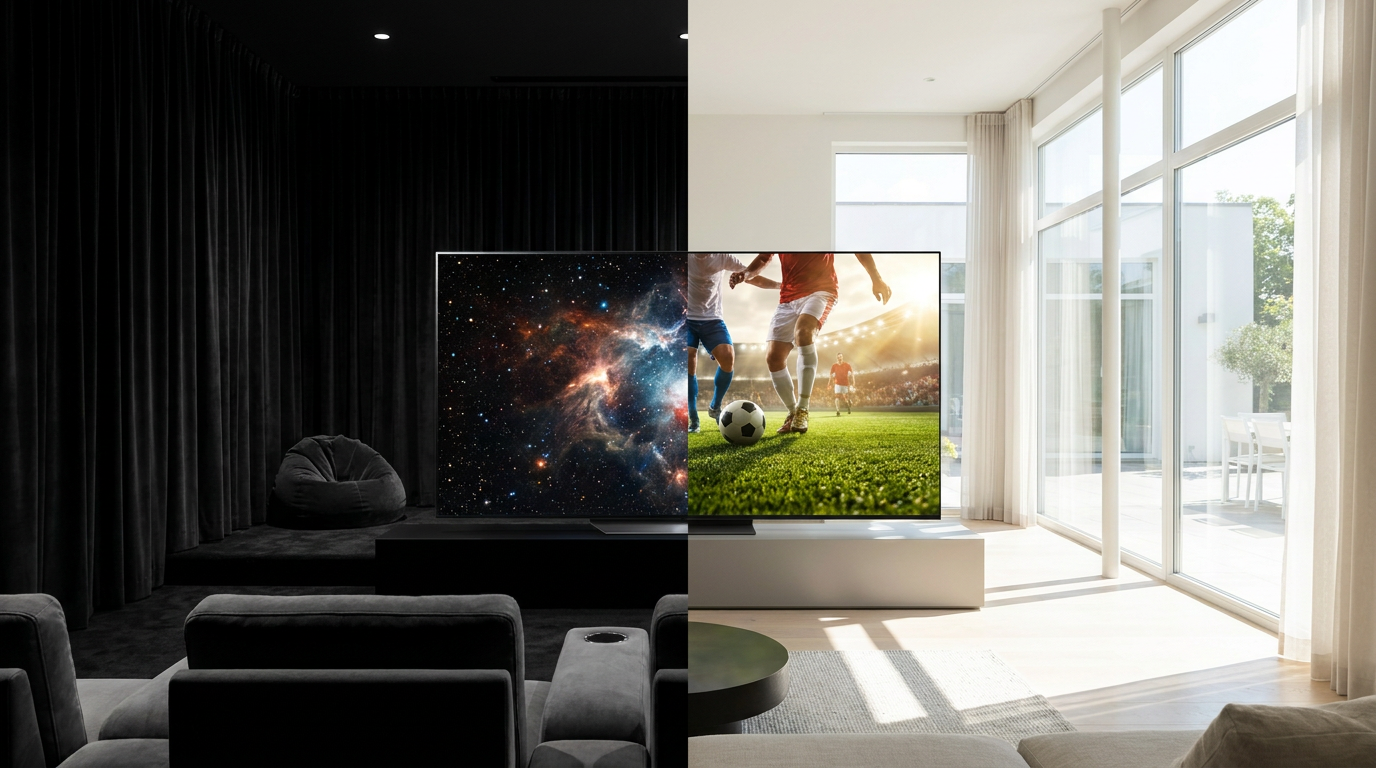
Buying a high-end television is no longer just about picking the largest screen on the showroom floor. It is now a calculated decision about matching display physics to the specific lighting conditions and viewing habits of a household. The marketing jargon can be deafening, but the underlying chemistry and engineering dictate exactly how a screen will perform in a sun-drenched living room versus a pitch-black home theater.[5]
The case for OLED begins with its fundamental architecture. Organic Light-Emitting Diodes are self-emissive, meaning each individual pixel generates its own light and can turn itself off completely. This allows OLED panels to achieve perfect, absolute black levels and an infinite contrast ratio, creating a cinematic depth that traditional backlights historically could not replicate.[1][7]
Recent engineering breakthroughs have only strengthened OLED's position. With the widespread adoption of Micro Lens Array (MLA) 3.0 and fourth-generation QD-OLED panels in 2026, manufacturers have pushed past the technology's historical brightness limits. These panels use billions of microscopic lenses to focus light outward, allowing modern OLEDs to reach up to 2,500 nits in small highlight windows without instantly overheating the organic compounds.[3][6]

For competitive gamers and home theater purists, the evidence heavily favors OLED. The technology boasts a near-instantaneous 0.03-millisecond pixel response time, which effectively eliminates motion blur and ghosting during high-speed esports or fast-paced action sequences. When viewed in a dark room, the pixel-level precision ensures that a single bright star in a black sky is rendered perfectly, without any surrounding light bleed.[2][7]
However, the case against OLED remains tied to its organic chemistry. Because the pixels degrade over time based on what they display, they carry a cumulative risk of differential aging, commonly known as burn-in. While 2026 models utilize deuterium stabilization and aggressive pixel-shifting algorithms to mitigate this wear, independent 10,000-hour stress tests show that static elements—like news tickers, desktop taskbars, or gaming health bars—still pose a slight risk of permanent image retention over years of heavy use.[6]
However, the case against OLED remains tied to its organic chemistry.
Enter Mini-LED, the inorganic alternative. Instead of relying on carbon-based compounds, Mini-LED televisions use thousands of microscopic Gallium Nitride LEDs serving as a backlight behind an LCD panel. Because these semiconductors are built to withstand massive amounts of heat and current for decades, they do not decay in a biological sense, completely eliminating the risk of burn-in.[4][7]
The case for Mini-LED is anchored in sheer, unadulterated luminance. Unburdened by the thermal limits of organic pixels, 2026 Mini-LED flagship models routinely push peak HDR brightness to a staggering 3,000 to 5,000 nits. This allows them to hold a full-field white screen at maximum brightness indefinitely, making them the undisputed champions of daytime viewing and sports broadcasts.[2][7]

To address the historical weakness of LCD panels—poor contrast and light bleed—engineers have dramatically increased the density of the backlights. Modern premium Mini-LEDs now feature up to 20,000 independent local dimming zones. By precisely turning off clusters of LEDs behind dark areas of the image, these televisions approximate OLED's black levels closely enough that most viewers cannot tell the difference in a standard, ambiently lit room.[2][5]
The case against Mini-LED centers on the physical limitations of those dimming zones. Even with 20,000 zones, a single zone still illuminates hundreds of pixels at once. In a pitch-black room, displaying a bright white subtitle on a black letterbox bar will inevitably cause a faint halo of light—known as blooming—to bleed into the darkness, breaking the cinematic illusion for discerning cinephiles.[4][5]
When quantifying the price-to-size trade-off, the evidence shifts back toward Mini-LED for value-conscious buyers. Because inorganic LCD panels are significantly cheaper to manufacture at massive scales, consumers can frequently purchase an 85-inch Mini-LED television for the exact same price as a premium 65-inch OLED. For many, the sheer physical immersion of a larger screen vastly outweighs a microscopic edge in absolute contrast.[5][7]

Ultimately, OLED fits well when a television is placed in a light-controlled or darkened room, and when the primary use is cinematic movie viewing or competitive gaming. It does not fit well when the screen will face direct afternoon sunlight, or when the household leaves static news channels and PC taskbars on the screen for eight hours a day.[1][4]
Conversely, Mini-LED fits well when a living room features massive windows and heavy ambient light, or when buyers want the absolute largest screen size possible for their budget. It does not fit well when the viewer is a home theater purist who demands absolute pixel-perfect black levels in a pitch-black room, as even the best dimming zones cannot entirely defy the physics of a backlight.[2][5]
How we got here
Pre-2021
OLED dominates the premium TV market with perfect blacks, while traditional LED LCDs struggle with poor contrast and heavy blooming.
2021–2023
Mini-LED technology enters the mainstream, dramatically increasing dimming zones and closing the contrast gap with OLED.
2024–2025
OLED manufacturers introduce MLA and QD-OLED technologies, pushing peak brightness past 2,000 nits to compete with Mini-LED.
2026
The technologies reach near-parity in mixed usage, with Mini-LEDs hitting 5,000+ nits and OLEDs perfecting their burn-in mitigation.
Viewpoints in depth
The OLED Purists
Advocates prioritizing absolute contrast, pixel-perfect black levels, and instantaneous response times.
For home theater enthusiasts and competitive esports players, OLED remains the undisputed champion. This camp argues that the 0.03-millisecond response time and infinite contrast ratio create a level of depth and motion clarity that backlights simply cannot replicate. They point to 2026 advancements in Micro Lens Array (MLA) technology, which have pushed OLED brightness past 2,000 nits, arguing that this effectively neutralizes Mini-LED's primary advantage in all but the most extreme sunlit environments.
The Mini-LED Pragmatists
Advocates prioritizing peak brightness, zero burn-in risk, and bright-room performance.
This perspective focuses on the realities of modern living rooms, which are often bathed in natural light. Mini-LED proponents argue that a television capable of 5,000 nits provides a vastly superior high-dynamic-range (HDR) experience during daytime viewing. Furthermore, they emphasize the peace of mind that comes with inorganic panels; for PC users, developers, and gamers who leave static interfaces on screen for thousands of hours, the complete absence of burn-in risk makes Mini-LED the only logical long-term investment.
The Value-to-Size Maximizers
Buyers and analysts focused on the immersive impact of screen size over microscopic contrast differences.
A growing segment of display analysts argues that the most noticeable upgrade a consumer can make is increasing their screen size. Because Mini-LED panels are significantly cheaper to manufacture at massive scales, this camp advocates for purchasing an 85-inch Mini-LED over a 65-inch OLED for the same price. They argue that at a standard ten-foot viewing distance, the sheer physical immersion of a larger screen vastly outweighs the 2% difference in absolute black levels that only lab instruments can reliably quantify.
What we don't know
- How well the latest deuterium-stabilized OLED panels will actually resist burn-in after 5 to 7 years of real-world consumer use.
- Whether upcoming Micro-LED technology will become affordable enough to replace both OLED and Mini-LED before the end of the decade.
Key terms
- Nits
- A measurement of visible light intensity, commonly used to describe the peak brightness a screen can achieve.
- Local Dimming Zones
- Specific clusters of backlights in a Mini-LED TV that can independently dim or turn off to improve black levels and contrast.
- Blooming
- A visual artifact where light from a bright object on a screen bleeds into the surrounding dark areas, creating a faint halo effect.
- Micro Lens Array (MLA)
- A technology used in modern OLED panels that uses billions of microscopic lenses to focus light outward, significantly increasing brightness.
- Burn-in
- Permanent image retention on a screen caused by the uneven degradation of pixels, typically from displaying static images for prolonged periods.
Frequently asked
Is OLED or Mini-LED better for a bright living room?
Mini-LED is significantly better for bright rooms. Its ability to reach 3,000 to 5,000 nits of peak brightness allows it to punch through heavy glare and direct sunlight without dimming.
Do 2026 OLED TVs still suffer from burn-in?
While the risk has been drastically reduced thanks to deuterium stabilization and software protections, cumulative burn-in is still a slight risk if static elements (like news tickers or gaming HUDs) are displayed for thousands of hours.
Which TV technology is better for competitive gaming?
OLED remains the top choice for competitive esports due to its near-instantaneous 0.03-millisecond response time, which eliminates motion blur and ghosting.
Why are Mini-LED TVs recommended for larger screen sizes?
Mini-LED panels are more cost-effective to manufacture at massive scales, allowing buyers to purchase an 85-inch Mini-LED for roughly the same price as a premium 65-inch OLED.
Sources
Source coverage
7 outlets
3 viewpoints surfaced







[1]RTINGSOLED Purists
OLED vs Mini LED TVs: Which is better in 2026?
Read on RTINGS →[2]PCWorldMini-LED Pragmatists
It's time to look beyond OLED to Mini-LED
Read on PCWorld →[3]TechRadarOLED Purists
OLED vs Mini-LED: The 2026 TV tech battle explained
Read on TechRadar →[4]CNETMini-LED Pragmatists
OLED vs. Mini-LED: Which TV tech is better?
Read on CNET →[5]Data Wire SolutionsValue-to-Size Maximizers
Best TVs for 2026: 10 OLED and Mini-LED Picks by Room, Brightness, and Install Reality
Read on Data Wire Solutions →[6]KTCMini-LED Pragmatists
OLED for Long-Term Productivity: A 10,000-Hour Burn-In Update
Read on KTC →[7]EasyCompareValue-to-Size Maximizers
Mini-LED vs OLED: Key Specs Compared
Read on EasyCompare →
Every angle. Every day.
Get shopping stories with full source coverage and perspective breakdowns delivered to your inbox.