
How Material Science is Engineering the Zero-Waste Fast Food Wrapper
Driven by a $2.21 billion market shift, the fast-food industry is replacing forever chemicals and single-use plastics with microbial biopolymers, water-based coatings, and reusable ecosystems.
By Factlen Editorial Team
- Material Scientists
- Focus on the chemical and engineering breakthroughs that allow sustainable materials to match the performance of plastics.
- Fast-Food Operators
- Prioritize scalability, cost-efficiency, and maintaining a seamless, mess-free experience for the consumer.
- Environmental Advocates
- Emphasize true circularity, pushing for reusable systems and better composting infrastructure over single-use bioplastics.
What's not represented
- · Waste Management Facilities
- · Independent Restaurant Owners
Why this matters
The packaging industry's shift away from PFAS and petroleum plastics directly reduces the microplastics and forever chemicals entering the human bloodstream and local ecosystems. For consumers, it means the convenience of takeout no longer requires a permanent environmental toll.
Key points
- The zero-waste packaging market has reached $2.21 billion in 2026, driven by regulatory pressure and consumer demand.
- Water-Based Barrier Coatings (WBBC) are replacing harmful PFAS chemicals to make paper wrappers grease-proof and fully recyclable.
- Polyhydroxyalkanoates (PHA), a bioplastic created via microbial fermentation, is replacing rigid petroleum plastics for items like clear cups and lids.
- Major chains are simultaneously scaling closed-loop reusable systems, allowing customers to return durable containers for industrial cleaning.
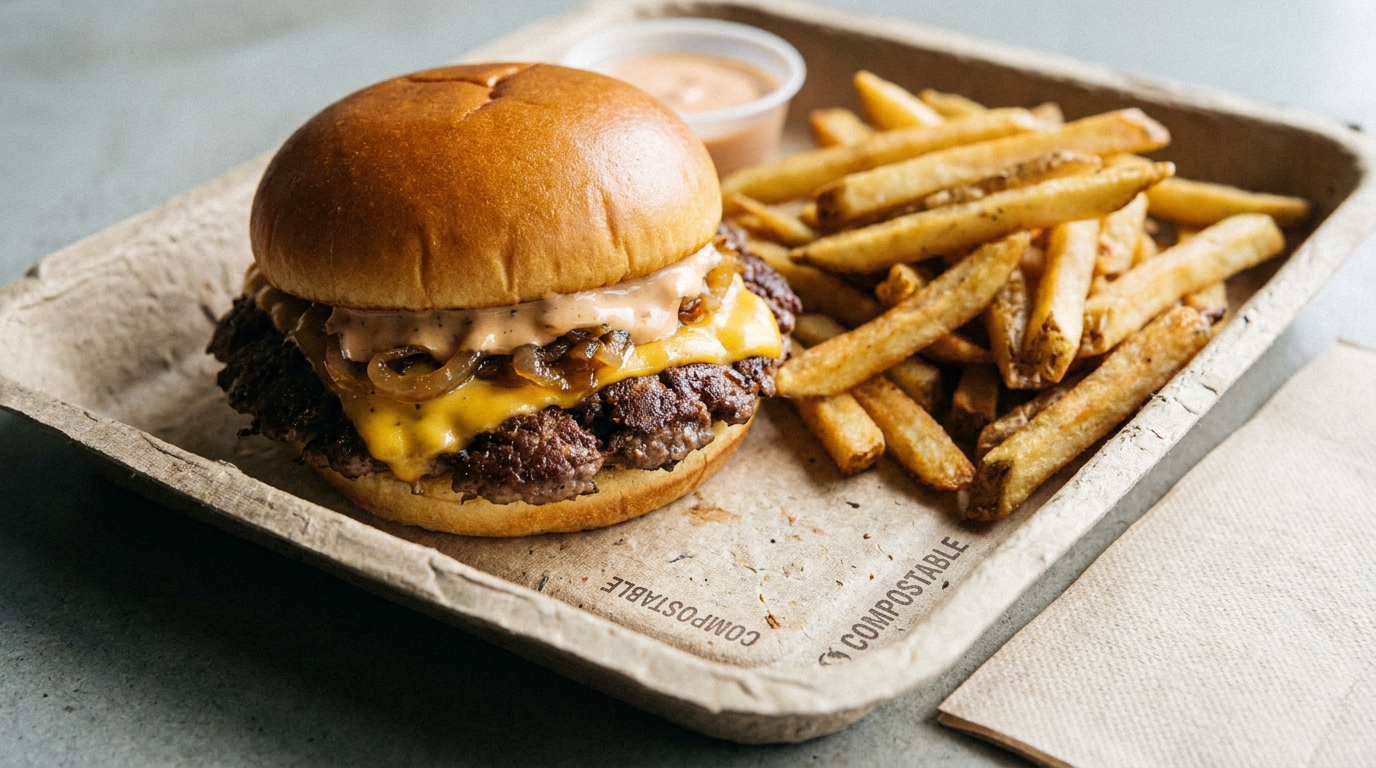
The fast-food drive-thru is a marvel of modern logistics, but it has long harbored a glaring flaw: the sheer volume of single-use waste it generates. For decades, the convenience of a quick meal came at the cost of billions of plastic cups, foam clamshells, and chemically treated wrappers heading straight for landfills. But in 2026, the industry is undergoing a quiet, structural revolution. The packaging that holds your burger and fries is being fundamentally re-engineered from the molecular level up.[7]
This shift is no longer a fringe environmental initiative; it is a massive economic engine. The global zero-waste packaging market has surged to an estimated $2.21 billion this year, driven by a combination of tightening government regulations and shifting consumer expectations. With the European Union enforcing mandates to recycle at least 65% of all packaging, the world's largest restaurant chains are moving beyond localized pilot programs and scaling sustainable materials globally.[1][5]

To understand the magnitude of this transition, one must look at the core engineering problem of fast food: grease and heat. Historically, keeping a burger's juices from soaking through its wrapper required coating paper with per- and polyfluoroalkyl substances (PFAS), widely known as "forever chemicals," or lining it with thin layers of petroleum-based plastics. Removing these materials without compromising the customer experience has been a monumental challenge for material scientists.[7]
The breakthrough has arrived in the form of Water-Based Barrier Coatings (WBBC). Advances in dispersion technology now allow manufacturers to apply microscopic, water-based layers to natural fiber packaging. These coatings provide the necessary resistance to grease, moisture, and oxygen, enabling paper to perform in demanding applications like hot takeaway meals and frozen foods without relying on harmful chemicals.[6]
Paper manufacturers have rapidly commercialized this technology. Products like Koehler's NexPlus OGR have been specifically developed for restaurant chains, providing a powerful barrier against oil and grease while remaining entirely free of fluorochemicals. Because these wrappers are made purely from treated natural fibers, they are fully recyclable and can be processed in standard paper recycling streams, closing the loop on one of the industry's most ubiquitous waste items.[3]

While advanced paper solves the wrapper problem, rigid containers—such as iced coffee cups, salad bowls, and clear lids—have proven far more difficult to replace. These items require transparency, impact strength, and a moisture barrier that paper simply cannot provide, keeping the industry tethered to traditional plastics.[7]
The solution to the rigid plastic dilemma is emerging through a class of biopolymers known as Polyhydroxyalkanoates, or PHA. Unlike conventional plastics derived from fossil fuels, PHA is produced through the microbial fermentation of renewable feedstocks, such as sugarcane. It is, essentially, a plastic grown by bacteria rather than extracted from an oil well.[2]
The solution to the rigid plastic dilemma is emerging through a class of biopolymers known as Polyhydroxyalkanoates, or PHA.
What makes PHA a holy grail for food packaging is its end-of-life profile. It possesses a remarkably low carbon footprint and is third-party certified to biodegrade in virtually all environments, including marine ecosystems. When blended with other biopolymers like polylactic acid (PLA), PHA achieves the toughness and transparency required for automated food packaging lines, ensuring that a compostable cup performs exactly like its plastic predecessor.[2]

Beyond bioplastics, some innovators are pushing the boundaries of packaging by eliminating the concept of waste entirely. Edible and highly soluble packaging materials are gaining traction for specific applications, such as condiment packets and shelf-stable meat wrappers.[2]
Materials derived from seaweed, rice, and upcycled agricultural waste are being engineered into thin films that protect food but dissolve harmlessly in water or can be safely consumed alongside the meal. While not yet ready to replace every ketchup packet globally, these zero-waste alternatives represent the bleeding edge of food-safe material science.[2][7]
Yet, material substitution is only half of the industry's strategy. The other half relies on changing consumer behavior through closed-loop reusable systems. Recognizing that even compostable single-use items require energy to produce, major chains are investing heavily in durable packaging that never reaches a trash can.[4]
Programs like Burger King's partnership with the TerraCycle Loop service and McDonald's ReCup initiative allow customers to purchase their meals in reusable cups and containers by paying a small deposit. After eating, the customer returns the packaging to a collection bin, where it is industrially cleaned, sanitized, and placed back into circulation.[4]

These reusable models are highly effective at reducing carbon footprints, provided the return rates remain high. By standardizing the container shapes and sharing cleaning infrastructure across different brands, the industry hopes to make returning a fast-food cup as frictionless as throwing it away.[4]
Despite these rapid advancements, a significant hurdle remains: waste management infrastructure. A highly engineered compostable bowl is only beneficial if it actually reaches a commercial composting facility. In regions lacking decentralized composting systems or standardized waste sorting, even the most advanced bioplastics risk ending up in conventional landfills, where they cannot break down as intended.[6]
The fast-food meal of 2026 represents a triumph of unseen engineering. From microbial fermentation to water-based dispersion coatings, the science of sustainability has finally caught up with the speed of the drive-thru. As infrastructure improves to match these material breakthroughs, the industry is proving that convenience no longer has to come at the expense of the planet.[7]
How we got here
2019
The EU passes the Packaging and Packaging Waste Directive, setting aggressive recycling targets for 2025.
2021
Burger King launches pilot programs for reusable packaging systems in select global cities.
2023
The SEC adopts climate-related disclosure rules, increasing pressure on public fast-food operators to track packaging emissions.
2026
The global zero-waste packaging market reaches $2.21 billion as advanced biopolymers and PFAS-free coatings achieve commercial scale.
Viewpoints in depth
Material Scientists
Focus on the chemical and engineering breakthroughs that allow sustainable materials to match the performance of plastics.
For material scientists, the challenge has always been matching the sheer utility of petroleum plastic. The development of Water-Based Barrier Coatings (WBBC) and Polyhydroxyalkanoates (PHA) represents a monumental leap. Researchers emphasize that these aren't just incremental improvements; they are entirely new classes of materials. By utilizing microbial fermentation and advanced dispersion techniques, scientists argue they have finally decoupled high-performance food packaging from fossil fuels and toxic forever chemicals.
Fast-Food Operators
Prioritize scalability, cost-efficiency, and maintaining a seamless, mess-free experience for the consumer.
Restaurant chains view sustainable packaging through the lens of operational reality. A compostable wrapper is useless if it causes a burger to leak grease onto a customer's lap, and a bioplastic cup is unviable if it shatters on the assembly line. Operators are adopting these new materials because they finally meet the rigorous mechanical specifications required for automated food packaging lines. Their primary concern moving forward is achieving economies of scale to bring the cost of biopolymers down to parity with traditional plastics.
Environmental Advocates
Emphasize true circularity, pushing for reusable systems and better composting infrastructure over single-use bioplastics.
While environmental groups welcome the phase-out of PFAS and petroleum plastics, they caution against viewing bioplastics as a silver bullet. They argue that replacing single-use plastic with single-use compostable material still requires massive energy inputs and agricultural land. Furthermore, without a robust network of commercial composting facilities, many bioplastics will still end up in landfills. Advocates strongly prefer closed-loop reusable systems, arguing that true sustainability requires changing consumer habits, not just the chemical composition of the trash.
What we don't know
- Whether municipal composting infrastructure will scale fast enough to handle the massive influx of bioplastics.
- How consumer return rates for deposit-based reusable cups will hold up outside of controlled pilot programs.
Key terms
- Polyhydroxyalkanoates (PHA)
- A class of biodegradable plastics produced naturally by microorganisms fermenting sugar or lipids.
- Water-Based Barrier Coatings (WBBC)
- Eco-friendly liquid coatings applied to paper to make it resistant to water and grease, replacing chemical liners.
- PFAS (Forever Chemicals)
- Per- and polyfluoroalkyl substances; a group of synthetic chemicals historically used to make packaging grease-proof, known for persisting indefinitely in the environment and human body.
- Circular Economy
- An economic system aimed at eliminating waste and the continual use of resources by reusing, sharing, repairing, and recycling materials.
- Biopolymer
- A type of plastic or material produced by living organisms, such as cellulose, starch, or microbially fermented plastics.
Frequently asked
What are Water-Based Barrier Coatings (WBBC)?
WBBCs are microscopic, water-based layers applied to paper packaging. They provide resistance to grease and moisture without using harmful PFAS chemicals, allowing the paper to remain fully recyclable.
How is PHA different from traditional plastic?
Traditional plastics are derived from fossil fuels, while PHA is a biopolymer produced through the microbial fermentation of renewable sugars like sugarcane. It is certified to biodegrade in all environments, including the ocean.
Do compostable wrappers break down in a backyard compost bin?
It depends on the material. While some advanced bioplastics like PHA can break down naturally, many compostable items (like PLA) require the high heat of a commercial, industrial composting facility to decompose properly.
How do reusable fast-food packaging programs work?
Customers pay a small deposit for a durable cup or container. After their meal, they return the item to a collection bin, where the restaurant industrially cleans and sanitizes it for the next customer, refunding the deposit.
Sources
Source coverage
7 outlets
3 viewpoints surfaced






[1]Coherent Market InsightsEnvironmental Advocates
Zero Waste Packaging Market Size and Forecast – 2026-2033
Read on Coherent Market Insights →[2]The Food InstituteMaterial Scientists
Emerging Innovations in Eco-Friendly Packaging
Read on The Food Institute →[3]Koehler PaperMaterial Scientists
Recyclable paper packaging for a growing fast food Industry
Read on Koehler Paper →[4]Interpack MagazineFast-Food Operators
The future of sustainable fast food packaging
Read on Interpack Magazine →[5]NaturepolyFast-Food Operators
McDonald's: Scaling Fiber-Based and Compostable Packaging Worldwide
Read on Naturepoly →[6]MillionPackMaterial Scientists
Food Packaging Trends: Paper-Based Packaging Replacing Plastic
Read on MillionPack →[7]Factlen Editorial TeamEnvironmental Advocates
Synthesis by Factlen editorial team
Read on Factlen Editorial Team →
Every angle. Every day.
Get food drink stories with full source coverage and perspective breakdowns delivered to your inbox.