
Kinetic Floors and Recycled Batteries: How Mega-Tours Are Decarbonizing Live Music
Major artists and climate scientists have developed a verified blueprint for sustainable touring, achieving up to a 59% reduction in carbon emissions. From kinetic dance floors to renewable battery grids, the live music industry is proving that global entertainment can align with climate targets.
By Factlen Editorial Team
- Pioneering Artists
- Musicians who argue that the industry must halt traditional touring until it can decouple from fossil fuels.
- Climate Scientists & Auditors
- Researchers who provide the rigorous data frameworks necessary to prevent corporate greenwashing.
- Logistics & Supply Chain Partners
- The freight and energy companies tasked with physically executing the green transition.
- Municipal Planners
- Local governments and transit authorities responsible for the infrastructure that supports mega-events.
What's not represented
- · Smaller independent artists who lack the budget to implement high-tech sustainable infrastructure.
- · Local venue operators in developing markets with limited access to renewable energy grids.
Why this matters
The entertainment industry's shift proves that massive, energy-intensive global operations can successfully decarbonize without losing their scale or appeal. It provides a tested, scalable blueprint for sustainable logistics that other industries can adopt.
Key points
- Major artists have successfully implemented zero-emission technologies on global stadium tours.
- Mobile battery grids made from recycled electric vehicle cells have replaced diesel generators.
- Kinetic dance floors and stationary bikes allow fans to generate clean power during the show.
- Logistics partners are utilizing Sustainable Aviation Fuel and electric trucks to cut freight emissions.
- MIT verified a 59% reduction in direct carbon emissions for Coldplay's recent world tour.
- Audience travel remains the largest unresolved hurdle, requiring municipal investment in green transit.
For decades, the global live music industry operated on a simple, carbon-heavy equation. Moving thousands of tons of steel, lighting rigs, and audio equipment across continents required fleets of diesel trucks and cargo planes. Powering stadium-sized spectacles demanded massive diesel generators, while millions of fans drove or flew to attend. The environmental cost of a single world tour was staggering, prompting some of the world's biggest acts to question whether live music could survive the climate era.[1]
The turning point arrived when major artists began halting their tours entirely. In 2019, the British rock band Coldplay announced they would not hit the road again until they could discover a way to make touring environmentally beneficial. Around the same time, the electronic collective Massive Attack commissioned the Tyndall Centre for Climate Change Research to analyze their footprint and build a comprehensive decarbonization roadmap for the entire sector.[2][4]
What began as a theoretical exercise has now materialized into a verified, scalable blueprint for the entertainment industry. By completely re-engineering how a show is powered, transported, and experienced, pioneering tours have proven that massive global events can decouple from fossil fuels without sacrificing their spectacle.[1][4]
The most immediate challenge for any stadium show is power generation. Historically, venues relied on local grids heavily supplemented by diesel generators to handle the massive spikes in electricity required for audio and lighting. To eliminate this, engineers developed the first-ever mobile, rechargeable show battery system. Built from repurposed electric vehicle batteries, these units can power an entire stadium production using 100% renewable energy.[4][7]

But the energy doesn't just come from the grid—it comes from the audience. In a novel approach to localized power generation, recent tours have installed kinetic dance floors and stationary power bikes inside the stadiums. As fans jump on the specialized floor tiles or pedal the bikes, their kinetic energy is captured and fed directly into the show's battery reserves, generating an average of 17 kilowatt-hours of clean power per night.[4]
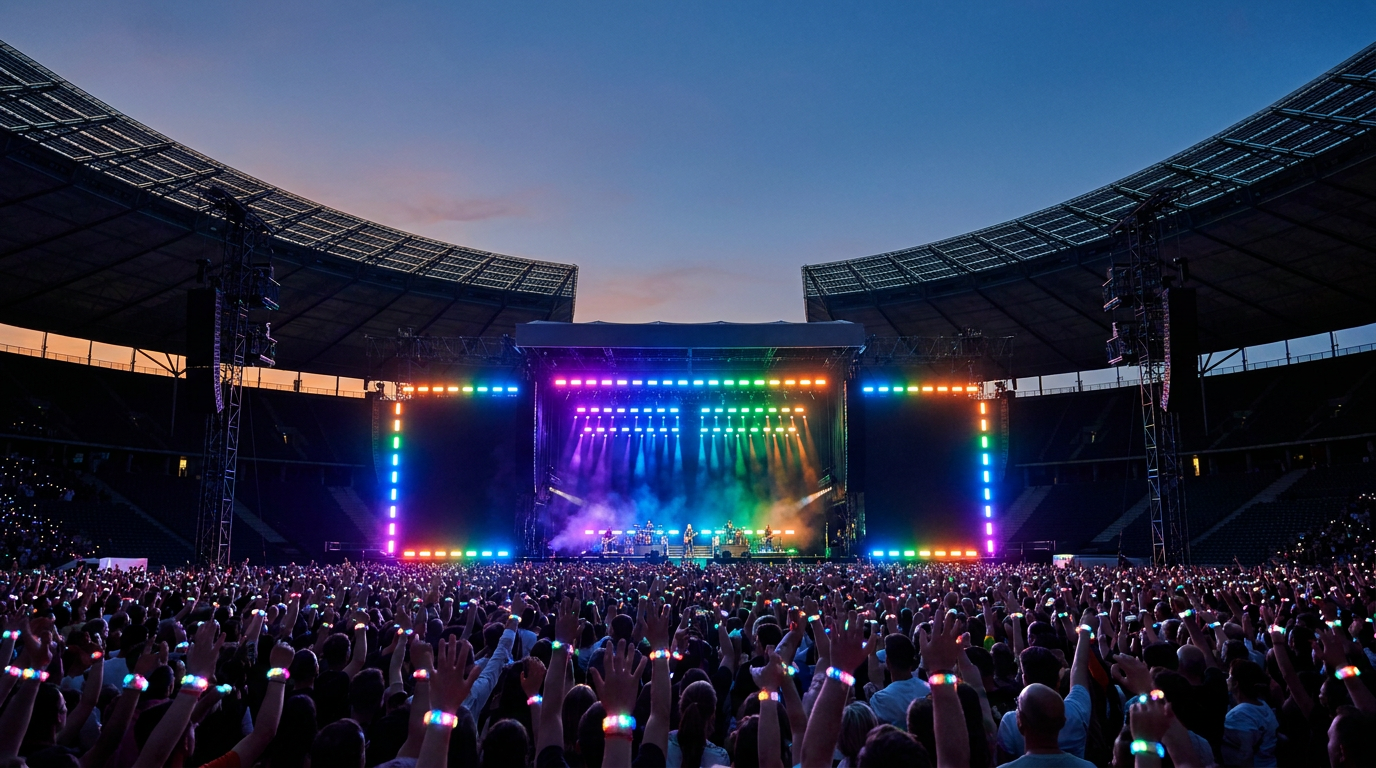
The visual elements of the concert experience have also undergone a total material redesign. The iconic glowing wristbands handed out to fans are now manufactured from 100% compostable, plant-based materials. Rather than becoming landfill waste, they are collected, sterilized, and recharged after every show. This closed-loop system has achieved an 86% return rate, reducing wristband production by 80%.[4]
Even the confetti raining down on the crowd has been swapped for biodegradable alternatives, while the stages themselves are constructed from lightweight, low-carbon, and reusable materials like recycled steel and bamboo. The lighting rigs have been upgraded to ultra-efficient LED and laser systems that cut power consumption by up to 50% compared to previous generations of touring equipment.[4][7]
While the stage show is highly visible, the invisible logistics of freight and travel account for the lion's share of a tour's direct emissions. To tackle this, artists have partnered with global logistics giants to overhaul their supply chains. Fleets of diesel trucks have been replaced by electric vehicles or trucks running on hydrotreated vegetable oil (HVO)—a renewable biofuel derived from waste cooking oil that contains zero palm oil.[4][6]

While the stage show is highly visible, the invisible logistics of freight and travel account for the lion's share of a tour's direct emissions.
For transcontinental jumps where flying is unavoidable, tours are heavily subsidizing the use of Sustainable Aviation Fuel (SAF). By paying a premium to fuel providers, tours ensure that an equivalent amount of SAF—made from renewable waste—is introduced into the aviation system, drastically cutting the net carbon impact of transporting crew and gear.[4][6]
The results of these interventions are no longer speculative; they are rigorously audited. In 2024, the Massachusetts Institute of Technology's Environmental Solutions Initiative verified the emissions data from Coldplay's 'Music of the Spheres' tour. The analysis confirmed a 59% reduction in direct carbon emissions compared to their previous stadium tour, easily surpassing the band's initial 50% target.[4][5]
Beyond simply reducing harm, the new model of touring aims to be actively restorative. For every ticket sold, funds are diverted to global reforestation and ocean cleanup projects. To date, this mechanism has financed the planting of over seven million trees and the deployment of solar-powered river interceptors designed to extract plastic waste before it reaches the ocean.[4][7]
Yet, despite these monumental gains in Scope 1 and Scope 2 emissions (direct operations and purchased energy), the industry still faces a daunting hurdle: Scope 3 emissions. In the context of live music, Scope 3 primarily consists of audience travel. You can green the stage, the trucks, and the wristbands, but if 80,000 fans drive gas-powered cars to a stadium, the overall carbon footprint remains massive.[2][3]

To mitigate this, tours are deploying a mix of incentives and infrastructure. Fans who prove they traveled via public transit, cycling, or walking are often rewarded with venue discounts or access to VIP areas. Furthermore, artists are partnering with local transit authorities to charter late-night trains and deploy fleets of free electric buses to shuttle attendees between the venue and major transit hubs.[3][8]
However, artists and climate scientists warn that the music industry cannot solve Scope 3 emissions in a vacuum. The Tyndall Centre's 'Super Low Carbon Live Music' roadmap explicitly calls out a glaring policy gap. While bands can optimize their own operations, they are entirely dependent on municipal governments to provide robust, electrified public transit networks and high-capacity renewable energy grids.[2][3]
As Massive Attack's Robert Del Naja has pointed out, the cultural sector is operating in a government void. While the blueprint for sustainable touring is now proven and publicly available as an open resource, scaling it requires systemic state investment in clean infrastructure. The burden, advocates argue, must shift from individual artists to the broader civic framework that hosts them.[2][3]
Nevertheless, the era of the carbon-heavy mega-tour is rapidly drawing to a close. By fusing rigorous climate science with high-end entertainment, the live music sector has provided a tangible, joyful demonstration of what a decarbonized future looks like. It is a powerful proof of concept: that human beings can still gather by the tens of thousands, experience world-class art, and leave the planet better than they found it.[1][2][4]

How we got here
1991
Massive Attack releases a song about global warming, beginning their long-term engagement with climate issues.
2019
Coldplay announces they will pause world tours until they can find a way to make them environmentally sustainable.
Summer 2021
The Tyndall Centre publishes the 'Super Low Carbon Live Music' roadmap, commissioned by Massive Attack.
March 2022
Coldplay launches the 'Music of the Spheres' world tour, implementing kinetic floors, renewable batteries, and sustainable fuels.
August 2024
Massive Attack hosts a major testbed show in Bristol, powered entirely by renewable batteries and featuring localized green transit.
2024
MIT verifies that Coldplay's tour achieved a 59% reduction in direct carbon emissions compared to their previous tour.
Viewpoints in depth
Pioneering Artists
Musicians who argue that the industry must halt traditional touring until it can decouple from fossil fuels.
Acts like Coldplay and Massive Attack have leveraged their massive cultural and financial capital to force supply chain changes. By refusing to tour under the old carbon-heavy models, they created a market demand for innovations like kinetic dance floors, mobile battery grids, and sustainable aviation fuel. They view their tours not just as entertainment, but as high-visibility testbeds for green technology that can eventually trickle down to smaller venues and artists.
Climate Scientists & Auditors
Researchers who provide the rigorous data frameworks necessary to prevent corporate greenwashing.
Institutions like the Tyndall Centre and MIT's Environmental Solutions Initiative argue that good intentions are meaningless without standardized, peer-reviewed data. They focus on establishing strict baselines for Scope 1, 2, and 3 emissions, ensuring that claims of 'carbon neutrality' are backed by actual reductions rather than cheap offset schemes. Their roadmaps emphasize that true decarbonization requires systemic changes to routing, freight, and energy use, not just planting trees.
Logistics & Supply Chain Partners
The freight and energy companies tasked with physically executing the green transition.
For global logistics firms like DHL and energy providers, sustainable touring is a massive logistical puzzle. They argue that the primary bottleneck is the availability and cost of alternative fuels, such as Hydrotreated Vegetable Oil (HVO) and Sustainable Aviation Fuel (SAF). Their perspective focuses on scaling these technologies and standardizing equipment so that tours don't have to ship heavy staging across oceans, ultimately aiming to make green logistics the default rather than a premium exception.
Municipal Planners
Local governments and transit authorities responsible for the infrastructure that supports mega-events.
While artists can control what happens inside the stadium, municipal planners control the grid and the roads outside of it. They point out that Scope 3 emissions—primarily audience travel—can only be solved through massive public investment in electrified transit and renewable grid capacity. From their view, the music industry's green ambitions are commendable, but ultimately constrained by the civic infrastructure of the cities they visit.
What we don't know
- How quickly these high-cost sustainable technologies will become affordable for mid-level and independent touring artists.
- Whether municipal governments will invest fast enough in the electrified public transit required to solve the industry's Scope 3 audience travel emissions.
- If the global supply of Sustainable Aviation Fuel (SAF) can scale rapidly enough to meet the demands of the entire entertainment sector.
Key terms
- Scope 1 and 2 Emissions
- Direct greenhouse gas emissions from sources controlled by the tour (like trucks and generators) and indirect emissions from purchased electricity.
- Scope 3 Emissions
- Indirect emissions occurring in the tour's value chain, most notably the carbon footprint of fans traveling to the concert.
- Sustainable Aviation Fuel (SAF)
- A liquid fuel used in commercial aviation which reduces CO2 emissions by up to 80%, produced from sustainable feedstocks like waste cooking oil.
- Hydrotreated Vegetable Oil (HVO)
- A fossil-free, renewable diesel alternative made from waste materials that can be used in standard diesel engines to significantly reduce carbon emissions.
- Kinetic Energy Harvesting
- The process of capturing the energy generated by human movement—such as dancing or pedaling a bike—and converting it into usable electrical power.
Frequently asked
What are Scope 3 emissions in live music?
Scope 3 emissions refer to indirect carbon outputs that the tour doesn't directly control. In live music, this is primarily the travel of the audience to and from the venue, which often accounts for the vast majority of an event's total carbon footprint.
How do kinetic dance floors work?
Kinetic dance floors are specialized floor tiles installed in general admission areas. When fans jump or dance on them, the downward force is converted into electricity, which is captured and fed into the show's battery system.
Are carbon offsets enough to make a tour sustainable?
Climate scientists and pioneering artists argue that offsets are not enough. True sustainability requires actively reducing direct emissions—such as using renewable batteries and sustainable fuels—rather than just paying to offset traditional fossil fuel use.
What happens to the LED wristbands after the show?
Modern sustainable tours use wristbands made from 100% compostable, plant-based materials. Fans are asked to return them at the end of the night so they can be sterilized, recharged, and reused, achieving return rates of over 85%.
Sources
Source coverage
8 outlets
4 viewpoints surfaced








[1]Factlen Editorial TeamMunicipal Planners
The Decarbonization of Live Music: A Factlen Explainer
Read on Factlen Editorial Team →[2]Tyndall Centre for Climate Change ResearchClimate Scientists & Auditors
Roadmap to Super Low Carbon Live Music
Read on Tyndall Centre for Climate Change Research →[3]NatureClimate Scientists & Auditors
Massive Attack's science-led drive to lower music's carbon footprint
Read on Nature →[4]Coldplay OfficialPioneering Artists
Music of the Spheres World Tour: Sustainability
Read on Coldplay Official →[5]MIT Environmental Solutions InitiativeClimate Scientists & Auditors
Review of Coldplay's Tour Emissions Data
Read on MIT Environmental Solutions Initiative →[6]DHL ExpressLogistics & Supply Chain Partners
Sustainable Touring With Coldplay
Read on DHL Express →[7]REVERBLogistics & Supply Chain Partners
Greening the Live Music Industry
Read on REVERB →[8]UNFCCCClimate Scientists & Auditors
The Paris Agreement and the Race to Zero
Read on UNFCCC →


Every angle. Every day.
Get entertainment stories with full source coverage and perspective breakdowns delivered to your inbox.