
OLED vs. Mini-LED: The 2026 Premium TV Comparison
As Tandem OLEDs and 20,000-zone Mini-LEDs hit the market, choosing a premium TV comes down to a strict trade-off between absolute black levels and sustained peak brightness.
By Factlen Editorial Team
- Bright-Room Pragmatists
- Value sustained full-screen brightness, glare reduction, and burn-in immunity for everyday mixed household usage.
- Cinematic Purists
- Argue that nothing beats pixel-level light control and infinite contrast for preserving true artistic intent in movies.
- Competitive Gamers
- Focus heavily on the technical metrics of motion clarity, sub-millisecond response times, and static-HUD durability.
What's not represented
- · Budget-conscious buyers priced out of both flagship technologies
- · Projector enthusiasts who prefer massive scale over panel brightness
Why this matters
A premium television is a multi-year investment that anchors the modern living room. Understanding the specific strengths of OLED and Mini-LED ensures buyers do not overpay for features that clash with their actual room lighting or viewing habits.
Key points
- OLED televisions use self-emissive pixels to achieve perfect black levels and infinite contrast, making them ideal for dark-room home theaters.
- Mini-LED televisions utilize thousands of microscopic backlight diodes to reach massive peak brightness, excelling in sunlit living rooms.
- 2026 OLED models have introduced Tandem and QD-OLED architectures to boost brightness, while Mini-LEDs have added thousands of dimming zones to reduce blooming.
- Mini-LED offers complete immunity to burn-in, making it the safer choice for static PC monitors and marathon gaming sessions.
The 2026 television market has crystallized into a two-horse race for premium living rooms, leaving standard LCDs far behind. For consumers looking to upgrade, the choice now comes down to a heavyweight title fight between OLED and Mini-LED. Both technologies have reached unprecedented levels of engineering, offering spectacular 4K and 8K resolutions, but they solve fundamentally different display problems. Choosing between them is no longer about finding an objective "best" television, but rather finding the specific technology that perfectly matches a buyer's room lighting, viewing habits, and budget.[1][2]
To understand the trade-offs, one must look at the underlying architecture. The case for OLED (Organic Light-Emitting Diode) centers on its self-emissive nature. Every single pixel on an OLED panel generates its own light and can turn itself off completely independently of its neighbors. There is no backlight. This allows the television to achieve absolute, perfect black levels, creating what reviewers call an "infinite contrast ratio." When a starship flies across a pitch-black galaxy on an OLED screen, the space around the ship emits zero light, resulting in a breathtakingly precise image.[1][3]
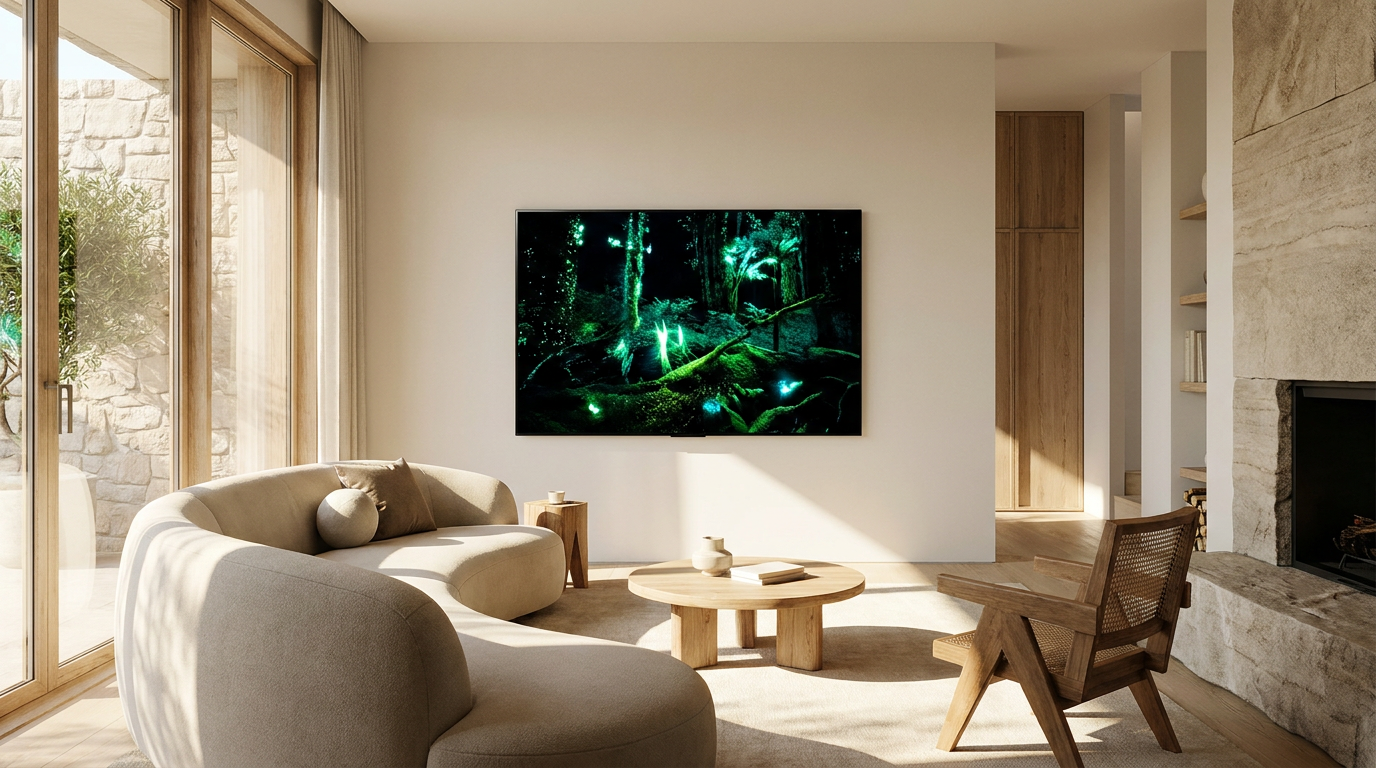
The evidence for OLED's dominance in dark environments is overwhelming. Home theater experts and calibration professionals consistently crown OLED as the undisputed king of cinematic viewing. Because there is no backlight bleeding through the panel, the image retains a three-dimensional depth and richness that traditional displays struggle to replicate. Furthermore, the absence of a backlight array allows OLED panels to be astonishingly thin—often thinner than a modern smartphone—making them a striking centerpiece when mounted flush against a living room wall.[1][4]
In 2026, OLED technology has taken a massive leap forward to address its historical weaknesses. Manufacturers have introduced "Tandem OLED" and refined "QD-OLED" (Quantum Dot OLED) architectures. By stacking multiple light-emitting layers or utilizing highly efficient quantum dots, these new flagship models can push significantly more brightness than previous generations without sacrificing their legendary pixel-level black control. This evolution has made modern OLEDs far more versatile, allowing their stunning color volume to punch through moderate ambient room light.[3][4]

Conversely, the argument against OLED revolves around its organic materials and thermal limitations. To protect the panel from overheating and to mitigate the risk of permanent image retention—commonly known as burn-in—OLED televisions employ an Auto Brightness Limiter (ABL). When a scene demands a massive amount of full-screen white light, such as a hockey game or a snow-covered documentary landscape, the ABL aggressively dims the entire screen. While burn-in risks have been drastically reduced by 2026 software algorithms, the anxiety of leaving static news tickers or video game interfaces on the screen still lingers for heavy users.[4][5]
This is where the case for Mini-LED begins. Rather than relying on self-emissive organic pixels, a Mini-LED television uses a traditional liquid crystal display (LCD) illuminated by an incredibly dense grid of microscopic inorganic light-emitting diodes. Because these diodes are built from robust semiconductors like gallium nitride, they can be driven with massive amounts of electrical current without degrading. The result is raw, unadulterated brightness. Flagship 2026 Mini-LED models routinely shatter the 3,000 to 5,000-nit barrier, making them exponentially brighter than even the most advanced OLEDs.[2][3]
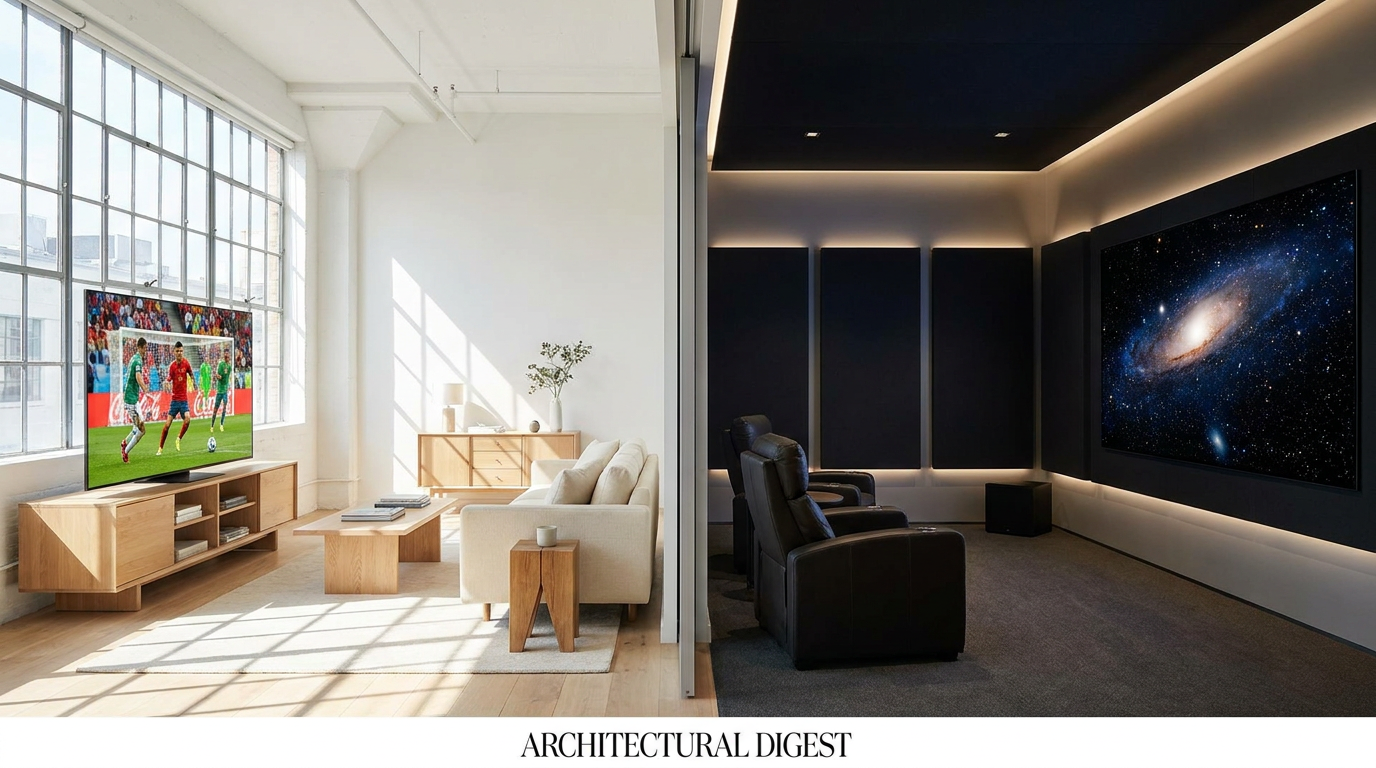
The evidence for Mini-LED's superiority in bright rooms is undeniable. Unlike OLED, a Mini-LED panel does not suffer from aggressive full-screen dimming. It can hold a blindingly bright, full-field white image indefinitely. For consumers with sun-drenched, open-concept living rooms featuring massive windows, Mini-LED is the only technology that can effortlessly punch through daytime glare. Sports fans and daytime viewers benefit immensely from this sustained luminance, ensuring that afternoon football games remain vivid and punchy regardless of the ambient light pouring into the room.[2][4]
The evidence for Mini-LED's superiority in bright rooms is undeniable.
The primary argument against Mini-LED has historically been the "blooming" or halo effect. Because the backlight cannot control light on a per-pixel basis, it must divide the screen into "local dimming zones." If a bright object, like a white subtitle or a streetlamp, appears against a dark background, the LEDs behind that object must light up. This light often bleeds into the adjacent dark pixels, creating a noticeable glowing halo that compromises the deep black levels and can pull a viewer out of a moody, cinematic scene.[1][3]
However, 2026 engineering has dramatically narrowed this performance gap. The latest premium Mini-LED televisions now feature staggering zone counts, with some flagship models boasting upwards of 20,000 independent local dimming zones. Paired with highly advanced AI processors that meticulously map the backlight to the on-screen action, these dense arrays have shrunk blooming artifacts to near-imperceptible levels for the average viewer. While lab instruments can still detect the difference, a Mini-LED in a standard living room now delivers black levels that closely rival OLED.[5]

The battleground extends fiercely into the gaming sector, where the trade-offs become highly quantified. For competitive esports players, OLED offers a distinct, measurable advantage: motion clarity. Because OLED pixels change state almost instantaneously, the technology boasts a staggering 0.03-millisecond response time. This near-zero pixel transition completely eliminates ghosting and motion blur during fast-paced camera pans in first-person shooters, providing a level of fluid clarity that traditional LCD panels simply cannot match.[4][5]
Mini-LED counters this with the ultimate promise of durability and peace of mind. While its pixel response time hovers around 1 millisecond—slower than OLED but still exceptionally fast for 144Hz and 240Hz gaming—it offers complete immunity to burn-in. Gamers can leave static heads-up displays, health bars, and minimaps on the screen for twelve hours straight without a single worry about permanently scarring their expensive television. For PC users who mix gaming with productivity tasks featuring static taskbars, Mini-LED is widely considered the safer long-term investment.[5][6]
When evaluating long-term durability, the inorganic nature of Mini-LED provides a structural head start for extreme, high-usage environments. Independent stress tests verify that these panels can easily surpass 10,000 hours of continuous, intense operation with virtually no degradation in peak brightness or color accuracy. While modern OLEDs are highly reliable and feature robust pixel-refresh cycles, the sheer thermal resilience of Mini-LED makes it the undisputed champion for televisions that are left running all day in family rooms or bright commercial spaces.[6]
Finally, the sizing and pricing reality heavily influences the final purchase decision. While 55-inch and 65-inch OLEDs have become highly competitive in price, manufacturing massive organic panels remains incredibly expensive. For buyers looking to build a true home cinema with an 85-inch or 98-inch display, Mini-LED offers a vastly superior value proposition. The technology scales to ultra-large formats far more affordably, allowing consumers to prioritize sheer screen real estate without sacrificing premium HDR performance.[3][4]

Ultimately, the decision requires an honest assessment of the viewing environment. OLED fits perfectly when the room lighting can be controlled, the primary media diet consists of cinematic movies or prestige television, and the viewer demands absolute, pixel-perfect contrast. It is the connoisseur's choice for a dedicated home theater. However, it does not fit well in sun-drenched rooms without blackout curtains, or in scenarios where the television serves as a permanent, static monitor for productivity workflows.[1][3]
Conversely, Mini-LED fits perfectly when the television serves as the central hub of a bright, active household. It excels at delivering punchy daytime sports, sustained full-screen brightness, and worry-free marathon gaming sessions without the looming specter of burn-in. It is the ultimate pragmatic powerhouse. It does not fit well for absolute purists who watch exclusively in pitch-black rooms and cannot tolerate even the slightest hint of backlight blooming around their movie subtitles.[2][4]
How we got here
2013
LG releases the first commercially successful large-format OLED TVs, establishing a new benchmark for perfect black levels.
2019
TCL introduces the first Mini-LED TV, shrinking backlight diodes to dramatically increase brightness and local dimming zones.
2022
Samsung debuts QD-OLED technology, merging quantum dots with OLED to improve color volume at higher brightness levels.
2026
The market reaches a new pinnacle with Tandem OLED panels and 20,000-zone Mini-LEDs, closing the performance gap between the two technologies.
Viewpoints in depth
Cinematic Purists
Home theater enthusiasts who prioritize absolute black levels and pixel-level precision above all else.
For cinematic purists, the television is a canvas meant to perfectly replicate the director's intent. This camp argues that any amount of backlight blooming—no matter how small—breaks the immersion of a moody, high-contrast film. They point to OLED's infinite contrast ratio and pixel-level light control as the only acceptable standard for critical viewing, arguing that the lower peak brightness is a non-issue in a properly light-controlled home theater environment.
Bright-Room Pragmatists
Everyday viewers who need a television that can overpower daytime glare and handle mixed content.
Bright-room pragmatists view the television as a versatile household appliance that must perform well under any lighting condition. This camp champions Mini-LED for its sheer horsepower, noting that perfect black levels are irrelevant if the screen is washed out by afternoon sunlight. They also heavily value the peace of mind that comes with Mini-LED's burn-in immunity, arguing that a premium TV should not require users to police how long a news channel or sports scoreboard remains on the screen.
Competitive Gamers
Players who dissect display technologies based on motion clarity, response times, and static-image durability.
The gaming community is uniquely split by the OLED versus Mini-LED debate. One faction heavily favors OLED for its near-instantaneous 0.03-millisecond response time, which provides unparalleled motion clarity in fast-paced competitive shooters. The opposing faction leans toward Mini-LED, citing the technology's ability to sustain blindingly bright HDR highlights without dimming, alongside its complete immunity to burn-in from static health bars and minimaps during marathon gaming sessions.
What we don't know
- Whether the long-term lifespan of 2026 Tandem OLED panels will truly match the inorganic durability of Mini-LEDs over a ten-year span.
- How quickly Micro-LED—a future technology combining the best of both—will become affordable enough to replace both OLED and Mini-LED in consumer living rooms.
Key terms
- Auto Brightness Limiter (ABL)
- A protective software feature in OLED TVs that automatically dims the screen when a large portion of the image becomes bright white, preventing the organic pixels from overheating.
- Local Dimming Zones
- Specific sections of a Mini-LED backlight that can be dimmed or turned off independently to improve black levels and contrast in dark scenes.
- Blooming (Halo Effect)
- A visual artifact on LED televisions where light bleeds from a bright object into the surrounding dark pixels, creating a glowing halo.
- Self-Emissive Display
- A screen technology, like OLED, where every individual pixel generates its own light and color, eliminating the need for a separate backlight.
Frequently asked
Is OLED burn-in still a serious problem in 2026?
It is significantly less common than in previous years due to advanced pixel-refresh algorithms and better heat dissipation. However, the risk remains for users who leave static images, like news tickers or PC taskbars, on the screen for many consecutive hours.
What exactly is Tandem OLED?
Tandem OLED is a newer panel architecture that stacks multiple light-emitting layers on top of each other. This allows the TV to produce a much brighter image while maintaining OLED's signature perfect black levels.
Does Mini-LED still suffer from blooming?
Yes, but it is far less noticeable than before. Premium 2026 models feature up to 20,000 local dimming zones and advanced AI processing, which shrinks the halo effect around bright objects to near-imperceptible levels for casual viewers.
Which TV technology is better for a bright living room?
Mini-LED is the superior choice for bright rooms. It can sustain massive full-screen brightness without dimming itself to prevent overheating, allowing it to easily overpower glare from large windows.
Sources
Source coverage
6 outlets
3 viewpoints surfaced






[1]RtingsCinematic Purists
Mini LED vs. OLED TVs: Which One Is The Best?
Read on Rtings →[2]Top Ten ReviewsBright-Room Pragmatists
Mini LED vs OLED TV: Which should you choose?
Read on Top Ten Reviews →[3]Data Wire SolutionsCinematic Purists
Best TVs for 2026: 10 OLED and Mini-LED Picks by Room, Brightness, and Install Reality
Read on Data Wire Solutions →[4]EcoPicksGoBright-Room Pragmatists
LG G5 OLED vs LG QNED9M Mini LED Comparison (2026 Buyer's Guide)
Read on EcoPicksGo →[5]KTCPlayCompetitive Gamers
5000-Zone Mini-LED: A 2026 Motion Clarity and Response Time Deep Dive
Read on KTCPlay →[6]BGRCompetitive Gamers
Do Mini LED TVs last longer than OLEDs?
Read on BGR →
Every angle. Every day.
Get shopping stories with full source coverage and perspective breakdowns delivered to your inbox.