
SpaceX's Record $85.7 Billion IPO Marks the End of the 'Magnificent 7' Era
SpaceX's historic public debut has vaulted the company to a $2.85 trillion valuation, prompting Wall Street to replace the 'Magnificent 7' tech grouping with a new AI-focused acronym: MANGOS.
By Factlen Editorial Team
- Frontier Tech Bulls
- Argue that the MANGOS grouping correctly identifies the companies building the actual infrastructure of the 2030s economy.
- Value Skeptics
- Warn that the euphoria surrounding the IPO and AI acquisitions has detached the stock from its near-term fundamentals.
- Space Industry Analysts
- Focus on the 'category king' effect, noting that SpaceX's public debut is forcing a brutal consolidation in the broader space sector.
What's not represented
- · Retail investors priced out of early private rounds
- · Regulators monitoring tech monopolies
Why this matters
The shift from the 'Magnificent 7' to 'MANGOS' signals a massive reallocation of global capital away from consumer internet platforms and toward the physical and digital infrastructure of the future. For retail investors and retirement funds, this marks the beginning of a new tech super-cycle driven by artificial intelligence and space logistics.
Key points
- SpaceX executed the largest IPO in history, raising $85.7 billion and reaching a $2.85 trillion market capitalization.
- The blockbuster debut has prompted Wall Street to replace the 'Magnificent 7' tech grouping with 'MANGOS' (Meta, Anthropic, Nvidia, Google, OpenAI, SpaceX).
- Thematic ETF issuer Corgi Funds has already filed a prospectus for a MANGOS exchange-traded fund.
- SpaceX aggressively expanded its artificial intelligence footprint by acquiring coding startup Cursor for $60 billion.
- Competing publicly traded space companies saw their stock prices drop sharply as investors consolidated capital into SpaceX.
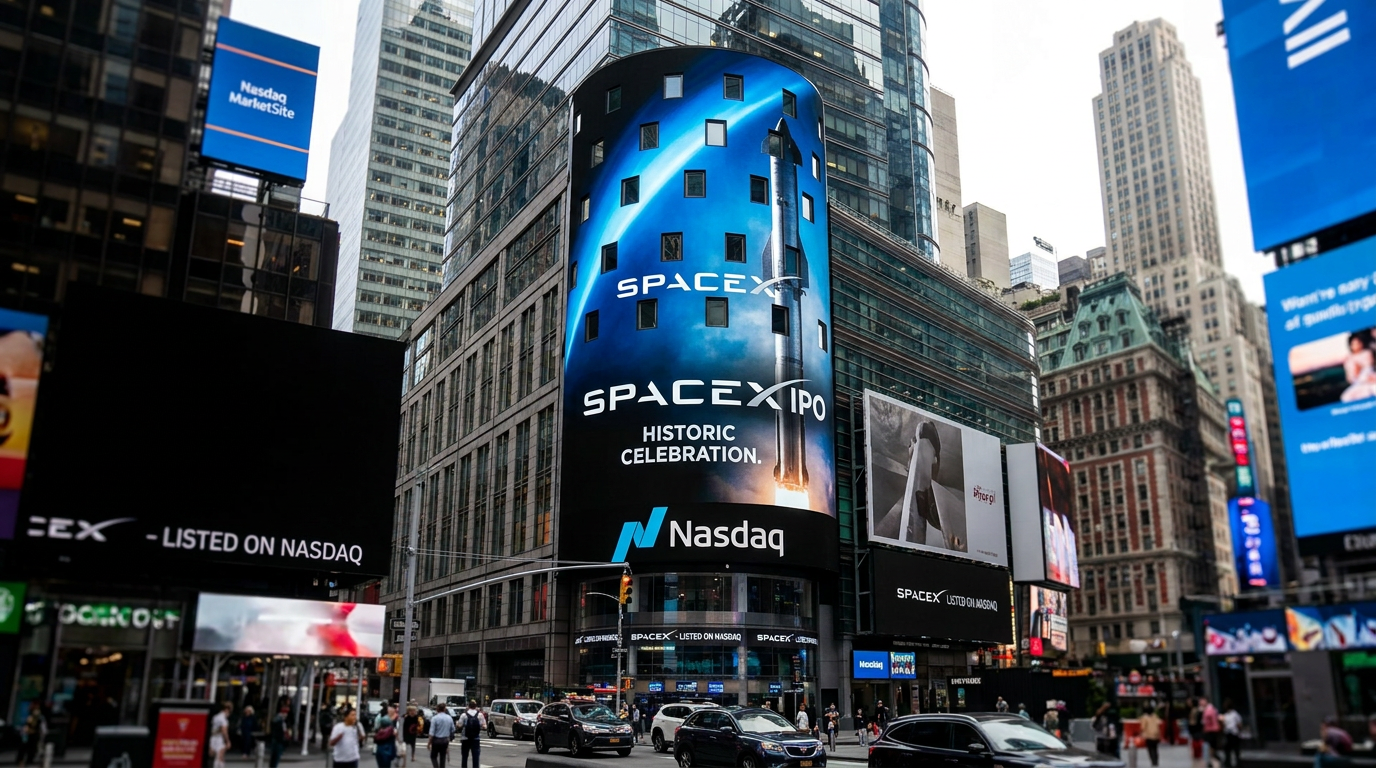
SpaceX has officially rewritten the record books, executing the largest initial public offering in history and fundamentally altering the taxonomy of Wall Street. Debuting on the Nasdaq under the ticker SPCX, Elon Musk’s aerospace and technology conglomerate raised a staggering $85.7 billion, eclipsing previous records held by Saudi Aramco and Alibaba.[1][2]
The mechanics of the offering underscore the unprecedented demand for the stock. SpaceX initially aimed to raise $75 billion by pricing 555.6 million shares at $135 each. However, overwhelming institutional and retail appetite—reportedly topping $350 billion in total orders—prompted underwriting banks like Goldman Sachs and Morgan Stanley to exercise their "greenshoe option," selling an additional 83.3 million shares to meet the frenzy.[1]
The market's reception was nothing short of euphoric. SPCX surged 19% on its opening day, closing near $161. By its second full day of trading, the company's market capitalization rocketed past $2.85 trillion, vaulting it ahead of established tech stalwarts like Amazon, Meta, and Tesla to become one of the most valuable corporations on Earth.[1][2][4]

But SpaceX’s public debut is doing more than just minting unprecedented wealth; it is forcing a rapid retirement of the "Magnificent 7" moniker that has dominated tech investing for the past two years. Investors and analysts are aggressively pivoting to a new acronym that captures the current zeitgeist: "MANGOS."[1][5]
Standing for Meta, Anthropic, Nvidia, Google, OpenAI, and SpaceX, the MANGOS grouping represents a hard pivot away from consumer-internet platforms and toward the foundational infrastructure of artificial intelligence and frontier technology. The shift highlights a growing consensus that the next decade of economic growth will be driven by compute power, large language models, and orbital logistics, rather than ad-supported social networks and consumer hardware.[1][5]
The financial industry is already racing to capitalize on the new paradigm. Thematic ETF issuer Corgi Funds filed a prospectus this week for a dedicated MANGOS exchange-traded fund. The filing raised eyebrows across the industry, as two of the marquee members—Anthropic and OpenAI—remain private companies, though both are widely expected to pursue their own mega-IPOs later this year.[1][6]

The rush to package these companies into retail-friendly funds underscores a broader anxiety among investors about missing the next major technological super-cycle. For years, retail portfolios were anchored by Apple and Microsoft. Now, wealth managers are scrambling to reallocate capital toward the companies physically building the data centers, training the models, and launching the orbital networks that will power the 2030s.[5][6]
The rush to package these companies into retail-friendly funds underscores a broader anxiety among investors about missing the next major technological super-cycle.
SpaceX’s inclusion in an AI-heavy index is no accident. While globally recognized for its reusable rockets and the Starlink satellite constellation, the company has aggressively positioned itself as an artificial intelligence powerhouse. Just days after its IPO, regulatory filings revealed SpaceX is spending $60 billion to acquire the AI coding startup Cursor, signaling a massive expansion of its software and machine-learning capabilities.[7]
This acquisition bridges the gap between aerospace hardware and generative AI. By integrating advanced coding models into its engineering pipeline, SpaceX aims to accelerate the development of complex autonomous systems for both its Starship program and its rapidly expanding defense contracts.[7]
The sheer gravitational pull of SpaceX’s debut has created turbulence for the rest of the space sector. As institutional and retail capital flooded into SPCX, competing publicly traded space companies experienced a sharp pullback. Shares of Rocket Lab, Planet Labs, and AST SpaceMobile all suffered double-digit percentage drops on the day of the IPO.[4]

Industry analysts note that this dynamic is common when a "category king" finally goes public. For years, investors seeking exposure to the space economy had to buy shares in smaller, specialized firms. Now that the undisputed market leader is available, capital is rapidly consolidating, forcing smaller players to prove their standalone viability in a market dominated by a $2.85 trillion giant.[4]
Despite the market euphoria, some financial analysts are urging caution. Morningstar issued a stark warning, estimating SpaceX’s fair value at just $63 per share—less than half of its IPO price. The firm acknowledged the "prodigious cost advantages" of SpaceX's core launch business, but warned that the aggressive expansion into artificial intelligence poses a material risk of value destruction.[3]
Morningstar analysts argue that the wide range of likely financial outcomes for the AI ventures makes the current valuation highly speculative. They caution that retail investors buying in at current levels are paying a massive premium for future execution that is far from guaranteed, especially as the company navigates the integration of a $60 billion acquisition.[3][7]

Conversely, bullish investors argue that traditional valuation metrics fail to capture the company's unique position. With an unprecedented path to inclusion in the Nasdaq 100 Index expected within weeks, supporters believe the stock has room to run as passive index funds are forced to buy in, regardless of fundamental price targets.[1][3]
Furthermore, proponents of the MANGOS thesis argue that SpaceX, much like Nvidia, is building monopolistic infrastructure that other companies will rely on for decades. Whether providing global broadband via Starlink or offering the only reliable heavy-lift capability for deploying massive orbital data centers, SpaceX is viewed as an indispensable utility for the next era of tech.[5]
Ultimately, the transition from FAANG to the Magnificent 7, and now to MANGOS, illustrates the rapid evolution of the global tech economy. As capital flows out of legacy platforms and into the physical and digital infrastructure of the future, SpaceX’s blockbuster debut serves as the definitive starting gun for a new era of frontier-tech dominance.[1][5]
How we got here
May 2026
SpaceX publicly files its S-1 paperwork for an initial public offering.
June 11, 2026
The 'MANGOS' acronym goes viral on social media as investors anticipate the tech taxonomy shift.
June 12, 2026
SpaceX officially debuts on the Nasdaq, raising an initial $75 billion.
June 15, 2026
Underwriters exercise their greenshoe option, bringing the total IPO raise to a record $85.7 billion.
June 16, 2026
SpaceX announces a $60 billion acquisition of AI coding startup Cursor.
Viewpoints in depth
Frontier Tech Bulls
Argue that the MANGOS grouping correctly identifies the companies building the actual infrastructure of the 2030s economy.
Proponents of the MANGOS shift believe that the era of consumer-internet dominance is over. They argue that SpaceX's massive valuation is justified by its monopolistic grip on orbital logistics and its aggressive push into artificial intelligence. For these investors, companies building the physical data centers, training the foundational models, and launching the satellite networks are the only true drivers of the next decade's economic growth.
Value Skeptics
Warn that the euphoria surrounding the IPO and AI acquisitions has detached the stock from its near-term fundamentals.
Financial analysts focused on traditional valuation metrics caution that retail investors are paying a massive premium for unproven synergies. They point to the $60 billion Cursor acquisition as a highly speculative bet that introduces significant execution risk. From this perspective, while SpaceX's core launch business is formidable, the current $2.85 trillion market capitalization prices in a flawless execution of its AI strategy that is far from guaranteed.
Space Industry Analysts
Focus on the 'category king' effect, noting that SpaceX's public debut is forcing a brutal consolidation in the broader space sector.
Industry watchers emphasize the collateral damage of SpaceX's blockbuster debut. For years, capital seeking exposure to the space economy was distributed among smaller, specialized firms. Now that the undisputed market leader is publicly traded, that capital is rapidly consolidating into SPCX, starving smaller aerospace companies of investment and forcing them to prove their standalone viability in a newly lopsided market.
What we don't know
- When Anthropic and OpenAI will officially file for their own IPOs to make the MANGOS ETF fully tradable.
- Whether SpaceX can successfully integrate the $60 billion Cursor acquisition into its aerospace engineering pipeline.
- How long the capital consolidation in the space sector will last before smaller aerospace firms can recover their valuations.
Key terms
- Greenshoe Option
- A provision in an IPO that allows underwriters to sell more shares than originally planned if investor demand is higher than expected.
- Magnificent 7
- A group of high-performing tech stocks (Apple, Microsoft, Alphabet, Amazon, Nvidia, Meta, and Tesla) that dominated market gains in recent years.
- Market Capitalization
- The total dollar market value of a company's outstanding shares of stock, calculated by multiplying the current share price by the total number of shares.
- Thematic ETF
- An exchange-traded fund designed to track specific trends or sectors, such as artificial intelligence or space exploration, rather than a broad market index.
- Economic Moat
- A distinct advantage a company has over its competitors that allows it to protect its market share and profitability over the long term.
Frequently asked
What does the MANGOS acronym stand for?
MANGOS stands for Meta, Anthropic, Nvidia, Google, OpenAI, and SpaceX. It is replacing the "Magnificent 7" as the new grouping of dominant tech companies.
How much did SpaceX raise in its IPO?
SpaceX raised a record-breaking $85.7 billion, making it the largest initial public offering in history, surpassing Saudi Aramco and Alibaba.
Why did other space stocks drop when SpaceX went public?
Investors consolidated their capital into SpaceX, the undisputed market leader, causing shares of smaller space companies like Rocket Lab and Planet Labs to fall sharply.
Is there a MANGOS ETF available to buy?
Corgi Funds has filed a prospectus for a MANGOS ETF, though it faces regulatory hurdles because Anthropic and OpenAI are currently still private companies.
Sources
Source coverage
7 outlets
3 viewpoints surfaced







[1]ForbesFrontier Tech Bulls
SpaceX's Public Debut Marks The End Of Big Tech's 'Magnificent 7' Era
Read on Forbes →[2]Space.comSpace Industry Analysts
SpaceX IPO brings Starship to NYC; Musk becomes first trillionaire
Read on Space.com →[3]MorningstarValue Skeptics
SpaceX Launches History's Largest IPO
Read on Morningstar →[4]Payload SpaceSpace Industry Analysts
Space Stocks Dip After SpaceX IPO
Read on Payload Space →[5]Seeking AlphaFrontier Tech Bulls
MANGOS Are Driving The 2026 AI Investment Narrative
Read on Seeking Alpha →[6]Crypto BriefingFrontier Tech Bulls
Corgi Files for MANGOS ETF Featuring Tech Giants
Read on Crypto Briefing →[7]Stock AnalysisFrontier Tech Bulls
SpaceX Explores New AI Avenues With $60 Billion Cursor Deal
Read on Stock Analysis →



Every angle. Every day.
Get business stories with full source coverage and perspective breakdowns delivered to your inbox.