
How Next-Generation Geothermal Energy is Unlocking 24/7 Clean Power
By adapting drilling techniques from the oil and gas industry, engineers are manufacturing artificial geothermal reservoirs deep underground. This breakthrough promises to provide the firm, carbon-free baseload power needed to complement solar and wind energy.
By Factlen Editorial Team
- Geothermal Developers
- Focuses on the rapid scaling of the technology and achieving price parity with fossil fuels.
- Grid Planners & Policymakers
- Emphasizes the critical need for firm, dispatchable baseload power to back up intermittent renewables.
- Environmental & Seismic Monitors
- Advocates for rigorous oversight of induced seismicity and water usage during hydraulic stimulation.
What's not represented
- · Local communities living near proposed EGS sites
- · Oil and gas executives viewing geothermal as a transition strategy
Why this matters
As the world races to decarbonize, the power grid desperately needs a clean energy source that runs 24/7 to back up intermittent solar and wind. Next-generation geothermal technology promises to unlock abundant, carbon-free baseload power anywhere on Earth, potentially solving the biggest bottleneck in the climate transition.
Key points
- Next-generation geothermal engineers underground reservoirs in hot, dry rock, bypassing the need for natural hot springs.
- The technology adapts horizontal drilling and hydraulic fracturing from the oil and gas industry.
- Fervo Energy's Project Red proved the commercial viability of EGS with over 614 days of continuous operation.
- Closed-loop systems (AGS) act like underground radiators, extracting heat via conduction without fracking.
- Geothermal provides 24/7 firm power with a fraction of the land footprint of solar or wind.
- Challenges include high upfront drilling costs, managing induced seismicity, and long-term thermal drawdown.
The global transition to clean energy has a "firm power" problem. While solar and wind power are rapidly decarbonizing the grid, they are inherently intermittent—they only generate electricity when the sun shines or the wind blows. To maintain a reliable grid, utilities need a baseload power source that can run 24 hours a day, seven days a week.[5][6]
Historically, that role has been filled by coal, natural gas, and nuclear power. But as fossil fuels are phased out and nuclear faces steep regulatory and construction hurdles, grid planners are searching for a clean, dispatchable alternative. Next-generation geothermal energy is emerging as the leading candidate to fill this massive gap.[5][7]
The U.S. Department of Energy estimates that advanced geothermal technologies could provide up to 120 gigawatts of firm, clean capacity in the United States alone by 2050. If scaled globally, the Massachusetts Institute of Technology suggests the heat beneath our feet could meet total planetary energy demand twice over.[5][6]
Traditional geothermal power has existed for over a century, but it has always been geographically constrained. It relies on finding naturally occurring hydrothermal reservoirs—rare underground anomalies where high heat, water, and permeable rock naturally coexist close to the surface. These conditions are typically only found near tectonic fault lines or volcanic regions, such as Iceland or California's Geysers.[5][7]
Next-generation geothermal technologies bypass this geographic lottery by manufacturing the necessary conditions underground. Instead of hunting for natural reservoirs, engineers drill deep into hot, dry crystalline rock—which exists everywhere on Earth if you drill deep enough—and artificially create the permeability and fluid flow required to extract heat.[5][7]
This shift from exploration to engineering is largely driven by technology transfer from the oil and gas industry. By adapting the horizontal drilling and hydraulic fracturing techniques developed during the shale boom, geothermal developers are unlocking vast new thermal resources. There are two primary approaches leading this revolution: Enhanced Geothermal Systems (EGS) and Advanced Geothermal Systems (AGS).[2][7]

Enhanced Geothermal Systems (EGS) work by injecting fluid into hot, dry rock to induce or expand fractures, creating an artificial reservoir. Water is circulated down an injection well, heated as it flows through the fractured rock, and brought back up a production well to drive a steam turbine at the surface.[5][7]
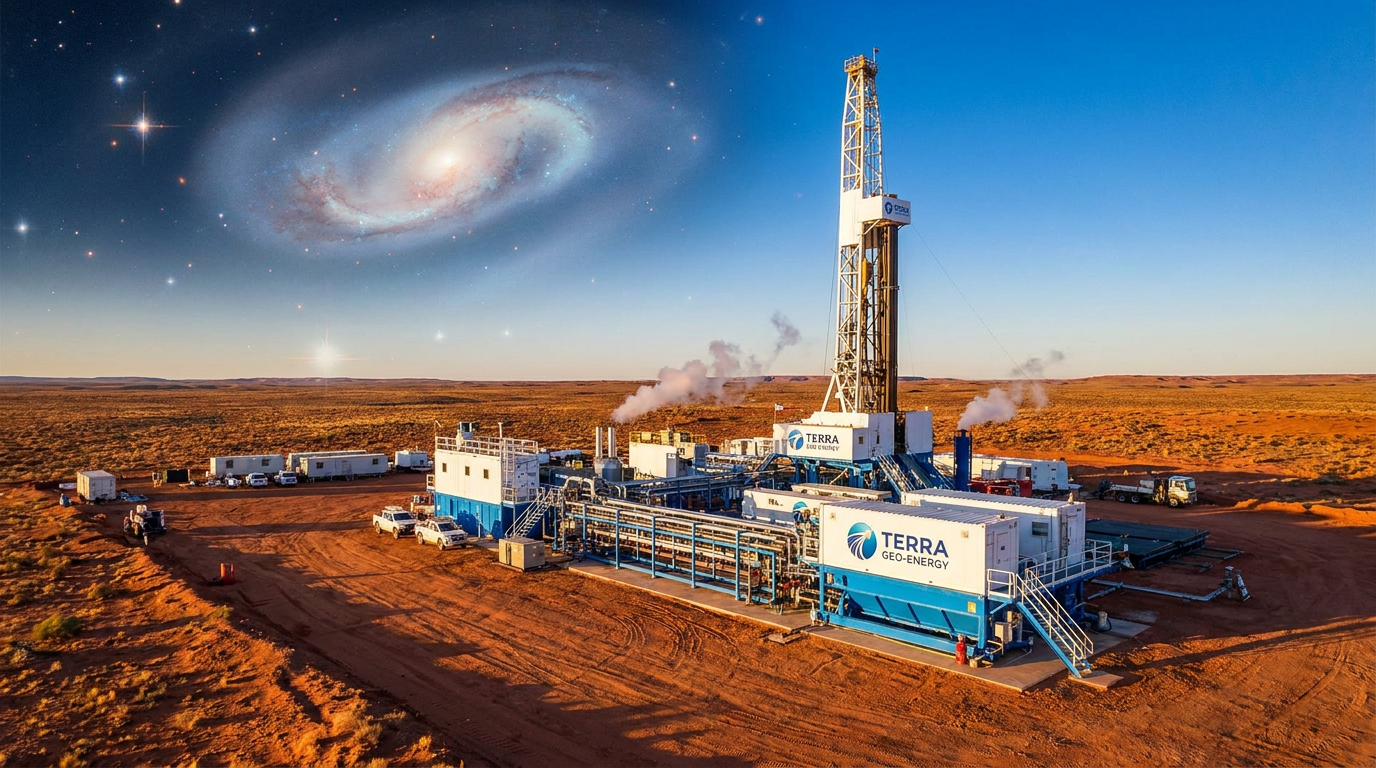
Houston-based Fervo Energy has become the industry leader in EGS by pioneering a unique horizontal well design. Instead of drilling two vertical wells and hoping they connect through random fractures, Fervo drills horizontally and creates a series of parallel fractures between an injection well and a production well. The resulting underground structure resembles a ladder, with the horizontal wells acting as the rails and the fractures acting as the rungs.[2]
This engineered approach has yielded unprecedented results. Fervo's "Project Red" in Nevada recently completed over 614 days of continuous operation, delivering an average gross power output of 2.1 megawatts. Crucially, the system required zero workovers or chemical treatments during this period, proving that EGS reservoirs can maintain stable, predictable performance over the long term.[1]
Fervo's "Project Red" in Nevada recently completed over 614 days of continuous operation, delivering an average gross power output of 2.1 megawatts.
Building on this success, Fervo is currently developing Cape Station in Beaver County, Utah. Situated near the Department of Energy's Frontier Observatory for Research in Geothermal Energy (FORGE), Cape Station aims to deliver 500 megawatts of continuous low-carbon electricity upon completion. The project has already demonstrated a 100% success rate in drilling wells into hard granitic basement rock, significantly reducing development costs.[1][3]

While EGS creates an open reservoir, Advanced Geothermal Systems (AGS) take a different approach: closed-loop architecture. Companies like Canada's Eavor propose drilling deep, sealed loops of pipe through hot rock. A working fluid is circulated through the sealed pipes, absorbing heat purely through conduction without ever physically interacting with the surrounding rock.[4][5]
Think of an AGS as a massive underground radiator. Because the system is entirely closed, it does not require hydraulic fracturing or the injection of external water into the subsurface. This makes AGS particularly attractive in regions with strict water conservation laws or intense opposition to fracking.[4]
In late 2025, Eavor's flagship AGS project in Geretsried, Bavaria, successfully began feeding electricity into the German grid. While the initial electrical output was relatively small—around 0.5 megawatts—it proved the viability of extracting conductive heat from deep, dry rock to generate commercial power.[4]
Both EGS and AGS offer profound environmental advantages over other energy sources. Geothermal energy has the lowest land-use intensity of all renewable technologies. A geothermal plant requires a fraction of the surface acreage needed for a comparable solar or wind farm, making it ideal for deployment near densely populated areas or industrial centers.[6][7]

Furthermore, next-generation geothermal provides an elegant transition pathway for the fossil fuel workforce. The skills required to drill deep, high-temperature geothermal wells are nearly identical to those used in oil and gas extraction. Rig operators, petroleum engineers, and geologists can directly transfer their expertise to the clean energy sector, preserving high-paying jobs in traditional energy communities.[7]
Despite the immense promise, the industry faces significant technical and economic hurdles. The upfront capital costs of drilling miles into hard, hot rock remain high. While the Department of Energy's "Earthshots" initiative aims to cut the cost of next-generation geothermal power by 90% to $45 per megawatt-hour by 2035, achieving that target will require massive economies of scale and continued drilling innovations.[6]
There are also subsurface risks to manage. EGS relies on hydraulic stimulation, which can induce microseismicity—small, localized earthquakes. To ensure safety, continuous monitoring is essential. At Fervo's Cape Station, geophysicists from the Lawrence Berkeley National Laboratory recently deployed a custom seismometer nearly 7,000 feet underground, successfully monitoring the reservoir at temperatures reaching 338°F for seven straight months.[3]
Another long-term challenge is thermal drawdown. Because next-generation systems extract heat faster than the Earth naturally replenishes it, they are essentially mining a thermal battery. Over decades of operation, the temperature of the rock surrounding the wells will gradually decline, which could reduce the electrical conversion efficiency of the power plant.[4]

Engineers are mitigating this by drilling longer horizontal laterals to increase the surface area for heat exchange, thereby spreading the thermal extraction over a much larger volume of rock. As the technology matures, developers will need to carefully balance extraction rates with reservoir longevity to ensure these plants can operate economically for 30 to 50 years.[4]
Ultimately, next-generation geothermal energy has crossed the threshold from theoretical research to commercial deployment. By combining the heat beneath our feet with the advanced drilling techniques of the 21st century, the industry is poised to deliver the holy grail of the clean energy transition: abundant, reliable, and carbon-free power that is always on.[8]
How we got here
1970s-2010s
Early research into Hot Dry Rock geothermal struggles with high costs and limited drilling technology.
2010s
The shale boom in the oil and gas industry rapidly advances horizontal drilling and hydraulic fracturing technologies.
2023
Fervo Energy publishes data from Project Red, demonstrating the commercial viability of horizontal EGS.
Late 2025
Eavor's Geretsried project in Bavaria begins feeding electricity into the German grid, proving closed-loop AGS technology.
Early 2026
Lawrence Berkeley National Laboratory completes seven months of continuous deep-underground seismic monitoring at Fervo's Cape Station.
Viewpoints in depth
Geothermal Developers' view
Focuses on the rapid scaling of the technology and achieving price parity with fossil fuels.
Developers argue that by leveraging the existing oil and gas workforce and supply chains, EGS and AGS can achieve price parity with fossil fuels much faster than anticipated. They point to successful pilot projects, like Fervo's Project Red and Eavor's Geretsried facility, as proof that the fundamental physics work at a commercial scale. Their primary goal is to drive down the cost of drilling through economies of scale and continuous technological refinement.
Grid Planners' view
Emphasizes the critical need for firm, dispatchable baseload power to back up intermittent renewables.
Grid operators and energy policymakers emphasize that the clean energy transition cannot succeed on intermittent renewables alone. They view next-generation geothermal as the critical missing puzzle piece—a firm, dispatchable baseload source that requires a fraction of the land area of solar or wind farms. For planners, the value of geothermal lies in its ability to ramp up and down to stabilize the grid when weather-dependent sources fall short.
Environmental Monitors' view
Advocates for rigorous oversight of induced seismicity and water usage during hydraulic stimulation.
While broadly supportive of clean energy, geophysicists and environmental monitors caution that scaling EGS requires rigorous oversight. They advocate for continuous, deep-well monitoring and transparent data sharing to ensure that hydraulic stimulation does not trigger damaging earthquakes or deplete local water resources. They stress that public acceptance of the technology hinges on proving that subsurface risks can be safely managed over the long term.
What we don't know
- Whether the cost of deep drilling can be reduced quickly enough to hit the DOE's $45/MWh target by 2035.
- How severe thermal drawdown will be over a 30-to-50-year commercial lifespan.
- How local communities will react to widespread geothermal fracking compared to oil and gas fracking.
Key terms
- Firm Power
- Electricity generation that can be dispatched on demand and maintained consistently 24/7, unlike intermittent sources like solar or wind.
- Enhanced Geothermal Systems (EGS)
- A technology that extracts heat by creating artificial fracture networks in hot, dry rock and circulating water through them.
- Advanced Geothermal Systems (AGS)
- A closed-loop geothermal technology that circulates a working fluid through sealed underground pipes, extracting heat purely via conduction.
- Induced Seismicity
- Minor earthquakes or tremors caused by human activity, such as the injection of fluids deep underground during hydraulic fracturing.
- Thermal Drawdown
- The gradual cooling of an underground rock reservoir over time as a geothermal system extracts heat faster than the Earth naturally replenishes it.
Frequently asked
What is the difference between traditional and next-generation geothermal?
Traditional geothermal relies on naturally occurring underground pools of hot water. Next-generation systems engineer these conditions by drilling into hot, dry rock and either fracturing it or using closed-loop pipes to extract heat.
Does next-generation geothermal use fracking?
Enhanced Geothermal Systems (EGS) use hydraulic fracturing techniques adapted from the oil and gas industry to create permeability in the rock. Advanced Geothermal Systems (AGS) use sealed, closed-loop pipes and do not require fracking.
Can geothermal energy replace solar and wind?
No, it is designed to complement them. Solar and wind will provide the bulk of cheap energy, while geothermal provides the "firm" baseload power needed when the sun isn't shining or the wind isn't blowing.
What are the risks of EGS?
The primary risk is induced seismicity—small earthquakes caused by fluid injection. Developers use continuous deep-underground monitoring to manage and mitigate this risk safely.
Sources
Source coverage
8 outlets
3 viewpoints surfaced








[1]Fervo EnergyGeothermal Developers
Project Red Operational Data and Performance
Read on Fervo Energy →[2]Information Technology and Innovation FoundationEnvironmental & Seismic Monitors
EGS in Action: Fervo Case Study
Read on Information Technology and Innovation Foundation →[3]Lawrence Berkeley National LaboratoryEnvironmental & Seismic Monitors
Scientists Develop New Technology to Continuously Monitor Geothermal Energy Operations
Read on Lawrence Berkeley National Laboratory →[4]CleanTechnicaGeothermal Developers
When Next-Generation Geothermal Meets First-of-a-Kind Reality
Read on CleanTechnica →[5]World Resources InstituteGrid Planners & Policymakers
How Do Next-Generation Geothermal Technologies Work?
Read on World Resources Institute →[6]BloombergNEFGrid Planners & Policymakers
Next-generation geothermal technology
Read on BloombergNEF →[7]Center for Climate and Energy SolutionsGrid Planners & Policymakers
Drilling Down on Next-Generation Geothermal Technology
Read on Center for Climate and Energy Solutions →[8]Factlen Editorial Team
Synthesis by Factlen editorial team
Read on Factlen Editorial Team →


Every angle. Every day.
Get guides stories with full source coverage and perspective breakdowns delivered to your inbox.