
The Deep Energy Retrofit: How Older Homes Are Electrifying for the Future
Advances in building science and electric appliances are allowing homeowners to transform drafty, fossil-fuel-dependent houses into hyper-efficient, zero-emission homes.
By Factlen Editorial Team
- Building Scientists
- Prioritizes the building envelope before upgrading mechanical systems.
- Electrification Advocates
- Focuses on the rapid replacement of fossil-fuel appliances to cut emissions.
- Pragmatic Homeowners
- Balances ideal building science with budget constraints and phased timelines.
What's not represented
- · Utility Companies
- · Historic Preservation Boards
Why this matters
As utility costs rise and climate regulations tighten, the transition away from fossil-fuel appliances is becoming inevitable. Understanding how to sequence these upgrades ensures homeowners don't waste thousands of dollars on oversized equipment or unnecessary electrical panel replacements.
Key points
- Deep energy retrofits systematically transition older homes away from fossil fuels to hyper-efficient electric systems.
- The process begins with weatherization, improving insulation and airtightness to reduce overall energy demand.
- Air-source heat pumps replace traditional gas furnaces, providing both heating and cooling by moving ambient thermal energy.
- Induction cooktops and heat pump water heaters replace gas appliances, improving indoor air quality and safety.
- Smart electrical panels can manage the increased power load, often avoiding the need for expensive utility service upgrades.
- A phased, over-time approach allows homeowners to spread out the costs as older appliances naturally fail.
For decades, living in an older home meant accepting a certain level of physical and financial discomfort. Drafty windows, uneven temperatures, and the unpredictable sting of winter heating bills were simply the price of historic charm. But a quiet revolution in building science and consumer technology is rewriting the rules of residential remodeling, proving that century-old houses can perform just as efficiently as modern new builds.[1]
The movement is known as the "deep energy retrofit" or whole-home electrification. Rather than merely updating aesthetic finishes or replacing a broken furnace with a slightly better gas model, homeowners are systematically decoupling their properties from fossil fuels entirely.[2]
In the United States alone, buildings account for nearly 40% of all greenhouse gas emissions, heavily driven by the natural gas, oil, and propane burned for heating and cooking. By transitioning to an all-electric framework, homeowners are not only decarbonizing their footprint but drastically improving indoor air quality and thermal comfort.[3]
The gold standard for this transformation is rooted in "EnerPHit," a specialized retrofit certification developed by the Passive House Institute. While the original Passive House standard was designed for new construction, where orientation and structure can be optimized from the start, EnerPHit adapts those rigorous physics to the constraints of existing architecture.[4]

A successful deep energy retrofit typically follows a specific order of operations, starting with the building's envelope. Building scientists emphasize that running a modern, highly efficient heat pump in a leaky house inflates electricity demand by 30 to 50 percent, which forces homeowners to buy oversized, more expensive equipment.[5]
Therefore, the first step is comprehensive weatherization: upgrading insulation in walls and attics, installing high-performance triple-pane windows, and meticulously sealing the hidden gaps where conditioned air escapes. This "fabric first" approach ensures that the home retains heat in the winter and rejects it in the summer.[6]
Once the envelope is secured, the focus shifts to the home's mechanical heart: the HVAC system. Because space heating and cooling account for over half of a typical home's energy use, replacing combustion-based furnaces is the single most impactful step a homeowner can take.[3]
The modern solution is the air-source heat pump. Unlike traditional furnaces that generate heat by burning fuel, heat pumps operate by moving heat. They act like a reversible refrigerator, extracting ambient thermal energy from the outside air and compressing it to warm the home's interior.[2]

Unlike traditional furnaces that generate heat by burning fuel, heat pumps operate by moving heat.
This technology has evolved dramatically over the last decade. Modern variable-speed units can operate efficiently in temperatures as low as zero degrees Fahrenheit, providing consistent, whisper-quiet comfort without the abrupt temperature swings associated with older gas furnaces.[2]
The electrification process then moves to the kitchen and utility rooms. Gas water heaters, which are notorious energy hogs that vent waste heat up a chimney, are being replaced by heat pump water heaters that use the same ambient-heat technology to warm domestic water at a fraction of the cost.[6]
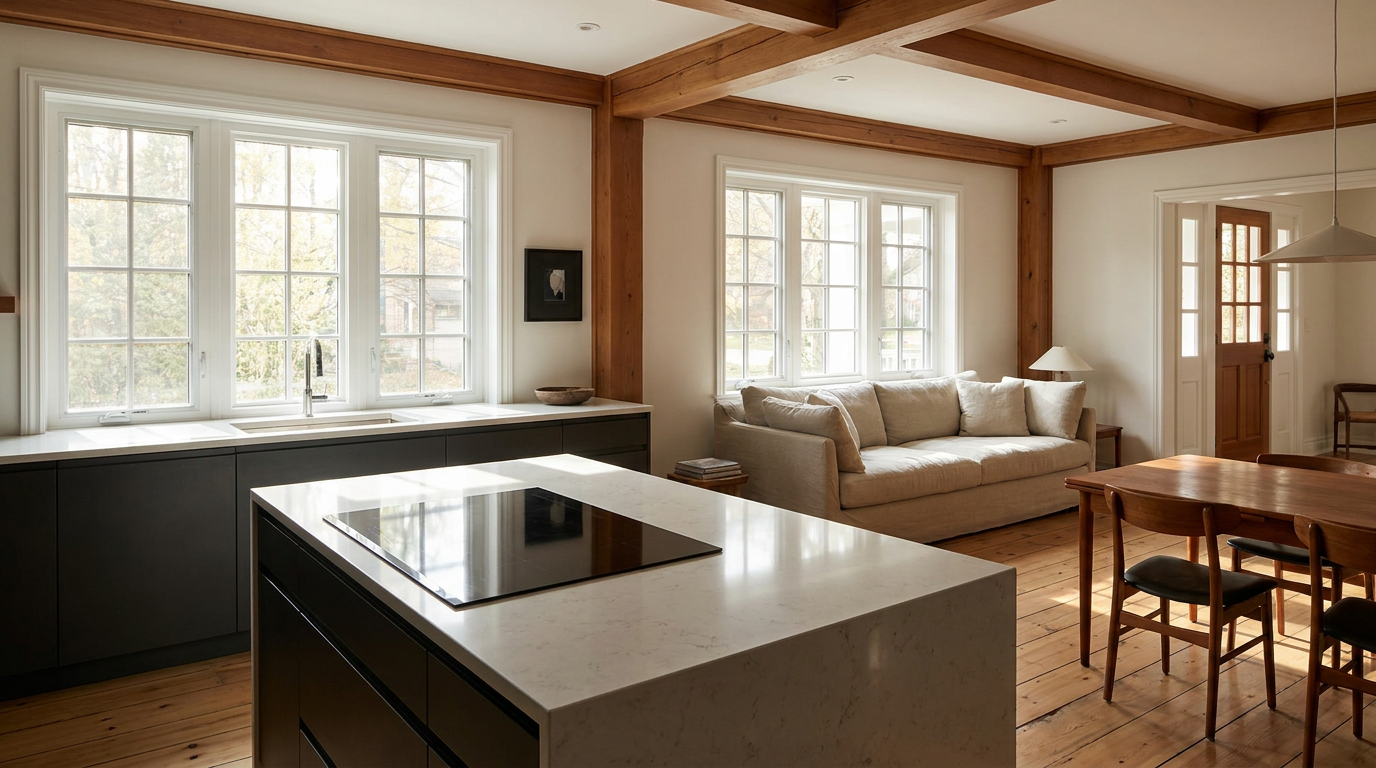
In the kitchen, the gas range—long prized by chefs but increasingly scrutinized by health officials for releasing indoor air pollutants like nitrogen dioxide—is being swapped for induction cooktops. Induction uses electromagnetic fields to heat the cookware directly, offering precise temperature control, faster boiling times, and a safer, combustion-free environment.[2]

However, this influx of new electrical demand presents a structural challenge for older properties. Many homes built in the mid-20th century feature 100-amp electrical panels, which are often insufficient to handle the simultaneous loads of a heat pump, an induction stove, a heat pump water heater, and an electric vehicle charger.[3]
Upgrading to a 200-amp service has traditionally been the default solution, but trenching new utility lines can be prohibitively expensive and time-consuming. To avoid these costly service upgrades, contractors are increasingly utilizing "Power Efficient Design" strategies.[7]
These strategies include installing smart electrical panels or circuit-sharing devices that automatically manage the home's power draw. For example, a smart panel can automatically pause an EV charger for the twenty minutes that an induction stove and a heat pump are running at full capacity, keeping the total load safely under the 100-amp limit.[5]

The financial realities of a deep energy retrofit require careful planning. A comprehensive overhaul—including envelope upgrades, a new HVAC system, panel upgrades, and solar integration—can range from $10,000 to well over $40,000 depending on the home's size, condition, and geographic location.[3]
Because of this high upfront cost, experts heavily recommend an "over-time" approach. Rather than a single dramatic renovation that empties a savings account, homeowners can create a master electrification plan and phase the upgrades over several years, replacing existing systems only as they reach the end of their natural lifespans.[2]
When executed properly, the return on investment is substantial. Certified EnerPHit retrofits have demonstrated staggering energy demand reductions of 75 to 90 percent compared to the home's baseline. Paired with rooftop solar panels, these hyper-efficient homes can essentially eliminate monthly utility bills.[6]
Beyond the monthly savings, deep energy retrofits significantly increase property value. Buyers are increasingly prioritizing sustainability, durability, and low operating costs in their real estate searches, allowing homeowners to recoup much of their investment upon resale.[6]
Ultimately, a deep energy retrofit does more than lower carbon emissions; it fundamentally extends the useful life of the building. By managing moisture, improving air quality, and stabilizing temperatures, these upgrades position older homes to perform efficiently and comfortably for another 50 to 100 years.[7]
How we got here
1990s
The Passive House standard is developed in Germany for ultra-efficient new construction.
2010
The Passive House Institute introduces EnerPHit, adapting the rigorous standard specifically for retrofitting older buildings.
2022
The US passes the Inflation Reduction Act, introducing major tax credits and rebates for home electrification and heat pumps.
2025
Heat pump sales consistently outpace gas furnace sales in several major global markets.
2026
Smart electrical panels and load-management software become standard in retrofits to avoid grid overloads.
Viewpoints in depth
Building Scientists' View
Prioritizing the building envelope before upgrading mechanical systems.
This camp argues that the 'fabric first' approach is non-negotiable. By focusing on insulation, airtightness, and high-performance windows, homeowners permanently reduce the building's energy demand. They caution that installing a high-efficiency heat pump in a drafty house simply masks the underlying problem, leading to oversized equipment, wasted electricity, and diminished thermal comfort.
Electrification Advocates' View
Focusing on the rapid replacement of fossil-fuel appliances to cut emissions.
Advocates for rapid electrification emphasize that the climate crisis requires immediate action. They argue that swapping a gas furnace for a heat pump or a gas stove for an induction cooktop yields instant decarbonization benefits, especially as the electrical grid becomes greener. While they support insulation, they believe homeowners shouldn't delay appliance upgrades just because a full deep energy retrofit is out of budget.
Pragmatic Homeowners' View
Balancing the ideal building science with budget constraints and phased timelines.
For many homeowners, a $40,000 all-at-once deep energy retrofit is financially impossible. This perspective focuses on strategic, phased upgrades. They advocate for replacing systems only when they naturally fail—swapping a dying gas water heater for a heat pump model, for instance—and utilizing smart electrical panels to avoid the hidden costs of upgrading utility service lines.
What we don't know
- How quickly local electrical grids will adapt to the increased residential load as whole-home electrification becomes the norm.
- Whether future government rebates will fully offset the high upfront costs of deep energy retrofits for middle- and low-income households.
Key terms
- EnerPHit
- A certification standard for energy-efficient retrofits of existing buildings, adapted from the rigorous Passive House principles.
- Heat Pump
- An electrical device that extracts ambient heat from one place and transfers it to another, used for both highly efficient heating and cooling.
- Induction Cooktop
- A cooking surface that uses electromagnetic fields to directly heat pots and pans, rather than using an open flame or a heated electric coil.
- Building Envelope
- The physical separator between the conditioned and unconditioned environment of a building, including the roof, walls, windows, and foundation.
- Smart Electrical Panel
- An upgraded breaker box that monitors and manages a home's electrical loads in real-time to prevent overloading the system.
Frequently asked
Do I have to do a deep energy retrofit all at once?
No. Experts highly recommend a phased approach, replacing systems like gas furnaces or water heaters with electric alternatives only as they reach the end of their natural lifespans.
Will a heat pump work in a very cold climate?
Yes. Modern variable-speed heat pumps are designed to extract heat and operate efficiently even when outside temperatures drop to zero degrees Fahrenheit.
Do I need to upgrade my electrical panel to electrify my home?
Often yes, especially if you have an older 100-amp panel. However, smart electrical panels and circuit-sharing devices can sometimes manage the load without requiring a full, expensive utility service upgrade.
Sources
Source coverage
7 outlets
3 viewpoints surfaced






[1]Factlen Editorial TeamPragmatic Homeowners
Synthesis by Factlen editorial team
Read on Factlen Editorial Team →[2]DwellPragmatic Homeowners
Making the Switch: A Practical Guide to Home Electrification
Read on Dwell →[3]EcoFlowElectrification Advocates
The Complete Guide to Home Electrification
Read on EcoFlow →[4]Passive House Association of IrelandBuilding Scientists
What is Enerphit?
Read on Passive House Association of Ireland →[5]BelinusElectrification Advocates
How to plan home electrification: your step-by-step guide
Read on Belinus →[6]RiseBuilding Scientists
Passive House Retrofits: The EnerPHit Program
Read on Rise →[7]Building Science CorporationBuilding Scientists
Mass Save Deep Energy Retrofit Builder Guide
Read on Building Science Corporation →

Every angle. Every day.
Get home stories with full source coverage and perspective breakdowns delivered to your inbox.