
The Science of 'Calm Focus': How L-Theanine and Caffeine Rewire the Brain's Energy Curve
Matcha and green tea deliver a fundamentally different kind of energy than coffee. Modern neuroscience reveals how a rare amino acid called L-theanine acts as a biological buffer, smoothing out caffeine's harsh spikes to create sustained, jitter-free focus.
By Factlen Editorial Team
- Neuroscience Researchers
- Focuses on the clinical data demonstrating the biochemical synergy and cognitive benefits of the L-theanine and caffeine stack.
- Clinical Skeptics
- Emphasizes that the cognitive lift is domain-specific and subtle, warning against viewing the compound as a limitless magic pill.
- Tea Cultivators
- Focuses on the agricultural science of shade-growing and how cultivation methods dictate the chemical makeup of the leaf.
What's not represented
- · Supplement Manufacturers
- · Dietitians
Why this matters
Understanding how to properly fuel the brain can eliminate the daily cycle of anxiety and afternoon exhaustion. By leveraging the biochemical synergy of L-theanine and caffeine, professionals can achieve longer-lasting, clearer focus without the physiological toll of harsh stimulants.
Key points
- L-theanine is a rare amino acid found in tea that promotes alpha brain waves, creating a state of relaxed alertness.
- When combined with caffeine, L-theanine acts as a biological buffer, preventing jitters and anxiety.
- The synergy of the two compounds stretches caffeine's energy release into a sustained 4-to-6-hour window.
- Clinical trials show the combination improves speed and accuracy on demanding cognitive tasks.
- Shade-grown teas like matcha contain the highest levels of L-theanine because blocking sunlight prevents its conversion into catechins.
For millions of professionals, the morning begins with a blunt-force physiological intervention: a heavy dose of coffee. The appeal is obvious, as caffeine is the most widely consumed psychoactive substance on earth, prized for its ability to instantly banish fatigue and sharpen the mind. But that raw stimulation often functions as a double-edged sword. The rapid spike in energy is frequently accompanied by a racing heart, a subtle undercurrent of anxiety, and the inevitable mid-afternoon crash that leaves the brain feeling scattered and depleted. We have accepted this physiological rollercoaster as the necessary cost of doing business in a demanding world.[6]
Yet, an entirely different model of stimulation has existed for centuries, rooted in the traditional consumption of green tea and matcha. Enthusiasts have long described the feeling of drinking high-quality tea as a state of "calm focus"—a sensation of being fully alert and energized, but without the nervous tension or the precipitous crash associated with coffee. For years, this was easily dismissed as the placebo effect of a soothing ritual or the exaggerated claims of wellness marketing. However, modern neuroscience has revealed that this distinct mental state is not a myth; it is the result of a highly specific biochemical synergy.[6]
The secret to tea’s unique cognitive profile does not lie in its caffeine content alone, but rather in the presence of a rare, naturally occurring co-pilot. When you consume a bowl of matcha or a cup of steeped green tea, you are ingesting a complex matrix of compounds that fundamentally alter how your nervous system processes stimulation. The most important of these is a unique molecule that acts as a biological buffer, smoothing out the jagged edges of caffeine and transforming raw, nervous energy into sustained, clear-headed attention.[6]
That molecule is L-theanine, a non-protein amino acid found almost exclusively in the leaves of Camellia sinensis, the plant from which all true teas are harvested. Unlike the amino acids that the human body uses to build muscle tissue or synthesize enzymes, L-theanine operates primarily within the central nervous system. Upon ingestion, it readily crosses the blood-brain barrier, allowing it to directly influence the brain's electrical activity and neurochemistry. It is one of the few natural compounds proven to alter cognitive states without acting as a sedative or a harsh stimulant.[4]

To understand why L-theanine is so valuable, it is necessary to first understand exactly what caffeine does in isolation. Throughout the waking day, a molecule called adenosine steadily accumulates in the brain, docking into specific receptors to signal fatigue and prepare the body for sleep. Caffeine works by impersonating adenosine and blocking those receptors, effectively blinding the brain to its own exhaustion. Simultaneously, it triggers the release of adrenaline and dopamine, shifting the central nervous system into a state of high alert. This is what causes the rapid spike in heart rate, the narrowing of blood vessels, and the jittery sensation of being "wired."[1]
L-theanine pulls the nervous system in the exact opposite direction. When isolated and studied in clinical settings, researchers have found that L-theanine significantly alters the brain's electrical output, specifically by promoting the generation of alpha brain waves. Operating at a frequency of 8 to 13 Hertz, alpha waves are the electrical signature of a brain in a state of "wakeful relaxation." This is the same neurological pattern observed in individuals who are engaged in deep meditation, or in athletes who have entered a state of creative flow.[4]
Crucially, promoting alpha wave activity does not induce drowsiness. Many compounds that reduce anxiety do so by depressing the central nervous system, leaving the user feeling sluggish, foggy, or sedated. L-theanine, however, manages to quiet the physiological markers of stress—lowering the resting heart rate and reducing the secretion of cortisol—while keeping the conscious mind entirely clear and attentive. It clears the static from the line without turning down the volume of your cognition.[4]
The true magic happens when these two compounds collide. In nature, L-theanine evolved alongside caffeine within the tea leaf, acting as a built-in regulatory mechanism. When consumed together, they form what cognitive researchers refer to as a highly effective "nootropic stack." Instead of allowing caffeine to push the nervous system past its optimal zone of arousal into the realm of anxiety, L-theanine acts as a governor. It neutralizes the vasoconstrictive side effects of the stimulant, preventing the physical jitters while preserving the cognitive lift.[2]
In nature, L-theanine evolved alongside caffeine within the tea leaf, acting as a built-in regulatory mechanism.
This synergy plays out directly in the brain's neurochemical pathways. While caffeine is hitting the accelerator, L-theanine is gently applying the brakes by modulating the release of key inhibitory neurotransmitters. It increases the availability of GABA (gamma-aminobutyric acid), which calms overexcited neurons, while also optimizing levels of serotonin and dopamine. This delicate balancing act prevents the sharp, artificial spikes in brain chemistry that typically lead to a harsh physiological crash once the caffeine clears the system.[4]

The practical result of this biochemical dance is a fundamentally different energy curve. When you drink a cup of black coffee, the caffeine is rapidly absorbed, peaking in the bloodstream within 30 to 45 minutes and often burning out within two hours. By contrast, the combination of caffeine and L-theanine results in a much slower, more sustained absorption rate. The energy from a high-quality matcha can stretch into a smooth, steady plateau lasting four to six hours, providing a long window of productivity without the desperate need for a midday refill.[6]
This is not merely subjective experience; it is heavily documented in the clinical literature. In rigorous, placebo-controlled trials, researchers have repeatedly tested the caffeine-and-theanine combination against caffeine alone. The results consistently show that the paired compounds improve both speed and accuracy on cognitively demanding tasks. Subjects given the combination demonstrate better focus, make fewer errors under pressure, and report significantly lower levels of mental fatigue during prolonged periods of intense concentration.[2]
The cognitive benefits may extend beyond healthy adults looking for a productivity boost. Studies investigating populations with mild cognitive impairment have found that the administration of green tea extracts rich in L-theanine and caffeine can lead to measurable improvements in working memory and selective attention. While it is not a cure for neurodegenerative decline, the ability of these compounds to support executive function and protect neural pathways from stress-induced damage has made them a subject of intense interest in longevity and brain-health research.[5]
However, clinical skeptics and recent meta-analyses caution against viewing L-theanine as a limitless cognitive panacea. While the compound reliably reduces subjective stress and improves certain types of focus, its effects are highly domain-specific. A comprehensive 2024 meta-analysis reviewing multiple randomized controlled trials found that while the L-theanine and caffeine stack significantly improved rapid visual information processing, it did not meaningfully improve simple reaction times or performance on basic stimulus tests.[3]
In other words, the synergy helps you manage complex, overwhelming information and prevents you from getting distracted, but it will not necessarily make your raw physical reflexes any faster. Furthermore, the researchers noted that the effects are subtle rather than overwhelming. L-theanine does not force the brain into a state of hyper-productivity; rather, it removes the physiological noise and anxiety that typically interfere with your natural ability to concentrate. It is a tool for optimization, not a magic pill.[3]
To fully leverage this biochemistry, one must understand that not all tea is created equal. The concentration of L-theanine in a given cup depends entirely on how the Camellia sinensis plant was cultivated and processed. The tea bush naturally synthesizes L-theanine in its root system and transports it up into the young leaves and buds. However, when those leaves are exposed to direct sunlight, the plant undergoes photosynthesis, which rapidly converts the calming L-theanine into astringent antioxidant compounds known as catechins.[7]

This agricultural reality is why premium Japanese teas like matcha and gyokuro are prized for their intense "calm focus" effects. Weeks before the harvest, farmers meticulously cover the tea fields with heavy shade cloths, blocking up to 90 percent of the sunlight. Desperate to capture whatever light remains, the plants push massive amounts of chlorophyll and L-theanine into their leaves. Because the sunlight is blocked, the L-theanine is never converted into catechins, resulting in a leaf that is extraordinarily rich in the calming amino acid.[7]
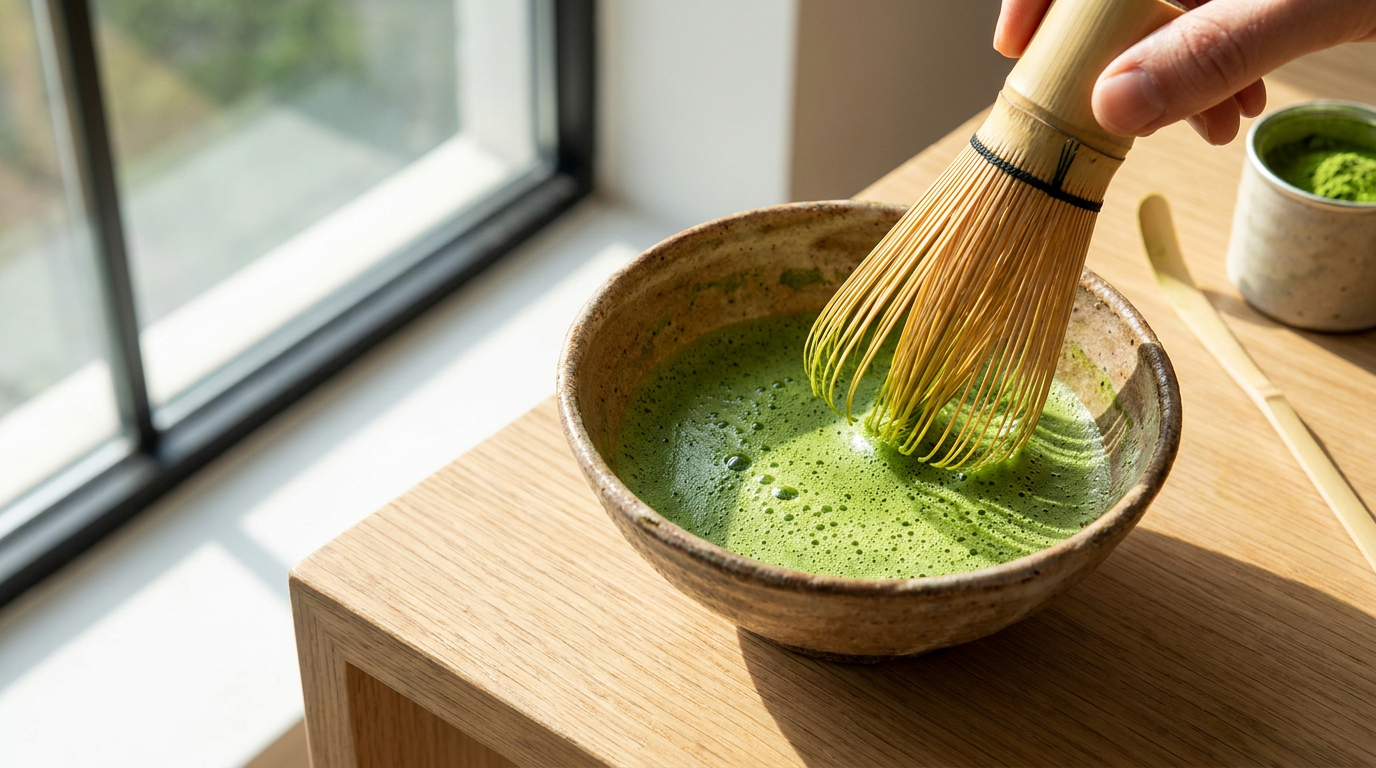
When these shade-grown leaves are steamed, dried, and ground into the fine, vibrant green powder known as ceremonial matcha, they provide the ultimate natural nootropic stack. Because you are consuming the entire leaf suspended in water, rather than just an infusion, a standard bowl of matcha delivers a naturally optimized ratio: roughly 35 to 70 milligrams of caffeine paired with 20 to 45 milligrams of L-theanine. It is a ratio that falls perfectly within the parameters proven by clinical trials to maximize focus while minimizing anxiety.[7]
In an era where attention is our most valuable and heavily taxed resource, the way we choose to stimulate our brains matters immensely. Relying on the brute force of isolated caffeine often creates as many problems as it solves, trading long-term nervous system stability for short-term alertness. The ancient practice of shade-growing tea, now validated by modern neuroscience, offers a far more elegant solution. By pairing stimulation with a biological buffer, L-theanine provides a blueprint for a calmer, more resilient, and ultimately more sustainable form of focus.[6]
Viewpoints in depth
Neuroscience Researchers
Focuses on the clinical data demonstrating the biochemical synergy and cognitive benefits of the L-theanine and caffeine stack.
For cognitive researchers, the combination of caffeine and L-theanine is considered one of the most reliable and heavily documented 'nootropic stacks' in existence. Studies consistently show that while caffeine alone provides raw stimulation, it often impairs fine motor control and increases anxiety under pressure. By introducing L-theanine, the nervous system is buffered. The amino acid increases the availability of GABA and promotes alpha brain waves, effectively neutralizing the vasoconstrictive side effects of caffeine. The result, validated by numerous placebo-controlled trials, is a measurable improvement in working memory, task accuracy, and sustained attention during demanding cognitive workloads.
Clinical Skeptics
Emphasizes that the cognitive lift is domain-specific and subtle, warning against viewing the compound as a limitless magic pill.
While acknowledging the stress-reducing properties of L-theanine, clinical skeptics and recent meta-analyses urge caution against overstating its benefits. Comprehensive reviews of the literature reveal that the cognitive enhancements are highly domain-specific. For instance, while the combination reliably improves rapid visual information processing and helps subjects manage complex tasks, it does not significantly improve simple reaction times or basic physical reflexes. Skeptics emphasize that L-theanine is not a limitless cognitive enhancer that forces the brain into hyper-productivity; rather, it simply removes the physiological noise and anxiety that typically interfere with a person's baseline ability to concentrate.
Tea Cultivators
Focuses on the agricultural science of shade-growing and how cultivation methods dictate the chemical makeup of the leaf.
From an agricultural perspective, the presence of L-theanine is entirely dependent on how the tea plant is managed before harvest. The Camellia sinensis bush synthesizes L-theanine in its roots and sends it to the leaves. However, if those leaves are exposed to direct sunlight, photosynthesis rapidly converts the calming amino acid into astringent catechins. To prevent this, cultivators of premium Japanese teas like matcha and gyokuro cover their fields with heavy shade cloths weeks before the harvest. This deliberate starvation of light halts the chemical conversion, trapping massive amounts of L-theanine in the leaf and creating the unique, naturally optimized ratio of compounds that defines ceremonial tea.
What we don't know
- The exact long-term neuroprotective benefits of daily L-theanine consumption against age-related cognitive decline.
- How individual genetic differences in caffeine metabolism affect the optimal ratio of L-theanine required for peak focus.
Key terms
- L-theanine
- A non-protein amino acid found almost exclusively in tea leaves that promotes relaxation and focus without causing drowsiness.
- Alpha brain waves
- Electrical patterns in the brain (8-13 Hz) associated with a state of wakeful relaxation, creative flow, and deep meditation.
- Adenosine
- A neurotransmitter that builds up throughout the day to signal fatigue; caffeine works by blocking its receptors.
- GABA
- Gamma-aminobutyric acid, an inhibitory neurotransmitter in the brain that helps regulate anxiety and promotes a calming effect.
- Catechins
- Antioxidant compounds in tea; L-theanine naturally converts into catechins when tea leaves are exposed to direct sunlight.
Frequently asked
Does L-theanine make you sleepy?
No. While L-theanine promotes relaxation and reduces anxiety, it does not act as a sedative. It increases alpha brain waves, which are linked to a state of 'wakeful relaxation' and clear focus.
Why does matcha have more L-theanine than regular green tea?
Matcha is made from shade-grown tea leaves. Blocking sunlight prevents the plant from converting the L-theanine into antioxidant catechins via photosynthesis, preserving massive amounts of the amino acid in the leaf.
Can I just take an L-theanine supplement with my coffee?
Yes. Many people use a 2:1 ratio of L-theanine to caffeine via supplements to artificially recreate the synergistic, jitter-free effect found naturally in tea.
How long does the energy from matcha last?
Because L-theanine slows the absorption of caffeine, the energy from matcha typically provides a sustained plateau of alertness lasting 4 to 6 hours, compared to the 1 to 2 hour spike of coffee.
Sources
Source coverage
7 outlets
3 viewpoints surfaced







[1]Nutrition ReviewsClinical Skeptics
Systematic review and meta-analysis of caffeine and L-theanine
Read on Nutrition Reviews →[2]Nutritional NeuroscienceNeuroscience Researchers
The effects of L-theanine, caffeine and their combination on cognition and mood
Read on Nutritional Neuroscience →[3]MDPIClinical Skeptics
Efficacy of L-Theanine on Cognitive Functions: A Meta-Analysis
Read on MDPI →[4]National Institutes of HealthNeuroscience Researchers
Effects of L-Theanine Administration on Stress-Related Symptoms and Cognitive Functions
Read on National Institutes of Health →[5]Journal of Medicinal FoodNeuroscience Researchers
A Combination of Green Tea Extract and L-Theanine Improves Memory and Attention
Read on Journal of Medicinal Food →[6]Factlen Editorial TeamTea Cultivators
Synthesis by Factlen editorial team
Read on Factlen Editorial Team →[7]Food Research InternationalTea Cultivators
Matcha cognition trial and L-theanine content
Read on Food Research International →

Every angle. Every day.
Get food drink stories with full source coverage and perspective breakdowns delivered to your inbox.