
The Evidence Behind the Passwordless Future: How Passkeys are Eliminating Phishing
With 5 billion passkeys now in active use, the tech industry is aggressively deprecating the password. We examine the cryptographic evidence, the success rates, and the emerging threat models of a passwordless web.
By Factlen Editorial Team
- Platform Ecosystems
- Prioritizing frictionless adoption and account recovery through cloud-synced credentials.
- High-Assurance Enterprise
- Demanding device-bound hardware keys for maximum security in critical environments.
- Academic Researchers
- Scrutinizing the expanded threat surface of cloud synchronization and cross-platform UX friction.
What's not represented
- · Small Business IT Administrators
- · Non-Smartphone Users
Why this matters
Passwords are the root cause of over 80% of hacking-related data breaches. The global transition to passkeys fundamentally changes how you protect your identity, money, and data, replacing easily stolen text with unphishable cryptographic hardware.
Key points
- Over 5 billion passkeys are now in active use globally, with 90% of consumers aware of the technology.
- Passkeys use public-key cryptography and origin binding to mathematically eliminate credential phishing and server-side breaches.
- Google data shows passkey sign-ins are four times more successful and twice as fast as traditional passwords.
- The ecosystem is split between highly secure 'device-bound' hardware keys and highly convenient cloud-backed 'synced passkeys'.
- While synced passkeys solve account recovery, security researchers warn they expand the threat boundary to cloud accounts.
The password is fundamentally broken. For decades, the cybersecurity industry has relied on shared secrets—strings of characters that users must memorize and servers must store. But as of mid-2026, the architecture of digital identity is undergoing its most significant structural shift since the invention of the password. The transition to passkeys, built on the FIDO2 standard, has reached critical mass, promising to eradicate entire categories of cyberattacks.[7]
The scale of adoption is no longer theoretical. According to the FIDO Alliance's 2026 State of Passkeys report, an estimated 5 billion passkeys are now in active use globally. Consumer awareness has hit 90%, with 75% of users having enabled a passkey on at least one account. In the enterprise sector, the shift is equally pronounced, with 68% of organizations actively deploying or piloting passkey authentication for their workforces.[1]
To understand why the industry is aggressively deprecating passwords, one must examine the underlying mechanism of a passkey. Unlike a password, a passkey is not a shared secret. It relies entirely on public-key cryptography. When a user registers for a service, their device generates a unique cryptographic key pair. The public key is sent to the server, while the private key remains securely locked within the device's hardware authenticator, such as a smartphone's secure enclave.[7]
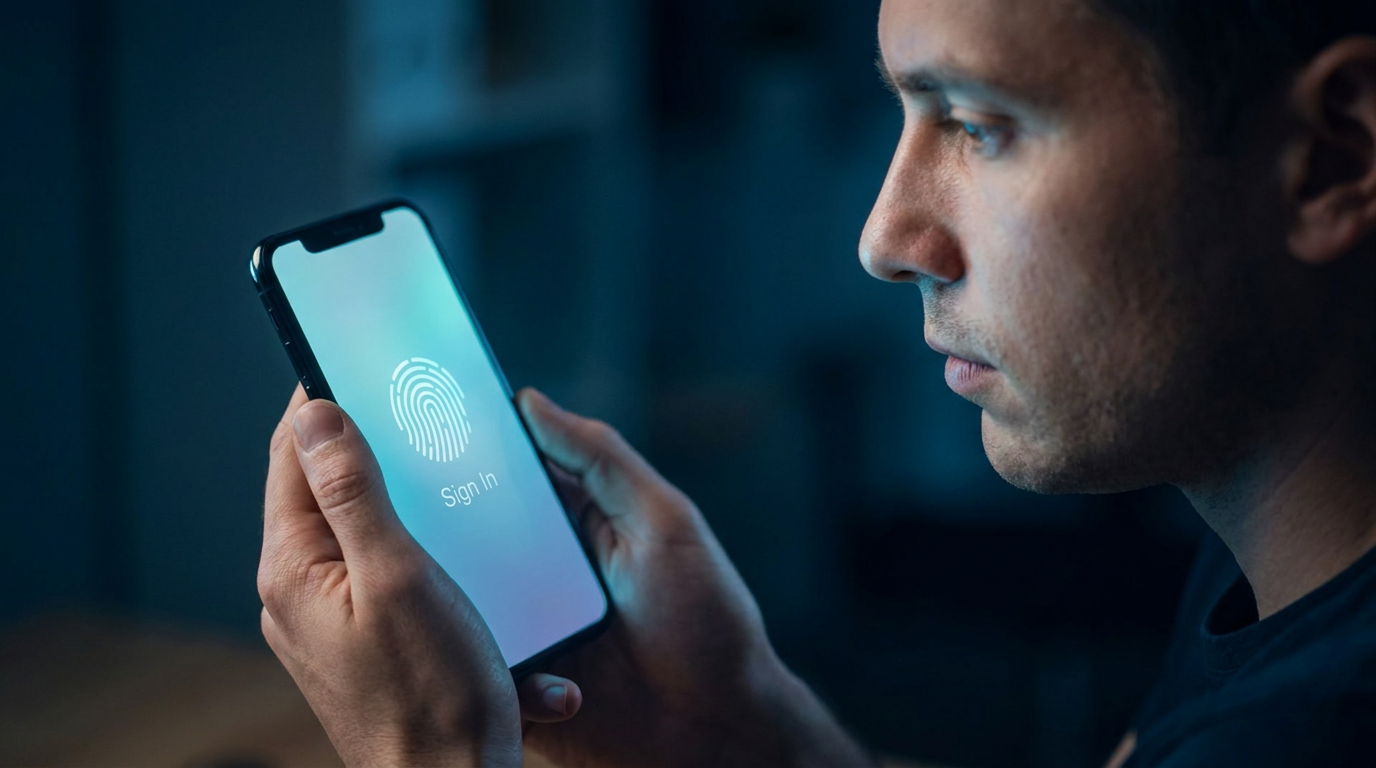
During authentication, the server sends a unique cryptographic challenge. The user's device prompts them for a local biometric gesture—a fingerprint or facial scan—to unlock the private key. The device then signs the challenge and returns the signature to the server. Because the server only holds the public key, a database breach yields nothing of value to an attacker; there are no passwords to steal, hash, or crack.[7]

The most critical security feature of passkeys, however, is "origin binding." Traditional multi-factor authentication (MFA), such as SMS codes or authenticator app digits, remains vulnerable to adversary-in-the-middle (AitM) phishing attacks. If a user is tricked into visiting a fake login page, they will dutifully type in their password and their MFA code, handing both directly to the attacker in real time.[4][7]
Passkeys mathematically eliminate this vector. The WebAuthn protocol ensures that the cryptographic signature is inextricably bound to the specific domain requesting it. If a user is lured to a visually identical phishing site hosted at "g00gle.com" instead of "google.com," the device's authenticator will simply refuse to sign the challenge. The phishing resistance is inherent to the protocol, removing the burden of vigilance from the user.[2][4]
The empirical evidence supporting this transition is striking. Google's internal telemetry reveals that passkey sign-ins are four times more successful than password attempts. Furthermore, the authentication process is twice as fast and significantly less error-prone. The average success rate for local passkey authentication sits at nearly 64%, compared to a dismal 13.8% for traditional passwords, drastically reducing user friction and IT support tickets.[2]

The empirical evidence supporting this transition is striking.
Regulatory and government bodies are actively codifying this shift. The U.S. Cybersecurity and Infrastructure Security Agency (CISA) has explicitly mandated the adoption of phishing-resistant authentication. In its "Secure by Demand" guidance, CISA urges software buyers to require passkeys as a default feature during procurement, aligning with National Institute of Standards and Technology (NIST) guidelines that classify device-bound passkeys at the highest Authentication Assurance Level (AAL3).[3]
Yet, the transition is not without its complexities and emerging threat models. The ecosystem has bifurcated into two distinct implementations: device-bound passkeys and synced passkeys. Device-bound keys, such as physical YubiKeys, never leave the hardware they were generated on. They offer maximum security but present severe usability challenges if the device is lost or destroyed, as the credential cannot be recovered.[4][5]
To solve the recovery problem for general consumers, Apple, Google, and Microsoft introduced synced passkeys. These credentials are automatically backed up and synchronized across a user's devices via cloud services like iCloud Keychain or Google Password Manager. This ensures that if a user drops their smartphone in a lake, they do not permanently lose access to their bank accounts and digital life.[2][5]

However, academic research presented at the International Conference on Cybersecurity Studies highlights that synced passkeys fundamentally alter the threat model. By allowing private keys to travel across devices, the security boundary expands from the local hardware to the cloud account managing the sync. If an attacker compromises a user's Apple ID or Google Account, they potentially gain access to the user's entire vault of synced passkeys.[4][5]
Security researchers have also demonstrated that while passkeys defeat traditional phishing, they are not immune to all forms of session hijacking. Malicious browser extensions or injected scripts running under the target origin can theoretically intercept the WebAuthn API calls. While the cryptographic credential itself cannot be stolen, an attacker with local machine access can manipulate the authentication flow.[5]
Furthermore, the user experience remains fragmented. Empirical studies document unpredictable user interfaces across different operating systems and browsers. The FIDO2 standard's original design lacked a native recovery model, leading platform vendors to implement proprietary sync solutions that sometimes trap users within specific ecosystems, complicating cross-platform interoperability.[4]
Despite these growing pains, the consensus among security professionals is absolute: the baseline security of a synced passkey vastly outperforms any password-based system. The elimination of credential reuse, server-side breaches, and automated phishing campaigns represents a generational leap in digital safety that outweighs the localized risks of cloud synchronization.[6][7]
As the infrastructure matures, the focus is shifting from technical feasibility to deployment logistics. With nearly half of the top 100 websites now supporting passkeys and major regulatory deadlines approaching globally, the password is entering its twilight. The future of authentication is cryptographic, invisible, and fundamentally more secure.[1][6]
How we got here
August 2019
Google implements early FIDO2 local device authentication for select flows.
April 2022
FIDO Alliance, Apple, Google, and Microsoft announce a joint commitment to expand passkey support.
May 2023
Google rolls out passkey support across all personal Google Accounts.
August 2024
CISA releases 'Secure by Demand' guidance urging software buyers to mandate passkey support.
May 2026
FIDO Alliance reports 5 billion passkeys are in active use globally.
Viewpoints in depth
Platform Ecosystems
Prioritizing frictionless adoption through cloud-synced credentials.
The major tech giants view the password as an existential security flaw that must be eradicated at scale. To achieve mass adoption, they champion 'synced passkeys' that back up to iCloud or Google Password Manager. They argue that the slight reduction in absolute security compared to hardware keys is a necessary tradeoff to solve the account recovery problem, ensuring users don't lose access to their digital lives if they drop their phone.
High-Assurance Enterprise
Demanding device-bound hardware for maximum security.
Agencies like CISA and enterprise security architects operate under a stricter threat model. They favor 'device-bound' passkeys—such as physical YubiKeys—that satisfy NIST's AAL3 requirements. Because these keys cannot be copied or synced to a cloud account, they are immune to cloud-breach vectors, making them the standard for protecting critical infrastructure and privileged corporate access.
Academic Researchers
Scrutinizing the expanded threat surface and UX friction.
Security researchers acknowledge the massive upgrade over passwords but warn against treating passkeys as a panacea. They point out that syncing passkeys shifts the security boundary to the user's cloud account, meaning an Apple ID compromise becomes a skeleton key. Furthermore, they document significant user experience hurdles, noting that inconsistent implementations across different browsers and operating systems still confuse average users.
What we don't know
- How cross-platform syncing (e.g., moving a passkey from an Apple iCloud account to a Google Android device) will be standardized to prevent ecosystem lock-in.
- Whether regulatory bodies will eventually deem cloud-synced passkeys insufficient for consumer banking, forcing a return to hardware tokens.
- How the industry will handle passkey inheritance and credential transfer in the event of a user's death.
Key terms
- FIDO2
- An open authentication standard that enables passwordless, phishing-resistant logins using public-key cryptography.
- WebAuthn
- The web API standard that allows browsers to communicate with authenticators to create and use passkeys.
- Origin Binding
- A security feature where a credential is mathematically tied to a specific website domain, preventing it from being used on fake phishing sites.
- Synced Passkey
- A passkey that is backed up and synchronized across multiple devices via a cloud provider, prioritizing user convenience and account recovery.
- Device-Bound Passkey
- A passkey locked to a specific piece of hardware (like a YubiKey) that cannot be copied or synced, offering the highest level of security.
Frequently asked
What exactly is a passkey?
A passkey is a cryptographic credential that replaces a password. It uses your device's biometric unlock (like Face ID or a fingerprint) to sign you into websites securely without typing anything.
What happens to my passkeys if I lose my phone?
Most consumer passkeys are 'synced passkeys' backed up to your cloud account (like iCloud Keychain or Google Password Manager). If you lose your phone, you can restore your passkeys on a new device by signing into your cloud account.
Can a passkey be stolen in a phishing attack?
No. Passkeys use 'origin binding,' meaning the cryptographic signature only works on the exact website it was created for. Even if a fake website tricks you, your device will refuse to hand over the credential.
Are my fingerprints sent to the website?
No. Your biometric data never leaves your device. It is only used locally to unlock the private cryptographic key, which then signs a challenge sent by the server.
Sources
Source coverage
7 outlets
3 viewpoints surfaced







[1]FIDO AllianceHigh-Assurance Enterprise
The State of Passkeys 2026: Global Consumer and Workforce Report
Read on FIDO Alliance →[2]Google Security BlogPlatform Ecosystems
The beginning of the end of the password
Read on Google Security Blog →[3]Biometric UpdateHigh-Assurance Enterprise
CISA 'Secure by Demand' guide pushes passkeys for software procurement
Read on Biometric Update →[4]ResearchGateAcademic Researchers
The State of FIDO2 Passkey Implementations: Challenges, Inconsistencies, and Opportunities
Read on ResearchGate →[5]CertiKAcademic Researchers
Passkey Wallet Security: Synced Passkeys and the Expanded Threat Model
Read on CertiK →[6]Authsignal
The Passkey Adoption Numbers: 2025 to 2026
Read on Authsignal →[7]Factlen Editorial Team
Synthesis by Factlen editorial team
Read on Factlen Editorial Team →

Every angle. Every day.
Get technology stories with full source coverage and perspective breakdowns delivered to your inbox.