
Lab-Grown vs. Mined Diamonds: The 2026 Consumer Guide to Price, Impact, and Value
As lab-grown stones capture over 55 percent of the engagement ring market, the choice between natural and cultivated diamonds comes down to a stark trade-off between geological rarity and financial efficiency.
By Factlen Editorial Team
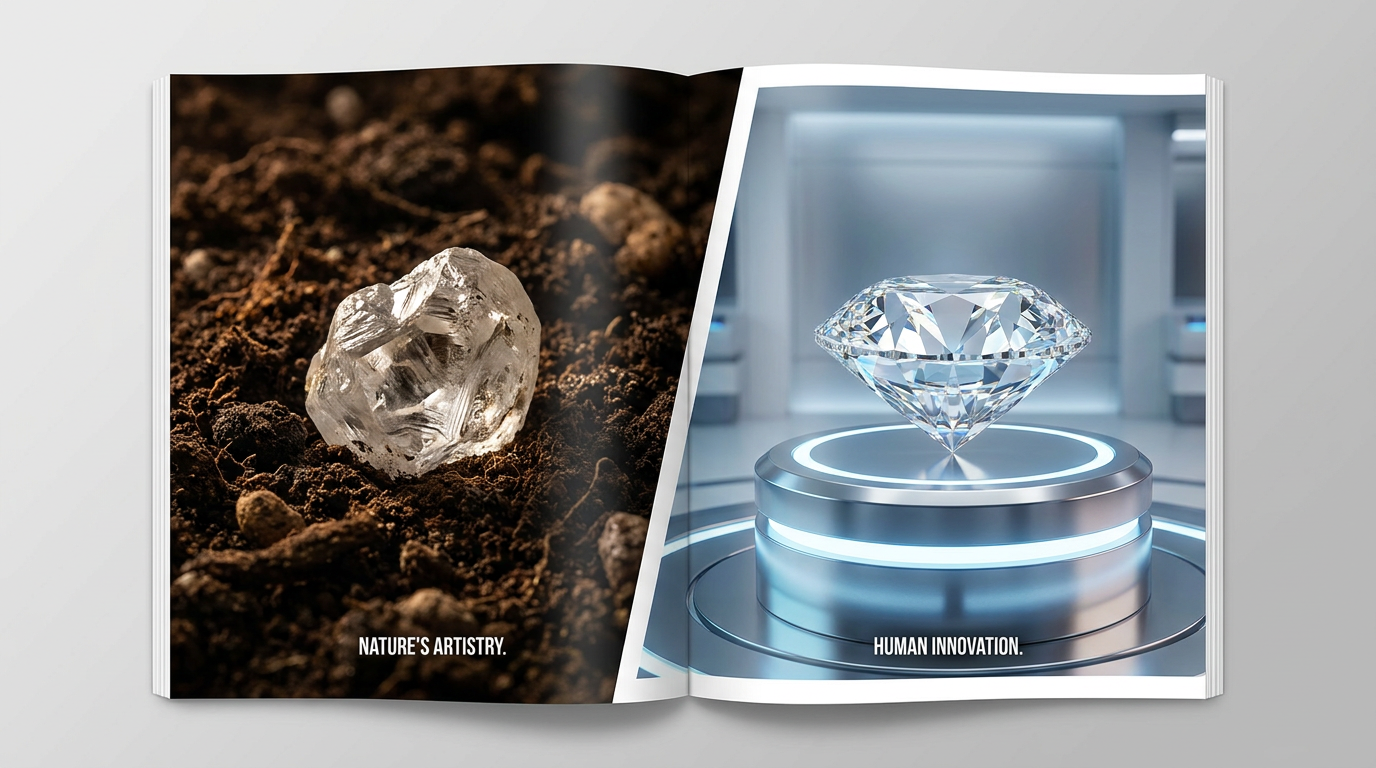
- Lab-Grown Advocates
- Argues that laboratory cultivation democratizes luxury, eliminates the ecological damage of mining, and offers identical physical quality for a fraction of the cost.
- Traditional Diamond Industry
- Maintains that natural diamonds hold inherent value due to their billion-year geological rarity, heritage, and ability to retain partial resale value.
- Eco-Conscious Consumers
- Focuses strictly on the carbon footprint and resource usage, demanding renewable energy certification for lab stones to avoid fossil-fuel emissions.
What's not represented
- · Industrial Diamond Manufacturers
- · Local Mining Communities
Why this matters
With lab-grown diamonds now capturing over half of the engagement ring market, buyers face a fundamental choice between geological rarity and technological efficiency. Understanding the exact trade-offs in price, environmental impact, and resale value ensures you do not overpay for a narrative that does not align with your personal priorities.
Key points
- Lab-grown and mined diamonds are chemically and physically identical, indistinguishable to the naked eye.
- Lab-grown stones cost 70 to 90 percent less than mined equivalents in 2026.
- Mined diamonds retain 20 to 30 percent of their resale value, while lab-grown stones have almost zero secondary market value.
- Lab-grown diamonds avoid the land destruction of mining but can have a higher carbon footprint if powered by fossil fuels.
The diamond industry has officially crossed a historic threshold in 2026. For the first time, lab-grown diamonds account for more than 55 percent of all engagement rings sold globally, marking a profound shift in how consumers approach luxury, romance, and value. What was once dismissed as a niche alternative has matured into a $33.5 billion global market. This transition is not merely a change in aesthetic preference, but a fundamental recalculation of what a diamond represents. Shoppers are now faced with a high-stakes choice between stones pulled from the earth and those cultivated in high-tech reactors. The decision touches on deeply personal values, financial pragmatism, and environmental ethics, forcing buyers to weigh the romantic allure of geological history against the undeniable efficiency of modern science.[1][3]
Before evaluating the trade-offs, the physical reality of the two options must be established. Lab-grown diamonds and mined diamonds are chemically, physically, and optically identical. Both consist of pure carbon atoms arranged in a rigid crystal lattice structure, both score a perfect 10 on the Mohs hardness scale, and both interact with light in the exact same manner. Even highly trained gemologists using standard magnification loupes cannot tell them apart by sight alone. The only way to distinguish a laboratory-cultivated stone from a natural one is through specialized spectroscopic equipment that detects trace nitrogen patterns and microscopic growth structures. By every scientific and gemological definition, a lab-grown stone is a real diamond, shifting the consumer debate entirely away from authenticity and toward origin, cost, and impact.[4][6]
The primary argument for choosing a lab-grown diamond rests on overwhelming financial efficiency. Because cultivating a diamond in a controlled laboratory environment bypasses the massive logistical costs of excavation, transportation, and global sorting, those savings are passed directly to the consumer. In 2026, the price gap has widened to its most dramatic point yet, with lab-grown stones costing between 70 and 90 percent less than their mined counterparts of equivalent quality. This allows buyers to either drastically reduce their overall budget or significantly upgrade the size and clarity of the stone they purchase. For a generation of shoppers facing high living costs, the ability to acquire a two-carat center stone for the historical price of a half-carat ring represents an undeniable value proposition.[4][5]

The quantified evidence of this price divergence is stark. As of mid-2026, a high-quality, one-carat lab-grown diamond typically retails between $800 and $1,500. An identical one-carat mined diamond, featuring the same cut, color, and clarity grades, commands anywhere from $4,000 to $10,000 depending on the retailer. The cost disparity accelerates exponentially as carat weight increases. A three-carat lab-grown stone might cost $3,000, while a mined equivalent easily surpasses $25,000. Manufacturing costs for lab-grown stones have fallen by roughly 74 percent since 2020, and prices have now stabilized near the actual cost of production. This transparency in pricing has effectively stripped the traditional luxury markup from the laboratory sector, turning the diamond into a standard consumer good rather than a heavily guarded commodity.[4][5]
Conversely, the argument for mined diamonds centers on geological rarity and long-term value retention. Traditionalists and luxury purists maintain that a diamond's worth is inextricably linked to its billion-year journey deep within the Earth's mantle. Because there is a finite supply of natural diamonds, they carry an inherent scarcity that manufactured stones simply cannot replicate. This scarcity translates directly to the secondary market. While neither type of diamond is a lucrative financial investment for the average consumer, mined diamonds consistently retain a portion of their original retail value. Advocates for natural stones argue that purchasing a mined diamond is an acquisition of a finite natural artifact, one that carries historical weight and traditional prestige that a factory-produced stone lacks.[6][9]
Conversely, the argument for mined diamonds centers on geological rarity and long-term value retention.
The evidence regarding resale value presents a sobering reality for both options, though it heavily favors mined stones in percentage terms. A standard one-carat mined diamond will typically lose 30 to 50 percent of its retail value the moment it is purchased, but it will generally fetch between 20 and 30 percent of its original price on the secondary wholesale market years later. In contrast, lab-grown diamonds have almost zero resale value in 2026. Because new production continues to become cheaper and more efficient, secondary buyers have no incentive to purchase a used lab-grown stone. A lab diamond bought for $1,200 today might receive a $50 offer from a jeweler in five years, if an offer is made at all. Buyers must accept that the money spent on a lab-grown diamond is entirely a sunk cost for immediate enjoyment.[6]

Beyond finances, the environmental trade-offs form the second major battleground. The argument for lab-grown diamonds highlights the severe ecological disruption caused by traditional mining. Extracting natural diamonds requires moving millions of tons of earth, leading to significant deforestation, habitat destruction, and soil erosion. Furthermore, mining operations consume vast amounts of water—sometimes up to 127 gallons per carat—to separate the rough stones from surrounding rock and dirt. Lab-grown diamonds require zero land excavation, leaving natural ecosystems entirely untouched. By confining production to industrial facilities, the laboratory sector avoids the creation of toxic tailings and the displacement of local wildlife, presenting a compelling case for consumers who prioritize land conservation and biodiversity.[7][8]
However, the environmental evidence against lab-grown diamonds reveals a complex reality regarding energy consumption. Replicating the extreme conditions of the Earth's mantle requires immense amounts of electricity. The two primary manufacturing methods—High Pressure High Temperature (HPHT) and Chemical Vapor Deposition (CVD)—run reactors at temperatures exceeding 1,400 degrees Celsius for weeks at a time. When these laboratories are powered by fossil fuels, their carbon footprint can actually exceed that of a traditional mine. Critics of the lab-grown industry point out that marketing these stones as universally eco-friendly is often greenwashing, as the invisible emissions from coal-powered electricity grids simply replace the visible destruction of an open-pit mine.[7][8]
The quantified environmental evidence hinges entirely on the energy source. A standard mined diamond emits approximately 160 kilograms of carbon dioxide equivalent per carat during extraction. A lab-grown diamond produced in a facility reliant on a fossil-fuel-heavy grid can emit upwards of 511 kilograms of carbon dioxide per carat, making it significantly worse for the climate. However, the industry is rapidly shifting. Lab-grown diamonds produced in facilities powered entirely by renewable energy—such as solar and wind farms—slash that footprint to under 20 kilograms of carbon dioxide per carat. For the eco-conscious consumer, the evidence dictates that a lab-grown diamond is only the greener choice if the retailer can provide transparent certification that the stone was cultivated using 100 percent renewable energy.[7]

Ultimately, the decision requires aligning the purchase with the buyer's specific priorities. A lab-grown diamond fits perfectly when the buyer prioritizes maximizing the size and visual quality of the stone within a strict budget. It is the ideal choice for consumers who view the ring as a beautiful piece of everyday jewelry rather than a financial asset, and who prefer to avoid the ecological land disruption associated with mining. Conversely, a lab-grown diamond does not fit well when the buyer places high emotional value on geological rarity, desires a stone that will retain some measure of financial equity for future generations, or views the billion-year natural formation process as an essential component of the diamond's romantic symbolism.[4][6][7]
On the other side of the ledger, a mined diamond fits well when the purchaser is deeply invested in the tradition, heritage, and inherent scarcity of a natural gemstone. It remains the necessary choice for heirloom pieces intended to hold partial monetary value, or for buyers who find the concept of a factory-grown stone unromantic. However, a mined diamond does not fit well when the buyer is operating on a tight budget but desires a large, flawless center stone. It is also a poor fit for consumers who are strictly opposed to the physical environmental degradation caused by extractive industries. In 2026, neither option is universally superior; the market simply offers two distinct products that cater to entirely different definitions of what makes a luxury item valuable.[5][6][8]
How we got here
1950s
General Electric successfully creates the first commercially viable synthetic diamonds, primarily for industrial use.
2018
The US Federal Trade Commission (FTC) revises its jewelry guidelines, officially recognizing lab-grown stones as real diamonds.
2020
Lab-grown diamonds begin to gain significant mainstream traction, though they still cost only 30-35% less than mined diamonds.
2024
Technological breakthroughs and massive production scaling in Asia cause lab-grown diamond prices to plummet by over 70%.
2026
Lab-grown diamonds cross the 55% market share threshold for global engagement ring sales, cementing their dominance.
Viewpoints in depth
Lab-Grown Advocates
Argues that laboratory cultivation democratizes luxury and eliminates the ecological damage of mining.
This camp views the traditional diamond industry's reliance on rarity as an artificial marketing construct designed to keep prices high. They emphasize that lab-grown stones offer identical physical and optical properties for a fraction of the cost, allowing consumers to purchase higher-quality stones without taking on debt. Furthermore, they argue that avoiding the massive land displacement, water usage, and human rights concerns historically associated with open-pit mining makes lab-grown stones the only ethical choice for modern luxury.
Traditional Diamond Industry
Maintains that natural diamonds hold inherent value due to their billion-year geological rarity.
Proponents of mined diamonds argue that a luxury item's value is intrinsically tied to its scarcity and heritage. They point out that while lab-grown diamonds are chemically identical, they are mass-produced in factories, which strips them of the romantic and historical weight of a stone formed deep within the Earth over billions of years. Additionally, they emphasize the stark reality of the resale market, noting that while natural diamonds depreciate, they still retain a baseline financial equity, whereas lab-grown stones are essentially worthless on the secondary market.
Eco-Conscious Consumers
Focuses strictly on the carbon footprint and resource usage of diamond production.
This perspective challenges the blanket assumption that all lab-grown diamonds are environmentally friendly. They point to the massive energy requirements of HPHT and CVD reactors, noting that when powered by coal or natural gas, a lab-grown diamond can emit significantly more carbon dioxide than a mined one. This camp demands rigorous transparency and third-party certification, arguing that a diamond can only be considered sustainable if it is cultivated using 100 percent renewable energy sources like solar or wind.
What we don't know
- Whether the resale market for lab-grown diamonds will completely collapse or find a new baseline as production costs hit their absolute floor.
- How quickly the entire lab-grown industry will transition to 100% renewable energy to offset its massive electricity requirements.
Key terms
- Chemical Vapor Deposition (CVD)
- A method of growing diamonds by placing a diamond seed in a vacuum chamber filled with carbon-rich gas, which bonds to the seed layer by layer.
- High Pressure High Temperature (HPHT)
- A manufacturing process that mimics the extreme heat and pressure of the Earth's mantle to dissolve carbon into a diamond seed.
- Mohs Scale
- A scientific scale used to measure the hardness of minerals, on which diamonds score a perfect 10, making them the hardest known natural substance.
- Carbon Footprint
- The total amount of greenhouse gases, specifically carbon dioxide, emitted directly or indirectly by the production of a single diamond.
Frequently asked
Are lab-grown diamonds real diamonds?
Yes. They are chemically, physically, and optically identical to mined diamonds. Both are pure carbon and score a 10 on the Mohs hardness scale.
Can a jeweler tell the difference by looking at it?
No. Even trained gemologists cannot distinguish them using a standard magnifying loupe. Identification requires specialized spectroscopic equipment.
Do lab-grown diamonds hold their resale value?
Almost none. Because production costs keep falling, the secondary market for lab-grown diamonds is very weak. Mined diamonds retain about 20 to 30 percent of their retail value.
Are lab-grown diamonds always better for the environment?
Not automatically. While they avoid land destruction, the reactors require massive amounts of electricity. They are only greener if the laboratory is powered by renewable energy.
Sources
Source coverage
9 outlets
3 viewpoints surfaced





[1]Persistence Market ResearchTraditional Diamond Industry
Lab Grown Diamonds Market Size and Trend Analysis 2026
Read on Persistence Market Research →[2]Straits ResearchTraditional Diamond Industry
Lab Grown Diamond Market Size & Growth Analysis
Read on Straits Research →[3]The Ice LaneLab-Grown Advocates
The Global Lab-Grown Diamond Market in 2026
Read on The Ice Lane →[4]Liori DiamondsLab-Grown Advocates
Cost Comparison: Lab vs Mined Diamonds in 2026
Read on Liori Diamonds →[5]Beyond CaratLab-Grown Advocates
Lab-Grown Diamond Prices in 2026: What to Expect
Read on Beyond Carat →[6]Vanhess JewelleryTraditional Diamond Industry
Lab-Grown vs Natural Diamonds: The Resale Reality
Read on Vanhess Jewellery →[7]Laure DiEco-Conscious Consumers
Are Lab-Grown Diamonds Really More Eco-Friendly?
Read on Laure Di →[8]Everyday DiamondsEco-Conscious Consumers
Environmental Impact: Lab-Grown vs Mined Diamonds
Read on Everyday Diamonds →[9]Factlen Editorial Team
Synthesis by Factlen editorial team
Read on Factlen Editorial Team →

Every angle. Every day.
Get shopping stories with full source coverage and perspective breakdowns delivered to your inbox.