
The 2026 Guide to EV Road Trips: How Infrastructure and Software Eliminated Range Anxiety
With over 71,000 fast-charging ports now active across the US and smart software automating route planning, taking an electric vehicle on a long-distance road trip has transitioned from a stressful puzzle to a seamless routine.
By Factlen Editorial Team
- Infrastructure & Policy Trackers
- Focuses on the macro-level expansion of charging networks and federal funding.
- Practical Route Planners
- Focuses on the software, strategies, and daily realities of driving an EV long distances.
- Vehicle & Hardware Analysts
- Focuses on the technological advancements in battery chemistry and vehicle aerodynamics.
What's not represented
- · Gas Station Operators transitioning to EV hubs
- · Rural grid operators managing localized power demands
Why this matters
As electric vehicle adoption accelerates, understanding how to navigate long-distance travel is essential for millions of new owners. Mastering modern route planning, charging curves, and the expanding infrastructure transforms a potentially stressful journey into a routine, cost-effective, and environmentally friendly road trip.
Key points
- The US public charging network has expanded to over 71,000 active DC fast-charging ports in 2026.
- The NEVI program mandates high-speed chargers every 50 miles along major interstate corridors.
- The industry-wide adoption of the NACS plug allows most modern EVs to seamlessly use the Tesla Supercharger network.
- Route planning software like ABRP automates the process of finding chargers based on real-time vehicle data.
- Embracing the 20-80% charging rule significantly reduces total wait times on long journeys.
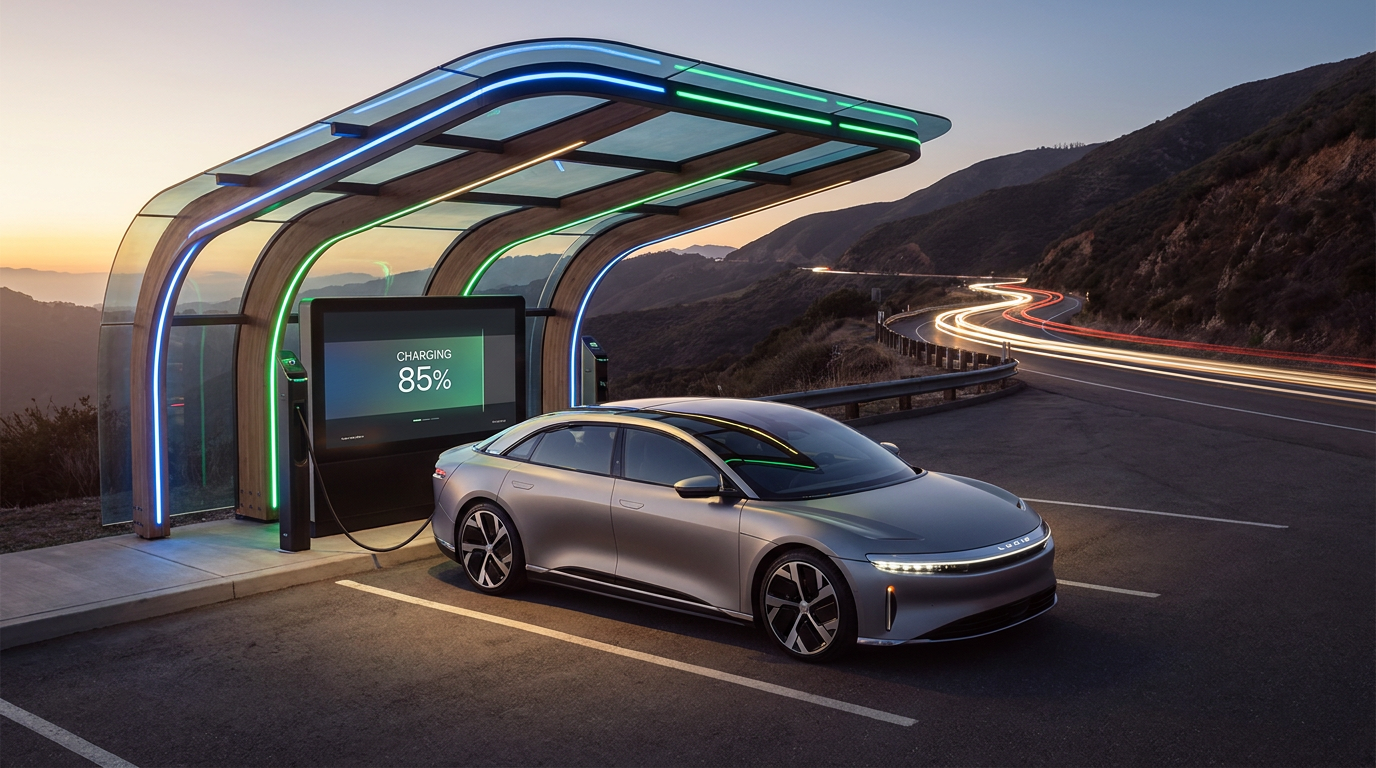
The great American road trip has been electrified. For years, the prospect of taking an electric vehicle on a multi-day journey was overshadowed by "range anxiety"—the persistent fear of being stranded without power. But in 2026, the narrative around electric vehicle travel has fundamentally shifted from anxiety to routine route management. Advances in battery technology, a massive influx of federal infrastructure funding, and highly sophisticated software have converged to make long-distance EV travel not just feasible, but genuinely enjoyable.[9]
The core driver of this shift is the sheer volume of new public charging infrastructure. As of mid-2026, the United States boasts over 71,000 active DC fast-charging ports, transforming once-daunting interstate corridors into easily navigable routes. This network expansion means that drivers are rarely far from a high-speed top-up, effectively blanketing the country's major arteries in reliable electricity.[6]
Much of this recent acceleration stems from the National Electric Vehicle Infrastructure (NEVI) program. Passed as part of the 2021 Bipartisan Infrastructure Law, NEVI allocated $5 billion to help states build out their charging networks. After a sluggish start mired in bureaucratic delays and planning phases, NEVI-funded installations surged through 2025 and 2026, finally translating federal dollars into physical hardware on the ground.[1]
The NEVI initiative specifically targets highway corridors, mandating that fast chargers be placed roughly every 50 miles along major interstates. This standardized spacing is designed to create a reliable baseline of coverage, ensuring that even EVs with smaller battery packs can confidently traverse state lines without fear of entering a "charging desert."[1][2]

Beyond sheer numbers, the standardization of the physical plug has fundamentally altered the road trip experience. The industry's rapid, near-universal adoption of the North American Charging Standard (NACS)—originally developed by Tesla—means that drivers of almost any modern EV can now seamlessly access the sprawling, highly reliable Supercharger network alongside other major providers.[4]
For older vehicles equipped with the Combined Charging System (CCS), the transition has been smoothed by the widespread availability of high-quality, manufacturer-approved adapters. These adapters ensure that early EV adopters are not left behind, allowing them to tap into the newly unified NACS infrastructure and significantly expanding their options on the road.[7]
While infrastructure provides the necessary foundation, vehicle capabilities have also crossed a critical threshold. The emergence of the "400-Mile Club" in 2026 highlights a growing roster of EVs capable of traveling 300 to 400 miles on a single charge under real-world conditions. This extended range means fewer required stops and greater flexibility when choosing where to pause.[3]
Interestingly, this extended range is not solely the result of automakers stuffing massive, heavy battery packs into their vehicles. Instead, engineers have increasingly prioritized aerodynamics, recognizing that drag is the silent enemy of highway efficiency. Sleek, low-drag designs allow modern EVs to cut through the air with minimal resistance, squeezing significantly more miles out of every kilowatt-hour.[3]

Despite these impressive hardware advancements, the secret to a truly seamless electric road trip lies in software. Route planning has evolved from a stressful guessing game into a precise, automated science. Drivers no longer need to manually search for chargers and calculate distances; the software does the heavy lifting before the car even leaves the driveway.[5][8]
Despite these impressive hardware advancements, the secret to a truly seamless electric road trip lies in software.
Applications like A Better Routeplanner (ABRP) have become indispensable tools for long-distance EV travel. Unlike standard navigation apps, ABRP models a specific vehicle's exact energy consumption, factoring in real-time variables such as elevation changes, weather conditions, driving speed, and even battery degradation to calculate the optimal charging strategy.[5][8]
Once on the road, the actual mechanics of "refueling" require a paradigm shift for drivers accustomed to gasoline. The most efficient strategy is not to plug in and wait for the battery to reach 100 percent at every stop. Instead, veteran EV road trippers embrace the "20-80 percent rule" to minimize their total wait time.[7]
This rule is dictated by the physics of DC fast charging, which follows a distinct curve. Electricity flows rapidly into an empty battery, but the vehicle's battery management system intentionally slows the charge rate significantly as it approaches 80 percent. This throttling is necessary to protect the battery cells from overheating and long-term degradation.[7][9]
Consequently, planning more frequent, shorter stops is vastly superior to waiting for a full charge. Arriving at a charger with a low battery, rapidly charging to 70 or 80 percent, and immediately getting back on the highway saves substantial time compared to enduring the slow trickle required to fill the final 20 percent of the pack.[7]

Environmental and geographic factors also play a crucial role in determining real-world range on a road trip. High cruising speeds, extreme hot or cold temperatures, and steep mountain inclines drain batteries much faster than driving on flat terrain in temperate weather. Savvy drivers factor these variables into their plans, knowing that a strong headwind might require an earlier stop.[7][8]
Conversely, the unique mechanics of electric powertrains offer distinct advantages in certain terrains. Regenerative braking allows EVs to recapture kinetic energy during long downhill descents, converting gravity and momentum back into electricity. It is entirely possible to reach the bottom of a mountain pass with more range than when you started the descent.[7]
The financial and environmental benefits of electric travel add another compelling layer to the experience. Driving an EV costs significantly less per mile than a gas-powered vehicle, and the total elimination of tailpipe emissions contributes to cleaner air—a benefit that is particularly impactful in heavily trafficked tourist corridors and national parks.[2]
Yet, challenges do remain in the final frontiers of EV travel. Deep rural "charging deserts" and highly remote recreational areas still require careful, deliberate planning, as ultra-high-speed infrastructure has naturally prioritized dense interstate corridors over isolated backroads.[6]
To address these remaining gaps, updated federal NEVI guidelines now offer states greater flexibility. Rather than strictly adhering to the 50-mile highway rule, states can now partner with local cooperatives, small-town gas stations, and rural businesses to install chargers in remote locations, ensuring that off-the-beaten-path destinations become accessible.[6]

The concept of the charging station itself is also undergoing a radical evolution. New "Rechargeries"—multi-million dollar, purpose-built hubs featuring comfortable lounges, dining options, clean restrooms, and ultra-fast 400 kW chargers—are beginning to replace the utilitarian, often-isolated gas station model, turning the charging stop into a genuinely pleasant break.[6]
Ultimately, the 2026 electric road trip is a testament to rapid technological and infrastructural maturation. Range anxiety is increasingly a psychological hurdle rather than a practical reality, fading quickly as drivers experience the quiet, efficient, and highly capable ecosystem of modern EV travel.[9]
How we got here
Nov 2021
Congress passes the Bipartisan Infrastructure Law, allocating $5 billion for the NEVI charging program.
May 2023
Ford announces adoption of Tesla's NACS plug, triggering an industry-wide shift toward a single charging standard.
Aug 2025
The Federal Highway Administration issues updated guidance, accelerating NEVI deployments and offering states more flexibility.
Mid 2026
The US surpasses 71,000 active DC fast-charging ports, significantly reducing highway charging deserts.
Viewpoints in depth
Infrastructure & Policy Trackers
Focuses on the macro-level expansion of charging networks and federal funding.
This perspective emphasizes that the primary barrier to EV adoption—range anxiety—is being dismantled by sheer volume. With billions in NEVI funding finally translating into physical steel in the ground, these trackers point to the 71,000+ active fast-charging ports as proof that the highway network is maturing. They argue that as 400 kW 'Rechargeries' and mandated 50-mile spacing become the norm, the focus should shift from whether a charger exists to how luxurious and reliable the charging experience can be.
Practical Route Planners
Focuses on the software, strategies, and daily realities of driving an EV long distances.
For this camp, successful road tripping is less about the total number of chargers and more about how drivers interact with them. They champion the '20-80% rule' and the use of sophisticated software like A Better Routeplanner (ABRP) to optimize travel time. This viewpoint stresses that range anxiety is largely a psychological hurdle born from a gas-station mindset; once drivers learn to trust their vehicle's predictive software and adapt their charging habits, long-distance electric travel becomes entirely routine.
Vehicle & Hardware Analysts
Focuses on the technological advancements in battery chemistry and vehicle aerodynamics.
Analysts in this space argue that the vehicle itself is the ultimate solution to range anxiety. By highlighting the emergence of the '400-Mile Club,' they note that automakers are pushing the boundaries of efficiency. Rather than just stuffing larger, heavier batteries into cars, the focus has shifted to reducing aerodynamic drag and improving thermal management. They contend that as baseline ranges push past 300 miles, the reliance on dense public charging infrastructure will naturally decrease for the average road tripper.
What we don't know
- How quickly rural 'charging deserts' will be filled as federal funding shifts focus from highways to remote areas.
- Whether local electrical grids in highly trafficked tourist destinations can handle peak holiday charging demand without upgrades.
Key terms
- NACS
- The North American Charging Standard, originally developed by Tesla, which has become the unified plug standard for most EVs in 2026.
- CCS
- The Combined Charging System, an older fast-charging standard still widely used but gradually being phased out in favor of NACS.
- DC Fast Charging
- High-power charging (Level 3) that delivers direct current straight to the battery, capable of adding hundreds of miles of range in minutes.
- Regenerative Braking
- A system that captures the kinetic energy usually lost during braking or coasting downhill and converts it into electricity to recharge the battery.
- State of Charge (SoC)
- The current energy level of an EV battery, expressed as a percentage from 0 to 100.
Frequently asked
Do I need to charge my EV to 100% at every stop?
No. DC fast charging slows down significantly after the battery reaches 80%. It is usually much faster to charge to 80%, drive to the next station, and charge again.
What happens if I encounter a broken charger?
Modern route planning apps like PlugShare provide real-time, crowdsourced data on charger reliability. It is always recommended to arrive at a station with a 15-20% buffer so you can reach a backup charger if necessary.
Can non-Tesla vehicles use Superchargers?
Yes. Thanks to the industry-wide adoption of the NACS standard and the availability of certified adapters, most modern EVs can now access the Tesla Supercharger network.
Does driving fast reduce an EV's range?
Yes. Aerodynamic drag increases exponentially with speed. Cruising at 70 mph instead of 80 mph can significantly extend your real-world highway range.
Sources
Source coverage
9 outlets
3 viewpoints surfaced









[1]ElectrekInfrastructure & Policy Trackers
EV charger installations funded by NEVI accelerate in 2025
Read on Electrek →[2]American Lung AssociationInfrastructure & Policy Trackers
Defeating Range Anxiety: Charging Stations Galore
Read on American Lung Association →[3]One EV GroupVehicle & Hardware Analysts
The 400-Mile Club: Every EV Making Range Anxiety History in 2026
Read on One EV Group →[4]Cost To ChargePractical Route Planners
Best EV Charging Networks 2026: Tesla vs Electrify America vs EVgo
Read on Cost To Charge →[5]EV Charger ScoutPractical Route Planners
Compare top EV charging apps for 2026
Read on EV Charger Scout →[6]ChevySUVInfrastructure & Policy Trackers
Charging Network Expansion in 2026: Where New EV Fast Chargers Are Coming
Read on ChevySUV →[7]EV-LectronPractical Route Planners
EV Road Trip - Essential Tips for a Stress-Free Experience
Read on EV-Lectron →[8]Plug In AmericaPractical Route Planners
EV Road Trip Guide: Tips for First-Timers
Read on Plug In America →[9]Factlen Editorial TeamVehicle & Hardware Analysts
Synthesis by Factlen editorial team
Read on Factlen Editorial Team →
Every angle. Every day.
Get automotive stories with full source coverage and perspective breakdowns delivered to your inbox.