
SpaceX Surges Past Amazon to $2.7 Trillion Valuation Following Historic IPO
Elon Musk's space and AI conglomerate has become one of the world's five most valuable public companies just days after its record-breaking stock market debut. Driven by a low public float and massive bets on artificial intelligence, the stock's blistering rally has reshaped the global technology hierarchy.
By Factlen Editorial Team
- Bullish Tech Investors
- This camp views SpaceX as a generational monopoly that justifies its unprecedented valuation.
- Cautious Market Analysts
- This group warns that the stock's rapid ascent is disconnected from its underlying financial fundamentals.
- Passive Index Funds
- This camp is driven entirely by the mechanics of index inclusion rather than active valuation.
What's not represented
- · Retail investors who were locked out of the initial IPO allocation
- · Legacy aerospace competitors facing a newly capitalized rival
Why this matters
SpaceX's record-breaking public debut not only mints the world's first trillionaire, but it also signals a massive shift in the global economy, where space infrastructure and artificial intelligence are now valued alongside legacy tech giants like Amazon and Microsoft.
Key points
- SpaceX's market capitalization surpassed $2.7 trillion on its third day of trading, overtaking Amazon.
- The company raised a record $85.7 billion in its initial public offering, pricing shares at $135.
- The stock's rapid surge is being driven by a low public float of just 4 to 5 percent.
- Investors are heavily pricing in SpaceX's expansion into artificial intelligence and computing infrastructure.
- The massive valuation has pushed CEO Elon Musk's net worth past the $1 trillion mark.
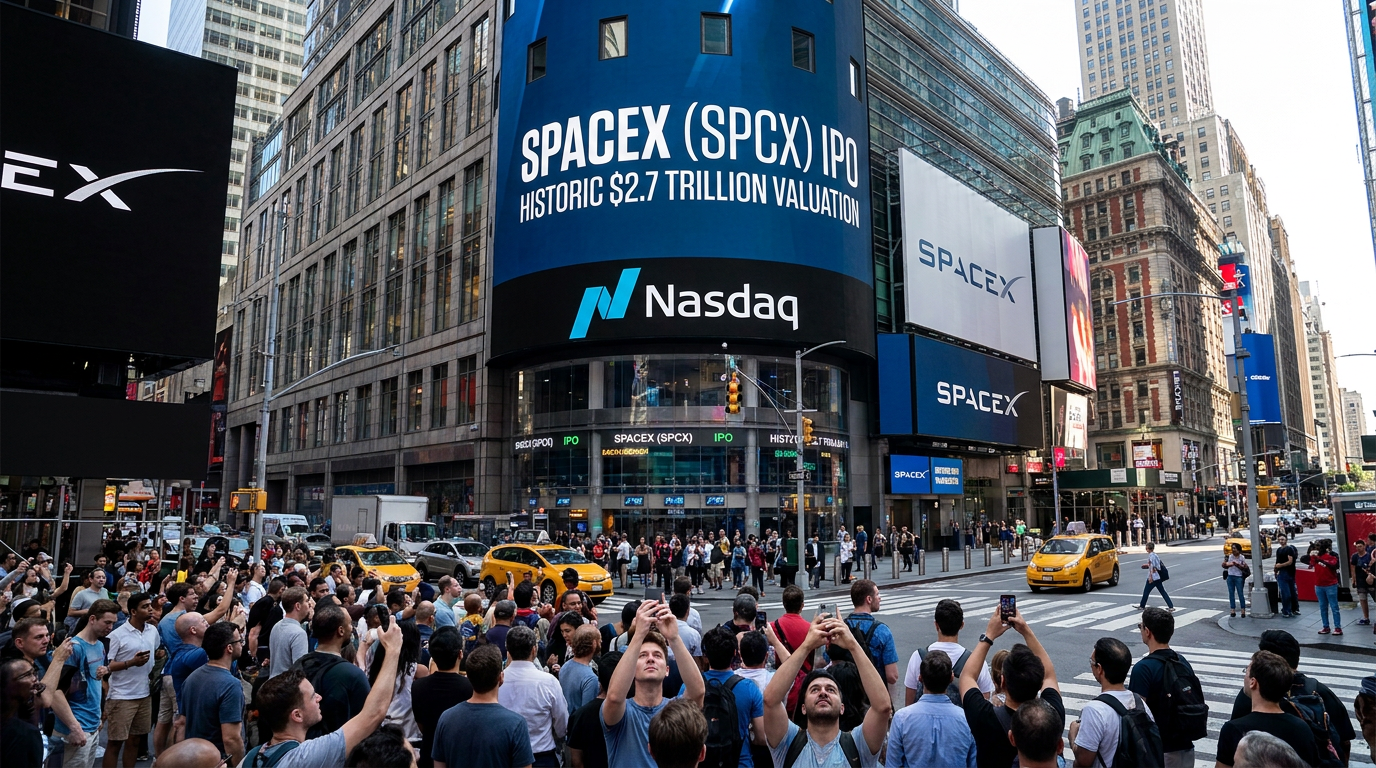
SpaceX has achieved a historic milestone on Wall Street, surging past a staggering $2.7 trillion market capitalization on its third day of public trading. The blistering rally propelled the aerospace and artificial intelligence conglomerate past e-commerce giant Amazon, cementing its position among the five most valuable public companies in the world. At its intraday peak on Tuesday morning, the stock even briefly eclipsed Microsoft to claim the number four spot, reshaping the global technology hierarchy in a matter of days. The unprecedented trading volume and retail enthusiasm have captivated the financial sector, marking a watershed moment for the commercialization of the space economy and signaling a massive shift in how public markets value next-generation infrastructure.[3][5]
The surge follows a record-breaking initial public offering last Friday that shattered previous Wall Street benchmarks. Pricing its shares at $135 under the ticker SPCX, the company raised an unprecedented $85.7 billion after underwriters exercised their greenshoe option to meet intense, overwhelming investor demand. The Nasdaq exchange floor was packed as executives celebrated the listing, which immediately valued the firm at nearly $1.8 trillion. Since the opening bell, shares have climbed more than 50 percent, trading above $210 and adding nearly $1 trillion to the company's valuation in less than a week. The sheer scale of the capital raise provides the company with a massive war chest to fund its ambitious interplanetary and computing goals.[5][6]

The blockbuster debut has fundamentally altered the landscape of global wealth, creating a new ceiling for individual net worth. With a 42 percent stake in the newly public entity, Chief Executive Officer Elon Musk has seen his personal fortune skyrocket overnight. Combined with his substantial holdings in electric vehicle maker Tesla, Musk's net worth has officially surpassed the $1 trillion threshold, making him the first individual in modern history to achieve trillionaire status. The financial windfall validates decades of high-risk bets on reusable rocket technology and satellite internet, transforming a company that began in a California warehouse into a cornerstone of the modern global economy.[4][6]
While SpaceX is best known to the public for its reusable Falcon 9 rockets and the rapidly expanding Starlink satellite internet constellation, Wall Street is increasingly pricing the company as an artificial intelligence juggernaut. Following its recent merger with Musk's AI venture, xAI, SpaceX announced a $60 billion all-stock acquisition of the AI coding startup Cursor. Investors are betting heavily that the integration of Starlink's global data network with advanced AI computing infrastructure will create entirely new, high-margin revenue streams that legacy tech companies cannot replicate. This pivot from pure aerospace to a hybrid space-compute model has been the primary catalyst for the stock's explosive premium.[1][4][7]
Following its recent merger with Musk's AI venture, xAI, SpaceX announced a $60 billion all-stock acquisition of the AI coding startup Cursor.
However, the $2.7 trillion price tag stands in stark contrast to the company's current financial reality, raising eyebrows among traditional value investors. SpaceX generated a healthy $18.7 billion in revenue last year, but it ultimately posted a net loss of $4.9 billion. This deficit was driven largely by the massive, ongoing capital expenditures required to build out its AI data centers and maintain its aggressive launch cadence. The current valuation is heavily reliant on forward-looking projections rather than current earnings, with Musk suggesting the company could reach $1 trillion in annual revenue by the end of the decade. Investors are essentially paying a massive premium today for a monopoly they believe will materialize tomorrow.[2][3][7]

Market analysts warn that the stock's rapid ascent is being amplified by technical trading factors rather than pure fundamental price discovery. Only about 4 to 5 percent of SpaceX's total shares were made available for public trading during the IPO, creating a severe supply-and-demand imbalance in the open market. This unusually small public float has left the stock prone to rapid, meme-stock-like volatility, as retail enthusiasm and options trading clash with a distinct lack of willing sellers. The scarcity of available shares means that even modest buying pressure can trigger outsized upward swings in the stock price, a dynamic that analysts expect to persist until insider lock-up periods begin to expire later this year.[2][3]
Institutional demand is also adding significant fuel to the fire, driven by the mechanical rules of modern passive investing. Because of its sheer size and immediate market capitalization, SpaceX is being fast-tracked for inclusion in major benchmark indexes, including the Nasdaq-100, FTSE Russell, and MSCI. This impending inclusion forces passive funds and exchange-traded funds to systematically accumulate shares so their portfolios accurately reflect the new index weightings. This creates a persistent, price-insensitive wave of forced buying, as index fund managers must acquire the stock regardless of its underlying valuation multiples or short-term unprofitability.[2][3][5]

Beyond SpaceX itself, the successful listing is sending ripples of optimism through the broader financial sector and Silicon Valley. Wall Street executives suggest the blockbuster debut could finally thaw a long-dormant IPO market, particularly for other highly valued artificial intelligence startups that have been hesitant to test public waters. Companies like Anthropic and OpenAI, which have been waiting on the sidelines and relying on private funding rounds, may now accelerate their own plans to tap public markets. As long as investor appetite for AI-adjacent mega-caps remains insatiable, the SpaceX debut may be remembered as the catalyst that reopened the floodgates for a new generation of technology listings.[4]
How we got here
2002
Elon Musk founds Space Exploration Technologies Corp. with the goal of reducing space transportation costs.
February 2026
SpaceX merges with Musk's artificial intelligence startup, xAI, expanding its focus beyond aerospace.
June 12, 2026
SpaceX debuts on the Nasdaq under the ticker SPCX, raising a record $85.7 billion.
June 16, 2026
Shares surge past $210 on the third day of trading, pushing the company's valuation past Amazon.
Viewpoints in depth
Bullish Tech Investors
This camp views SpaceX as a generational monopoly that justifies its unprecedented valuation.
Proponents argue that SpaceX is no longer just a rocket company, but a foundational pillar of the future economy. By combining the global connectivity monopoly of the Starlink satellite network with the massive computing power of xAI and the newly acquired Cursor, bulls believe SpaceX is uniquely positioned to dominate the artificial intelligence era. They point to Elon Musk's track record with Tesla and argue that the company's current unprofitability is a necessary phase of aggressive capital expenditure that will yield trillions in future revenue.
Cautious Market Analysts
This group warns that the stock's rapid ascent is disconnected from its underlying financial fundamentals.
Skeptics point out that a $2.7 trillion valuation is difficult to justify for a company that posted a $4.9 billion net loss last year. They argue that the current price action is largely a mirage created by a severe supply-and-demand imbalance, as only about 4 percent of the company's shares are actually available for public trading. Analysts warn that this low public float has turned SpaceX into a massive 'meme stock,' leaving retail investors vulnerable to sharp corrections once the initial euphoria fades and insider lock-up periods expire.
Passive Index Funds
This camp is driven entirely by the mechanics of index inclusion rather than active valuation.
For institutional managers running exchange-traded funds and passive index trackers, SpaceX's valuation debate is irrelevant. Because of its sheer size, the company is being fast-tracked for inclusion in major benchmarks like the Nasdaq-100 and MSCI indexes. These funds are mechanically required to purchase shares to reflect the company's weight in the broader market. This forced buying creates a persistent bid under the stock, further amplifying the price surge regardless of traditional earnings multiples.
What we don't know
- It remains unclear how the stock will react when insider lock-up periods expire and more shares flood the market.
- Whether SpaceX can successfully integrate its $60 billion AI acquisition, Cursor, into its core aerospace business is still unproven.
- The exact timeline for SpaceX to achieve profitability and reach its projected $1 trillion in annual revenue is highly uncertain.
Key terms
- Initial Public Offering (IPO)
- The process of offering shares of a private corporation to the public in a new stock issuance, allowing the company to raise capital from public investors.
- Market Capitalization
- The total dollar market value of a company's outstanding shares of stock, calculated by multiplying the current share price by the total number of shares.
- Greenshoe Option
- A provision in an underwriting agreement that allows the underwriter to sell more shares than originally planned if investor demand is higher than expected.
- Public Float
- The portion of a company's shares that are in the hands of public investors and available for trading, excluding locked-in stock held by insiders.
- Passive Funds
- Investment vehicles, such as exchange-traded funds (ETFs), that automatically track a market index rather than relying on a manager to actively pick stocks.
Frequently asked
Why is SpaceX valued so highly despite losing money?
Investors are pricing in massive future growth, particularly from its Starlink satellite network and its aggressive expansion into artificial intelligence following its merger with xAI.
How much of SpaceX is actually trading on the stock market?
Only about 4% to 5% of the company's total shares were made available in the IPO, creating a low supply that has fueled rapid price swings.
What does this mean for Elon Musk's net worth?
The surge in SpaceX's valuation, combined with his holdings in Tesla, has pushed Musk's net worth past the $1 trillion mark, making him the world's first trillionaire.
What is the ticker symbol for SpaceX?
SpaceX is trading on the Nasdaq exchange under the ticker symbol SPCX.
Sources
Source coverage
7 outlets
3 viewpoints surfaced







[1]BloombergCautious Market Analysts
Damodaran: AI Shaky, High-Potential Business for SpaceX
Read on Bloomberg →[2]CNBCCautious Market Analysts
SpaceX's blistering start still faces key tests that will determine the stock's true value
Read on CNBC →[3]ReutersPassive Index Funds
SpaceX roared past Amazon's market valuation on Tuesday
Read on Reuters →[4]Financial TimesBullish Tech Investors
SpaceX shares soar in biggest stock market debut in history
Read on Financial Times →[5]Business InsiderPassive Index Funds
SpaceX Stock: Market Capitalization Passes Amazon
Read on Business Insider →[6]The GuardianBullish Tech Investors
SpaceX makes biggest stock market debut in history, making Musk first trillionaire
Read on The Guardian →[7]Fox BusinessBullish Tech Investors
Musk's SpaceX surges past Amazon in market cap after historic IPO debut
Read on Fox Business →



Every angle. Every day.
Get business stories with full source coverage and perspective breakdowns delivered to your inbox.