
How Electric Hydrofoils Are Solving the Range Problem for Zero-Emission Boats
By using underwater wings to lift their hulls above the surface, a new generation of electric boats is cutting drag by 80 percent and making zero-emission public transit viable.
By Factlen Editorial Team
- Marine Tech Innovators
- Engineers and manufacturers focused on pushing the boundaries of aerodynamic efficiency and zero-emission transit.
- Transit & Port Authorities
- Municipal operators prioritizing reduced commute times, lower operating costs, and shoreline protection.
- Maritime Pragmatists
- Industry analysts who acknowledge the breakthrough but caution against viewing it as a universal maritime solution.
What's not represented
- · Marine wildlife conservationists evaluating the impact of reduced noise and wake
- · Traditional diesel ferry operators facing fleet obsolescence
Why this matters
By solving the battery-range problem that has long plagued electric boats, hydrofoil technology paves the way for zero-emission, silent, and wake-free public transit on the world's urban waterways.
Key points
- Water density creates massive drag, historically limiting electric boats to slow speeds and short ranges.
- Hydrofoils act as underwater wings, lifting the hull out of the water and reducing drag by up to 80 percent.
- Onboard flight controllers adjust the foils 100 times per second to maintain a smooth, stable ride over waves.
- The Candela P-12 ferry in Stockholm emits 95 percent less CO2 than the diesel vessels it replaces.
- Because they generate virtually no wake, hydrofoils can operate at high speeds in sensitive urban waterways.
- While upfront costs are high, the massive efficiency gains reduce operating and fuel costs by up to 90 percent.
The transition to electric vehicles has rapidly reshaped how the world drives, but the water has remained a stubbornly difficult frontier to electrify. The barrier is a matter of simple physics: water is nearly 800 times denser than air. Pushing a traditional boat hull through that density requires a massive amount of energy, creating a vicious cycle for marine engineers.[4]
To make a conventional boat electric and fast, designers must install an enormous battery pack. However, that battery adds immense weight, which pushes the hull deeper into the water, thereby increasing drag and requiring even more power to move. Because of this displacement problem, standard electric boats have historically been restricted to slow speeds and very short ranges, unable to compete with the energy density of marine diesel.[5]
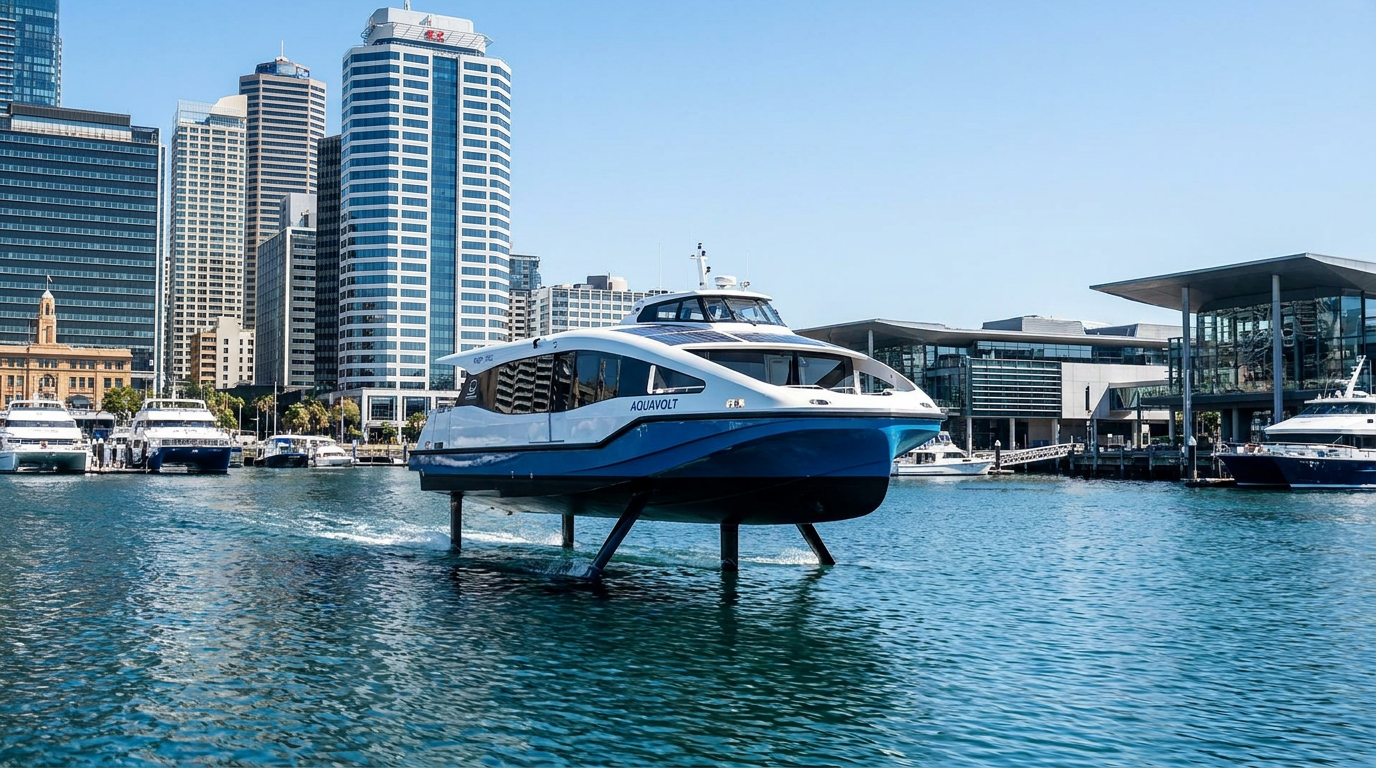
The solution to this maritime paradox involves taking the boat out of the water entirely. Enter the electric hydrofoil, a technology that merges marine engineering with aerospace design. By attaching submerged, wing-like structures to the bottom of the hull, engineers have found a way to bypass the friction of the water's surface.[5][6]
The mechanism operates on the exact same fluid-dynamics principles as an airplane in flight. As the vessel accelerates, water flows over and under the submerged foils, generating upward lift. Once the boat reaches a critical speed—typically around 14 to 16 knots—that lift exceeds the weight of the vessel, raising the entire hull into the air.[4][6]

The moment the hull breaks free of the surface, the vessel's energy profile transforms. Drag drops by up to 80 percent, instantly shattering the battery-weight paradox. With the friction of the hull eliminated, a relatively small, lightweight lithium-ion battery can suddenly propel a boat at high speeds for dozens of miles.[4][6]
But balancing a multi-ton vessel on thin underwater struts in unpredictable seas is incredibly complex. Modern electric hydrofoils rely on active flight controllers to stay upright. These onboard computers use sensors to read the waves ahead and adjust the angle of the foils up to 100 times per second. It is the same basic control-surface technology used to stabilize modern fighter jets, ensuring the boat remains perfectly level even in choppy conditions.[1]
This technology has rapidly moved from prototype to public infrastructure. In Stockholm, the world's first serial-production electric hydrofoil ferry, the Candela P-12 "NOVA," recently completed its autumn trial in the city's public transport network. By flying above the water at 25 knots, the vessel cut commute times on certain routes in half, bypassing the speed limits that restrict traditional ferries.[2]
This technology has rapidly moved from prototype to public infrastructure.
The environmental math behind the Stockholm deployment is striking. Data from the trial revealed that the NOVA ferry emits just 23 grams of carbon dioxide per passenger-kilometer. By comparison, the conventional diesel ferries operating on the exact same route emit 439 grams per passenger-kilometer. The hydrofoil represents a 95 percent reduction in emissions, operating on a fraction of the total energy.[2]

Beyond the climate benefits, the passenger experience is radically altered. Because the hull glides above the chop rather than battering through it, the ride is exceptionally smooth, eliminating the sudden drops and swaying that cause sea sickness. It is also nearly silent; cabin noise during the Stockholm trials measured around 63 decibels. To human ears, that is the difference between standing in a loud pub and sitting in a quiet library.[1][6]
Crucially for urban environments, flying boats generate virtually no wake. Traditional ferries displace massive amounts of water, creating waves that erode shorelines, damage docked vessels, and disrupt marine ecosystems. The absence of a wake allows hydrofoils to maintain high speeds through sensitive archipelagos and narrow city canals without causing environmental damage.[2]
To prove that electric passenger vessels are no longer confined to short, fixed routes, a Candela P-12 recently completed a record-breaking 160-nautical-mile journey from Gothenburg, Sweden, to Oslo, Norway. The three-day voyage utilized existing DC fast-charging networks along the coast. The total electricity cost for the entire international journey amounted to roughly $235.[3]
Global transit authorities are taking notice of these economics. The Maharashtra Maritime Board in India is purchasing 15 hydrofoil ferries to replace aging wooden diesel boats on the busy commuter routes between Mumbai and Alibaug. Similar vessels are currently slated for deployment in Saudi Arabia, New Zealand, and on Lake Tahoe in the United States.[7][8]

While the operational economics are highly favorable, the capital costs remain a hurdle. Consumer-focused electric hydrofoils, such as the Candela C-8 daycruiser, carry a starting price of around $400,000. However, commercial operators find that the math quickly balances out. Because electricity is significantly cheaper than marine fuel, and the vessels require 80 percent less energy to move, total operating costs can plummet by up to 90 percent compared to combustion-engine equivalents.[5][6]
The technology does have physical limitations. Submerged carbon-fiber wings are vulnerable to striking submerged logs, debris, or marine life, requiring reinforced struts and automated retraction systems to prevent catastrophic damage. Furthermore, the foils require a minimum water depth to operate, restricting these vessels from navigating extremely shallow coastal flats until the foils are fully raised into a low-speed mode.

Additionally, while hydrofoils are revolutionizing ferries and recreational boats, they cannot scale to the largest vessels on the ocean. Massive cargo ships and supertankers are simply too heavy to be lifted out of the water by submerged wings. Fortunately, those massive displacement ships are already highly efficient when traveling at slow, steady speeds across deep oceans.[5]
For the millions of people who commute across bays, lakes, and coastal waterways, however, the paradigm has permanently shifted. By combining a 160-year-old aerodynamic concept with modern aerospace software and lithium-ion batteries, the marine industry has finally solved the electric range problem. The future of sustainable boating is no longer about pushing through the water—it is about flying above it.[5]
How we got here
1860s
French inventor Emmanuel Denis Farcot patents the fundamental concept of the hydrofoil.
Mid-20th Century
Aerospace companies develop large, fossil-fuel-powered hydrofoil ferries, but high operating costs limit their global adoption.
2023
Candela launches the C-8, proving that combining hydrofoils with electric motors solves the range limitations of electric boats.
Late 2024
The Candela P-12 'NOVA' enters public transit service in Stockholm, becoming the world's first electric hydrofoil commuter ferry.
Early 2026
An electric hydrofoil completes a record-breaking 160-nautical-mile journey from Sweden to Norway on just $235 of electricity.
Viewpoints in depth
Marine Tech Innovators
Engineers and manufacturers focused on pushing the boundaries of aerodynamic efficiency and zero-emission transit.
This camp views the water's surface as a friction barrier to be bypassed rather than pushed through. By borrowing flight-controller software from the aerospace industry and applying it to marine engineering, they argue that the battery-weight paradox of traditional electric boats has been permanently solved. Their focus is on expanding the technology from luxury daycruisers to high-capacity public ferries, emphasizing that the 80 percent reduction in drag makes electrification viable for high-speed coastal transport.
Transit & Port Authorities
Municipal operators prioritizing reduced commute times, lower operating costs, and shoreline protection.
For city planners and maritime boards, the appeal of hydrofoils lies in the operational math and urban integration. Because these vessels generate virtually no wake, they can operate at high speeds in narrow canals and sensitive archipelagos where traditional ferries are strictly speed-limited. Transit authorities emphasize that while the initial purchase price is high, the 90 percent reduction in fuel and maintenance costs—combined with faster turnaround times—makes hydrofoils a highly economical replacement for aging diesel fleets.
Maritime Pragmatists
Industry analysts who acknowledge the breakthrough but caution against viewing it as a universal maritime solution.
While praising the efficiency gains for light passenger travel, this camp points out the physical limitations of the technology. They note that submerged foils are inherently vulnerable to striking marine debris, requiring expensive sensors and reinforced materials. Furthermore, they emphasize that hydrofoils cannot scale to solve the emissions crisis of massive global freight; cargo ships and supertankers are simply too heavy to ever be lifted out of the water, meaning other green technologies will be required for heavy maritime logistics.
What we don't know
- How frequently commercial hydrofoils will suffer operational downtime due to submerged debris strikes in heavily polluted waterways.
- Whether the high upfront capital costs will prevent widespread adoption in developing nations with aging diesel ferry fleets.
Key terms
- Hydrofoil
- An underwater wing attached to a boat's hull that generates lift, raising the vessel out of the water at speed.
- Displacement
- The volume of water a boat pushes out of the way as it moves, which creates significant drag and requires massive energy to overcome.
- Flight Controller
- An onboard computer system that rapidly adjusts the angle of the hydrofoils to maintain stability and balance over waves.
- Wake
- The waves created by a boat moving through the water, which can cause shoreline erosion and damage to other vessels.
Frequently asked
What happens if a hydrofoil hits a log or debris?
Most modern hydrofoils are equipped with sensors and reinforced carbon-fiber struts designed to withstand minor impacts or automatically retract upon striking large objects, though heavy debris remains a risk.
Can hydrofoil technology be used for massive cargo ships?
No. Hydrofoils require the vessel to be light enough for the underwater wings to lift it. Massive cargo ships are too heavy, though they are already highly efficient at slow speeds.
Do electric hydrofoils cause sea sickness?
Because the hull flies above the surface rather than crashing through waves, the ride is exceptionally smooth, which significantly reduces the motions that cause sea sickness.
How much does an electric hydrofoil boat cost?
Upfront costs are currently high; consumer models like the Candela C-8 start around $400,000, though commercial operators recoup costs through 90% lower fuel and maintenance expenses.
Sources
Source coverage
8 outlets
3 viewpoints surfaced








[1]New AtlasMarine Tech Innovators
High-speed hydrofoil e-ferry is quieter than a library
Read on New Atlas →[2]ShippaxTransit & Port Authorities
The world's first flying electric ferry deemed a success – Stockholm Expands Service
Read on Shippax →[3]Riviera Maritime MediaMarine Tech Innovators
Candela P-12 completes world's longest electric sea journey
Read on Riviera Maritime Media →[4]Curbing CarbonMaritime Pragmatists
Electric Hydrofoils: Redefining Sustainable Maritime Transport
Read on Curbing Carbon →[5]Interesting EngineeringMaritime Pragmatists
How Hydrofoils are Leading the Way for Electric Boats
Read on Interesting Engineering →[6]GMA NewsMarine Tech Innovators
Electric boat goes airborne for cleaner ocean voyage
Read on GMA News →[7]TIMEMarine Tech Innovators
Candela P-12 Shuttle: The Best Inventions of 2025
Read on TIME →[8]Hindustan TimesTransit & Port Authorities
State govt to buy 15 electric boats for Mumbai ferry services
Read on Hindustan Times →
Every angle. Every day.
Get automotive stories with full source coverage and perspective breakdowns delivered to your inbox.