
How Women's Wrestling Became the Fastest-Growing Sport in America
Following the inaugural NCAA Women's Wrestling Championships in 2026, the sport is experiencing explosive grassroots growth, offering thousands of young athletes new pathways to college.
By Factlen Editorial Team
- Grassroots Advocates
- Focuses on the sport's ability to build confidence and inclusivity at the high school level.
- Collegiate Administrators
- Prioritizes the structural integration of women's wrestling into the NCAA and Title IX compliance.
- Elite Development Programs
- Views the collegiate expansion as a crucial pipeline for Olympic and international success.
What's not represented
- · Male wrestlers adjusting to shared resources
- · High school athletic directors managing budget constraints
Why this matters
The explosion of women's wrestling provides thousands of young female athletes with new pathways to college scholarships, leadership opportunities, and elite competition, fundamentally changing the landscape of scholastic sports.
Key points
- Women's wrestling is currently the fastest-growing high school sport in the United States, with over 74,000 participants in the 2024-25 season.
- The NCAA hosted its first-ever unified Women's Wrestling Championships in March 2026, with McKendree University claiming the inaugural team title.
- Forty states now offer sanctioned girls-only high school state championships, a massive increase from just a handful a decade ago.
- Over 150 colleges and universities now sponsor women's varsity wrestling programs, creating a robust pipeline for athletic scholarships.
For decades, the image of American scholastic wrestling was overwhelmingly male—a grueling winter sport confined to boys' locker rooms and male-dominated tournaments. Girls who wanted to compete had to join the boys' team, often facing structural barriers and a lack of dedicated coaching. But over the past five years, a quiet revolution has transformed the mat. Women’s wrestling has exploded into the fastest-growing high school and collegiate sport in the United States, culminating in a historic milestone this year.[5][7]
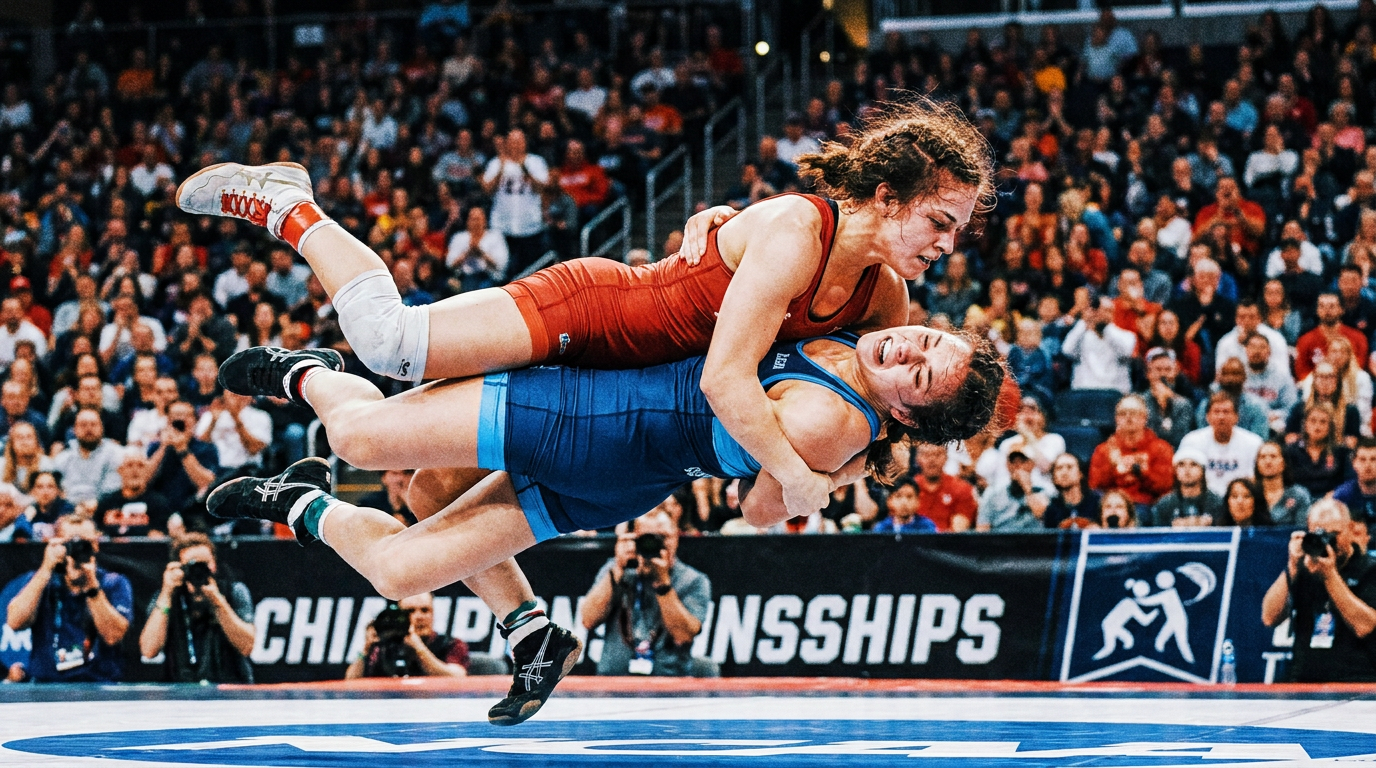
In March 2026, the NCAA hosted the first-ever Women's Wrestling Championships at Xtream Arena in Coralville, Iowa. The event marked the official arrival of women's wrestling as the 91st NCAA championship sport. Operating under a unified National Collegiate format, the tournament brought together 52 teams from across Division I, Division II, and Division III, creating a single, highly competitive field.[1][4][6]
The inaugural team title was captured by McKendree University, a Division II powerhouse that edged out the University of Iowa in a tightly contested team race, 171 to 166. The Bearcats crowned three individual national champions, including Cameron Guerin, who made collegiate history by securing her fifth national title across various governing bodies.[1][4]

The atmosphere in Coralville reflected the pent-up demand for the sport. Thousands of fans packed the arena to watch athletes like North Central’s Bella Mir and Lehigh’s Audrey Jimenez, who was named the tournament's Outstanding Wrestler, claim their spots in the history books. For the athletes, the championship validated years of grueling training in a sport that, until recently, offered them few collegiate pathways.[1]
The NCAA championship is the capstone of a massive grassroots surge. According to the National Federation of State High School Associations (NFHS), girls' high school wrestling participation topped 74,000 during the 2024-25 academic year. This represented a staggering 15 percent jump from the previous year alone, setting an all-time record for the sport.[2]
To put that growth into perspective, just a decade ago, barely 11,000 girls participated in high school wrestling nationwide. The recent explosion has been driven by a concerted effort to create girls-only programs. In a single year, nearly 1,000 high schools added dedicated girls' wrestling teams, providing young women with their own coaches, practice times, and competitive schedules.[2]

State athletic associations have rapidly adapted to the influx of athletes. As recently as 2018, only a handful of states offered official girls' wrestling state championships. Today, 40 states have sanctioned girls-only state tournaments. This state-level recognition is crucial; it legitimizes the sport, secures funding from athletic departments, and provides a clear competitive goal for high school athletes.[3]
State athletic associations have rapidly adapted to the influx of athletes.
The cultural shift within the wrestling community has been profound. Historically viewed as an exclusive "boys' club," the sport has embraced its new demographic. High school coaches report that girls are drawn to the sport's unique blend of individual accountability and team camaraderie. On the mat, there is nowhere to hide, and the self-discipline required to succeed builds a specific type of confidence that resonates strongly with young female athletes.[5]
This high school boom has forced higher education to take notice. Over 150 colleges and universities now sponsor women's varsity wrestling programs, spanning the NCAA, NAIA, and NJCAA. For athletic directors, adding women's wrestling is an attractive proposition: it helps institutions meet Title IX compliance by boosting female athletic participation, and it taps into a rapidly expanding recruiting pool.[3]
The creation of collegiate programs has fundamentally altered the trajectory for female wrestlers. Previously, elite high school girls had to transition to judo, mixed martial arts, or abandon combat sports entirely to secure collegiate athletic scholarships. Now, universities are actively recruiting female wrestlers, offering financial aid and world-class training facilities.[3][7]

The domestic growth is also inextricably linked to international success. Women's wrestling debuted as an Olympic sport in 2004, and the United States has steadily built a powerhouse national team. The visibility of American Olympic medalists has provided young girls with highly visible role models, proving that wrestling can be a viable, long-term athletic career.[3]
The expanded collegiate pipeline directly benefits USA Wrestling's elite development programs. With athletes now able to compete at a high level throughout their college years, the national team has a deeper, more experienced pool of talent to draw from for international competitions. The NCAA's adoption of freestyle wrestling—the same style used in the Olympics—ensures that collegiate athletes are perfectly primed for the global stage.[3][7]
Despite the overwhelming success, the sport's rapid expansion presents logistical challenges. The sudden addition of thousands of programs has created a severe shortage of qualified coaches and referees. While the NFHS reported a 12 percent increase in wrestling officials recently, the demand still outpaces the supply in many regions, forcing state associations to aggressively recruit and train new arbiters.[2]

The unified NCAA format is also a temporary measure. Because the sport is growing so quickly, the NCAA has already announced that Division III will host its own separate women's wrestling championship beginning in the 2027-28 season. As more Division I and Division II schools add programs, the championship structure will eventually mirror the multi-tiered system used in men's wrestling.[3]
What was once a novelty has become a permanent fixture in the American sporting landscape. The 2026 NCAA Championships proved that women's wrestling can draw crowds, generate compelling storylines, and anchor athletic departments. As the grassroots numbers continue to swell, the sport is no longer just fighting for a place on the mat—it is actively redefining it.[4][7]
How we got here
1998
Texas becomes the first state to hold a girls-only high school state wrestling championship.
2004
Women's wrestling makes its debut as an official Olympic sport at the Athens Games.
2020
The NJCAA recognizes women's wrestling as an emerging sport, paving the way for collegiate expansion.
2024-2025
High school girls wrestling participation surpasses 74,000 athletes nationwide, setting a new record.
March 2026
The NCAA hosts the first-ever Women's Wrestling Championships in Coralville, Iowa.
Viewpoints in depth
Grassroots Advocates
Focuses on the sport's ability to build confidence and inclusivity at the high school level.
For high school coaches and grassroots organizers, the explosion of girls' wrestling is primarily a story of empowerment. Advocates emphasize that wrestling offers a unique environment where athletes of all body types can succeed, as weight classes level the physical playing field. They point to the self-discipline and mental toughness required to compete individually on the mat as transformative for young women. Their primary goal is to ensure that the remaining states sanction girls-only championships, eliminating the need for girls to compete against boys and providing dedicated resources for female athletes.
Collegiate Administrators
Prioritizes the structural integration of women's wrestling into the NCAA and Title IX compliance.
From the perspective of university athletic departments, women's wrestling represents a strategic opportunity. Administrators view the sport as a highly effective way to boost female athletic participation numbers, aiding in Title IX compliance. However, they also face the logistical challenges of integrating a new sport. Their focus is on managing the unified championship format, securing funding for scholarships, and navigating the eventual split into separate Division I, II, and III championships as participation numbers continue to swell.
Elite Development Programs
Views the collegiate expansion as a crucial pipeline for Olympic and international success.
Organizations like USA Wrestling and elite coaching associations view the NCAA sanctioning as the missing link in their developmental pipeline. Previously, elite female wrestlers lacked a structured, highly competitive domestic circuit during their college years, often forcing them to train independently or transition to other sports. By establishing a robust collegiate system that uses international freestyle rules, these programs believe the United States is perfectly positioned to dominate the global stage and consistently produce Olympic medalists.
What we don't know
- It remains unclear exactly when the NCAA will split the unified championship into separate Division I and Division II tournaments, though Division III is slated to separate by 2028.
- State athletic associations are still determining how to solve the severe shortage of qualified wrestling officials needed to support the thousands of new high school programs.
Key terms
- Unified National Collegiate format
- A championship structure where schools from NCAA Divisions I, II, and III compete in the same tournament bracket until participation numbers warrant separate division championships.
- Sanctioned sport
- A sport officially recognized and governed by a state high school athletic association, allowing for official state championships and dedicated funding.
- Freestyle wrestling
- The style of wrestling used in women's collegiate and Olympic competition, which allows the use of the wrestler's or opponent's legs in offense and defense.
- Title IX
- The federal civil rights law in the United States that prohibits sex-based discrimination in any school or education program receiving federal funding.
Frequently asked
Is women's wrestling an official NCAA sport?
Yes, women's wrestling became the 91st NCAA championship sport, holding its first unified national championship in March 2026.
Do high school girls have to wrestle boys?
While girls previously had to join co-ed teams, 40 states now offer sanctioned girls-only wrestling programs and separate state championships.
What is the unified collegiate format?
Because the sport is newly sanctioned, the 2026 NCAA championship combined Division I, II, and III programs into a single tournament field.
What style of wrestling do women compete in?
Women's collegiate and Olympic wrestling uses the freestyle ruleset, which differs from the folkstyle ruleset traditionally used in men's American collegiate wrestling.
Sources
Source coverage
7 outlets
3 viewpoints surfaced







[1]WikipediaCollegiate Administrators
2026 NCAA Women's Wrestling Championships
Read on Wikipedia →[2]NFHSGrassroots Advocates
High School Wrestling's Comeback: Participation, Opportunity Reach All-time Highs
Read on NFHS →[3]National Wrestling Coaches AssociationElite Development Programs
Women's Wrestling Facts & Resources
Read on National Wrestling Coaches Association →[4]NCAACollegiate Administrators
McKendree takes inaugural NCAA Women's Wrestling Championships behind three individual champions
Read on NCAA →[5]The Hamilton County ReporterGrassroots Advocates
The growth of women's high school wrestling
Read on The Hamilton County Reporter →[6]Lock Haven AthleticsCollegiate Administrators
Brackets released for 2026 NCAA Women's Wrestling Championship
Read on Lock Haven Athletics →[7]Factlen Editorial TeamElite Development Programs
Synthesis by Factlen editorial team
Read on Factlen Editorial Team →
More in sports
See all 11 stories →Standings
Global Club Rugby Reaches Its Climax: URC, Premiership, and Super Rugby Finals Set
0 sources

Injury
Grass-Court Injury Report: Triumphant Returns and Major Absences Reshape the Road to Wimbledon
0 sources

Knicks Basketball
New York Knicks Win 2026 NBA Finals, Ending 53-Year Championship Drought
0 sources
Standings
Race to Turin and Riyadh Heats Up as Tennis Enters Grass-Court Swing
0 sources

Every angle. Every day.
Get sports stories with full source coverage and perspective breakdowns delivered to your inbox.